
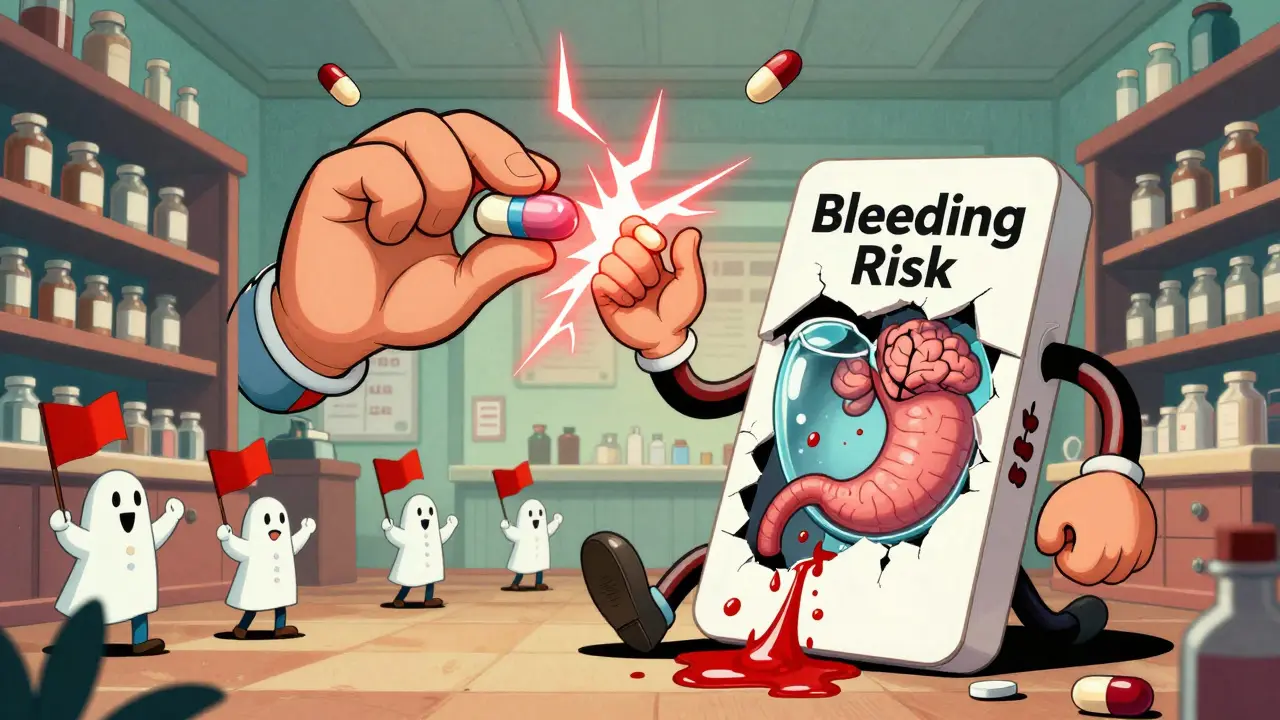
Warfarin-NSAID Risk Calculator
Understand Your Risk
Select the NSAID you're considering taking while on warfarin. This calculator shows the increased bleeding risk and provides safer alternatives.
Your Bleeding Risk
Safer Alternatives
Acetaminophen (Tylenol)
Safe for warfarin patients when taken at recommended doses (up to 3,000 mg/day). Has no effect on platelets or stomach lining.
Topical NSAIDs
For localized pain, topical gels like diclofenac (Voltaren) absorb less than 5% into bloodstream and pose minimal risk.
Every year, millions of Americans take warfarin to prevent dangerous blood clots - whether from atrial fibrillation, deep vein thrombosis, or a mechanical heart valve. At the same time, countless others reach for over-the-counter ibuprofen or naproxen for a headache, back pain, or arthritic stiffness. What most people don’t realize is that combining these two types of medications can turn a simple pain reliever into a silent killer.
Why Warfarin and NSAIDs Don’t Mix
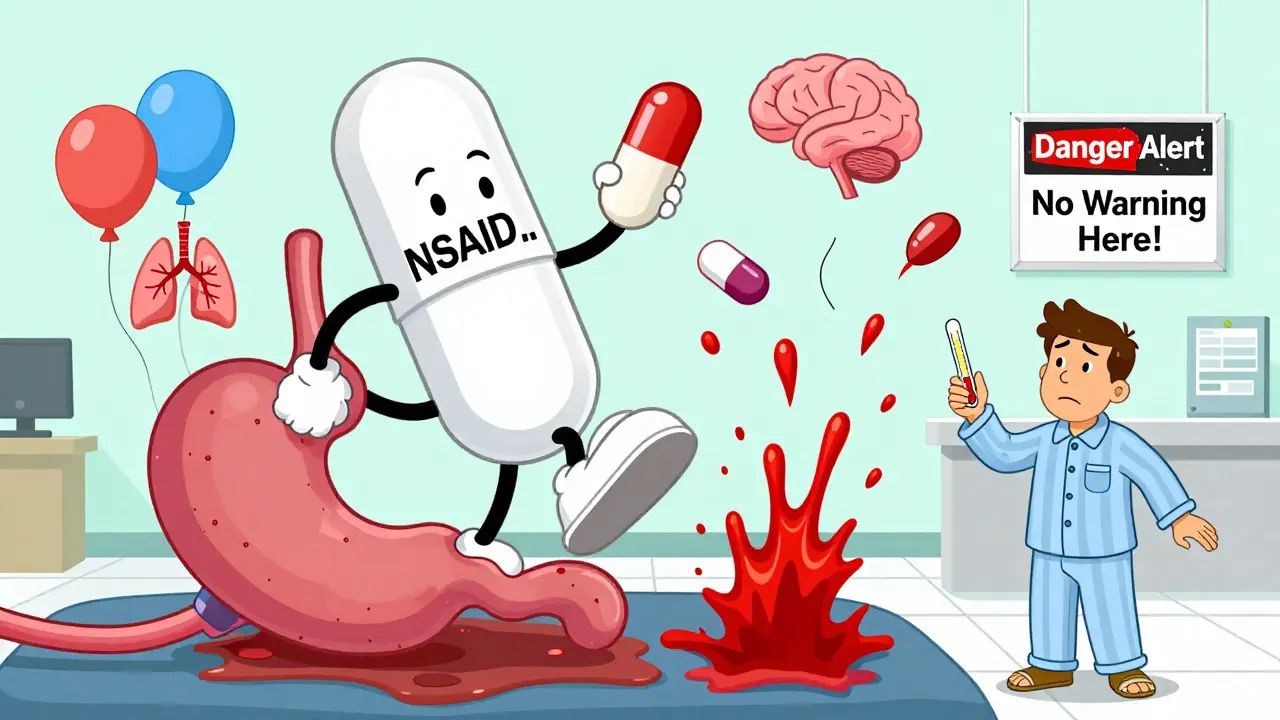
Warfarin works by blocking vitamin K, which your body needs to make clotting factors. Without those factors, blood takes longer to clot - which is exactly what you want if you’re at risk for a stroke or pulmonary embolism. But NSAIDs like ibuprofen, naproxen, and celecoxib do something else entirely: they shut down cyclooxygenase enzymes (COX-1 and COX-2), which are critical for platelet function and stomach lining protection. When you take both, you’re not just slowing clotting - you’re also making your platelets less able to plug leaks in blood vessels. At the same time, your stomach lining becomes more vulnerable to erosion. The result? A perfect storm for bleeding. Studies show this combination increases your risk of serious bleeding by more than two times compared to warfarin alone.Not All NSAIDs Are Created Equal
It’s a myth that all NSAIDs are equally risky. Some are far more dangerous when paired with warfarin.- Naproxen increases bleeding risk by 4.1 times
- Diclofenac raises it by 3.3 times
- Ibuprofen still pushes it up by 1.79 times
- Meloxicam - often prescribed for arthritis - spikes INR levels in nearly 40% of warfarin users
Where the Bleeding Happens
It’s not just about getting a nosebleed or a bruise. The real danger lies in internal bleeding - often silent until it’s too late.- Gastrointestinal bleeding: 2.24 times more likely. This is the most common - and deadliest - outcome.
- Intracranial bleeding: 3.22 times higher risk. A stroke caused by bleeding in the brain is often fatal.
- Pulmonary bleeding: 1.36 times more common. Can mimic pneumonia or heart failure.
- Urinary tract bleeding: 1.57 times higher. Often mistaken for a UTI or kidney stone.
What Patients Say - Real Stories
Online forums are full of terrifying accounts:"I took two ibuprofen for a headache. 24 hours later, my hemoglobin dropped from 14 to 8. I was passed out in the ER. They didn’t even ask if I was on blood thinners until I mentioned it." - Reddit user, r/BloodThinners, March 2023
"My mom was on warfarin for AFib. She took naproxen for her knee pain. Two weeks later, she was in the ICU with a GI bleed. They didn’t warn her." - Drugs.com review, 2022The average safety rating for warfarin-NSAID combinations on Drugs.com? 2.1 out of 10. Eighty-seven percent of reviews explicitly warn against it.
Why Doctors Still Prescribe It
You’d think this would be a no-brainer. But it’s not. A 2023 analysis found that over 42% of warfarin patients still get NSAID prescriptions every year - even though the American College of Cardiology and American Heart Association issued a Class I recommendation in 2020: "NSAIDs should be avoided in patients taking oral anticoagulants." Why? Several reasons:- Patients don’t tell doctors they’re taking OTC painkillers. In 68% of warfarin-related bleeding cases, the patient never mentioned NSAID use.
- Many EHR systems don’t flag the interaction. Over 40% of U.S. hospitals still don’t have alerts for this combo.
- Some clinicians think "low dose, short term" is safe. It’s not.
What to Do Instead
You need pain relief? There are safer options.- Acetaminophen (Tylenol): The top choice. No effect on platelets or stomach lining. Use up to 3,000 mg/day if your liver is healthy.
- Topical NSAIDs: Gels like diclofenac gel (Voltaren) or lidocaine patches. Less than 5% of the drug enters your bloodstream - low enough to be considered safe with warfarin.
- Physical therapy and heat/cold therapy: For arthritis or back pain, these reduce reliance on meds entirely.
- Non-pharmacological options: Acupuncture, massage, or cognitive behavioral therapy for chronic pain.

What to Do If You Must Take an NSAID
If your doctor says you absolutely need an NSAID - say, after a surgery or severe injury - here’s the protocol:- Use the lowest possible dose for the shortest time - no more than 3-5 days.
- Avoid naproxen, diclofenac, and meloxicam. If you must pick one, ibuprofen is the least risky.
- Get your INR checked before starting - then again 3 to 5 days after.
- Monitor weekly while taking it, then again 7 days after stopping.
- Take a proton pump inhibitor like omeprazole to protect your stomach.
- Know the warning signs: Black or tarry stools, vomiting blood, severe headache, dizziness, unexplained bruising, or sudden weakness.
The Bigger Picture
This isn’t just a drug interaction. It’s a systemic failure. We have 3.1 million Americans on warfarin. Nearly 17 million use NSAIDs monthly. The annual cost of bleeding events tied to this combo? Over $1.8 billion. And yet, the FDA’s warning on NSAID labels hasn’t changed since 2005 - it’s buried in fine print. Pharmacies don’t always screen for it. EHRs don’t reliably alert. Patients don’t know to ask. And too many providers still think, "It’s just a little ibuprofen."The truth? There’s no safe dose. No safe duration. No safe patient. The Institute for Safe Medication Practices rates this combination as "high risk with no acceptable safe use parameters."
Every time someone takes an NSAID while on warfarin, they’re playing Russian roulette with their internal organs. The odds are stacked against them - and the consequences are often permanent.
Can I take ibuprofen with warfarin if I only use it once in a while?
No. Even a single dose of ibuprofen can increase your bleeding risk by nearly 80%. The interaction doesn’t require long-term use. Your platelets are affected within hours, and your stomach lining starts breaking down immediately. There’s no safe "occasional" use when you’re on warfarin.
Is Tylenol (acetaminophen) safe with warfarin?
Yes, acetaminophen is the safest over-the-counter pain reliever for people on warfarin. It doesn’t affect platelets or the stomach lining. But don’t exceed 3,000 mg per day - higher doses can damage your liver, especially if you drink alcohol or have existing liver disease.
What about topical NSAIDs like Voltaren gel?
Topical NSAIDs are generally considered safe with warfarin because very little of the drug enters your bloodstream - less than 5%. Studies show no significant increase in INR or bleeding risk with topical diclofenac. They’re a good option for localized pain like arthritis in the knee or elbow.
Do newer blood thinners like Eliquis or Xarelto avoid this risk?
No. While NOACs like apixaban (Eliquis) and rivaroxaban (Xarelto) have fewer drug interactions overall, combining them with NSAIDs still increases bleeding risk - sometimes just as much as with warfarin. A 2019 Circulation study found NSAID use with any oral anticoagulant doubles the risk of major bleeding. Don’t assume a newer drug makes you immune.
What should I do if I’ve already taken NSAIDs while on warfarin?
Stop the NSAID immediately. Call your doctor or anticoagulation clinic and ask for an INR test within 24 to 48 hours. Watch for signs of bleeding: unusual bruising, dark stools, blood in urine, severe headaches, or dizziness. If you feel weak, faint, or have chest pain, go to the ER. Don’t wait.
Why don’t pharmacies warn me about this?
Many do - but not all. Pharmacists are trained to screen for interactions, but if you pick up your NSAID at a different pharmacy than your warfarin, or if you buy it over-the-counter, the system often misses it. Also, some EHR systems don’t flag the interaction. Always tell your pharmacist you’re on warfarin - even if you think it’s "just ibuprofen."
Final Takeaway
There’s no middle ground here. Warfarin and NSAIDs don’t coexist safely. The data is clear, the risks are severe, and the consequences are often irreversible. If you’re on warfarin, acetaminophen and non-drug therapies are your best friends. If you’re a provider, stop prescribing NSAIDs to anticoagulated patients - and make sure your patients know why. This isn’t about being overly cautious. It’s about preventing preventable deaths.Comments (8)
-
Solomon Ahonsi February 1, 2026
This is why people die from simple headaches. You take one ibuprofen, think you're fine, then wake up with a GI bleed and your family is picking out your coffin. No warning, no second chance. Doctors don't care until it's too late.

-
George Firican February 2, 2026
It's not just about the pharmacology-it's about the culture of medical complacency. We treat pain like a nuisance to be silenced, not a signal to be understood. The body doesn't need more chemicals; it needs space, rest, and respect. We've outsourced healing to pills because we're too busy, too distracted, too disconnected from our own biology. Warfarin users aren't being warned-they're being set up for a silent collapse, and the system is fine with that because it's profitable to keep prescribing.

-
Matt W February 3, 2026
I had a cousin who took naproxen for her arthritis while on warfarin. She ended up in the ICU with a massive bleed. No one told her it was dangerous. She thought 'OTC' meant 'safe.' Now she's on disability and can't walk without a cane. This isn't theoretical. It's real. Please, if you're on blood thinners, just use Tylenol. It's not that hard.

-
Anthony Massirman February 3, 2026
Stop taking NSAIDs. Use Tylenol. Done.

-
Gary Mitts February 5, 2026
Wow. So the solution is just... not taking medicine? Revolutionary. Next you'll tell me sunlight cures cancer.

-
clarissa sulio February 5, 2026
Why do we let foreign drug companies dictate our health? This is why America needs to make its own painkillers-safe ones. Not this imported nonsense.

-
jay patel February 6, 2026
man i was on warfarin for like 6 months after a pulmonary embolism and i took ibuprofen like 3 times for my back pain cause i thought it was fine... turns out i was lucky i didnt bleed out. my dr never said anything and the pharmacist just shrugged when i asked. now i only use heat packs and tylenol. also i keep a journal of every pill i take cause i dont trust anyone anymore. also tylenol is the real MVP

-
Ansley Mayson February 7, 2026
So let me get this straight. The entire medical system is broken, patients are ignorant, and the only safe option is a drug that can cause liver failure if you take too much? Brilliant. We're all just waiting to die with a warning label in our hand.
