
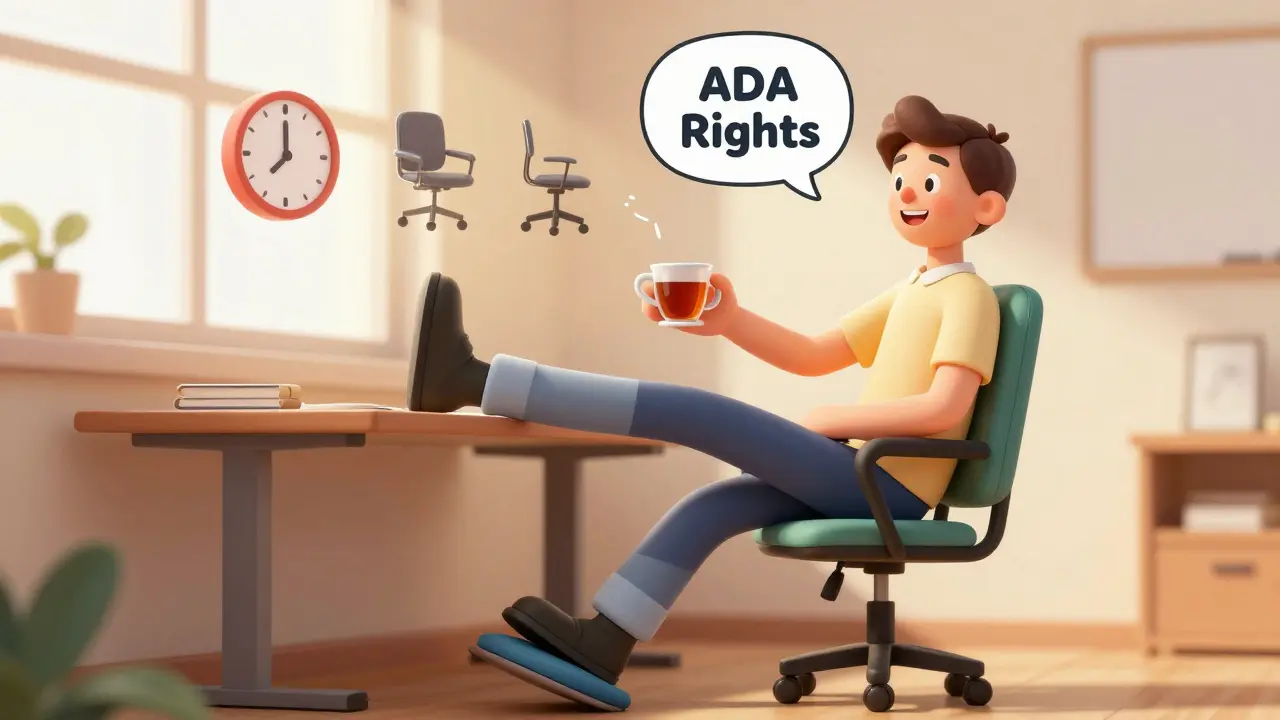
Going back to work after living with chronic pain isn’t just about showing up-it’s about finding a way to stay there without making things worse. Many people assume that if you’re in pain, you can’t work. But the truth is, millions of people with chronic pain are working right now, and they’re doing it because their employers made small, smart changes. It’s not about being lazy. It’s about adjusting the job to fit the person, not the other way around.
What Counts as Chronic Pain Under the Law?
Chronic pain isn’t just a bad day. It’s pain that lasts longer than three months and keeps you from doing everyday things-standing for too long, typing, walking to the bathroom, even getting out of bed. Under the Americans with Disabilities Act (ADA), this kind of pain can legally count as a disability if it limits major life activities. That means your employer has to make reasonable changes to help you do your job. This isn’t a favor. It’s the law.
The Equal Employment Opportunity Commission (EEOC) says this clearly: if your pain affects how you sit, move, focus, or stand, your employer must talk to you about what help you need. You don’t have to be bedridden. You don’t have to prove you’re "disabled" in the way people think. You just have to show that your pain gets in the way of doing your job normally.
Accommodations That Actually Work
Here’s what real people are using to stay at work:
- Adjustable desks - Standing one hour, sitting the next. These cost $300-$1,200, but many employers already have them. If not, you can ask for one. The Job Accommodation Network says 56% of accommodations cost nothing.
- Ergonomic chairs and cushions - A good chair can cut lower back strain by 40%. Look for ones with lumbar support and adjustable armrests. Cushions that distribute pressure? They cost $50-$200 and often make all the difference.
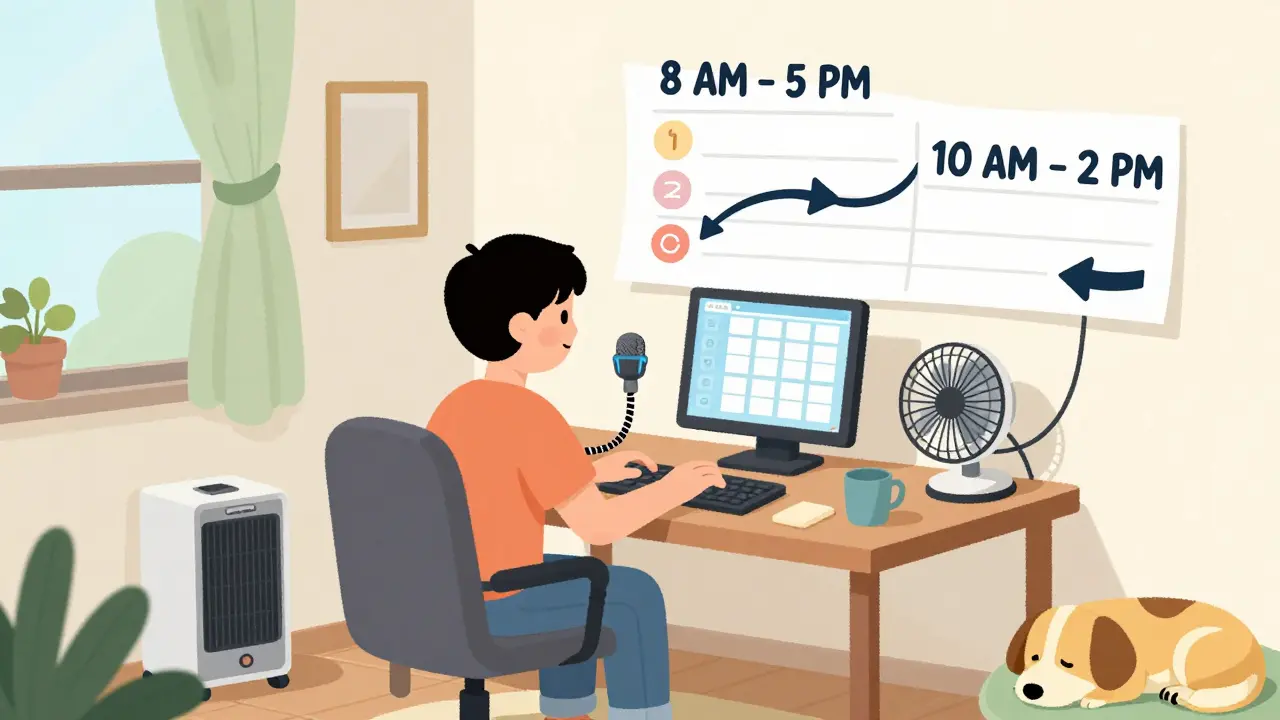
- Flexible hours - Starting at 10 a.m. instead of 8 a.m. lets you rest or go to physical therapy without losing pay. Some people work 4-hour days, 5 days a week. Others work from home two days a week.
- Extra breaks - A 10-minute walk or stretch every 90 minutes isn’t luxury. It’s medicine. Studies show this reduces pain flare-ups by up to 35%.
- Voice-to-text software - If typing hurts, try Dragon NaturallySpeaking or Windows Speech Recognition. Costs $100-$300. You’d be surprised how many people use this and never tell anyone.
- Reduced walking distance - Moving your desk closer to the bathroom, kitchen, or printer. If you get tired after 150 feet, that’s a real limit. Your employer must move you if it’s possible.
- Temperature control - If heat or cold makes your pain worse (common with nerve conditions), ask for a personal heater, fan, or a desk near a window. This is often free and easy.
These aren’t "special privileges." They’re tools. Like a blind person needs a screen reader, someone with chronic pain needs a chair that doesn’t hurt. The key? Don’t ask for "something to help." Ask for exactly what you need.
How to Ask for Accommodations Without Getting Rejected
Most people fail here-not because their request is unreasonable, but because they don’t say it right.
Don’t say: "I’m in pain. Can you help?"
Do say: "I have chronic lower back pain diagnosed as degenerative disc disease. I can sit for 45 minutes before needing to stand. I’m requesting an adjustable sit-stand desk and 10-minute breaks every 90 minutes to avoid flare-ups. My doctor attached a note. I’m happy to discuss how this affects my productivity. I’ve included the ADA guidelines on reasonable accommodation for reference."
Write it down. Email it. Attach your doctor’s note. The more specific you are, the harder it is to say no. Federal employees who used this method had an 89% approval rate. Vague requests? Only 45% got approved.
And yes, mention the ADA. Not to scare them. But to remind them they’re legally required to listen. The EEOC says employers can’t force you to accept a specific accommodation-they have to work with you to find one that works.
What If Your Boss Says No?
Some employers will push back. They’ll say: "We can’t afford it." "It’s not our job." "We don’t have time."
Here’s the truth: 56% of accommodations cost nothing. A 10-minute break? Free. Moving your desk? Free. Letting you work from home? Free. The median cost for the rest? $300. That’s less than one new printer.
If they say "undue hardship," ask: "What part of this is too expensive? Can we try it for 30 days?" Many employers don’t know the law. The Job Accommodation Network (JAN) offers free advice to employers too. Suggest they call JAN at 1-800-526-7234. They resolve 82% of cases without lawsuits.
Also remember: California requires accommodations for companies with 5+ employees. Other states like New York and Washington have similar rules. If you’re in one of those places, you have even stronger rights.
What About FMLA? Is That Enough?
FMLA gives you 12 weeks of unpaid leave. That’s helpful if you’re recovering from surgery. But if you have chronic pain? You’re not going to get better in 12 weeks. You need to keep working, not take time off.
FMLA doesn’t require accommodations. ADA does. So don’t rely on leave. Use it if you need a break, but then come back with a plan. Graduated return-to-work programs-starting at 20-50% hours, then building up-are 63% more successful at keeping people employed long-term than jumping straight back to full-time.
The Hidden Factor: Your Team
Here’s something no one talks about: your coworkers matter.
Research shows employees with strong relationships at work are 2.3 times more likely to get their accommodations approved. Why? Because if your team sees you as reliable, they’ll cover for you when you need a break. They’ll notice if you’re struggling. They’ll speak up if management pushes back.
That’s why culture matters more than policy. If your boss is supportive, even a small change can stick. If your team is hostile? Even the best accommodation won’t help.
Start small. Tell one trusted coworker. Ask them to help you explain it to others. People are more willing to help when they understand why.
What to Do If You’re Scared to Ask
Sixty-two percent of people with chronic pain wait too long to ask. Thirty-one percent quit instead.
It’s scary. You worry you’ll be seen as weak. Or replaced. Or ignored.
But here’s what happens when you don’t speak up: your pain gets worse. You burn out. You lose income. You lose your identity. You lose control.
Getting help isn’t admitting defeat. It’s taking charge. You’re not asking for pity. You’re asking for fairness. And you’re entitled to it.
Start with your doctor. Get a letter that says: "This patient has chronic pain that limits [specific function]. Recommended accommodation: [specific change]." Then email HR. Use the same language as above. Be calm. Be clear. Be firm.

What Happens Next?
Once you ask, your employer has to respond. Federal agencies have 10 business days. Private companies? No deadline-but they must respond "promptly." If they don’t reply in two weeks, follow up. Send another email. Say: "I’m following up on my request for accommodation under the ADA. I’d appreciate a response by [date]."
If they still don’t respond? Contact the Job Accommodation Network. They’ll help you draft a letter. They’ll even call your employer. No cost. No pressure. Just support.
And if you’re still stuck? The EEOC handles complaints. You can file anonymously. They investigate. And they’ve seen a 17% increase in chronic pain accommodation claims since 2021. You’re not alone.
What’s Changing Right Now?
Long COVID is now recognized as a disability under ADA. That means thousands of new people are legally protected. The Department of Labor launched the "Return to Work Initiative" in 2023, funding programs in 12 states to standardize how employers handle chronic pain.
Wearable tech is starting to help too. Some employers now accept data from pain-tracking devices (like smartwatches that measure movement, heart rate, and sleep) as proof of need. It’s still rare-only 7% of cases-but it’s growing.
And the biggest shift? People are finally talking about it. Chronic pain isn’t a secret anymore. It’s a workplace issue. And workplaces are starting to adapt.
Final Thought: You Belong Here
You didn’t quit because you couldn’t handle the job. You just needed the right setup. That’s all. No grand heroics. No miracle cure. Just smart changes. The same way a teacher needs a whiteboard, a mechanic needs a wrench, you need a chair that doesn’t hurt.
There’s no shame in needing help. There’s only shame in letting fear keep you away from work you love.
Can my employer fire me for asking for accommodations?
No. Under the ADA, it’s illegal to fire someone for requesting a reasonable accommodation. If you’re terminated after asking, you may have grounds for a discrimination claim. Document everything-emails, dates, conversations. Contact the EEOC or Job Accommodation Network for help.
Do I need a doctor’s note to request accommodations?
Yes. Your employer can legally ask for medical documentation that confirms your diagnosis and explains how your pain limits your ability to perform job tasks. The note should include recommended accommodations but doesn’t need to reveal your full medical history. Keep it focused on function, not diagnosis.
What if my job requires standing or heavy lifting?
You may still be able to stay in the role. Employers must reassign marginal duties-tasks that aren’t essential to the job. For example, if you’re a retail worker and your job is mostly helping customers, but you’re asked to lift heavy boxes, your employer might reassign the lifting to someone else. They can’t remove core duties, but they can adjust non-essential ones.
Can I work remotely as an accommodation?
Yes. Remote work is one of the most common and effective accommodations for chronic pain. It eliminates commute stress, reduces exposure to triggers like noise or temperature, and gives you control over your environment. Even if your job isn’t fully remote, intermittent telework (e.g., 2 days a week) is often reasonable.
Are there limits to what accommodations employers must provide?
Yes. Employers don’t have to provide accommodations that cause "undue hardship"-meaning significant difficulty or expense based on company size, resources, and structure. A small business with 10 employees may not need to buy a $1,500 ergonomic chair, but they must still explore cheaper alternatives like cushions or flexible hours. The key is engaging in a good-faith conversation.
Can I get accommodations if I work for a small company?
Under federal ADA law, only employers with 15 or more employees are required to provide accommodations. But in states like California, New York, and Washington, the threshold is lower-sometimes as low as 5 employees. Check your state’s civil rights laws. You may have more protection than you think.