
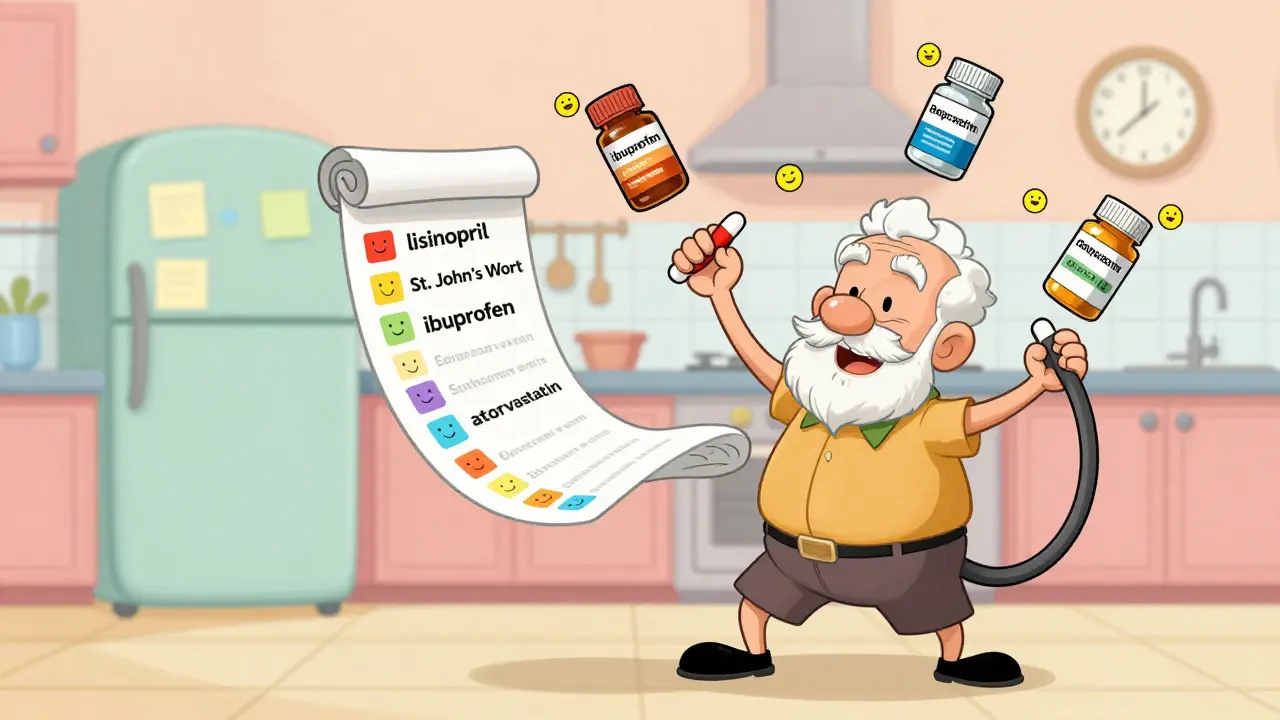
More than one in three adults between 60 and 70 are taking five or more prescription drugs at once. By age 75, that number jumps to 41%. It’s not just about managing illness anymore-it’s about surviving a maze of pills, each with its own timing, side effects, and hidden dangers. One wrong mix can land you in the hospital. But you don’t have to figure this out alone. Coordinating your prescriptions isn’t complicated if you know where to start.
Keep a Complete, Updated Medication List
Start with a list that includes everything you take. Not just prescriptions. Include over-the-counter painkillers, heartburn meds, vitamins, herbal supplements, and even eye drops. Many people forget these, but they’re often the source of dangerous interactions. For example, taking St. John’s Wort with antidepressants can trigger serotonin syndrome-a life-threatening condition. Or combining ibuprofen with blood pressure meds can spike kidney damage risk. Your list needs specifics: the generic name (like lisinopril), the brand name (like Zestril), the dosage (10 mg), the time of day (take with breakfast), the reason (for high blood pressure), and any special notes (avoid grapefruit, take on empty stomach). Keep this list in your wallet, on your phone, and share it with every doctor and pharmacist you see. Update it every time you start, stop, or change a dose. A 2022 Medscape report found that pharmacists using complete lists catch 94% of potential drug clashes-compared to just 47% when information is incomplete.Use One Pharmacy for All Prescriptions
Splitting prescriptions between CVS, Walgreens, and a local pharmacy might feel convenient, but it’s risky. Each pharmacy only sees part of your picture. That means they can’t spot interactions between drugs from different places. A 2023 Health Affairs study showed that people using a single pharmacy have 47% fewer dangerous drug interactions than those who spread prescriptions across multiple locations. Your pharmacist becomes your safety net. They track everything you take, check for interactions with new prescriptions, and even warn you about OTC meds that could clash. Most community pharmacies now offer free medication reviews. Ask for one every six months. If you’re on eight or more medications and have two or more chronic conditions, Medicare Part D requires them to offer you a Medication Therapy Management (MTM) session-at no extra cost. These sessions last about 22 minutes and can cut medication-related problems by 37%.Try Medication Synchronization
Imagine getting all your monthly prescriptions ready on the same day-say, the first Tuesday of every month. No more juggling refill dates. No more running out of blood pressure pills while you’re waiting for your diabetes med to be ready. That’s medication synchronization, or “med sync.” It’s simple: you pick a date that works for you. The pharmacy then adjusts your refill schedules so everything lines up. If you need a 30-day supply of metformin and a 90-day supply of atorvastatin, they’ll give you a partial fill now so both run out on the same day. The American Society of Health-System Pharmacists says properly run med sync programs reduce missed doses by 31% and save $1,200-$1,800 per patient each year by preventing hospital visits. Ask your pharmacist if they offer it. Most independent pharmacies and big chains like CVS, Walgreens, and Rite Aid now do. It usually takes 2-3 weeks to set up, but after that, it’s automatic. You’ll get a call when your meds are ready, and you pick them all up at once.Use a Pill Organizer-But Make It Work for You
A simple 7-day pill box with morning and evening compartments can be a game-changer. A 2023 study in the Journal of General Internal Medicine tracked 1,245 older adults using these organizers. Adherence jumped from 62% to 87% in just six months. But not all organizers are equal. Basic ones don’t remind you. Smart ones do. Devices like Hero Health cost around $899 and beep, flash lights, and even text family members if you miss a dose. They’re great-if you can afford them. For most people, a $10 plastic organizer works fine. Just make sure to fill it weekly, at the same time. Sunday evenings while watching your favorite show is a proven habit. A University of Michigan study found that sticking to a routine like this improves adherence by 33%. Don’t forget: some pills can’t be crushed or split. Check with your pharmacist before putting anything into an organizer. Also, keep your pills in their original bottles for safety and reference. The organizer is just a helper, not a replacement.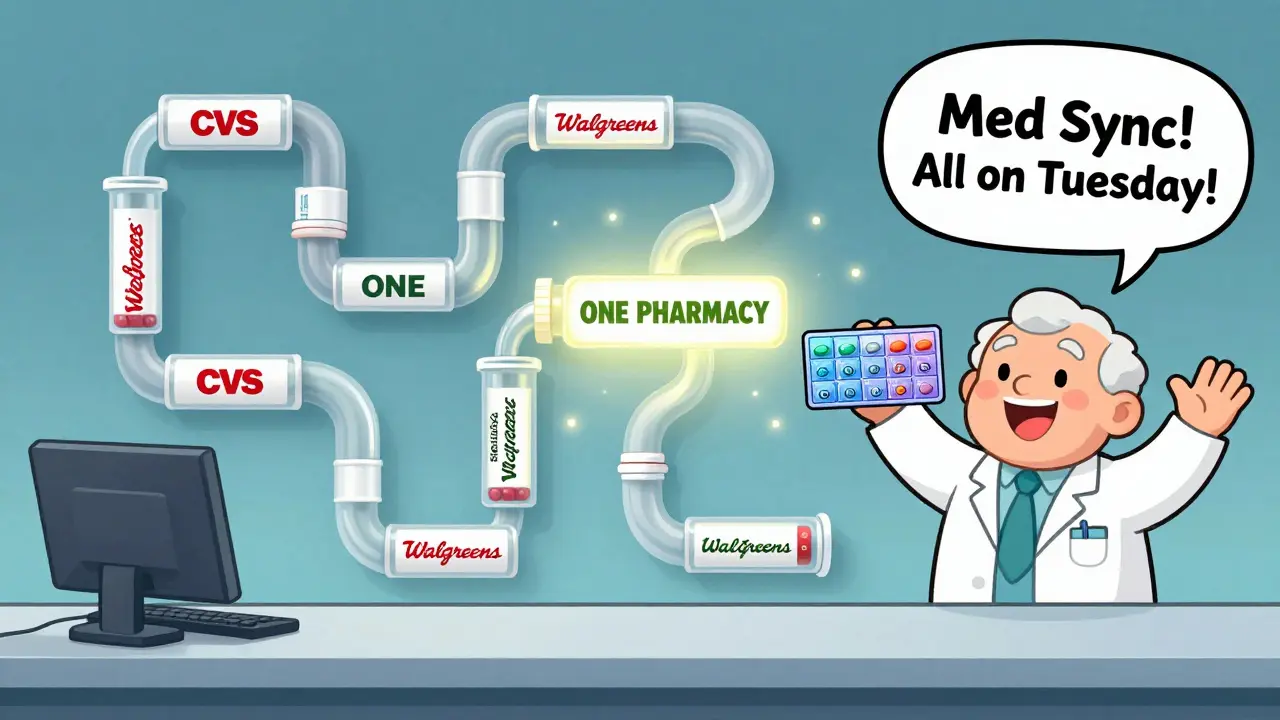
Watch for Hidden Risks-OTC and Supplements
You wouldn’t think a daily vitamin or a cold tablet could be dangerous. But they can. Eighty-two percent of serious drug interactions happen because patients don’t tell their doctors about supplements or OTC meds they’re taking. Common troublemakers:- NSAIDs (ibuprofen, naproxen) + blood thinners = higher risk of stomach bleeding
- Calcium supplements + thyroid meds = calcium blocks absorption-take them 2 hours apart
- St. John’s Wort + antidepressants = serotonin overload
- Alcohol + sedatives = dangerous drowsiness
Use Digital Tools-If They Fit Your Life
Apps like Medisafe and MyMeds send reminders, track refills, and even alert you to potential interactions. A 2022 JAMA Internal Medicine trial showed users had 28% better adherence than those using paper logs. But here’s the catch: 62% of adults over 75 don’t use smartphones regularly. If you’re not comfortable with tech, don’t force it. A pill organizer and a phone call to your pharmacist will do more good than an app you never open. If you do use an app, make sure it lets you input every medication-including supplements. And sync it with your pharmacy’s refill system if possible. CVS’s app, for example, sends a reminder 72 hours before you run out. In a 6-month trial with over 3,000 patients, that cut missed doses by 28%.Know When to Ask About Deprescribing
Sometimes, the best way to avoid conflicts is to take fewer pills. Not every medication you started years ago is still necessary. Blood pressure meds, cholesterol drugs, or even sleep aids might be safe to reduce-or stop-after your condition improves. The American Geriatrics Society, the American Society of Health-System Pharmacists, and the American Psychiatric Association all agree: regularly review your meds. Ask your doctor: “Is this still helping me? Could I take less? Are there side effects I’m ignoring?” Deprescribing isn’t giving up-it’s getting smarter. A 2023 Commonwealth Fund analysis found that every $1 spent on coordinated medication management saves $7.20 in avoided hospital stays, ER visits, and long-term care.
Timing Matters More Than You Think
It’s not just what you take-it’s when. Some drugs need to be taken on an empty stomach. Others must be taken with food. Some need spacing. Examples:- Thyroid meds (levothyroxine): Take first thing in the morning, 30-60 minutes before breakfast. Calcium, iron, or coffee within 4 hours can block absorption.
- Proton pump inhibitors (omeprazole): Take 30 minutes before your first meal. They work best when your stomach is preparing to digest.
- Statins (atorvastatin): Best taken at night. Your liver makes most cholesterol while you sleep.
- Diuretics (furosemide): Take in the morning. You don’t want to be up all night using the bathroom.
What If You Still Feel Off?
Drowsiness? Dry mouth? Upset stomach? Dizziness? These aren’t just “old age.” They’re red flags. Dr. Ami Patel, a clinical pharmacist, says these are often early signs of a drug interaction. Don’t ignore them. Don’t just power through. Call your pharmacist. Bring your list. Say: “I’ve been feeling off since I started this new med.” They’ll check for interactions, adjust timing, or suggest alternatives. Most don’t charge for this advice.What’s Next?
Start today. Write down every pill you take. Call your pharmacy and ask if they offer med sync. Set up a weekly pill-filling routine. Ask your doctor if any meds can be reduced. You don’t need to fix everything at once. Just make one change. Then another. The goal isn’t perfection. It’s safety. Every interaction avoided is a hospital visit prevented. Every dose taken on time is another day you stay independent. Medication coordination isn’t about being perfect-it’s about being smart.Can I just use my doctor’s list instead of making my own?
No. Your doctor’s electronic record may be missing supplements, OTC drugs, or even over-the-counter pain relievers you take regularly. Pharmacists see the full picture only if you give them the complete list. Always carry your own updated list to every appointment.
Is it safe to crush pills or open capsules to make them easier to swallow?
Not always. Extended-release pills, enteric-coated capsules, and some blood pressure or seizure meds can become dangerous if crushed. They’re designed to release slowly. Crushing them can cause a dangerous spike in drug levels. Always check with your pharmacist before altering any pill.
How often should I review my medications with my pharmacist?
At least every six months. If you’ve had a hospital stay, started a new drug, or noticed new side effects, do it sooner. Medicare Part D requires pharmacies to offer a free medication review annually to patients on eight or more medications for two or more chronic conditions.
Do I need to tell my pharmacist about vitamins and herbal supplements?
Yes. Many people don’t realize that supplements like fish oil, garlic, ginkgo, or St. John’s Wort can interact with blood thinners, blood pressure meds, and antidepressants. These aren’t harmless. Your pharmacist needs to know everything you take.
Can medication synchronization help if I take insulin or injectables?
Yes. Med sync doesn’t just work for pills. Many pharmacies now coordinate insulin refills, inhalers, patches, and injectables. They’ll make sure you never run out of your daily meds. Just ask your pharmacist if they can include your injectables in the sync program.
Comments (15)
-
Stacey Smith December 20, 2025This is why America needs real healthcare reform. People shouldn't have to become pharmacists just to stay alive.
My grandma died because her doctor didn't coordinate her meds. She was on 11 pills. No one told her grapefruit killed her blood pressure med.
Stop putting the burden on seniors. Fix the system.

-
Christina Weber December 21, 2025Your post contains multiple grammatical errors and inconsistent punctuation. For instance, you use a comma splice in 'It’s not just about managing illness anymore-it’s about surviving a maze of pills'-the em dash is incorrectly used. Also, 'med sync' is not a standardized term; it should be 'medication synchronization' on first use.
Additionally, the reference to '2022 Medscape report' lacks a DOI or URL. Credibility suffers without proper sourcing.

-
Meina Taiwo December 21, 2025In Nigeria, most elderly can't afford even one prescription. We don't have pharmacies that sync meds or offer free reviews.
But the core advice? Still valid. Write it down. Talk to the pharmacist. Don't assume anything.
Even with nothing, you can still be smart.

-
Siobhan K. December 22, 2025Of course the pharmaceutical industry loves this 'you just need to talk to your pharmacist' advice.
They're the ones who created the 12-pill-a-day nightmare in the first place.
Meanwhile, your pharmacist is overworked, underpaid, and paid by the drug companies to upsell.
Don't get me wrong-this list is useful. But it's like telling a drowning person to swim better.

-
Jason Silva December 23, 2025I know what's really happening 😈
Big Pharma wants you to take MORE pills so you stay dependent.
They don't want you to deprescribe-they want you to buy new ones every month.
That's why they fund all these 'med sync' programs. It's a trap.
My uncle took 17 pills. He died in 2021. The coroner said 'polypharmacy'.
They're lying to you. 🕵️♂️💊

-
Sarah Williams December 23, 2025I started med sync last year. Changed my life.
Now I get all my meds on the first Tuesday. No more panic when I run out of blood pressure pills.
My pharmacist even caught that my fish oil was clashing with my warfarin.
Best $0 I ever spent.

-
Brian Furnell December 24, 2025The pharmacokinetic interplay between CYP450 substrates and inhibitors is profoundly underappreciated in lay discourse.
For instance, St. John’s Wort induces CYP3A4 and P-glycoprotein, thereby reducing plasma concentrations of SSRIs, anticoagulants, and even oral contraceptives-potentially triggering therapeutic failure.
Similarly, NSAIDs inhibit renal prostaglandin synthesis, which, in conjunction with ACE inhibitors, precipitates acute kidney injury via afferent arteriolar vasoconstriction.
Moreover, the chronopharmacological alignment of statins with nocturnal hepatic cholesterol biosynthesis is not merely optimal-it is mechanistically imperative.
Yet, the average patient lacks the cognitive scaffolding to parse these interactions.
That’s why standardized, digitized medication reconciliation protocols-integrated with EHRs and pharmacy dispensing systems-are not ancillary; they are existential.
And yes, the 94% detection rate in complete lists is statistically significant (p<0.001).
Deprescribing isn’t 'giving up.' It’s pharmacovigilance in action.
And if you’re still taking omeprazole after 8 weeks without indication? You’re part of the problem.

-
Cara C December 26, 2025I just wanted to say thank you for writing this.
My mom is 72 and on 9 meds. She was terrified to ask her doctor if any could be cut.
I printed this out, highlighted the deprescribing section, and we took it to her appointment.
They took her off the sleeping pill and reduced her statin.
She says she feels like herself again.
You didn’t just write advice. You gave us hope.

-
Peggy Adams December 27, 2025I read this and thought-why am I even trying?
They don’t care if I live or die.
My pills cost $800/month. My insurance denies everything.
So I just skip doses.
Whatever.

-
Orlando Marquez Jr December 27, 2025The structural imperatives of polypharmacy in aging populations demand a multidisciplinary, systems-level intervention.
While individual-level strategies-such as medication synchronization and pharmacist-led reviews-are commendable and empirically supported, they remain palliative in nature.
True progress requires the integration of geriatric pharmacotherapy into primary care workflows, mandatory electronic health record interoperability across prescribers, and federal reimbursement incentives for deprescribing initiatives.
Until then, we are managing symptoms, not solving the disease.

-
Cameron Hoover December 28, 2025I used to think I was fine until I started feeling like a zombie.
Then I found out my anxiety meds were clashing with my thyroid med.
One phone call to my pharmacist. One change.
I cried. Not because I was sad.
Because I finally felt like me again.

-
Swapneel Mehta December 28, 2025This is gold.
I’m 48, and I’ve been helping my parents with their meds for years.
They still don’t trust the pharmacist.
I showed them this.
They’re going to ask for med sync next week.
Small wins.

-
Theo Newbold December 29, 2025Let’s be honest. 90% of these 'interactions' are exaggerated to sell more drugs.
St. John’s Wort? Maybe. But most OTC combos are harmless.
Doctors and pharmacists scare people into compliance.
My dad took ibuprofen with his blood pressure med for 10 years. He’s fine.
Stop fearmongering.

-
Southern NH Pagan Pride December 30, 2025The government is using these 'medication sync' programs to track us.
Every pill you take? They’re logging it.
Next thing you know, your Social Security gets cut because you 'failed compliance'.
And the 'free reviews'? They’re just collecting data for the CDC.
They don’t care if you live. They care if you’re 'statistically optimal'.
Don’t fall for it.

-
mukesh matav December 31, 2025In India, we don’t have pharmacies that do med sync.
But we have something better: family.
My aunt takes her pills with my uncle every morning.
They write names on sticky notes.
They check each other.
Simple. Human.
Maybe we don’t need tech. Maybe we just need each other.
