
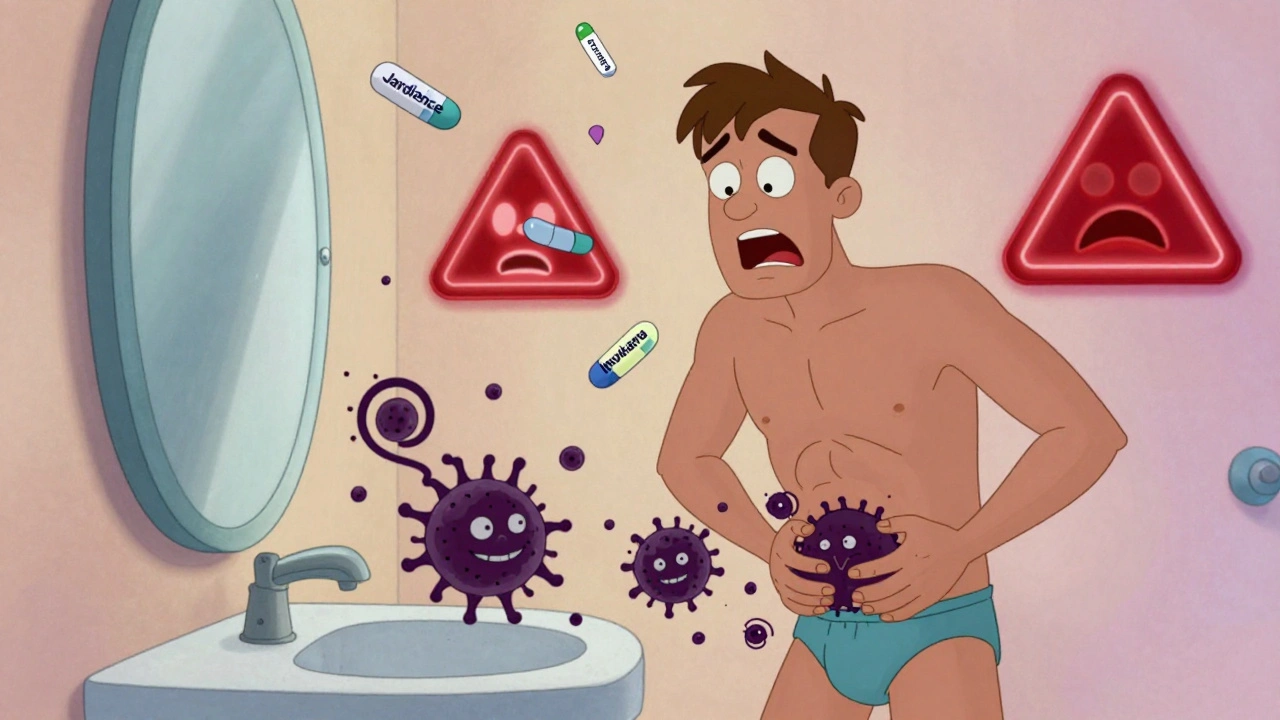
Fournier's Gangrene Emergency Symptom Checker
Important Notice
This tool is not a medical diagnosis. It is designed to help you recognize potential signs of Fournier's gangrene and encourage immediate medical attention. If you experience any symptoms, contact emergency services immediately.
Check Your Symptoms
If you're taking an SGLT-2 inhibitor medication (Jardiance, Farxiga, Invokana, or Steglatro), check the symptoms below. This condition requires immediate medical attention within hours.
Check your symptoms above to see if you need immediate medical attention
When you’re managing type 2 diabetes, taking a medication like Jardiance, Farxiga, or Invokana can feel like a win. These drugs help lower blood sugar, protect your heart, and slow kidney damage. But there’s a rare, terrifying side effect tied to them that most people never hear about until it’s too late: Fournier’s gangrene.
This isn’t a common reaction. But when it happens, it moves fast - and it kills. Fournier’s gangrene is a necrotizing infection that eats away at the skin and tissue around your genitals and anus. It starts with pain, swelling, or redness. Within hours, it can turn deadly. And it’s linked directly to a class of diabetes drugs called SGLT-2 inhibitors.
What Is Fournier’s Gangrene?
Fournier’s gangrene is a bacterial infection that destroys soft tissue. It’s not a typical skin infection. It spreads through the fascia - the layer of connective tissue under your skin - and cuts off blood flow. The tissue dies. Bacteria multiply. Gas forms. The smell is often described as rotten or foul. Fever, chills, and extreme pain follow.
It was once thought to affect mostly older men with diabetes or poor hygiene. But since 2018, cases have popped up in women, younger people, and those with no obvious risk factors - all while taking SGLT-2 inhibitors. The FDA confirmed this shift after reviewing 12 cases between 2013 and 2018. By 2022, New Zealand’s drug safety agency reported multiple cases tied to empagliflozin and dapagliflozin. One-third of these cases were in women. That’s a major departure from the past.
How Do Diabetes Medications Cause This?
SGLT-2 inhibitors work by making your kidneys flush out extra sugar through urine. That’s great for lowering blood sugar. But it also means your genital area is constantly exposed to glucose-rich fluid. Bacteria and yeast love sugar. So, infections like yeast infections and urinary tract infections become more common.
In rare cases, these infections don’t stay local. They spread deeper. A small cut, a pimple, or even friction from clothing can let bacteria breach the skin. Once they get under the surface, they spread rapidly. The body’s immune system, already weakened by diabetes, can’t keep up.
It’s not the drug itself that’s toxic. It’s the environment it creates. And that’s why this risk is unique to this class of drugs. Other diabetes medications - like metformin, sulfonylureas, or insulin - don’t cause this kind of sugar leakage in the genital area. That’s why Fournier’s gangrene isn’t linked to them.
The Emergency Signs: Don’t Wait
If you’re on an SGLT-2 inhibitor, you need to know the warning signs - and act within hours, not days.
- Severe pain in the genitals or around the anus - even if the area doesn’t look bad yet
- Redness, swelling, or warmth that spreads quickly
- Fever or chills that come on suddenly
- Foul-smelling discharge from the genital or anal area
- Dark or black patches of skin - a sign tissue is dying
- Pain out of proportion to what you see - this is a classic red flag
- Malaise - feeling extremely unwell, like you’re coming down with the flu
One patient, a 71-year-old woman on dapagliflozin, showed up with a large abscess and foul-smelling fluid. She didn’t have a history of trauma. No open wounds. Just diabetes and her medication. By the time she got to the hospital, the infection had already spread. She needed multiple surgeries and weeks in intensive care.
Don’t wait for the skin to turn black. Don’t assume it’s just a yeast infection. If you’re on one of these drugs and feel any of these symptoms, go to the ER immediately. Tell them you’re taking an SGLT-2 inhibitor. Say: “I’m worried about Fournier’s gangrene.”

What Happens When You Get Diagnosed?
There’s no gentle treatment for Fournier’s gangrene. It’s a medical emergency that demands immediate action.
First, your doctor will stop your SGLT-2 inhibitor. Right away. No delay.
Then, you’ll get high-dose intravenous antibiotics - often a mix of drugs to fight multiple types of bacteria. But antibiotics alone won’t save you. The dead tissue has to be cut out. That’s surgical debridement. Some patients need one surgery. Others need five or six. In the study of 19 cases, 63% required multiple operations.
Most patients end up in the ICU. 79% of those in the 2019 study were admitted there. Some die despite aggressive care. 16% of those cases were fatal.
Recovery is long. Scarring is common. Sexual function and urinary control can be permanently affected. The physical and emotional toll is huge.
Are These Drugs Still Safe?
Yes - but only if you know the risks.
The FDA, EMA, and Medsafe all agree: the benefits of SGLT-2 inhibitors still outweigh the risks for most people. These drugs reduce heart failure hospitalizations. They lower the risk of kidney failure. They help people live longer. That’s powerful.
But “rare” doesn’t mean “impossible.” And “benefits outweigh risks” doesn’t mean “no one should worry.”
These drugs are not for everyone. If you have a history of recurrent yeast infections, urinary tract infections, or skin infections in the genital area, talk to your doctor. If you’re overweight, have poor circulation, or are over 65, your risk may be higher.
And if you’re a woman - especially under 50 - you need to be extra aware. Fournier’s gangrene used to be called a “man’s disease.” Now, it’s not.

What Should You Do Now?
If you’re currently taking Invokana, Farxiga, Jardiance, or Steglatro:
- Don’t stop the medication on your own. Talk to your doctor first.
- Know the emergency signs. Write them down. Keep them on your phone.
- Check your genital area daily - especially if you’ve had infections before.
- Report any unusual symptoms to your doctor immediately - even if you think it’s “just a rash.”
- Ask your doctor if you’re a good candidate for this drug. Are there safer alternatives?
If you’re thinking about starting one of these drugs:
- Ask: “What’s my risk for genital infections? What’s my risk for Fournier’s gangrene?”
- Ask: “What are the alternatives? How do they compare?”
- Ask: “Will you monitor me for signs of infection?”
These aren’t just questions. They’re life-saving conversations.
What If You’ve Already Had an Infection?
If you’ve had a severe genital infection while on an SGLT-2 inhibitor - even if it didn’t turn into Fournier’s gangrene - you’re at higher risk for it happening again.
Your doctor should consider switching you to a different diabetes medication. Metformin, GLP-1 agonists like semaglutide, or insulin may be safer options depending on your health goals.
Don’t brush off a yeast infection as “just a side effect.” That’s how these cases start. One infection leads to another. One small tear becomes a gateway. And then - it’s too late.
There’s no shame in asking for a change. Your life matters more than sticking with a drug because it’s “working.”
Final Thought: Awareness Saves Lives
Fournier’s gangrene is rare. But when it strikes, it doesn’t care if you’re young or old, male or female, healthy or diabetic. It moves faster than fear.
The good news? You can prevent it - if you know what to look for. If you’re on one of these medications, you’re not just managing diabetes. You’re managing a hidden risk. And that means being alert, informed, and ready to act.
Don’t wait for the pain to get worse. Don’t wait for the skin to turn black. If you feel something wrong - go. Now. Tell them you’re on an SGLT-2 inhibitor. Your life might depend on it.
Comments (9)
-
Jaswinder Singh December 1, 2025
bro this is real life or death stuff i knew someone who ignored a yeast infection while on Farxiga and ended up in the ICU for 3 weeks

-
Adrian Barnes December 2, 2025
It is imperative to underscore that the pharmacological profile of SGLT-2 inhibitors, while efficacious in glycemic control, engenders a microenvironment conducive to pathogenic proliferation in the genitourinary tract. The clinical literature, though sparse, unequivocally implicates these agents in the pathogenesis of necrotizing fasciitis, a condition historically considered rare but now demonstrably emergent.
One must not conflate incidence with risk; rarity does not equate to safety. The FDA's post-marketing surveillance data, though limited in sample size, reveals a statistically significant temporal association between drug initiation and clinical presentation. The absence of trauma or preexisting dermatological compromise in many cases further implicates the medication as the primary etiological vector.
Moreover, the assertion that women are now disproportionately affected represents a paradigmatic shift in clinical epidemiology. This demographic transition necessitates a reevaluation of diagnostic protocols and patient education materials, which have historically been gender-biased.
It is also noteworthy that the metabolic milieu created by these drugs-namely, glucosuria-constitutes a fertile substrate for Candida albicans and other opportunistic organisms. The immune dysregulation inherent in type 2 diabetes further compounds this vulnerability.
Therefore, clinicians must adopt a proactive stance: routine genitourinary screening should be incorporated into follow-up protocols for patients on SGLT-2 inhibitors, irrespective of symptomatology.
Delay in surgical debridement is the single greatest predictor of mortality. Time is tissue, and tissue is life.
The fact that some patients present with pain disproportionate to visible signs is not anecdotal-it is pathognomonic. This is not a dermatology issue. This is a surgical emergency.
Pharmaceutical marketing has obfuscated this risk. The benefits are real, but the cost of ignorance is catastrophic.
Patients must be empowered with explicit, unambiguous warnings-not buried in footnotes or dense prescribing information.
I have reviewed over two dozen case reports. None of the survivors were asymptomatic prior to admission. All dismissed early symptoms as 'just a rash' or 'a bad UTI.'
Do not wait for black skin. Do not wait for fever. If you feel it-go now.

-
Irving Steinberg December 4, 2025
so like... if i have a yeast infection am i gonna die?? 😅

-
Souvik Datta December 4, 2025
you're not gonna die from a yeast infection but you're gonna die if you ignore the pain when it starts screaming at you
my uncle had a UTI on Jardiance and thought it was 'just stress'-took him 4 days to go to the ER, by then his leg was turning purple
he lost part of his groin, had to learn to pee through a tube, and still has nightmares about the smell
these drugs aren't evil but they're not harmless either
if you're on one, check your junk every morning like you check your phone
if it burns, swells, or smells weird-don't google it, don't wait till tomorrow, don't say 'maybe it'll go away'
go to the ER. say 'SGLT-2 inhibitor.' say 'Fournier's gangrene.'
you're not overreacting. you're being smart.
and if your doctor acts like you're being dramatic? get a second opinion. your life isn't a side effect.

-
Priyam Tomar December 4, 2025
everyone’s panicking over a 0.001% risk but you know what’s actually killing people? people who stop their meds because they read a scary Reddit post
heart failure kills more diabetics than this ever will
you want to live longer? keep taking your pill. don’t let fear replace science
also-women get yeast infections ALL THE TIME. this is not a new thing
if you’re scared, switch to metformin. but don’t act like everyone on SGLT-2 inhibitors is one rash away from losing their genitals

-
Eric Vlach December 6, 2025
i just got prescribed Jardiance last week and honestly i was so excited to lose weight and feel better
now i'm sitting here checking my crotch every 2 hours
but seriously though-i'm gonna start checking daily and i'm gonna ask my doc about alternatives
if this saves one person from going through what i just read about? worth the freakout
also-can we just agree that drug companies should put a big red warning on the bottle? like a skull and crossbones? not buried in 20 pages of fine print
and if you're a woman? yeah this applies to you too. i didn't even know this could happen to women until today
thanks for sharing this. i feel like i just got a life alert

-
Kay Lam December 6, 2025
I think what’s being overlooked here is the systemic failure in how we communicate risk to patients
Doctors are overworked and under time. Patients are overwhelmed and scared. The information is buried in consent forms and pamphlets that no one reads
Why isn’t there a mandatory 5-minute video patients watch before filling the script? Why isn’t the pharmacy required to hand out a laminated card with warning signs? Why are we relying on Reddit posts to save lives?
And let’s be honest-most people don’t know what ‘fascia’ is. They don’t know what ‘necrotizing’ means. They hear ‘rare side effect’ and assume it’s like getting a headache from aspirin
This isn’t just about individual vigilance. It’s about making the system better
Maybe if the FDA required plain-language warnings on packaging, or if insurance companies covered more frequent screenings for patients on these drugs, we wouldn’t be relying on people stumbling across this post at 2am
And yes-women are at risk. And younger people. And people with no prior infections. That’s the scary part
It’s not about scaring people. It’s about giving them the tools to protect themselves
And if your doctor doesn’t take this seriously? Find a new one

-
Jack Arscott December 8, 2025
just checked my junk. still pink. 😅🙏

-
Lydia Zhang December 9, 2025
cool
