
Vision Emergency Checker
Select the symptoms you're experiencing. This tool will help you determine if your blurred vision requires immediate medical attention based on guidelines from the American Academy of Ophthalmology.
Results will appear here
After checking your symptoms, we'll provide guidance on next steps.
Blurred vision isn’t always just a sign you need new glasses. For millions of people taking common medications, it’s a warning sign that something deeper is going on. You might not think twice about a little fuzziness after taking a pill for high blood pressure, a migraine, or acne-but that blur could be your body’s way of telling you your eyes are under stress. And in some cases, it’s the first clue to serious, even permanent, damage.
How Medications Blur Your Vision
Medications don’t just target your symptoms. They move through your bloodstream and can affect every part of your body-including your eyes. The eye is packed with delicate tissues: the cornea, lens, retina, optic nerve, and muscles that control focus. Many drugs interfere with these structures in ways that aren’t obvious until vision starts to change.
Some medications cause temporary blurring by relaxing the muscles that help your eyes focus. Others build up deposits on the cornea, damage the retina, or raise pressure inside the eye. The good news? Most of these effects are preventable-if you know what to look for and when to act.
Top Medications Linked to Blurred Vision
Over 100 prescription drugs have blurred vision listed as a known side effect. But a handful stand out because of how common or how dangerous the effect can be.
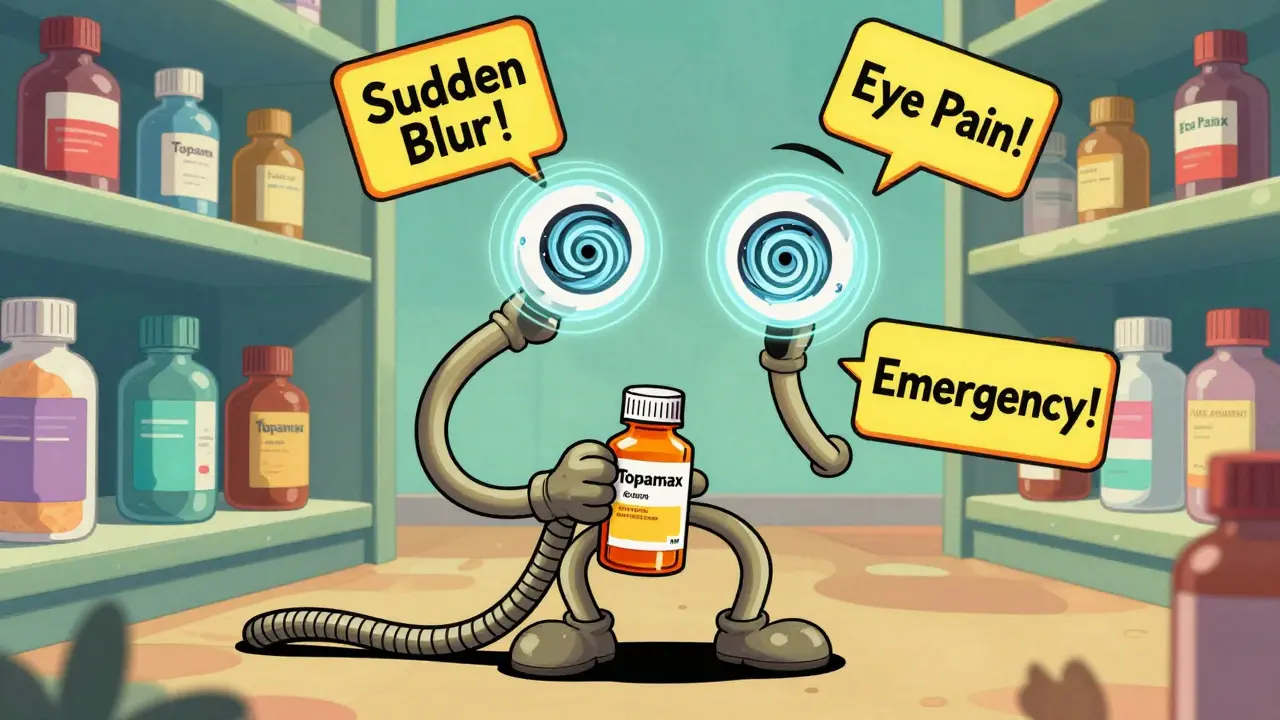
- Topiramate (Topamax): Used for seizures and migraines, this drug can trigger acute angle-closure glaucoma in up to 2% of users within the first month. Symptoms include sudden blurred vision, severe eye pain, headache, and nausea. This isn’t just a nuisance-it’s an emergency. Left untreated, it can cause permanent vision loss in under 48 hours.
- Amiodarone (Cordarone): Prescribed for irregular heart rhythms, this drug causes vortex keratopathy in over 70% of long-term users. You’ll see halos around lights and blurry vision, especially at night. These corneal deposits usually don’t go away even after stopping the drug.
- Isotretinoin (Accutane, Absorica): For severe acne, this medication dries out your tear film in 45-60% of users. The result? Dry, gritty eyes and blurry vision that gets worse by midday. Some users report difficulty driving at night.
- Corticosteroids (prednisone, dexamethasone): These powerful anti-inflammatories can raise eye pressure in 30-40% of people with glaucoma, and cause posterior subcapsular cataracts in 5-7% of long-term users. If you have diabetes, your risk jumps 3.2 times higher.
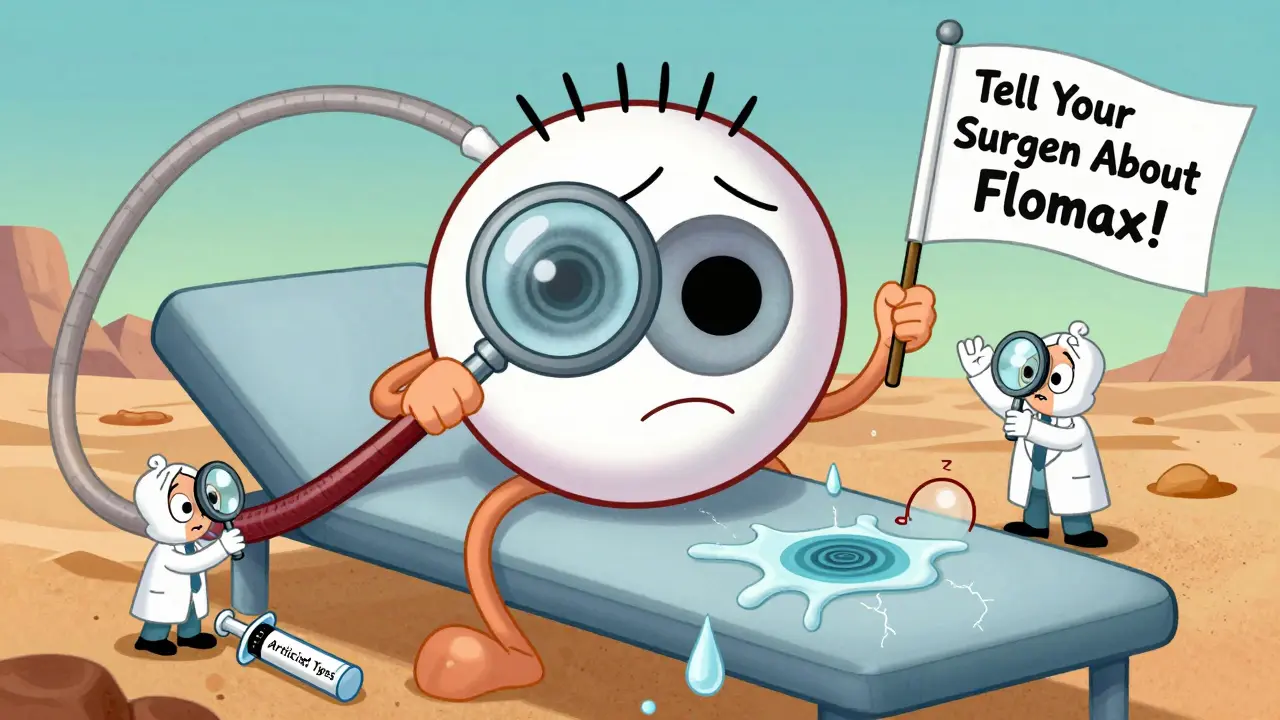
- Tamsulosin (Flomax): Used for enlarged prostate, this drug causes intraoperative floppy iris syndrome in 95% of patients during cataract surgery. Surgeons need to know you’re taking it-otherwise, the procedure can go wrong.
- Hydroxychloroquine (Plaquenil): Common for lupus and rheumatoid arthritis, this drug can cause bull’s eye maculopathy, a type of retinal damage that’s often irreversible. It usually shows up after five years of use, but damage can start much earlier.
When Blurred Vision Is an Emergency
Not all blurred vision is the same. Some changes are annoying. Others are urgent.
If your vision suddenly goes blurry and you have:
- Severe eye pain
- Headache with nausea or vomiting
- Red, swollen eyes
- Seeing halos or rainbow rings around lights
- Sudden loss of peripheral vision
-call your eye doctor immediately. These are signs of acute angle-closure glaucoma or retinal detachment. Both can lead to permanent blindness within hours if not treated.
Even if the blurriness is mild, don’t ignore it if it’s new, getting worse, or happening after starting a new medication. Many people assume it’s just fatigue or aging. But if you started a new drug three weeks ago and now can’t read your phone without squinting, that’s not normal.
Who’s at Highest Risk?
Some people are more vulnerable to medication-related vision damage.
- People with diabetes: Your eyes are already at risk. Steroids, even short-term, can cause rapid cataract formation and fluid shifts in the retina.
- People with glaucoma: If you’re already fighting high eye pressure, adding a drug that raises it-even a little-can push you over the edge.
- Older adults: Your eyes naturally produce fewer tears and process drugs slower. This means side effects hit harder and last longer.
- Those on multiple medications: Drug interactions can amplify side effects. A blood pressure pill + an antihistamine + a painkiller? That’s a recipe for dry eyes and blurry vision.
If you fall into one of these groups, you need to be proactive. Don’t wait for symptoms. Ask your doctor: "Is this drug linked to eye damage? Should I get my eyes checked?"
What Doctors Recommend for Monitoring
Prevention is way easier than fixing damage. Here’s what leading eye groups advise:
- For Plaquenil users: Get a baseline eye exam before starting, then every 6-12 months after five years. The test should include spectral-domain optical coherence tomography (SD-OCT) and automated visual fields-standard tools now used in most clinics.
- For amiodarone users: Annual slit-lamp exams to check for corneal deposits. These are visible under magnification and don’t require pupil dilation.
- For steroid users: Eye pressure checks every 2-4 weeks if you’re on long-term treatment. If pressure rises, your doctor may switch you or add eye drops.
- For Accutane users: Use preservative-free artificial tears 4-6 times daily. If dryness persists, your doctor might recommend punctal plugs or Restasis.
- For Flomax users: Tell your cataract surgeon at least four weeks before surgery. There are special techniques to handle the floppy iris-and they work best when planned ahead.
The American Academy of Ophthalmology updated its guidelines in 2023, lowering the maximum safe daily dose of Plaquenil from 5.0 mg/kg to 2.3 mg/kg based on new research. That’s a big change-and it shows how fast this field is evolving.
What You Can Do Right Now
You don’t need to stop your meds. But you do need to be informed.
- Check your pill bottle. Look for "vision" or "eye" in the side effects section. If it’s there, don’t panic-but do pay attention.
- Track your symptoms. Keep a simple log: When did the blur start? Does it get worse at certain times of day? Does it go away after a few hours?
- Talk to your pharmacist. They see hundreds of prescriptions a day. Ask: "Does this drug commonly cause eye problems?" They’ll know.
- Ask your doctor about an eye exam. Even if you’re not due for one, say: "I’m on [drug name]. Should I get my eyes checked?"
- Don’t wait for pain. Blurry vision is often the first-and sometimes the only-sign of damage. By the time you feel pain, it might be too late.
One patient on Reddit wrote: "I stopped Topamax because I couldn’t drive. My vision didn’t come back." Another said: "I didn’t tell my surgeon I was on Flomax. My cataract surgery took twice as long. I almost lost sight in one eye." These aren’t rare stories. They’re preventable ones.
What’s Changing in Eye Care
The field is catching up. In March 2023, the FDA approved the first AI-powered tool to detect early Plaquenil damage with 94.7% accuracy-far better than older methods. By 2026, genetic testing may identify who’s at highest risk for drug-induced eye damage before they even start treatment.
Pharmaceutical companies now include ocular warnings on 89% of drug labels, up from 62% in 2015. Hospitals have mandatory eye consults for high-risk drugs. And ophthalmology residents now get 24 hours of training on medication side effects-up from just 8 hours in 2010.
This isn’t just about vision. It’s about awareness. Too many people assume side effects are "just part of taking medicine." But when it comes to your eyes, a little blur can mean a lot.
Can blurred vision from medication be reversed?
It depends on the drug and how long you’ve been taking it. Temporary causes-like dry eyes from Accutane or muscle relaxation from anticholinergics-usually improve within days or weeks after stopping the drug. But damage to the retina (like from Plaquenil) or cornea (like from amiodarone) is often permanent. Early detection is key. If caught early, some retinal changes can be slowed or stopped.
Do over-the-counter drugs cause blurred vision?
Yes. Antihistamines (like Benadryl), decongestants, and even some pain relievers like ibuprofen can cause dry eyes or temporary blurring. Long-term use of NSAIDs (daily for over two years) raises the risk of retinal hemorrhages and cataracts. It’s not as common as with prescriptions, but it still happens.
Should I stop my medication if I get blurred vision?
No-not without talking to your doctor. Stopping a medication suddenly can be dangerous. For example, quitting amiodarone without medical supervision can cause dangerous heart rhythms. Instead, note your symptoms, schedule an eye exam, and discuss alternatives with your prescriber. The goal is to protect your vision without risking your health.
How often should I get my eyes checked if I’m on high-risk meds?
For Plaquenil, amiodarone, or long-term steroids: at least once a year. If you have diabetes, glaucoma, or are on multiple high-risk drugs, every 6 months is safer. Your eye doctor will decide based on your age, dosage, and other health factors. Don’t wait for symptoms-screening catches damage before you notice it.
Can I prevent vision damage from medications?
Yes, in most cases. Prevention starts with knowing your risk. Ask your doctor about eye side effects before starting any new drug. Get baseline eye exams if you’re on long-term meds. Use artificial tears if your eyes feel dry. Avoid smoking-it worsens drug-related damage. And never ignore blurry vision just because "it’s just a side effect."
Blurred vision from medication isn’t something you have to live with. It’s a signal. And when you treat it as one, you protect more than your sight-you protect your future.