
When you’re blind or have low vision, getting medical information shouldn’t mean waiting for someone to read a paper form or hoping a doctor remembers to describe a chart. Yet too often, that’s exactly what happens. Millions of Americans live with vision loss that affects daily life - 7.6 million people aged 16 and older, according to the National Eye Institute. For them, healthcare isn’t just about treatment - it’s about access. And the most reliable, independent way to get that access? Audio resources.
Audio isn’t just a convenience. It’s a legal right. Under the Americans with Disabilities Act (ADA) and Section 504 of the Rehabilitation Act, healthcare providers must offer auxiliary aids like audio recordings, screen readers, and voice-based systems. The Affordable Care Act doubled down on this, requiring equal communication access. But knowing the law is one thing. Using it effectively is another.
What Audio Resources Actually Exist Today
Not all audio tools are created equal. Some are free. Some cost money. Some work in hospitals. Others work anywhere. Here’s what’s actually out there and how they help.
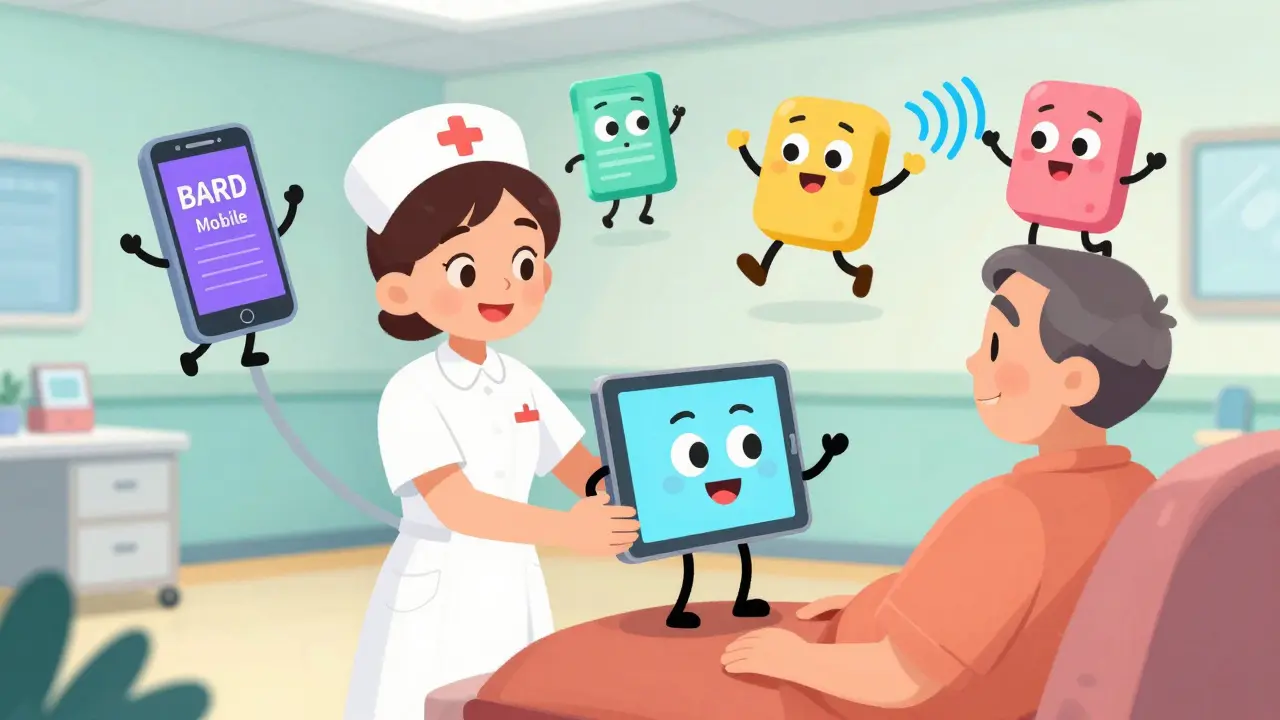
- BARD Mobile - Run by the National Library Service for the Blind and Physically Handicapped (NLS), this free app gives access to over 50,000 audiobooks, including medical guides, drug handouts, and condition-specific materials. It’s updated daily and works on iOS 12+ and Android 5+. No subscription. No credit card. Just eligibility - which you get by certifying your vision loss through the Braille Institute.
- Voice Dream Reader - A $29.99 app that reads anything aloud: PDFs, emails, web pages, even scanned documents. It supports over 100 voices and 30 languages. For patients who get printed discharge instructions or lab results, this turns paper into speech instantly. Works on iOS 14+ and Android 8+.
- KNFBReader - This $99 app uses your phone’s camera to scan printed text - prescriptions, consent forms, appointment slips - and reads it back in under three seconds. Developer testing shows 98.7% accuracy. It’s not just a scanner. It’s a lifeline when you can’t read a label or a bill.
- RightHear Talking Signage - Installed in hospitals like Johns Hopkins, this system uses Bluetooth beacons to guide you through buildings. Walk into a clinic, and your phone whispers, “Turn left to the Cardiology Department.” No internet needed. It cut navigation requests by 47% in pilot hospitals.
- CRIS Radio and Spectrum Access - Free, nonprofit radio services that broadcast health news, medication alerts, and wellness tips 24/7. You can listen on FM, online, or through smart speakers. No app needed. Just tune in.
These aren’t just tech toys. They’re tools that prevent mistakes. A diabetic patient in 2022 avoided a hypoglycemic emergency because her audio recording of insulin instructions was available when her printed sheet was smudged. That’s not luck - that’s design.
Why Audio Beats Paper and Screens
Imagine you’re told to take a pill twice a day. The nurse hands you a sheet. You can’t see it. You ask someone to read it. They say, “Take one in the morning and one at night.” But what time? What food? What side effects? Did they mention the interaction with your blood pressure meds? You forget half of it.
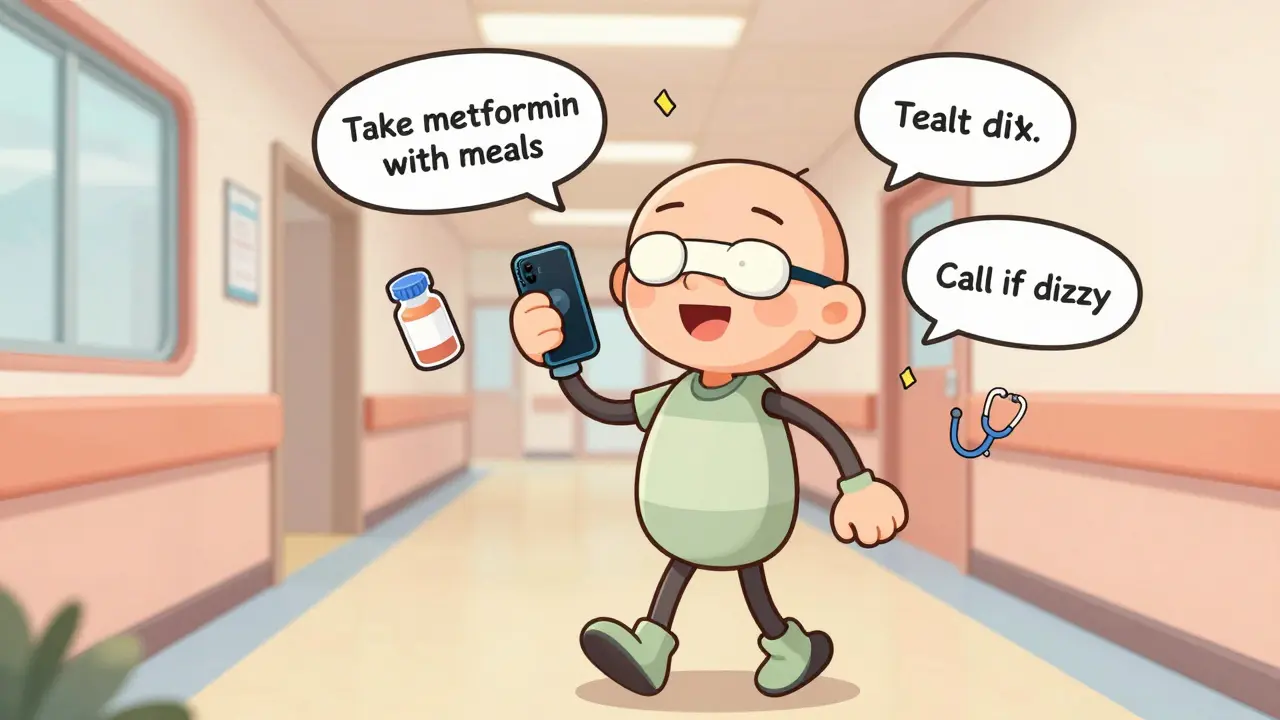
Now imagine an audio file. It says: “Take 10 milligrams of metformin with breakfast and dinner. Avoid alcohol. Report blurred vision or nausea immediately. Call your provider if you feel dizzy.” It’s detailed. It’s repeatable. It’s yours.
Studies show audio reduces medication errors by 31% in visually impaired patients. That’s not a guess. It’s from Dr. Roxana Mehran at Mount Sinai, published in Health Affairs. Why? Because audio gives control. You pause. You rewind. You listen again. Paper doesn’t do that. Screens with tiny text don’t either.
And it’s not just about meds. It’s about appointments. Lab results. Consent forms. Emergency instructions. All of it becomes accessible when spoken clearly and accurately.
What’s Missing - And Why It Matters
Here’s the harsh truth: 63% of visually impaired patients say audio resources aren’t consistently available across providers. One hospital gives you a free audiobook. The next says, “We don’t have that.”
Surveys by the National Federation of the Blind found that 41% of patients waited days - sometimes weeks - to get test results because they were only offered in print. That’s not negligence. It’s systemic. Many clinics still think “accessibility” means a braille sign. It doesn’t. It means audio, screen reader compatibility, and trained staff.
And here’s another gap: staff don’t know what’s available. A 2023 Lighthouse Guild survey found 58% of patients said their doctors or nurses had never heard of BARD Mobile or KNFBReader. How can you use a tool if no one tells you it exists?
Audio quality is another issue. Some hospital-recorded messages are muffled, too fast, or lack proper pauses. One patient described a recording that said, “Takeyourpillstwiceaday.” No breaks. No clarity. That’s worse than no recording at all.
What’s Changing - Fast
The rules are shifting. In 2023, the 21st Century Cures Act required all electronic health record (EHR) systems to include audio output by December 2024. That means your doctor’s chart, your lab results, your discharge summary - all will be readable by screen readers. No more printing. No more delays.
And the content is growing. In early 2024, NLS added 37% more medical audio titles to BARD Mobile - including new guides on managing kidney disease, heart failure, and mental health conditions. RightHear launched a healthcare-specific module in January 2024, adding clinical wayfinding - like guiding you to the dialysis unit or the radiology waiting room.
Even bigger: Mayo Clinic is testing AI-powered audio summaries. Imagine your entire visit - diagnoses, meds, follow-ups - condensed into a 90-second audio summary you can listen to on your way home. Pilot testing starts in Q3 2024.
Medicare now covers audio description services for beneficiaries with certified vision loss. That means if your doctor’s office gives you a video explaining a procedure, they must also offer an audio version - and Medicare will pay for it.
How to Get Started - Step by Step
If you’re visually impaired or helping someone who is, here’s how to get the audio tools you need:
- Check eligibility - You don’t need a perfect diagnosis. If vision loss affects daily tasks (reading, recognizing faces, navigating), you qualify for NLS and Braille Institute services. Call them. No doctor’s note required.
- Apply for BARD Mobile - Go to the NLS website or call 1-800-221-4799. You’ll get a free account. Download the app. Start listening to medical guides.
- Try Voice Dream Reader - Download it from the App Store or Google Play. Use it to scan any printed document. You’ll be amazed how fast it works.
- Ask your provider - Don’t wait. Say: “Do you offer audio versions of my discharge instructions or lab results?” If they say no, ask for the accessibility coordinator. They’re required by law to help.
- Use RightHear in hospitals - If your hospital uses Talking Signage, your phone will automatically detect it. No setup needed. Just walk in.
And if you’re a caregiver or family member? Help them set up these tools. Teach them how to pause, rewind, and replay. Audio isn’t magic - it’s repetition that builds confidence.
What’s Next
By 2025, the CMS Office of Minority Health plans to require all healthcare facilities to offer real-time audio translation for non-English-speaking visually impaired patients. That’s huge. It means a Spanish-speaking patient with glaucoma won’t have to rely on a child to interpret their treatment plan.
But funding is still shaky. Only 62% of hospitals have dedicated budgets for audio accessibility beyond minimum legal requirements. That’s why patient demand matters. The more people ask for audio, the more providers will build it.
The future of healthcare isn’t just about better drugs or new surgeries. It’s about who gets to understand them. Audio resources don’t just deliver information. They restore dignity. They give control. They save lives.
If you’re blind or have low vision, you don’t need someone to read to you. You need systems that speak to you - clearly, reliably, and on your terms.
Comments (12)
-
RacRac Rachel March 3, 2026This is exactly the kind of post that makes me believe change is possible. 🌟 I’ve used BARD Mobile for years, and it’s saved me from so many medication mix-ups. The fact that NLS just added 37% more medical titles? Game changer. I wish every hospital had a dedicated accessibility liaison - but until then, I’m telling every blind friend I know to download Voice Dream Reader. It’s cheap, it’s powerful, and it doesn’t need Wi-Fi. You don’t need permission to be independent. Just download the app. 💪🎧

-
Jane Ryan Ryder March 5, 2026Oh great another feel good tech article. We’re all just supposed to clap because some app reads aloud? Meanwhile, my Medicare copay went up 20% and no one’s talking about that. Real accessibility isn’t a fancy app - it’s not being charged extra for basic care. This whole thing feels like corporate virtue signaling with a side of condescension. 🙄

-
Callum Duffy March 5, 2026An admirably thorough and well-researched overview. The integration of legal frameworks with practical tools is particularly commendable. One might argue, however, that the true barrier lies not in the availability of technology, but in institutional inertia. Hospitals operate under severe budgetary constraints, and while compliance with ADA is mandatory, prioritisation remains discretionary. The 21st Century Cures Act may compel change, but without enforcement mechanisms, we risk another wave of well-intentioned but underimplemented policy.

-
Chris Beckman March 7, 2026lol i tried knfbreader and it read my grocery list as "milk bread eggs toilet paper" but then said "toilet paper" as "toilet paper" like it was confused. i think it thinks i'm trying to scan a bathroom sign. also, why do these apps always need android 8+? my phone is 3 years old and it still works fine. i just use voice to text and ask my wife to read stuff. it's easier.

-
Levi Viloria March 7, 2026I’ve been working in healthcare accessibility for over a decade, and this is one of the clearest summaries I’ve seen. What’s missing from most discussions is the cultural layer - many patients don’t ask for help because they’ve been conditioned to believe their needs are burdensome. That’s why the step-by-step guide at the end matters. It’s not just about tools. It’s about shifting the narrative: You deserve to understand your own care. No apologies needed.

-
Dean Jones March 8, 2026The fundamental issue here isn’t technological - it’s ontological. The healthcare system operates on a paradigm of visual documentation because it was designed by and for the sighted majority. Audio isn’t merely an accommodation; it’s a reconfiguration of epistemic authority. When information is rendered audible, it ceases to be a document and becomes an experience - one that can be replayed, internalized, and owned. This isn’t about accessibility. It’s about sovereignty. The fact that 63% of patients report inconsistent access isn’t a failure of infrastructure - it’s a failure of imagination. We still treat the blind as recipients of charity, not as agents of their own narrative. Until we redesign the system around the lived reality of non-sighted individuals - not as an add-on, but as the default - we are merely decorating a house built on a sinking foundation.

-
Donna Zurick March 10, 2026YES. I just got my mom set up with RightHear at her new clinic and she cried. Said she felt like she wasn’t lost anymore. We need more of this. Seriously. Tell your doctor. Tell your hospital. This isn’t optional. It’s life-saving.

-
tatiana verdesoto March 11, 2026I’m a low-vision nurse and I’ve been pushing my hospital to adopt these tools for years. We finally got BARD Mobile listed in our patient portal last month. The feedback? "I didn’t know I was allowed to ask for this." That’s the real crisis. Not the tech. Not the cost. The silence. Let’s stop waiting for patients to ask. Let’s offer it. First. Always.

-
Jessica Chaloux March 12, 2026I lost my vision after surgery last year and this post literally saved me. I was about to give up on my chemo info because I couldn’t read the pamphlets. Found BARD Mobile on a forum and now I listen to my treatment plan every night before bed. I’m not crying. I’m not. 😭

-
Mariah Carle March 13, 2026There’s a deeper truth here: audio isn’t just a tool - it’s a ritual. When you press play on a medical recording, you’re not just receiving information. You’re reclaiming autonomy. You’re saying: I am here. I am listening. I am not invisible. And that’s why the muffled hospital recordings are so damaging - they don’t just fail to inform. They fail to affirm.

-
Divya Mallick March 14, 2026This is why we need structural reform. You think audio is the solution? It’s a band-aid on a hemorrhage. The real issue is the medical industrial complex’s refusal to decentralize information. Why should a patient have to download five apps to get their own medical data? Why isn’t it embedded in the EHR? Why isn’t audio output mandatory at the API level? We’re optimizing for convenience instead of equity. And until we stop treating accessibility as a compliance checkbox and start treating it as a human right, we’re just rearranging deck chairs on the Titanic.

-
Richard Elric5111 March 14, 2026The most profound insight in this entire piece is not technological, nor legal - it is phenomenological. The patient who listens to their own discharge instructions is no longer a passive recipient of care. They become the primary interpreter of their own condition. This shift - from dependence to self-interpretation - is the true revolution. The ADA mandates access. But audio grants agency. And agency, in the final analysis, is the only form of dignity that cannot be revoked.
