

Ever looked up at a clear blue sky and seen tiny dots or squiggly lines drifting across your vision? Or noticed sudden flashes of light, like a camera bulb going off in the corner of your eye? You’re not alone. These are called floaters and flashes, and for most people over 50, they’re just part of getting older. But sometimes, they’re a warning sign - and waiting too long to check them out could cost you your vision.
What Are Floaters and Flashes?
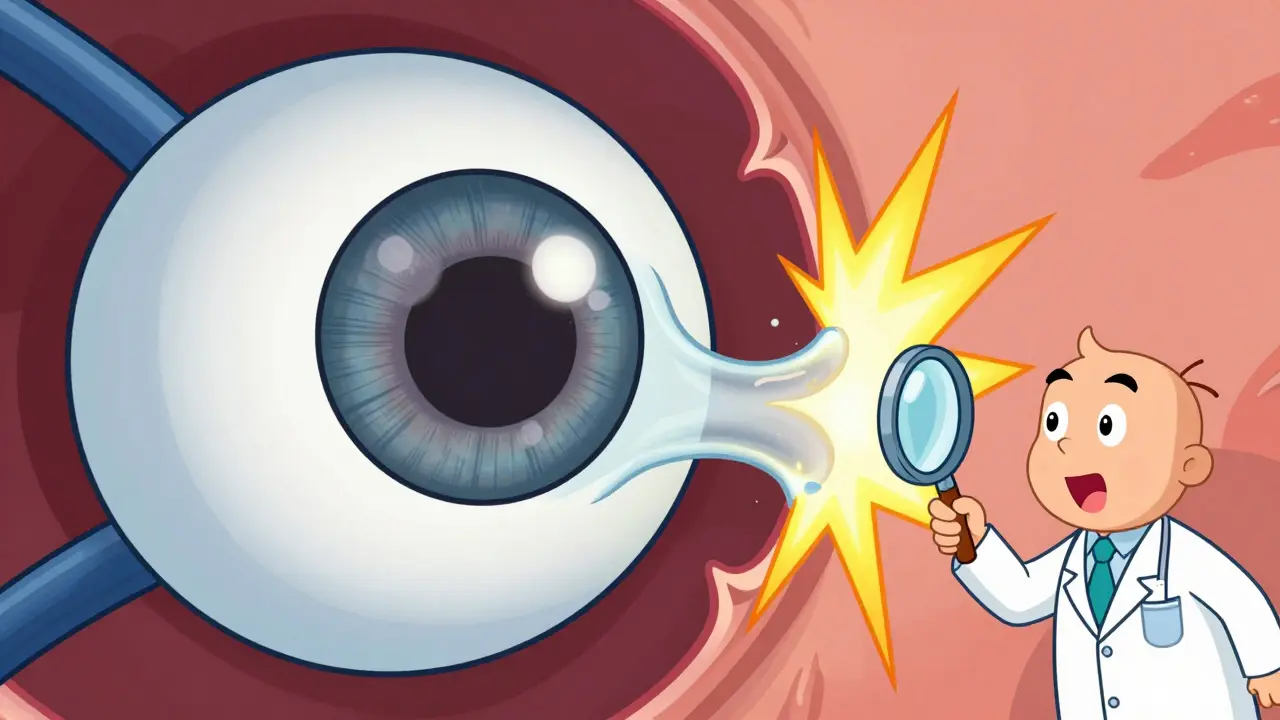
Floaters are those little shadows you see moving when you shift your gaze. They look like specks, threads, or cobwebs floating in front of your eyes. They’re not on your eyeball - they’re inside it, in the vitreous, a clear, gel-like substance that fills the space between your lens and retina. As you age, this gel starts to break down. Water separates from the collagen fibers, and the fibers clump together. These clumps cast shadows on your retina, and your brain interprets them as floaters. Flashes are different. They’re not objects - they’re sensations of light. You’ll see brief streaks or sparks, usually at the edge of your vision. They happen when the shrinking vitreous tugs on the retina. That tug stimulates the retinal cells, and your brain reads it as a flash of light, even though there’s no actual light there. Both are most noticeable against bright backgrounds - like a white wall, a computer screen, or the sky. They’re worse in dim light because your pupils are wider, letting in more scattered light that makes the floaters stand out more.Why Do They Happen? The Role of the Vitreous
The vitreous is about 99% water and 1% collagen. In your 20s and 30s, it’s thick and firm, holding the retina in place. By your 50s, it starts to liquefy. This process, called syneresis, is completely normal. Around age 65, about 75% of people have noticeable floaters. By 70, nearly two-thirds have had a posterior vitreous detachment (PVD) - that’s when the vitreous pulls away from the retina. PVD isn’t a disease. It’s a natural aging change. Think of it like gelatin separating from water in an old Jell-O mold. But here’s the catch: sometimes, when the vitreous pulls away, it doesn’t detach smoothly. If it’s stuck to the retina in places, it can tear the retina as it pulls free. That’s when things get dangerous.When Are Floaters and Flashes Dangerous?
Most of the time, floaters and flashes are harmless. But there are red flags that mean you need to see an eye doctor right away:- Suddenly seeing a shower of new floaters - not one or two, but dozens appearing in minutes
- Flashes that come in clusters, especially if they happen over seconds or hours
- A dark curtain or shadow moving across your vision
- Loss of side vision - like your peripheral view is being blocked
- Flashes and floaters in someone under 50
Who’s at Higher Risk?
Not everyone gets PVD at the same time. Some people are more likely to have it - and complications - earlier:- People who are nearsighted (myopic): Their eyes are longer, so the vitreous pulls harder on the retina. They often develop PVD in their 40s instead of their 60s.
- People with diabetes: High blood sugar damages tiny blood vessels in the eye. If they leak into the vitreous, it causes sudden black or red floaters - a sign of vitreous hemorrhage, which carries a 70% risk of retinal tear.
- Those who’ve had eye surgery, trauma, or inflammation: Any injury to the eye can speed up vitreous changes.
- People with a family history of retinal detachment.
What Happens When You See a Doctor?
If you show up with new floaters or flashes, your eye doctor won’t just glance at your eyes. They’ll dilate your pupils with drops - which takes about 20 minutes to work. Then they’ll use a bright light and a special lens to look at your retina, all the way to the edges. This is called a dilated fundus exam. It’s the only way to see if there’s a tear, a detachment, or bleeding. They’ll also check your eye pressure, your pupils’ reaction to light, and whether your vision is equally sharp in both eyes. If everything looks normal, you’ll likely be told to wait and watch. But if they spot a tear, they’ll schedule treatment - usually laser surgery - within hours.Can You Treat Floaters?
Most people don’t need treatment. Over time, your brain learns to ignore them. Floaters often settle below your line of sight, and they become less noticeable within six months. Some people say they disappear entirely. There are treatments - but they’re risky and rarely needed. Laser vitreolysis uses a laser to break up large floaters. It’s not widely covered by insurance in the U.S., and studies show mixed results. Surgery to remove the vitreous (vitrectomy) is even riskier - it can cause cataracts, retinal tears, or infection. Doctors only recommend it if floaters are so bad they block your vision completely - and even then, it’s rare.What Should You Do Right Now?
If you’ve had floaters for years and they haven’t changed, you’re probably fine. Keep getting regular eye exams - at least once a year after 50, or every 6 months if you’re diabetic or nearsighted. But if you’ve noticed any sudden changes - even just one new floater or a single flash - call your eye doctor. Don’t wait. Don’t Google it. Don’t hope it goes away. Get checked within 24 to 48 hours. If you have flashes happening repeatedly, or a curtain over your vision, go to the emergency eye clinic today.
What to Expect After Diagnosis
If it’s just PVD, you’ll get a clean bill of health. Your doctor might tell you to avoid heavy lifting or intense exercise for a couple of weeks, just to be safe while the vitreous settles. You’ll likely be asked to come back in a few weeks to make sure nothing changed. If there’s a retinal tear, you’ll have a quick laser procedure - no hospital stay, no overnight recovery. It’s done in the office, takes less than 15 minutes, and feels like a bright light flickering in your eye. You’ll be back to normal the next day. If it’s a detachment, you’ll need surgery - but again, the sooner you catch it, the better your vision will recover. Most people keep good vision if treated within days.Myths vs. Facts
- Myth: Floaters are caused by stress or lack of sleep. Fact: They’re caused by physical changes inside your eye - nothing to do with tiredness or anxiety.
- Myth: You can “shake” floaters away by moving your eyes fast. Fact: They move with the vitreous, not your eye muscles. They’ll drift when you move your eyes, but you can’t make them vanish by flicking your gaze.
- Myth: Only older people get them. Fact: While rare under 40, trauma, eye surgery, or diabetes can cause them at any age - and those cases are more serious.
- Myth: If the floaters fade, you’re safe. Fact: They can fade and still hide a tear underneath. Only an exam can confirm.
Final Thoughts
Floaters and flashes are common. Most of the time, they’re just noise - annoying, but harmless. But your eyes are delicate. A tiny tear can turn into a detached retina in hours. And once the retina lifts off, vision loss is often permanent. Don’t ignore sudden changes. Don’t assume it’s just aging. If something new pops up - especially flashes or a flood of new floaters - get it checked. It’s not an emergency unless it is. And the only way to know for sure is to see a professional.Are floaters and flashes always a sign of something serious?
No. Most floaters and flashes are caused by posterior vitreous detachment (PVD), a normal part of aging. Around 75% of people over 65 have them. But sudden increases in floaters, especially with flashes, can signal a retinal tear or detachment - which requires urgent care. Only an eye exam can tell the difference.
How long do floaters last?
Most floaters become less noticeable within six months as your brain adapts and the vitreous settles. Some may fade completely. Others stick around but drift out of your central vision. They rarely disappear entirely, but they rarely cause problems either.
Can I prevent floaters and flashes?
You can’t prevent the natural aging of the vitreous. But you can reduce your risk of complications by controlling conditions like diabetes and high blood pressure, wearing protective eyewear during sports or work, and getting regular eye exams - especially after age 50 or if you’re nearsighted.
Should I be worried if I only have one new floater?
One new floater without flashes or vision loss is usually not an emergency. But it still needs to be checked within 24 to 48 hours. Sometimes, a single floater can be the first sign of a small tear. It’s better to be safe than to miss something that could lead to vision loss.
Is it normal to see flashes in only one eye?
Yes. Vitreous changes happen independently in each eye. Flashes and floaters usually appear in one eye at a time. If you suddenly notice them in both eyes together, especially with other symptoms, that’s more concerning and should be evaluated immediately.
Do I need to see an ophthalmologist or can my optometrist handle this?
An optometrist can do the initial exam and refer you if needed. But if there’s any suspicion of a retinal tear or detachment, you’ll need to see an ophthalmologist - specifically a retina specialist - for treatment. Many clinics have same-day appointments for urgent cases. Don’t delay if symptoms are sudden or worsening.
Comments (10)
-
Jay Ara December 26, 2025happened to me last year thought it was just tired eyes then boom 20 new floaters in 5 mins
got checked same day turns out tiny tear
laser took 10 mins no big deal
if you see something new dont wait

-
Michael Bond December 28, 2025This is the kind of post that saves vision.

-
Kuldipsinh Rathod December 29, 2025my grandma had this and ignored it for weeks said it was just dust in her eyes
ended up losing 40% of her side vision
please dont be like her

-
SHAKTI BHARDWAJ December 30, 2025so basically your eyes are just falling apart and we're supposed to be scared of every little flicker
what a scam
next theyll tell us blinking causes cataracts

-
Matthew Ingersoll December 30, 2025In India we have a saying: 'The eye sees what the mind believes.'
Many dismiss these symptoms because they fear what the doctor might say.
But the truth is, your eyes don't lie - and neither does time.

-
carissa projo December 31, 2025There’s something deeply human about the way our bodies change without asking permission.
Floaters aren’t just physics - they’re time made visible.
Each one a whisper from the vitreous saying, 'I’m aging too.'
And yet, we’re taught to ignore the quiet signals until they scream.
Maybe the real lesson here isn’t about retinas - it’s about listening.
To your body. To your intuition. To the small, strange things that don’t fit the noise.
Don’t wait for the curtain to fall before you open your eyes.

-
josue robert figueroa salazar January 1, 2026floaters are just your eyeballs crying from too much screen time
go outside for 5 mins and stop panicking

-
david jackson January 3, 2026I once saw a flash during a thunderstorm and thought it was lightning reflecting off my laptop
turned out it was a vitreous tug
and I didn’t realize until three days later when I got a second one
and then I spent 48 hours Googling every possible outcome from 'eye flash' to 'retinal detachment horror stories'
and then I went to the clinic and they said it was benign
but here’s the thing - I still check my vision every morning now
like a ritual
because I learned that your eyes don’t give you second chances
and sometimes the silence between flashes is louder than the flashes themselves
and I’m not saying you should live in fear
but maybe just... pay attention
like your life depends on it
because it kind of does

-
wendy parrales fong January 4, 2026I used to think floaters were just part of getting old
then I had one appear overnight
called my optometrist same day
they said it was nothing
but they still checked
and I’m glad they did
because now I know what to watch for
and I tell everyone I know
don’t wait
just call

-
Jeanette Jeffrey January 5, 2026You people are so dramatic. Floaters are nature’s way of reminding you you’re not immortal.
Get over it. Or go blind. Either way, you’ll be less annoying.
