
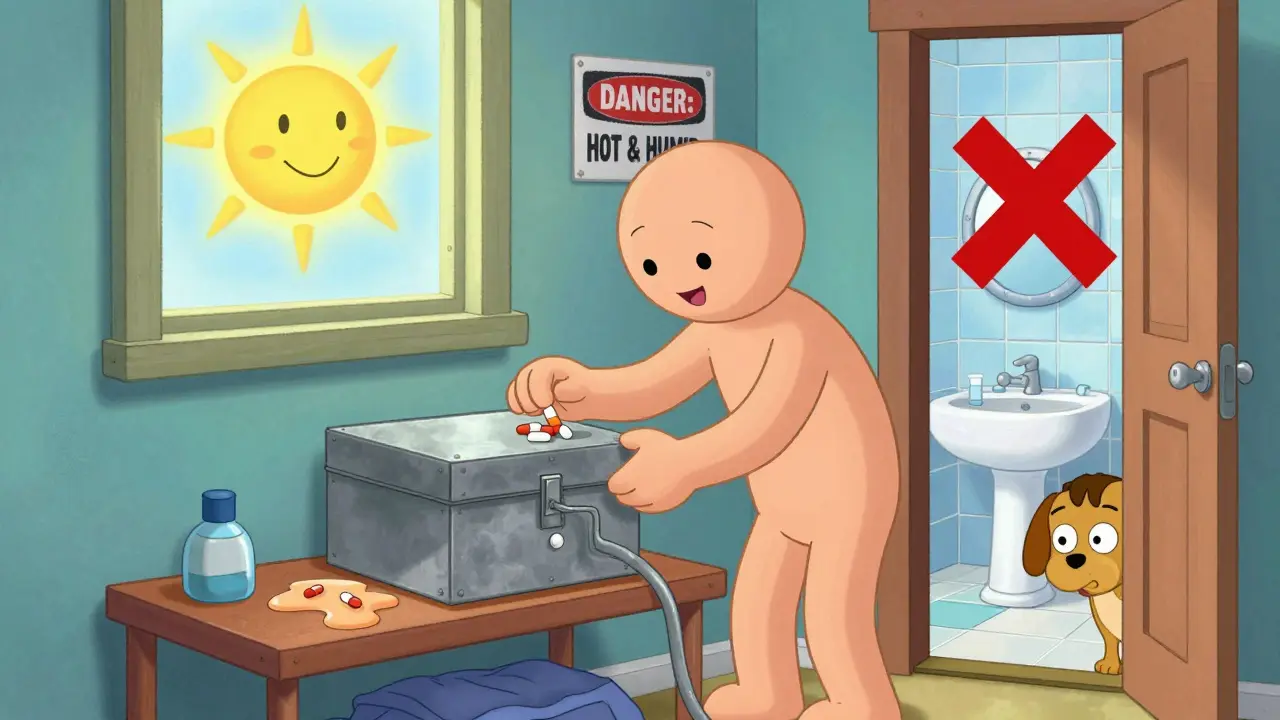
Every year, millions of unused or expired medications end up in toilets, sinks, or medicine cabinets-places they don’t belong. This isn’t just a messy habit; it’s a public health and environmental risk. Flushing pills can contaminate drinking water. Leaving opioids unlocked invites misuse by teens or visitors. Even storing insulin in a hot bathroom can make it useless. Proper medication storage and drug disposal isn’t optional-it’s a critical step in keeping people safe, protecting the environment, and following the law.
How to Store Medications Safely at Home
Most prescriptions come with storage instructions, but few people read them. The truth is, heat, moisture, and light can break down medicine before its expiration date. A bathroom cabinet? That’s the worst place. Humidity from showers and heat from hair dryers can ruin tablets and liquids. Instead, keep medications in a cool, dry spot-like a bedroom drawer or a closet shelf away from windows.Temperature matters. Most pills are fine between 68°F and 77°F (20°C-25°C). But some, like insulin, EpiPens, or certain antibiotics, need refrigeration at 36°F to 46°F (2°C-8°C). Always check the label. If you’re unsure, call your pharmacist. They’ll tell you what’s safe to leave out and what needs the fridge.
Children and pets are the biggest risk. A single pill can be deadly to a toddler or dog. Keep all medications out of reach-not just locked up, but stored in a high cabinet or a locked box. This is especially true for controlled substances like opioids (oxycodone, hydrocodone), benzodiazepines (Xanax, Valium), or stimulants (Adderall). The DEA requires these to be stored in a locked container, and many pharmacies now sell affordable lockboxes designed for this exact purpose.
Don’t mix medications in pill organizers unless you need to. If you do, label them clearly with the drug name and dosage. Never store different drugs in the same container, even if they look alike. One mistake can lead to a dangerous overdose.
What to Do With Unused or Expired Medications
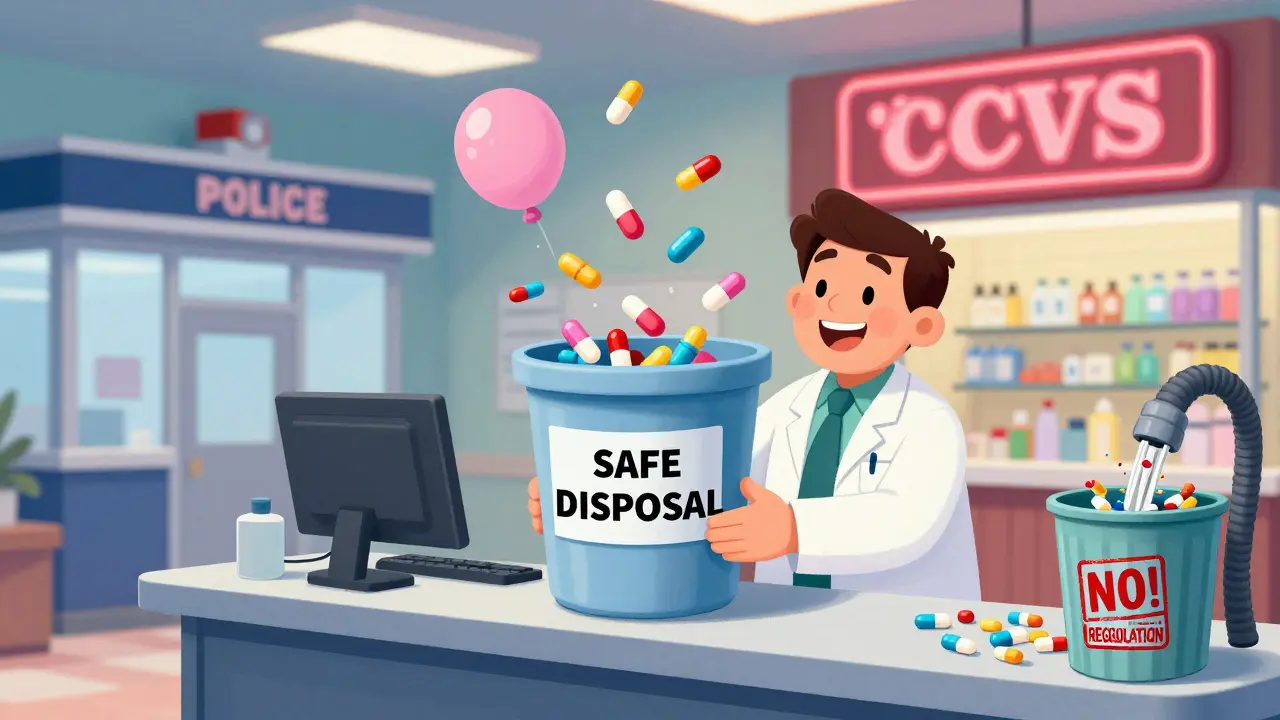
The best way to get rid of unwanted prescriptions? Use a drug take-back program. These are free, safe, and available in most communities. You’ll find them at local pharmacies, police stations, or during National Prescription Drug Take Back Days (hosted twice a year by the DEA). Since 2010, these programs have collected over 14 million pounds of unused meds-enough to fill 1,000 semi-trucks.But here’s the catch: take-back programs are only for individual consumers. Hospitals, nursing homes, and clinics can’t use them. They have to follow strict federal rules under EPA Subpart P and DEA regulations. That means they can’t just toss pills in the trash or flush them. They must use licensed medical waste haulers and incinerators.
For home users, if a take-back site isn’t nearby, the FDA has a clear backup plan. Remove pills from their original bottles. Mix them with something unappealing-used coffee grounds, cat litter, or dirt. Don’t crush them unless the label says it’s safe. Put the mixture in a sealed plastic bag or container. Then throw it in the trash. Scratch out your name and prescription number from the empty bottle before recycling it.
There’s one exception: the FDA’s flush list. These are 15 high-risk opioids and one benzodiazepine that are so dangerous if misused that flushing is the safest option if you can’t get to a take-back site. The list includes drugs like fentanyl patches, oxycodone tablets, and alprazolam. You can find the full list on the FDA’s website. If your medication is on it, and you can’t access a disposal program, flushing is the lesser evil.
Why You Can’t Just Flush or Trash Everything
Flushing medications sounds easy, but it’s illegal for most drugs-and harmful. The EPA estimates that 247 million pounds of pharmaceuticals enter U.S. waterways every year. That’s not just trace amounts. It’s enough to affect fish reproduction, alter animal behavior, and potentially impact human health over time. Since 2019, EPA Subpart P has banned flushing hazardous pharmaceutical waste in healthcare settings. The rule also applies to home users for most medications.Not all drugs are created equal. About 5% to 10% of pharmaceutical waste is classified as hazardous by the EPA. These include chemo drugs, certain antibiotics, and some painkillers. They’re listed on the P-list and U-list. Mixing these with regular trash or pouring them down the drain can lead to fines for healthcare providers and environmental damage. Even if you’re not a hospital, you should still avoid flushing unless your drug is on the FDA’s flush list.
Throwing pills in the trash without mixing them? That’s risky too. Trash collectors, scavengers, or pets could find them. In 2022, a CDC report showed that 61% of Americans thought flushing was acceptable-when it’s only safe for a handful of drugs. The FDA’s own survey found only 37% knew about take-back programs. That gap in knowledge leads to unsafe habits.
What Healthcare Facilities Must Do
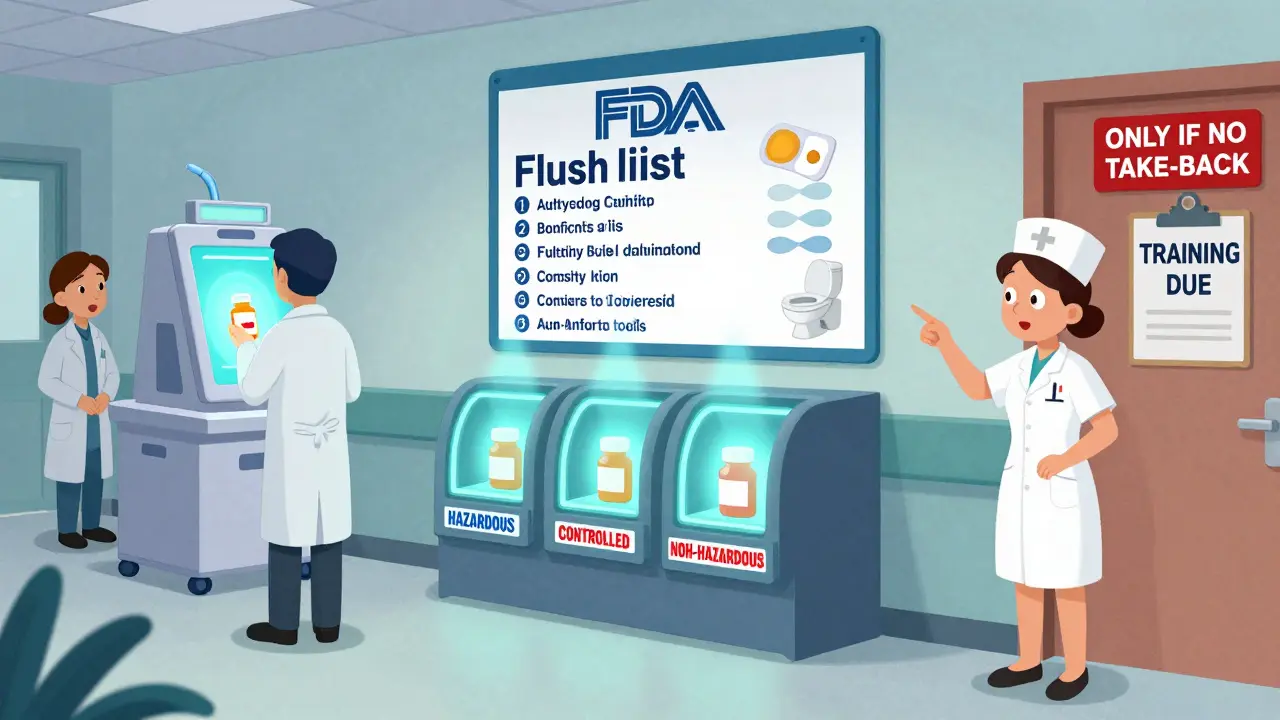
Hospitals, clinics, and pharmacies face far more complex rules. They can’t rely on drop boxes. They must segregate waste into three categories: hazardous, non-hazardous, and controlled substances. Hazardous waste-like chemo drugs or certain antibiotics-must go into labeled, leak-proof containers and be shipped to incineration facilities with a federal manifest. Records of these shipments must be kept for three years.Controlled substances are another layer. Even if they’re not hazardous, DEA rules require them to be handled separately. They can’t go in the same bin as expired aspirin or antacids. Facilities must work with Environmental Health and Safety (EHS) departments to document destruction. A 2022 American Hospital Association survey found that 68% of hospitals saw their annual pharmaceutical waste costs rise by an average of $12,500 after Subpart P took effect.
Staff training is mandatory. Employees who handle or prepare waste for transport must complete hazardous materials training every three years. Nurses report confusion: 42% said they didn’t know how to classify many common drugs. Tools like digital waste classification apps and smart disposal kiosks are now being piloted in 127 hospitals to reduce errors. But until those are widespread, double-checking labels and consulting pharmacy staff is still the best practice.
What’s Changing in 2025 and Beyond
Regulations are tightening. The EPA is considering new water quality standards for pharmaceuticals by 2025. That could mean even stricter limits on what gets flushed or dumped. The DEA is also reviewing whether to expand take-back options-possibly allowing pharmacies and mailers to collect controlled substances directly from homes, not just during special events.Technology is helping. Smart disposal kiosks can scan a pill bottle, identify the drug, and route it to the right disposal stream. Some are already in use in hospitals and pharmacies. And manufacturers are starting to pay more attention. Deloitte’s 2023 survey found that 89% of healthcare executives plan to include pharmaceutical waste into their broader sustainability goals by 2025.
For now, the rules are clear: store safely, dispose properly. Whether you’re a patient, a nurse, or a pharmacist, your actions matter. One improperly stored pill can lead to an overdose. One flushed drug can contaminate a river. The system is designed to protect you-and everyone else. Use it right.
Can I flush any medications down the toilet?
Only medications on the FDA’s official flush list should be flushed. This includes 15 opioid painkillers like fentanyl patches and oxycodone, and one benzodiazepine: alprazolam (Xanax). Flushing other drugs is illegal and harmful to the environment. If you’re unsure, check the label or ask your pharmacist.
Where can I find a drug take-back location near me?
The DEA hosts two National Prescription Drug Take Back Days each year. You can also find permanent collection sites at pharmacies like CVS, Walgreens, and Rite Aid, or at local police departments. Visit the DEA’s website or call your pharmacy to find the nearest drop-off point. Many locations accept both prescription and over-the-counter meds.
What if I can’t find a take-back program?
If no take-back option is available, mix your unused pills with coffee grounds, cat litter, or dirt. Don’t crush them. Put the mixture in a sealed plastic bag or container. Throw it in the trash. Scratch out your personal info on the empty bottle before recycling it. This method reduces contamination by 99.8% compared to flushing.
Is it safe to store medications in the bathroom?
No. Bathrooms are too humid and hot, which can break down medications and reduce their effectiveness. Store pills in a cool, dry place like a bedroom drawer or kitchen cabinet away from windows. Insulin and some biologics need refrigeration-check the label.
Why can’t hospitals use drug take-back bins like I do?
DEA rules only allow take-back programs for ‘ultimate users’-people who were prescribed the medication. Hospitals generate waste from unused stock, expired inventory, or patient leftovers. That’s considered commercial waste, not personal. They must follow EPA Subpart P and DEA regulations, which require licensed disposal through incineration or certified medical waste handlers.
Do I need to keep records if I dispose of medication at home?
No. Home users aren’t required to keep records. But healthcare facilities must maintain destruction records for at least three years and return certificates of disposal. This is part of federal compliance under EPA and DEA rules. For individuals, the goal is safe disposal-not paperwork.
Comments (13)
-
Sam Pearlman February 16, 2026I mean, I get it, but who really cares if a few pills end up in the water? We’ve got bigger problems like inflation and traffic. Also, I’ve been flushing my old Xanax for years and my fish are still alive. Maybe they’re just tough.

-
Steph Carr February 17, 2026Ah yes, the great American pharmaceutical paradox: we’re told to store meds like nuclear material, then told to dispose of them like trash unless we have a PhD in EPA regulations. Meanwhile, my grandma keeps her insulin in the glove compartment because ‘the fridge is too cold for medicine.’ I’m not judging. Just… documenting.

-
Jonathan Ruth February 18, 2026You people act like flushing pills is some kind of crime. Its not. Its practical. Your toilet is designed for waste. Your trash can is designed for trash. Why make it complicated? The FDA list is there for a reason. Stop overthinking. Just flush the ones that say flush. Simple.

-
Philip Blankenship February 18, 2026I used to keep all my meds in the bathroom until my dog ate half a bottle of gabapentin last year. She’s fine now, but I learned my lesson. Now everything’s in a locked drawer in my bedroom. Even my Advil. Yeah, even the ibuprofen. My kid’s got a 3-year-old brain. I don’t trust her with anything that glows in the dark. Also, I mix my expired stuff with cat litter now. It’s weird, but it works. I feel like a mad scientist.

-
Tony Shuman February 18, 2026This whole thing feels like government overreach wrapped in a pretty bow. First they tell you to take the pills, then they tell you how to store them, then how to destroy them, then they charge you for disposal programs. Who’s really profiting here? I bet the lockbox companies are laughing all the way to the bank. And don’t get me started on the ‘take-back’ programs. I’ve seen those bins. They’re always empty. It’s theater.

-
Logan Hawker February 20, 2026The EPA’s Subpart P framework is fundamentally misaligned with decentralized pharmaceutical waste streams. The regulatory arbitrage between ‘ultimate users’ and institutional generators creates perverse incentives. Moreover, the absence of harmonized federal-state disposal protocols introduces systemic inefficiencies in traceability and environmental risk mitigation. In layman’s terms? We’re doing it wrong. And the FDA flush list? It’s a Band-Aid on a hemorrhage.

-
James Lloyd February 21, 2026Just wanted to add a quick practical tip: if you’re using a pill organizer, write the drug name on the compartment with a permanent marker - not just the dosage. I once mixed up my thyroid med with my blood pressure pill because they looked identical. Took me three days to realize. Never again. Also, if your pharmacy doesn’t have a take-back bin, ask them to order one. They’re required to accept them if you request it. Just say the word.

-
Digital Raju Yadav February 22, 2026America is weak. You flush pills? You store them in drawers? You pay for bins? In India we just throw them in the river. Nature cleans everything. You think your water is clean? Ha. Our rivers have been cleaning pharmaceuticals since the 1980s. You need to be tougher. Stop being so soft. Your pills are not special.

-
Carrie Schluckbier February 22, 2026I don’t trust any of this. Take-back programs? They’re just government surveillance. Who’s tracking what pills go in? Who’s recording who dropped them off? I heard they’re building a national database of everyone’s prescription history. And the lockboxes? They’ve got RFID chips. I’m not storing my meds in a tracking device. I’m keeping mine in a mason jar under the sink. If the government wants them, they can dig for them.

-
guy greenfeld February 24, 2026There’s a metaphysical layer here we’re ignoring. Medications aren’t just chemicals. They’re extensions of our vulnerability. To flush them is to deny our dependency. To lock them away is to imprison our pain. The real issue isn’t contamination - it’s our collective refusal to sit with the discomfort of needing help. We’d rather bury it in a drawer or flush it into the ocean than admit we’re broken. And the system? It feeds on that denial.

-
Adam Short February 24, 2026I’m British. We don’t do this over here. We just chuck them in the bin. No fuss. No lockboxes. No ‘FDA flush list’. We’ve got a National Health Service - we don’t need American bureaucracy to tell us how to dispose of our own medicine. Your system is insane. I’ve seen your pharmacies. They look like banks. And the bins? They’ve got signs in three languages. Who are you even trying to impress?

-
Geoff Forbes February 25, 2026I think the whole system is a scam. Why do we need to ‘mix with cat litter’? That’s just a marketing ploy to sell more cat litter. And who’s to say the ‘incinerators’ aren’t just dumping it in landfills? I read a blog once that said 70% of ‘disposed’ meds end up in the same rivers. It’s all theater. I just keep mine. You never know when you’ll need them again. Better safe than sorry.

-
Oliver Calvert February 25, 2026For anyone wondering about the FDA flush list - here’s the direct link: fda.gov/drugs/safe-disposal-medicines/flush-list. It’s only 15 drugs. Most are opioids. If yours isn’t on it, don’t flush. And if you’re in a rural area with no take-back, the coffee grounds trick works. I’ve done it for years. Just don’t crush them. It’s not necessary. Seal. Trash. Done.
