
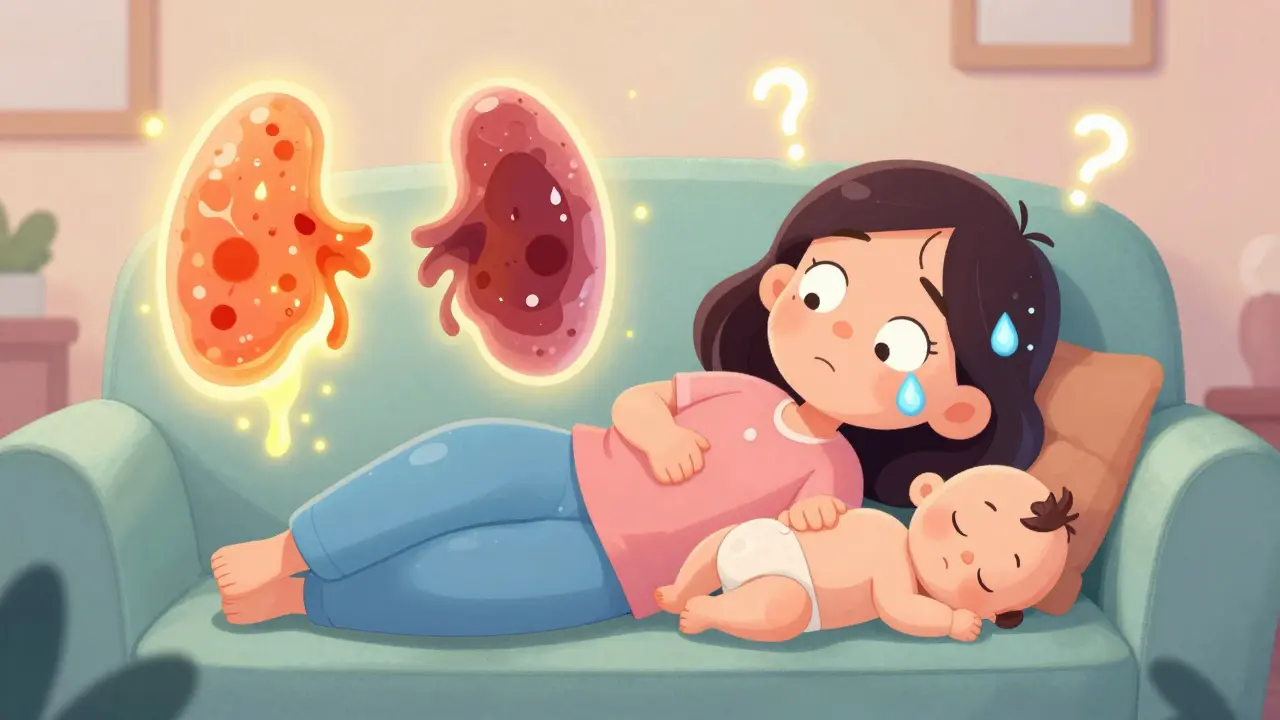
After giving birth, many women feel exhausted, overwhelmed, and emotionally drained. It’s normal. But what if your fatigue isn’t just from sleepless nights? What if you’re losing weight despite eating more, or gaining weight even though you’re eating less? What if you’re suddenly cold when everyone else is sweating, or your heart is racing without cause? These aren’t just signs of being a new mom-they could be symptoms of postpartum thyroiditis, a temporary but often misunderstood thyroid condition that affects 5 to 10% of women after childbirth.
What Exactly Is Postpartum Thyroiditis?
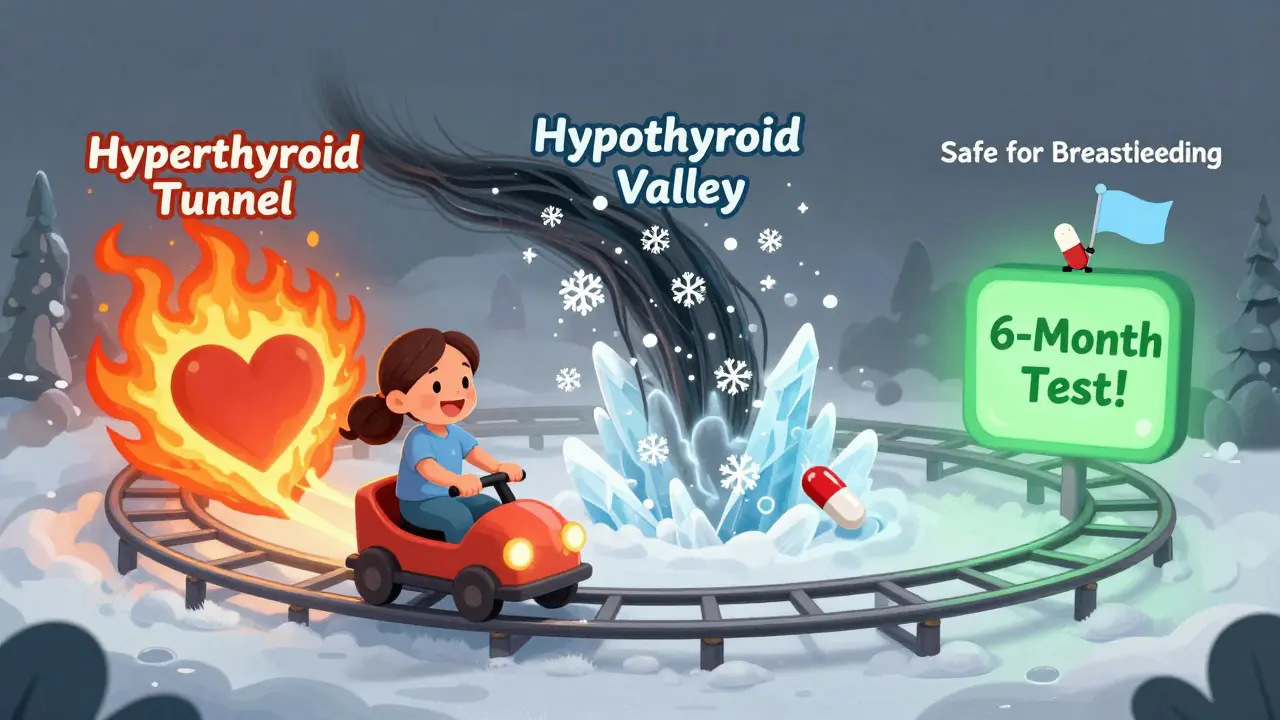
Postpartum thyroiditis is an autoimmune reaction that happens after pregnancy. Your immune system, which was suppressed during pregnancy to protect the baby, kicks back into high gear after delivery. In some women, it starts attacking the thyroid gland-mistaking it for a threat. This triggers inflammation, which first causes the thyroid to leak stored hormones (hyperthyroid phase), then burns out its ability to make new ones (hypothyroid phase).
Unlike Graves’ disease, which causes permanent overactivity of the thyroid, postpartum thyroiditis is usually temporary. About 70 to 80% of women see their thyroid function return to normal within a year. But for 20 to 30%, the damage is lasting, leading to lifelong hypothyroidism that requires daily medication.
The key difference? No goiter. No bulging eyes. No radioactive iodine uptake. Just silent inflammation, often going unnoticed until symptoms become impossible to ignore.
The Two Phases: Hyperthyroid Then Hypothyroid
This condition doesn’t hit you all at once. It comes in two waves.
Phase One: Hyperthyroidism (1-4 months postpartum)
For a few weeks to a few months, your body floods with excess thyroid hormone. You might feel:
- Heart racing, even at rest (over 100 bpm)
- Hot all the time, sweating without reason
- Shaky hands or trembling
- Weight loss-5 to 7 pounds without trying
- Insomnia, even when the baby is sleeping
Here’s the catch: up to half of women don’t notice these symptoms. Doctors often write them off as “just being a new mom.” But if you’re losing weight and feeling wired despite exhaustion, it’s not normal.
Phase Two: Hypothyroidism (4-8 months postpartum)
After the hormone surge fades, your thyroid runs out of steam. This is when most women finally realize something’s wrong:
- Extreme fatigue-worse than any sleep deprivation
- Feeling cold when others are warm
- Constipation, dry skin, brittle nails
- Hair thinning or shedding in clumps
- Brain fog-forgetting names, losing focus, struggling to make simple decisions
- Weight gain of 5 to 10 pounds, no matter how much you eat or move
One study found 72% of women in this phase had measurable drops in executive function. That’s not “baby brain.” That’s your thyroid not making enough hormone to power your brain.
And here’s something many don’t know: 10 to 25% of women skip the hyperthyroid phase entirely. They go straight into hypothyroidism. If you’re struggling with fatigue and weight gain at 6 months postpartum, don’t assume it’s just stress.
How Is It Diagnosed?
There’s no single symptom that confirms it. Diagnosis requires blood tests.
During the hyperthyroid phase, your TSH will be low (below 0.4 mIU/L) and your free T4 high. In the hypothyroid phase, TSH rises above 4.5 mIU/L and free T4 drops.
But the real clue? Thyroid peroxidase antibodies (TPOAb). If you test positive, you have an autoimmune thyroid problem. About 80 to 90% of women with postpartum thyroiditis have these antibodies. Testing for them isn’t always done-but it should be if you’re symptomatic.
Doctors also check radioactive iodine uptake. In Graves’ disease, the thyroid soaks it up like a sponge. In postpartum thyroiditis, it barely takes any-because the gland is damaged, not overactive.
Many women wait months-or even over a year-before getting tested. The average time to diagnosis? 5.2 months. That’s too long. If you’re not feeling like yourself after 8 weeks postpartum, ask for a TSH and free T4 test. Don’t wait.
Why So Many Women Are Misdiagnosed
Postpartum thyroiditis is confused with postpartum depression more often than you’d think. In fact, about 30% of cases are misdiagnosed as depression.
Why? Because fatigue, mood swings, brain fog, and irritability show up in both. But here’s the difference:
- Depression: low mood, guilt, loss of interest in baby, thoughts of hopelessness
- Thyroiditis: physical symptoms-racing heart, cold intolerance, hair loss, weight changes-along with mood symptoms
On Reddit’s r/Thyroid community, 78% of women said they were first told they were “just depressed.” One woman said, “I was prescribed antidepressants for 6 months before someone finally ran thyroid tests.”
And here’s the danger: treating thyroiditis with antidepressants doesn’t fix the root problem. You might feel a little better temporarily-but your body is still starving for thyroid hormone.
Primary care doctors and even some OB-GYNs don’t routinely test for thyroid issues after birth. A 2023 survey found only 42% of obstetricians consider thyroid dysfunction in women with ongoing symptoms beyond 12 weeks. That’s a gap in care that’s costing women months of unnecessary suffering.

Who’s at Risk?
Not every woman gets postpartum thyroiditis. But some are far more likely to.
- Women with type 1 diabetes (25-30% risk)
- Those with a personal or family history of autoimmune disease (like Hashimoto’s or rheumatoid arthritis)
- Women who had postpartum thyroiditis in a previous pregnancy (40% recurrence rate)
- Those with high TPO antibody levels during pregnancy
If you fall into any of these groups, your doctor should test your TPO antibodies at 10 weeks postpartum. Studies show this predicts 70% of future cases. Early detection means early treatment-and less damage.
Treatment: What Works and What Doesn’t
There’s no cure. But there’s smart management.
Hyperthyroid phase: Usually no treatment needed unless symptoms are severe. If your heart is racing at 120 bpm and you’re shaking, a beta-blocker (like propranolol) can help calm things down. It doesn’t fix the thyroid-it just eases the symptoms. No antithyroid drugs like methimazole are used. They’re for Graves’ disease, not this.
Hypothyroid phase: If TSH is above 10 mIU/L, or if you’re symptomatic with TSH above 4.5, levothyroxine (synthetic thyroid hormone) is recommended. Many women take it for 6 to 12 months. Then, doctors retest. If TSH normalizes, they stop it. If not, you may need it for life.
Some women worry about taking thyroid meds while breastfeeding. That’s unnecessary. Levothyroxine is safe. Only tiny amounts pass into breast milk, and it’s the same hormone your body makes. In fact, untreated hypothyroidism can lower milk supply. Treating it often improves it.
Don’t wait for symptoms to get worse before starting treatment. If you’re struggling with brain fog and exhaustion, even mild hypothyroidism can affect your ability to care for your baby and recover emotionally.
What Happens Long-Term?
Most women recover. But not all.
Of those who develop postpartum thyroiditis, 20 to 30% end up with permanent hypothyroidism. That means lifelong medication. It’s not a failure. It’s just how the body changed.
Women with high TPO antibodies at diagnosis are at highest risk. One study showed 70% of women with very high antibody levels developed permanent thyroid damage.
That’s why follow-up matters. Get your TSH checked at 6 months and again at 12 months after symptoms start-even if you feel fine. Thyroid function can change slowly. You might not notice until it’s too late.
What’s New in 2025?
There’s progress.
In January 2024, the Cleveland Clinic launched a digital symptom tracker that flags thyroid dysfunction based on patterns in fatigue, temperature sensitivity, and weight changes. In a pilot study, it cut diagnosis time by 40%.
Researchers are also testing new biomarkers. Interleukin-10, a protein linked to immune regulation, shows 88% accuracy in predicting who will develop postpartum thyroiditis before symptoms even start.
And experts are pushing for change. Dr. Angela Leung from UCLA predicts universal TSH screening at 6 and 12 weeks postpartum will become standard in the U.S. within five years. Why? Because catching it early saves money-$2,300 per case, according to cost studies.
Right now, European countries screen high-risk women routinely. The U.S. doesn’t. But awareness is growing.
What Should You Do?
If you’re a new mom and something feels off-beyond the usual exhaustion-here’s what to do:
- Track your symptoms. Write down when you feel hot, cold, jittery, or drained.
- Ask your doctor for a TSH and free T4 blood test. Don’t wait for a 6-week checkup if you’re struggling.
- If you have type 1 diabetes, a history of thyroid issues, or high TPO antibodies, ask for TPO antibody testing.
- If diagnosed, get retested at 6 and 12 months to see if your thyroid recovers.
- If you’re on levothyroxine, don’t stop it without retesting. Your body might need it longer than you think.
Postpartum thyroiditis isn’t rare. It’s underdiagnosed.
You’re not weak. You’re not “just stressed.” Your body went through a massive shift-and your thyroid might still be trying to catch up.
Ask for the test. Get the answers. Your energy, your mind, and your baby deserve nothing less.
Frequently Asked Questions
Can postpartum thyroiditis affect my baby?
No, postpartum thyroiditis itself doesn’t directly harm your baby. The condition affects your thyroid, not your breast milk’s composition. Levothyroxine, the treatment for hypothyroidism, is safe during breastfeeding. In fact, treating your thyroid helps maintain milk supply and your ability to care for your baby. Untreated hypothyroidism, however, can lead to fatigue so severe it impacts bonding and daily care.
Is postpartum thyroiditis the same as Hashimoto’s?
They’re very similar. Both are autoimmune and involve TPO antibodies. The main difference is timing. Hashimoto’s develops outside of pregnancy and is permanent. Postpartum thyroiditis is triggered by pregnancy and often temporary. But if you develop permanent hypothyroidism after postpartum thyroiditis, you’re essentially living with Hashimoto’s. The underlying immune attack is the same.
Can I prevent postpartum thyroiditis?
No, you can’t prevent it if you’re genetically predisposed. But if you have risk factors-like type 1 diabetes or prior thyroiditis-getting tested early (at 10 weeks postpartum) lets you catch it before symptoms worsen. Early treatment reduces long-term damage and improves recovery chances.
Will my next pregnancy trigger it again?
Yes. If you had postpartum thyroiditis after one pregnancy, you have a 40% chance of getting it again after the next. Talk to your OB-GYN or endocrinologist before getting pregnant again. Testing TPO antibodies early in pregnancy can help predict risk and plan monitoring.
How long does it take to feel better after starting treatment?
If you’re on levothyroxine for hypothyroidism, most women notice improved energy and mental clarity within 2 to 4 weeks. Weight loss, if needed, takes longer-often 2 to 3 months. Don’t expect overnight results. Thyroid hormone replacement needs time to stabilize. Your doctor will adjust your dose based on blood tests, not how you feel.
Comments (15)
-
Joy Nickles December 31, 2025I was told I was just depressed for 8 months... then my heart was racing at 130 bpm and I couldn't walk to the mailbox without collapsing. TSH was 0.03. Free T4 was through the roof. No one even looked at my thyroid until I showed up to my OB's office crying because I couldn't remember my baby's name. Don't wait. Get tested.

-
Emma Hooper January 2, 2026OMG YES. I thought I was losing my mind. Hair falling out in clumps, freezing in a 75-degree room, gaining 12 lbs while eating salad and running 5 miles a day. My doctor said 'you're just tired, honey.' I cried in the parking lot. Then I googled 'postpartum thyroiditis' and found this. Took me 11 months. Don't be me.

-
Harriet Hollingsworth January 3, 2026If you're a new mom and your doctor doesn't test your thyroid after birth you're being failed by the system. This isn't optional medical care. It's basic science. Your body just underwent a hormonal earthquake and they're giving you a wellness pamphlet? Unacceptable.

-
Deepika D January 3, 2026Hey mama, I'm a nurse and I've seen this so many times. You're not lazy, you're not broken, you're not 'just stressed.' Your thyroid is screaming. If you're tired after 3 months, cold when everyone's sweating, losing hair like a dog shedding, or your brain feels like it's wrapped in cotton-ask for TSH, free T4, and TPOAb. Do it before your 6-week checkup. Don't wait. Your baby needs you sharp. And you deserve to feel like yourself again. I promise you, once you start levothyroxine, it's like someone turned the lights back on. I've had 3 patients cry happy tears after their first dose. You can be next.

-
Chandreson Chandreas January 4, 2026i just wanna say... we're all just trying to survive. the body does wild things after birth. thyroiditis isn't your fault. it's not weakness. it's biology. and you're not alone. 🌱❤️

-
Stewart Smith January 5, 2026Funny how they call it 'baby brain' but never 'thyroid brain.' Like your foggy thoughts are cute but your racing heart is just 'normal exhaustion.' Yeah right.

-
Aaron Bales January 6, 2026TPOAb test is critical. If you have it, get retested at 6 and 12 months. Permanent hypothyroidism is not a failure. It's a new normal. And it's manageable.

-
anggit marga January 6, 2026This is why white people always have time to research stuff. In Nigeria we just pray and hope the baby stops crying. Also thyroid what now? We got no labs. We got mama and herbs.

-
Retha Dungga January 6, 2026we are all just temporary vessels for cosmic energy anyway so maybe the thyroid is just your soul trying to exit early 🌌

-
Lawver Stanton January 7, 2026I read this whole thing and now I'm convinced I have it. But also I'm convinced I have 7 other autoimmune diseases, a tumor, and that my cat is judging me. My brain is a horror movie and I haven't slept since February. I'm not sure if this is real or if I'm just spiraling. Either way, I'm going to the ER tomorrow. I can't take this anymore.

-
Sara Stinnett January 9, 2026This is exactly why I stopped trusting the medical industrial complex. They diagnose depression because it's easier than running blood tests. And then they profit off antidepressants. Meanwhile, women are left gasping for oxygen while their brains turn to mush. This isn't healthcare. It's negligence dressed in white coats.

-
Urvi Patel January 10, 2026I'm Indian and I've seen this in my family. My cousin had it after her second child. No one believed her until she collapsed. Then they said 'oh, you're just like your aunt.' We need more awareness. Not just in the US. In India too.

-
Martin Viau January 11, 2026The data on interleukin-10 as a predictive biomarker is compelling but still preliminary. The real issue is systemic: primary care in the US is a transactional wasteland. No one has time to connect symptoms to physiology. We need integrated endocrine-obstetric pathways, not blog posts.

-
Marilyn Ferrera January 12, 2026If you're breastfeeding and worried about levothyroxine: it's safe. The amount in milk is less than what your baby produces naturally. Untreated hypothyroidism is the real risk. Please get tested.

-
Darren Pearson January 13, 2026The assertion that postpartum thyroiditis is 'temporary' is statistically misleading. For a significant subset of women, it becomes permanent hypothyroidism. The language of 'recovery' obscures the lifelong medical dependency that follows. This is not a glitch-it's a paradigm shift in endocrine function. The medical community must stop framing it as a transient anomaly.
