
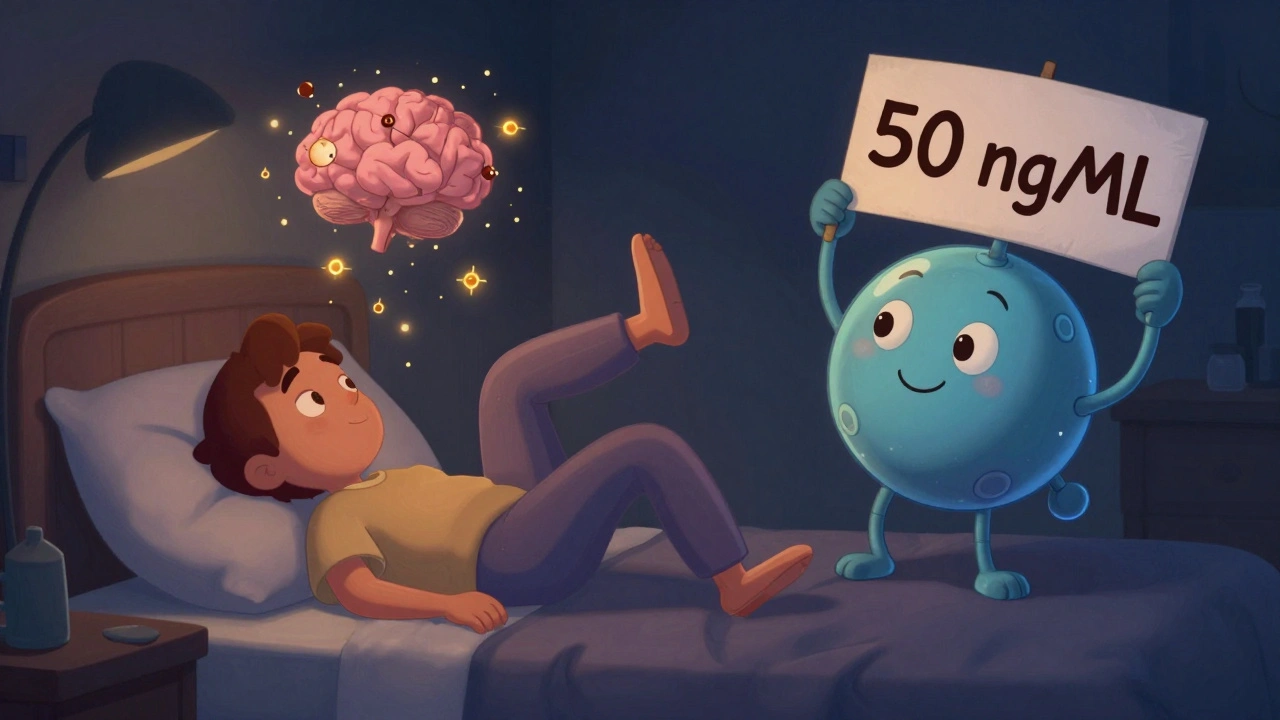
Restless legs syndrome isn’t just about discomfort-it’s often a sign your brain isn’t getting enough iron. If you’ve been lying awake at night, your legs twitching or crawling with an urge to move, you’re not alone. About 1 in 10 adults in the U.S. deal with this, and many don’t realize their symptoms could be tied to something simple: low iron stores. Not low blood iron. Not anemia. But low ferritin-the protein that stores iron in your body, especially in the brain. And here’s the catch: your ferritin level might be "normal" on a standard lab report, but still too low to stop your restless legs.
Why Ferritin Matters More Than Your Iron Count
Doctors often check your serum iron or hemoglobin when you’re tired or sluggish. But for restless legs, those numbers can look fine while your brain is starving for iron. Ferritin is the key. It’s the storage form of iron, and it’s the only marker that tells you how much iron your body has tucked away for long-term use-especially for your nervous system.
Research shows that people with restless legs syndrome (RLS) often have ferritin levels below 50 ng/mL, even if their hemoglobin is normal. In fact, a 2020 study in Nature Scientific Reports found that RLS patients had ferritin levels averaging 38 ng/mL, while healthy controls averaged 72 ng/mL. That’s more than a 40% difference. And it’s not just a correlation-when you raise ferritin, symptoms improve.
Why does this happen? Iron is needed to make dopamine, the brain chemical that helps control movement. When iron drops in the substantia nigra (a part of the brain involved in motor control), dopamine function falters. That’s when your legs start to feel like they’re crawling, tingling, or aching-especially when you’re still. And it gets worse at night, which is why sleep suffers.
The Magic Number: 50 ng/mL Is the New Target
For decades, labs considered ferritin levels between 12 and 300 ng/mL as "normal." But for restless legs, that range is too wide. The American Academy of Neurology, the American Academy of Sleep Medicine, and the European Restless Legs Syndrome Study Group all agree: if your ferritin is below 50 ng/mL, you should be treated-even if you’re not anemic.
Here’s why 50 ng/mL matters: studies show that when ferritin drops below this level, symptoms become significantly worse. One 2019 trial in Sleep Medicine found that 52% of RLS patients with ferritin under 50 ng/mL saw at least half their symptoms disappear after iron therapy. Only 18% of those with the same ferritin level but who got a placebo saw improvement.
Even more telling: patients with ferritin between 50 and 75 ng/mL still respond to iron. A 2019 study in the European Journal of Neurology showed that 35% of these patients had meaningful symptom relief after supplementation. That’s why many sleep specialists now treat anyone under 75 ng/mL-not just those below 50.
Oral Iron: How to Take It Right
If your ferritin is low, your doctor will likely recommend iron supplements. But not all iron is created equal-and taking it wrong can make things worse.
The most common form is ferrous sulfate: 325 mg tablets contain 65 mg of elemental iron. That’s the dose most studies use. But here’s the problem: up to 30% of people can’t tolerate it. Stomach upset, constipation, nausea-these side effects make people quit.
How to fix it?
- Take it on an empty stomach. Iron absorbs best without food-especially not with dairy, coffee, or tea, which block absorption.
- Pair it with vitamin C. A 100-200 mg vitamin C pill or a glass of orange juice boosts absorption by up to 40%. It turns iron into a form your gut can grab onto more easily.
- Try alternate-day dosing. A 2020 study in Blood Advances showed that taking iron every other day improves absorption and cuts side effects in half, without losing effectiveness.
- Be patient. It takes 4 to 8 weeks to see symptom changes. Don’t give up after two weeks.
Some people do better with gentler forms like ferrous gluconate or ferric citrate, which cause fewer stomach issues. But ferrous sulfate is still the most studied and cost-effective option.

When Oral Iron Doesn’t Work: IV Iron Is the Next Step
If you’ve tried oral iron for 3 months and your ferritin is still below 30 ng/mL-or you can’t tolerate it-your next move is intravenous (IV) iron.
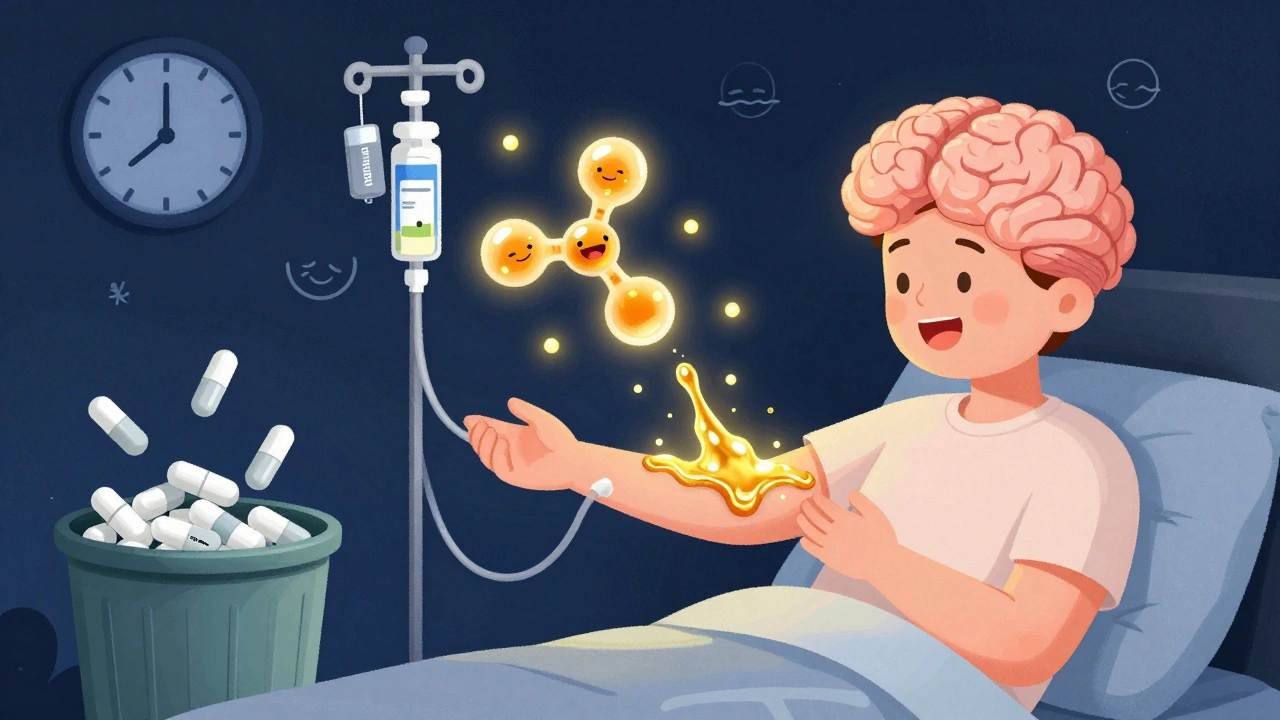
IV iron, like ferric carboxymaltose, delivers 1,000 mg of iron directly into your bloodstream. One infusion can raise ferritin by over 120 ng/mL in just 6 weeks. A 2021 study in Sleep Medicine showed that 68% of RLS patients had major symptom improvement after a single IV dose. And the effects? They last. One 2021 Neurology study found that 65% of patients stayed symptom-free for two years after just one infusion.
IV iron isn’t for everyone. It’s more expensive and requires a clinic visit. But for those who’ve tried everything else and still can’t sleep, it’s often life-changing. The American Academy of Sleep Medicine now considers IV iron a strong option for anyone with ferritin under 75 ng/mL who doesn’t respond to oral iron.
Why Dopamine Pills Aren’t the Answer (Long-Term)
Many doctors prescribe pramipexole or ropinirole for RLS. They work fast-sometimes in a few days. But they come with a hidden cost: augmentation.
Augmentation means your symptoms get worse over time. They start earlier in the day, spread to your arms, or become more intense. Up to 70% of people on long-term dopamine agonists develop it. The more severe your RLS at the start, the higher the risk.
Iron therapy doesn’t cause augmentation. It doesn’t mask symptoms-it fixes the root problem. And it’s cheaper. A year of oral iron costs about $200. A year of dopamine pills? $2,500 to $5,000. IV iron costs more upfront, but you might only need it once every 1-2 years.
Experts like Dr. Richard P. Allen from Johns Hopkins say clearly: "Iron repletion should precede dopaminergic therapy." That means try iron first. Especially if your ferritin is under 75.
What About Diet?
You might think eating more red meat or spinach will fix it. But it won’t.
Heme iron from meat (like beef liver or steak) is better absorbed than plant iron. But one 4-ounce serving gives you about 1-2 mg of absorbable iron. A single ferrous sulfate tablet gives you 65 mg. That’s 30-60 times more.
Supplements are necessary to reach therapeutic levels. Diet helps, but it’s not enough. If your ferritin is below 50, you need medicine-not just kale.
Monitoring and Long-Term Management
After starting iron, get your ferritin rechecked in 8-12 weeks. Your goal? 75-100 ng/mL. That’s the sweet spot for sustained symptom control.
Once you’re there, you might not need daily supplements anymore. Some people switch to maintenance doses-like one tablet every other day-or get IV iron every 1-2 years. Others find their symptoms stay gone without further treatment.
Don’t stop monitoring. Ferritin can drop again, especially if you’re a woman with heavy periods, have digestive issues like celiac disease, or take acid blockers long-term. Those conditions interfere with iron absorption.
What’s New in 2025?
Research is moving fast. A 2023 study in Sleep Medicine found that measuring both ferritin and hepcidin (a hormone that blocks iron absorption) gives a clearer picture. If your ferritin is low AND your hepcidin is high, your body is actively preventing iron from reaching your brain-even if you’re taking supplements.
New iron formulations are coming. Liposomal iron and ferric maltol are designed to be gentler on the stomach and better absorbed. Early results show 40-60% fewer side effects than traditional ferrous sulfate.
The American Academy of Sleep Medicine is expected to update its guidelines in early 2025 to recommend IV iron as a first-line option for patients with ferritin under 75 ng/mL. That’s a big shift-and it’s based on solid data.
Bottom line: if you have restless legs and haven’t checked your ferritin, you’re missing the most effective treatment available. It’s not about caffeine or stretching. It’s about iron. And if your ferritin is under 75, you owe it to yourself to try it.
Comments (11)
-
Jennifer Blandford December 5, 2025
OMG I’ve been dealing with this for YEARS and no one ever mentioned ferritin. I thought I was just stressed or had bad sleep hygiene. Got my levels checked last month-32 ng/mL. Started iron + vitamin C every other day. Two weeks in and I’m actually sleeping through the night. No more leg zombies. Thank you for this post. 🙏

-
Iris Carmen December 5, 2025
i was just gonna say same but then i saw ur comment and now im just vibin. my legs feel like they got ants in em and i thought it was my shoes. turns out its my brain being hungry for iron. gonna ask my doc for ferritin test tmrw.

-
Shubham Mathur December 5, 2025
Finally someone says it straight. Iron isn't just for anemia. It's for dopamine. Dopamine is for movement. Movement is for sleep. Sleep is for life. You think your legs twitch because you're tired? No. Your brain is rusting. Ferritin under 50? You're running on fumes. Start supplementing. Don't wait for your doctor to catch up. They're still stuck in 1998.
And yes, ferrous sulfate works. Yes, it wrecks your gut. But take it with orange juice. Every other day. And stop drinking tea with meals. It's not tea time. It's iron theft time.

-
Rich Paul December 6, 2025
yo i read this whole thing and honestly the IV iron part is wild. like why isn't this mainstream? i had a cousin who got a single infusion and went from 18 ng/mL to 120 in 6 weeks. she hasn't had RLS since. and it cost her $1,200 out of pocket. insurance denied it because her hemoglobin was 'normal'. so now she's basically a walking iron IV and i'm like bro we need to make this a thing. like why are we still prescribing pramipexole like it's a magic wand? it's not. it's a trap. augmentation is real. i've seen friends turn into anxious, twitchy messes on those drugs. iron is the OG fix.
also liposomal iron? sounds like sci-fi but i'm down to try it. if it doesn't make me constipated i'm all in.

-
Delaine Kiara December 6, 2025
Okay but let’s be real-why is it that every time someone posts about a legit medical breakthrough, the comments are full of people saying ‘I did this and it worked’ but never actually cite the study or the dose? Like, I get it, you’re excited, but if you’re going to tell someone to ‘take iron with orange juice,’ maybe specify the exact supplement, the frequency, the duration? Otherwise it’s just anecdotal noise. And don’t even get me started on ‘IV iron is life-changing’-without knowing who administered it, what brand, what iron deficiency profile they had, it’s just emotional marketing. I’m not saying it doesn’t work-I’m saying if you want to help people, give them the details, not the vibes.
Also, the part about hepcidin? That’s the real frontier. Most docs don’t even test for it. If your ferritin is low but your hepcidin is high, you’re basically a locked vault with no key. Supplements won’t help. You need to fix the *regulation*, not just the supply. That’s the next level. And nobody’s talking about it. Until now. Thank you, OP. Now can we get a follow-up on hepcidin testing protocols?

-
Raja Herbal December 7, 2025
So let me get this straight-you’re telling me that after decades of doctors telling people to stretch and drink chamomile tea, the real solution is… iron pills? And we didn’t know this because…? I mean, I get it, science moves slow. But this feels like someone finally saying ‘the emperor has no clothes’ and we’re all just sitting here clapping like it’s a revelation. Meanwhile, in India, grandmas have been giving jaggery and beetroot to restless legs for centuries. No lab test needed. Just food. Funny how modern medicine reinvents the wheel while ignoring the kitchen.

-
Ryan Brady December 8, 2025
So now we're giving IV iron to people who can't sleep? Next thing you know they'll be giving it to people who don't like Mondays. This is why America's healthcare is broken. You don't fix a symptom with a $2000 IV drip-you fix the lifestyle. Get off the couch. Walk more. Stop eating processed crap. Iron isn't the problem. Laziness is. And now we're turning normal nighttime leg twitching into a medical crisis. Wake up.
Also, why are we trusting some journal from 'Sleep Medicine'? That's like trusting a TikTok doctor. I bet the study was funded by a supplement company. Classic.

-
Ronald Ezamaru December 9, 2025
I’ve been a sleep tech for 14 years and I’ve seen this over and over. Patients come in with severe RLS, terrified they’re going crazy. We run labs. Ferritin’s at 28. They’ve been told ‘it’s stress’ or ‘it’s aging.’ I’ve had patients cry when we started them on iron-because for the first time in years, they slept. No dopamine drugs. No side effects. Just iron. And yes, it takes time. But when it works? It’s not a miracle. It’s biology.
Don’t let the skeptics scare you. If your ferritin is under 75 and you have RLS, try iron. Not as a last resort. As a first step. Your brain needs it. And you deserve to sleep.

-
Stacy Tolbert December 9, 2025
I just want to say thank you to the person who wrote this. I’ve been alone with this for so long. My husband thinks I’m being dramatic. My mom says ‘just move your legs.’ I’ve cried in the bathroom because I couldn’t sleep and felt like no one understood. This isn’t just ‘restless legs.’ It’s a war inside your body. And now I know I’m not broken. I just needed iron. I’m starting tomorrow. I’m so tired of being tired.

-
Asset Finance Komrade December 10, 2025
While I appreciate the enthusiasm, the premise rests on a questionable assumption: that ferritin is a reliable proxy for cerebral iron. The blood-brain barrier is not a sieve. There is no conclusive evidence that serum ferritin directly correlates with brain iron stores in humans-only indirect correlations in MRI studies with small samples. Furthermore, the 50 ng/mL threshold is not an evidence-based universal cutoff but a consensus opinion. The fact that multiple guidelines agree does not make it a biological law. One must also consider inflammation, hepcidin dysregulation, and genetic polymorphisms in iron metabolism. To treat based solely on ferritin without ruling out these confounders is to risk overmedicalizing a complex neurobehavioral condition. Let us not replace one reductionist model with another.

-
Brianna Black December 11, 2025
Okay, I’m not a doctor but I’ve been reading everything I can on this since my sister got IV iron last year. And I’m telling you-it changed her life. She went from barely sleeping 3 hours a night to 7. She started painting again. She hugged people without flinching because she wasn’t in agony. And yes, it cost money. But she’s not on dopamine meds anymore, and her doctor says she’s one of the few RLS patients who didn’t develop augmentation.
I’m not saying this for clout. I’m saying it because I watched someone disappear into their own body, and then come back. If you have restless legs and your ferritin is low? Please, just get tested. Don’t wait. Don’t listen to the people who say it’s ‘all in your head.’ It’s not. It’s in your brain. And it can be fixed.
Also-thank you for writing this. I’ve been trying to tell people this for months. You just gave me the script I needed.
