
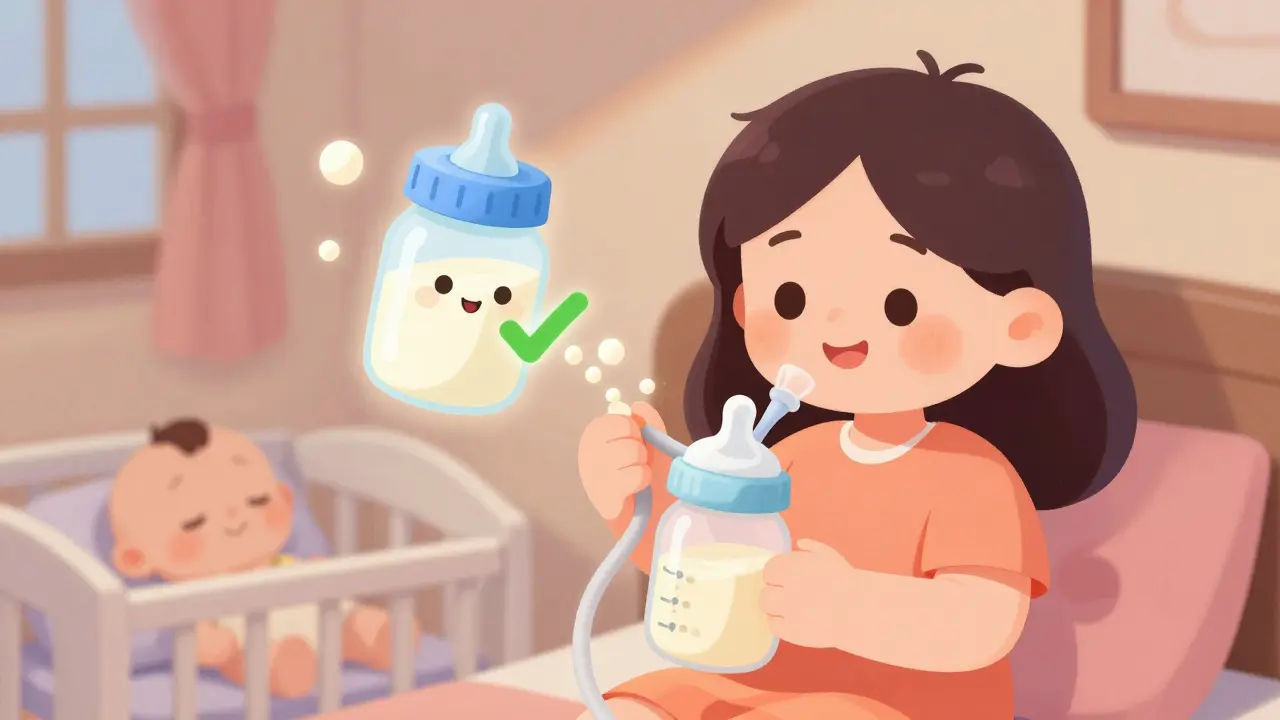
Most new moms hear it early: "Take your medicine? Better pump and dump." But what if that advice is wrong? For the vast majority of medications, you don’t need to throw away your breast milk at all. The truth is, pumping and storing milk during medication use is often perfectly safe-and discarding milk unnecessarily can hurt your supply, stress you out, and even make breastfeeding harder to keep going.
Why Most "Pump and Dump" Advice Is Outdated
You’ve probably seen warning labels on medicine bottles that say "not recommended during breastfeeding." That doesn’t mean you can’t breastfeed. It means the manufacturer doesn’t have enough data to say it’s 100% safe-and they’re covering their legal bases. The FDA doesn’t require drug companies to test medications on breastfeeding women. So, the default label is often a blanket warning, even when the actual risk is tiny or nonexistent. Real experts don’t rely on those labels. The American Academy of Pediatrics, the CDC, and the American College of Obstetricians and Gynecologists all agree: over 98% of medications are safe to take while breastfeeding. Only a handful-like certain cancer drugs, radioactive isotopes, or ergotamine-require you to pause nursing. For everything else? You can keep feeding your baby. The "pump and dump" myth started decades ago when doctors didn’t understand how drugs move into breast milk. Today, we know better. Studies show that most medications transfer to milk in amounts so small they’re practically harmless. For example, when a mom takes 650 mg of acetaminophen, her baby gets less than 0.1% of that dose through breast milk. That’s less than what they’d get from a single drop of infant Tylenol.How Medications Actually Get Into Breast Milk
Not all drugs behave the same way. What makes one safe and another risky? It comes down to a few key science facts:- Molecular size: If a drug molecule is bigger than 500 Daltons, it struggles to pass into milk. Most antibiotics and painkillers are too big to cross easily.
- Protein binding: If a drug sticks tightly to proteins in your blood, it can’t float freely into milk. Drugs with over 80% protein binding (like many antidepressants) rarely transfer in meaningful amounts.
- Half-life: How long does it stay in your system? A drug with a half-life under 4 hours (like ibuprofen) clears quickly. One with a 14-hour half-life (like naproxen) builds up and is riskier.
- Oral absorption: Even if a drug gets into milk, will your baby absorb it? Many drugs are poorly absorbed in a baby’s gut, so they pass right through without doing anything.
When You Actually Need to Pump and Dump
There are exceptions. You should temporarily stop breastfeeding only if you’re taking:- Chemotherapy drugs (like methotrexate or cyclophosphamide)
- Radioactive isotopes used in imaging tests (like thyroid scans with I-131)
- Ergot alkaloids (used for migraines, like ergotamine)
- Some antiviral drugs for HIV (like certain nucleoside analogs)
Smart Timing: The Real Secret to Safety
You don’t need to pump and dump. You need to time things right. Here’s how:- For once-daily meds: Take the pill right after your baby’s longest sleep stretch-usually right after bedtime. By the time your baby wakes up, the drug has cleared from your system.
- For multiple daily doses: Breastfeed right before you take your pill. That way, your baby gets milk when drug levels are lowest.
- For short-acting meds: Ibuprofen clears in 2-3 hours. Acetaminophen in 3-4 hours. Wait 4-6 hours after taking it before the next feeding if you’re worried.
- For long-acting meds: Avoid naproxen (Aleve) and choose ibuprofen instead. Clindamycin? Use it only if no other option exists-it has higher transfer rates and can cause diarrhea in babies.
Storage Rules Don’t Change
Taking medication doesn’t alter how long your milk lasts. You don’t need special containers or shorter storage times. Follow standard guidelines:- Room temperature (up to 25°C): 4 hours
- Refrigerator (up to 4°C): 4 days
- Freezer (-18°C): 6 months
What Medications Are Safe? Real Examples
Here’s what you can actually take without fear:| Medication Type | Safe Options | Risk Level | Why It’s Safe |
|---|---|---|---|
| Pain Relief | Acetaminophen, Ibuprofen | L1 (Safest) | Minimal transfer, no documented infant effects |
| Antibiotics | Cephalexin, Amoxicillin, Penicillin | L1-L2 | Low transfer, widely studied, no adverse outcomes in thousands of cases |
| Antidepressants | Sertraline, Fluoxetine (low dose), Escitalopram | L1-L2 | Sertraline has the lowest transfer rate among SSRIs; no behavioral issues reported |
| Allergy Meds | Loratadine, Cetirizine | L1 | Non-drowsy options; minimal sedation in infants |
| Birth Control | Progestin-only pills, IUDs | L1 | Estrogen-containing pills can reduce supply; avoid them in early breastfeeding |

Where to Get Real Advice (Not Guesswork)
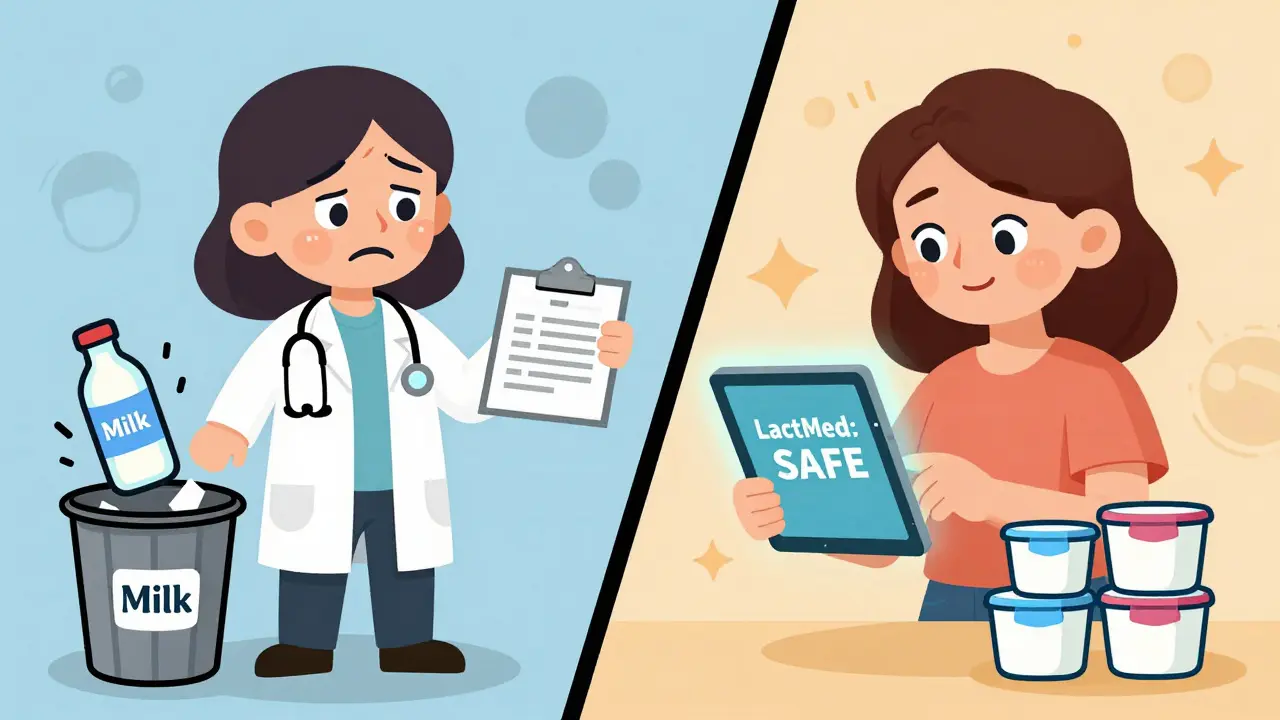
Don’t rely on your pharmacist’s printed handout or a Google search. Use trusted, science-backed tools:- LactMed: A free, NIH-run database updated weekly. Search any drug and get detailed data on transfer rates, infant exposure, and case reports. It’s used by hospitals nationwide.
- MotherToBaby: Call 866-626-6847. Real experts answer questions in 10-15 minutes. They’ll tell you exactly what to do, even for new or obscure meds.
- InfantRisk Center App: Free app with real-time safety ratings. Downloaded over 250,000 times. You can scan a pill bottle and get instant guidance.
- La Leche League: Their Medication Decision Tree helps you walk through your options step by step.
What Happens When You Pump and Dump for No Reason
A Kaiser Permanente survey of 3,852 breastfeeding moms found 57% threw out milk when taking antibiotics-even though penicillin and cephalosporins are among the safest drugs for babies. The result? Supply drops. Stress spikes. And many moms end up switching to formula-not because they wanted to, but because their bodies stopped making enough milk. One mom in Chicago pumped and dumped for 72 hours after being told to do so for a simple antibiotic. Her supply dropped 40% and never recovered. She ended up supplementing with formula, which added cost, stress, and guilt. On the flip side, a mom in Texas took sertraline while breastfeeding her 6-week-old. She followed timing advice from MotherToBaby and saw zero side effects. She kept breastfeeding for 18 months.What to Do Next
If you’re on medication and breastfeeding:- Don’t panic. Don’t dump unless you’re told to by a trusted source.
- Check LactMed or call MotherToBaby before you take anything new.
- Time your doses around feedings to minimize baby’s exposure.
- Store milk normally-no special rules needed.
- Bring this info to your doctor. Say: "I’m breastfeeding. Can you check if this is safe? I’d like to avoid pumping and dumping unless absolutely necessary."
Is it safe to breastfeed while taking ibuprofen?
Yes. Ibuprofen transfers to breast milk in very small amounts-less than 0.1% of the mother’s dose. It clears quickly (half-life of 2-3 hours) and has been used safely in millions of breastfeeding mothers. It’s one of the top-recommended pain relievers for nursing moms.
What if I take an antibiotic? Do I need to pump and dump?
Almost never. Antibiotics like amoxicillin, cephalexin, and penicillin are considered safest for breastfeeding. Only clindamycin and a few others have higher transfer rates and may cause infant diarrhea. If you’re prescribed an antibiotic, check LactMed or call MotherToBaby before assuming you need to dump.
Can antidepressants affect my baby’s development?
Sertraline is the most studied and safest antidepressant for breastfeeding. Over 98% of infants exposed to it show no side effects. Other SSRIs like fluoxetine and escitalopram are also low-risk. Untreated depression, however, can affect bonding and infant development more than the medication itself. The benefits of treating your mental health usually outweigh any tiny theoretical risk.
How long should I wait after taking medication before breastfeeding?
For most single-dose meds, wait 4-6 hours after taking it. For short-acting drugs like ibuprofen or acetaminophen, you can breastfeed right before taking the pill. For long-acting meds, avoid them altogether if safer options exist. Timing matters more than dumping.
Does pumping and dumping remove medication from my milk faster?
No. Pumping doesn’t speed up how fast your body clears the drug. Medication leaves your system through your liver and kidneys, not your breasts. Dumping milk only removes the milk that’s already there-it doesn’t make your body eliminate the drug faster. The only way to reduce exposure is to wait for the drug to clear naturally, which is why timing your doses is so important.
What should I do if my doctor says to pump and dump?
Ask for the reason. Say: "Can you check LactMed or call MotherToBaby to confirm?" Most providers aren’t trained in lactation pharmacology. If they can’t provide evidence-based reasoning, get a second opinion. Your milk supply and your baby’s health are worth advocating for.
Comments (9)
-
Robin Van Emous January 26, 2026
So many moms are told to pump and dump without knowing why. I didn't know most meds are safe until I read this. Seriously, why do doctors still say 'dump it' by default? It's like they're scared of liability more than they care about moms' mental health or supply.
My sister dumped for three days on amoxicillin. Her supply crashed. She ended up formula feeding and felt guilty for months. This info needs to be everywhere.

-
Angie Thompson January 27, 2026
OMG YES 💪🍼 I was SO scared to take my Zoloft after baby was born… like, I cried reading the bottle label. But then I called MotherToBaby and they were like ‘you’re fine, just time it right!’
I took it right after bedtime, kept nursing, and my baby slept like a angel. No fuss. No drama. Just mom and milk. 🥹
PS: LactMed is my new BFF. Saved my sanity.

-
rasna saha January 28, 2026
This is such a needed post. In India, so many women are told to stop breastfeeding if they take any medicine-even paracetamol. I had to explain to my own mother-in-law that ibuprofen won’t hurt the baby. She thought it was poison.
Thank you for sharing the science. I’ll share this with my lactation group. So many moms need to hear this.

-
Ashley Porter January 29, 2026
From a pharmacokinetics standpoint, the key variables are volume of distribution, protein binding, and molecular weight. Most NSAIDs and SSRIs have low Vd and high protein binding, which limits transmammary transfer. Also, neonatal hepatic immaturity reduces first-pass metabolism, but for drugs like sertraline, the plasma concentrations in infants remain subtherapeutic.
Bottom line: pharmacodynamic risk ≠ pharmacokinetic exposure. Most labels are precautionary, not evidence-based.

-
shivam utkresth January 31, 2026
Bro, this is wild. In India, even the local chemist will hand you a leaflet saying ‘don’t breastfeed if you take painkillers.’ Like, what? I gave my wife ibuprofen after a C-section and she kept nursing. Baby was fine. No drama.
Why do people treat breastfeeding like it’s a fragile glass sculpture? It’s biology, not magic. We got science now. Use it.
Also, LactMed? I just downloaded it. This is the real MVP app.

-
Kipper Pickens January 31, 2026
Interesting that the FDA doesn’t require lactation studies. That’s a regulatory gap. But the real issue is cultural inertia. Medical training doesn’t emphasize lactation pharmacology. So even if the data exists, providers don’t know it.
Also, the ‘pump and dump’ myth persists because it’s easier than educating. It’s the lazy default. We need mandatory lactation training for all prescribers.

-
Aurelie L. February 2, 2026
I think this is dangerous advice.
What if your baby has a rare metabolic disorder? What if the drug interacts with something undiagnosed? You can’t just say ‘it’s safe’ and assume everyone’s fine.
My cousin’s baby had a seizure after she took a ‘safe’ antibiotic. No one knew she had a G6PD deficiency.
Maybe don’t be so reckless.

-
Joanna Domżalska February 4, 2026
So you’re telling me it’s fine to take antidepressants while breastfeeding… but we’re supposed to believe that chemicals don’t affect developing brains?
What about long-term neurodevelopmental outcomes? Where’s the 20-year study?
And why are we normalizing chemical dependency in moms? Maybe the real problem is that society expects women to push through postpartum depression with pills instead of support.
Just saying… maybe the real solution isn’t more drugs. Maybe it’s better maternity leave. Or paid therapy. Or a village.
But sure, keep dumping your milk and popping pills. That’s easier.

-
Josh josh February 4, 2026this post saved my life no cap
