
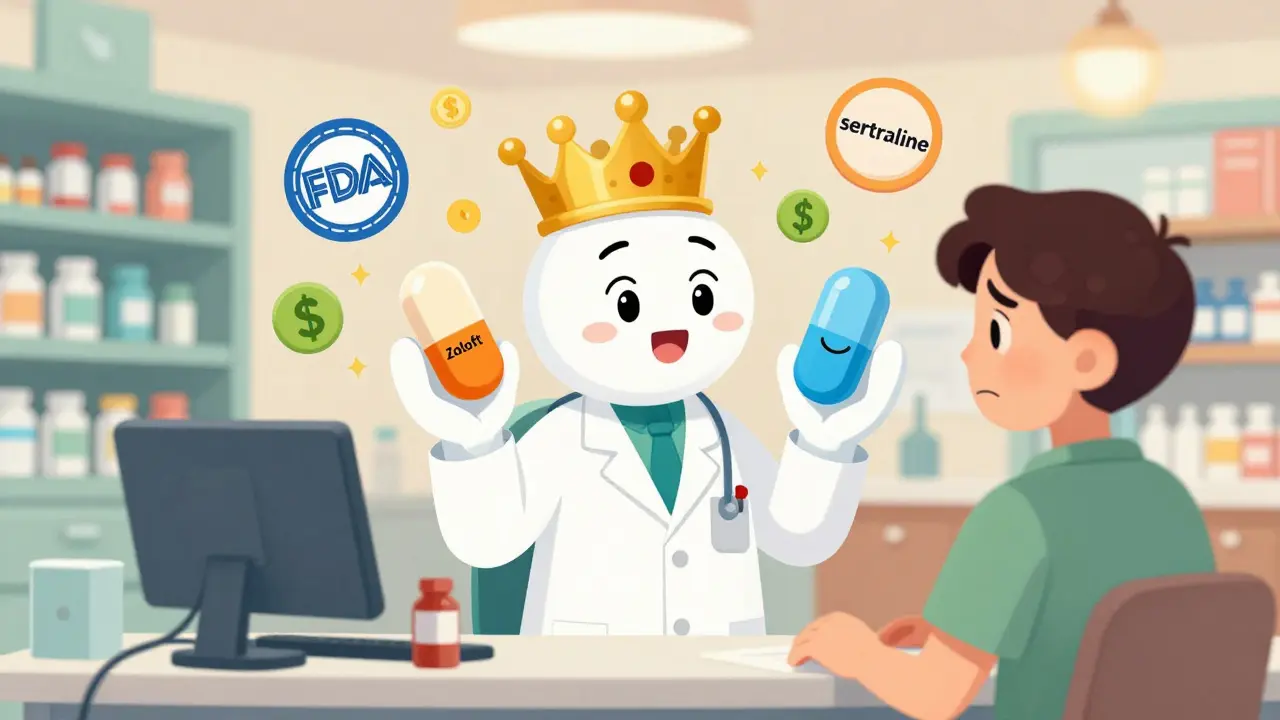
When you pick up a prescription, you might see two options on the receipt: the brand-name drug your doctor wrote, or a cheaper generic version. Many people wonder - is the generic just as good? Is it safe? Will it even work the same way? These aren’t just questions about price. They’re questions about your health, your routine, and your peace of mind.
What Exactly Is a Generic Drug?
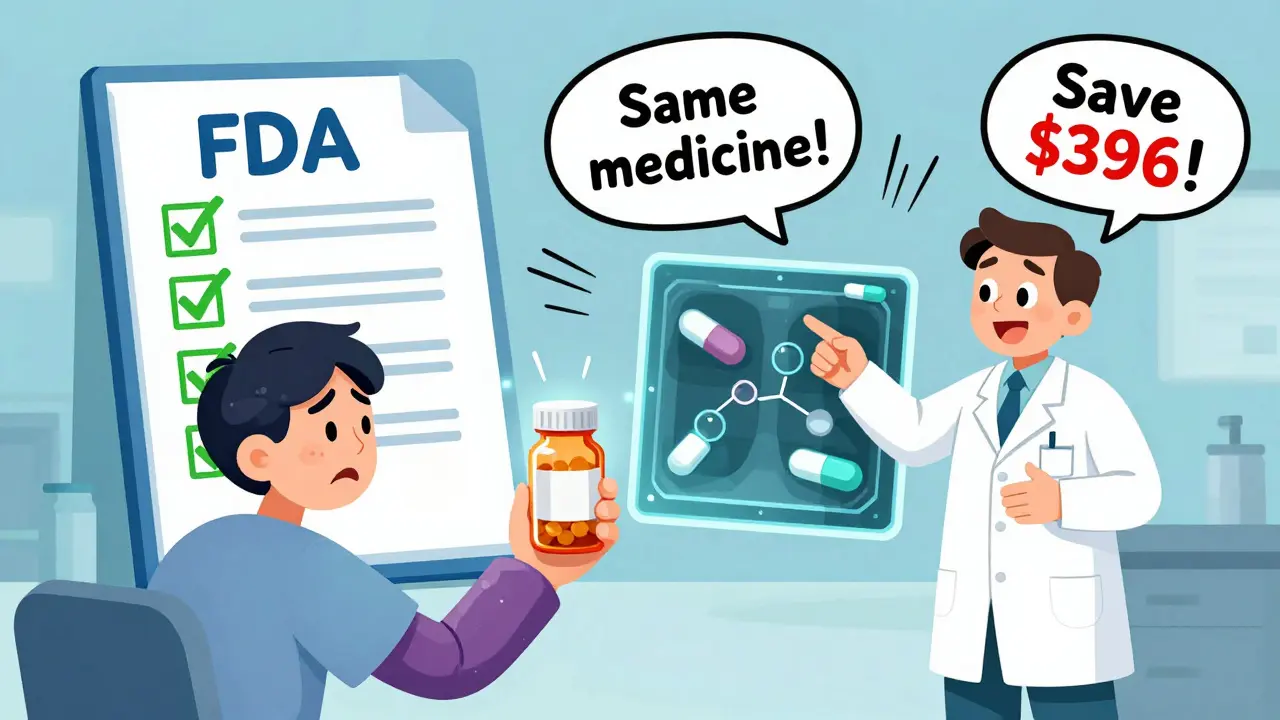
A generic drug is not a copy. It’s not a knockoff. It’s the exact same medicine, chemically, as the brand-name version. The FDA requires that generic drugs contain the same active ingredient, in the same strength, and work the same way in your body. That means if you take 10 mg of generic sertraline, your bloodstream gets the same amount of the drug as if you took 10 mg of Zoloft. The difference? Generics cost 80 to 85% less.
The system that makes this possible started in 1984 with the Hatch-Waxman Act. Before that, generic manufacturers had to run full clinical trials - just like the original drug maker. That made generics too expensive to produce. The new law created a faster path called the Abbreviated New Drug Application (ANDA). Generics now only need to prove they’re bioequivalent - meaning they release the active ingredient into your blood at the same rate and amount as the brand. The FDA requires that the 90% confidence interval for absorption falls between 80% and 125% of the brand. In reality, most generics are within 3.5% of the original.
Why Do Generics Cost So Much Less?
Brand-name drug companies spend years and billions of dollars developing a new medicine. They pay for clinical trials, marketing, patent protection, and sales teams. Once the patent expires - usually after 20 years - other companies can make the same drug without repeating those costs. They don’t need to run new trials. They don’t need to advertise. They just need to prove the chemistry matches.
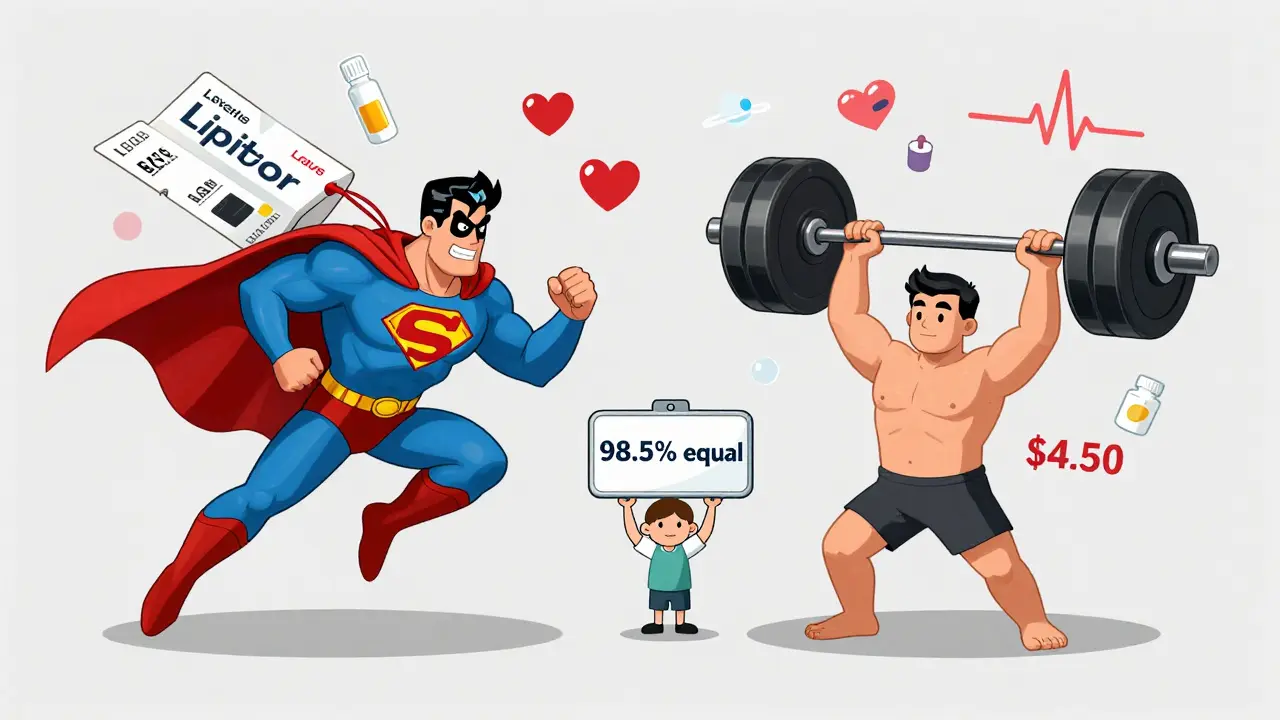
That’s why a 30-day supply of generic atorvastatin (the active ingredient in Lipitor) can cost as little as 10 cents per pill. The brand version? Around $4.50. Generic sertraline? About $4. Zoloft? Up to $400. That’s not a trick. That’s how the system works.
Over the last decade, generic drugs saved the U.S. healthcare system $1.67 trillion. That’s $265 saved per person, every year. For someone on a fixed income, that kind of savings means they can afford to take their medication consistently - instead of skipping doses because they can’t pay.
Are Generics Really Just as Effective?
Yes - in nearly every case.
A 2019 meta-analysis in JAMA Internal Medicine reviewed 47 studies with nearly 10,000 patients. It found that generic drugs performed identically to brand-name drugs in 98.5% of cases. That held true for heart medications, antidepressants, diabetes drugs, and blood pressure pills. The FDA has reviewed over 2,000 bioequivalence studies. The average difference in how the body absorbs the drug? Less than 4%.
There are exceptions. A few types of drugs are so sensitive that even tiny changes can matter. These are called drugs with a narrow therapeutic index. That means the difference between a helpful dose and a dangerous one is very small.
Examples include:
- Levothyroxine (for thyroid disease)
- Warfarin (a blood thinner)
- Phenytoin and carbamazepine (for seizures)
In these cases, the FDA and many doctors recommend sticking with one version - brand or generic - and not switching back and forth. Why? Because even a 5% change in absorption could affect how well your thyroid works or how thin your blood stays. Twenty-eight states require doctors to note “dispense as written” on prescriptions for these drugs.
One 2017 study in Neurology found that some epilepsy patients had breakthrough seizures after switching from brand carbamazepine to a generic. Not because the generic was bad - but because switching between different generic manufacturers changed the timing of drug release slightly. That’s why consistency matters here.
What About the Inactive Ingredients?
Generics can look different. They might be a different color, shape, or size. That’s because the inactive ingredients - the fillers, dyes, and binders - aren’t protected by patent. One manufacturer might use cornstarch. Another might use lactose. One might use red dye. Another might use none at all.
For most people, this doesn’t matter. But if you have a rare allergy - say, to lactose or a specific dye - you need to know what’s in your pill. That’s why it’s important to check the manufacturer name on the bottle. If you notice your pill suddenly looks different, don’t assume it’s a mistake. Ask your pharmacist. They can tell you if it’s a new generic version.
Some patients report feeling “off” after switching - headaches, nausea, or a sense that the drug isn’t working as well. In most cases, it’s psychological. But not always. A 2012 FDA warning flagged certain generic versions of extended-release bupropion (Wellbutrin XL) for inconsistent absorption. That’s why, for complex formulations like extended-release or delayed-release pills, the FDA requires extra testing.
When Might You Want to Stick With the Brand?
There are three real reasons to choose brand over generic:
- Narrow therapeutic index drugs - as mentioned above. Stick with one version.
- Complex delivery systems - like inhalers, patches, or injectables. A 2016 study in Chest found that 12% of patients switching from Advair Diskus to a generic inhaler had trouble using the device properly. The active ingredient was the same, but the mechanics were different. That’s not the drug’s fault - it’s the device.
- Personal experience - if you’ve tried a generic and felt worse, talk to your doctor. It’s rare, but it happens. Don’t assume it’s in your head.
There’s also something called a “branded generic.” These are versions made by the original brand company - but sold under a different name at a lower price. For example, Eli Lilly sells Humalog insulin as a “authorized generic” - same formula, same factory, but cheaper than the brand. These are a good middle ground if you trust the brand but need to save money.
How to Make the Switch Safely
Switching to a generic is usually safe - and smart. But here’s how to do it right:
- Ask your pharmacist - They know which generics are available and which manufacturers are used. If your pill changes shape or color, they can tell you if it’s the same drug or a different maker.
- Use the FDA’s Drugs@FDA database - You can look up your drug and see which generics are approved and rated as “AB” (therapeutically equivalent).
- Don’t switch between multiple generic brands - Especially for thyroid or seizure meds. Stick with one manufacturer if possible.
- Monitor your symptoms - If you’re on a chronic medication, pay attention to how you feel after switching. Report changes to your doctor.
- Check your insurance - Most Medicare Part D and private plans automatically switch you to generics. If you want to stay on brand, you may need to pay more or get a prior authorization.
One study found that giving patients visual aids - photos of their pills - reduced medication errors by 37% when switching to generics. A simple picture can prevent confusion.
What Patients Really Think
On Drugs.com, 82% of users reported being satisfied with generic drugs. That’s only 3% lower than brand-name satisfaction. But the complaints are specific:
- 27% of Reddit users mentioned confusion over pill appearance - “I thought I got the wrong medicine.”
- 41% of negative reviews for generic bupropion cited reduced effectiveness - though this is rare and often linked to specific manufacturers.
- 93% of people on r/PersonalFinance said cost was the main reason they switched.
Here’s the kicker: 68% of patients are nervous about generics at first. But after a pharmacist explains how the FDA approves them, 89% keep using them. And adherence - meaning taking the drug as prescribed - improves by 22% when people can afford it.
What’s Changing Right Now?
The generic market is growing fast. In 2022, 90% of all U.S. prescriptions were filled with generics. That number is expected to hit 93% by 2027. But challenges remain:
- Only 35% of off-patent complex drugs (like inhalers or eye drops) have generic versions.
- 78% of active drug ingredients come from India and China - a supply chain risk.
- The Inflation Reduction Act (2022) will let Medicare negotiate prices for 10 top drugs starting in 2026 - which could push more patients toward generics.
The FDA’s new GDUFA III rules are speeding up approval times. In 2022, over 1,100 generics were approved - more than double the number in 2016. That means more choices, more competition, and lower prices ahead.
Bottom Line: Choose Smart, Not Scared
Generic drugs are not second-rate. They’re not cheap knockoffs. They’re the same medicine, tested just as hard, made under the same rules. For 98 out of 100 people, they work just as well - and save hundreds, sometimes thousands, of dollars a year.
There are exceptions - and you should know them. But don’t let fear of the unknown keep you from saving money. Talk to your pharmacist. Ask questions. Check your pill. Stay consistent. And remember: the goal isn’t to pick the most expensive drug. It’s to take the right one - every day - without breaking the bank.
Are generic drugs as safe as brand-name drugs?
Yes. The FDA requires generic drugs to meet the same strict standards for safety, strength, purity, and quality as brand-name drugs. Both are made in FDA-inspected facilities, and both must pass the same tests before they can be sold. The only difference is cost - not safety.
Why do generic pills look different from brand-name pills?
By law, generic drugs can’t look exactly like the brand-name version - that would violate trademark rules. So they use different colors, shapes, or sizes. But the active ingredient, dose, and how it works in your body are identical. If your pill changes appearance, it’s likely a different manufacturer - not a different drug.
Can I switch between different generic versions of the same drug?
For most medications, yes. But for drugs with a narrow therapeutic index - like levothyroxine, warfarin, or seizure meds - it’s better to stick with one manufacturer. Even small changes in how the drug is absorbed can affect your health. If you notice changes in how you feel after switching generics, talk to your doctor.
Why do some people say generic drugs don’t work as well?
In rare cases, yes - but usually because of the drug type or the manufacturer. Extended-release versions, like bupropion XL, have had issues with inconsistent absorption in certain generics. Complex delivery systems, like inhalers, can also cause problems if the device doesn’t work the same. Most of the time, though, the perception that generics don’t work is due to placebo effect or changing pill appearance. Always check with your pharmacist before assuming it’s the drug.
How do I know if a generic is approved by the FDA?
Look up your drug on the FDA’s Drugs@FDA database or check the Orange Book. Approved generics will be listed with an “AB” rating, meaning they’re therapeutically equivalent to the brand. If it’s not listed or has an “BX” rating, it’s not considered interchangeable. Your pharmacist can help you find this information.
Comments (9)
-
Edward Stevens December 15, 2025
Oh wow, so generics are just the brand’s baby brother who got kicked out of the house but still has the same DNA? Cool, I’ll take the $4 sertraline instead of the $400 Zoloft - my wallet’s been crying since 2020.

-
Sarthak Jain December 16, 2025
bro i switched to generic atorvastatin last year n my cholestrol dropped like it was on a slide 😎 but my pill changed color twice n i thought i got scammed lmao. pharmacist said its legit, just diff maker. now i take pic of my bottle every time. saved me $200/month. india makes most of em but FDA checks em hard. still, if u got thyroid or seizures? dont switch brands. stay consistent. #pharmachatter

-
Tim Bartik December 17, 2025
Let me get this straight - we’re letting China and India make our life-saving meds while our own pharma execs cash in on patent monopolies? And you call this ‘science’? This ain’t healthcare, this is a goddamn colonial export scheme. I’d rather pay $400 for Zoloft made in Ohio than swallow some powder from a factory that doesn’t even speak English. And don’t even get me started on the ‘AB rating’ - that’s just corporate legalese for ‘we hope this doesn’t kill you.’

-
jeremy carroll December 18, 2025
Just wanted to say - switching to generic meds changed my life. I was skipping doses because I couldn’t afford it. Now I take my blood pressure med every day, no stress. Don’t let the pill color freak you out - your body doesn’t care if it’s blue or white, it cares if you take it. You got this. 💪

-
Rich Robertson December 18, 2025
In South Africa, we call generics ‘the people’s medicine.’ We don’t have the luxury of brand loyalty when your monthly income is less than the cost of one brand-name pill. The FDA’s standards are actually pretty impressive - more rigorous than some countries’ entire regulatory systems. The real tragedy isn’t generics - it’s that so many people still believe they’re inferior. It’s not about the pill. It’s about who gets to feel safe in their own body.

-
Natalie Koeber December 19, 2025
Have you seen the FDA’s inspection reports? Half of the generic facilities are in countries where they use the same water for cleaning vats and drinking. I switched to brand because I don’t want to become a lab rat for Big Pharma’s offshore cost-cutting. And don’t tell me ‘it’s the same active ingredient’ - what about the fillers? The dyes? The *invisible* toxins? My cousin’s thyroid went haywire after switching. Coincidence? I think not.

-
Rulich Pretorius December 21, 2025
The real question isn’t whether generics work - it’s why we’ve built a system where cost becomes a proxy for medical trust. People fear the unknown, yes - but they also fear being exploited. The system exploits that fear to sell $400 pills when $4 will do. The solution isn’t to shame patients for choosing affordability - it’s to dismantle the illusion that price equals quality. Your life isn’t a luxury item. Neither is your medicine.

-
Wade Mercer December 22, 2025
Anyone who takes generics is just lazy. If you really cared about your health, you’d pay the full price. The brand-name drugs have better quality control. Period. I don’t care what the FDA says - if it’s not made by the original company, it’s not the same. I’d rather die poor than take a chance on some knockoff.

-
Dwayne hiers December 22, 2025
For drugs with narrow therapeutic index - levothyroxine, warfarin, phenytoin - bioequivalence is measured by Cmax and AUC0–t with a 90% CI of 80–125%. But intra-subject variability can be >20% in some patients, especially with extended-release formulations. That’s why switching between generics - even if both are AB-rated - can cause subtherapeutic or toxic exposure. The FDA’s GDUFA III accelerated review doesn’t eliminate pharmacokinetic heterogeneity. Always monitor TSH, INR, or drug levels post-switch. And yes - if your pill looks different, ask for the manufacturer code. It’s not paranoia. It’s precision medicine.
