
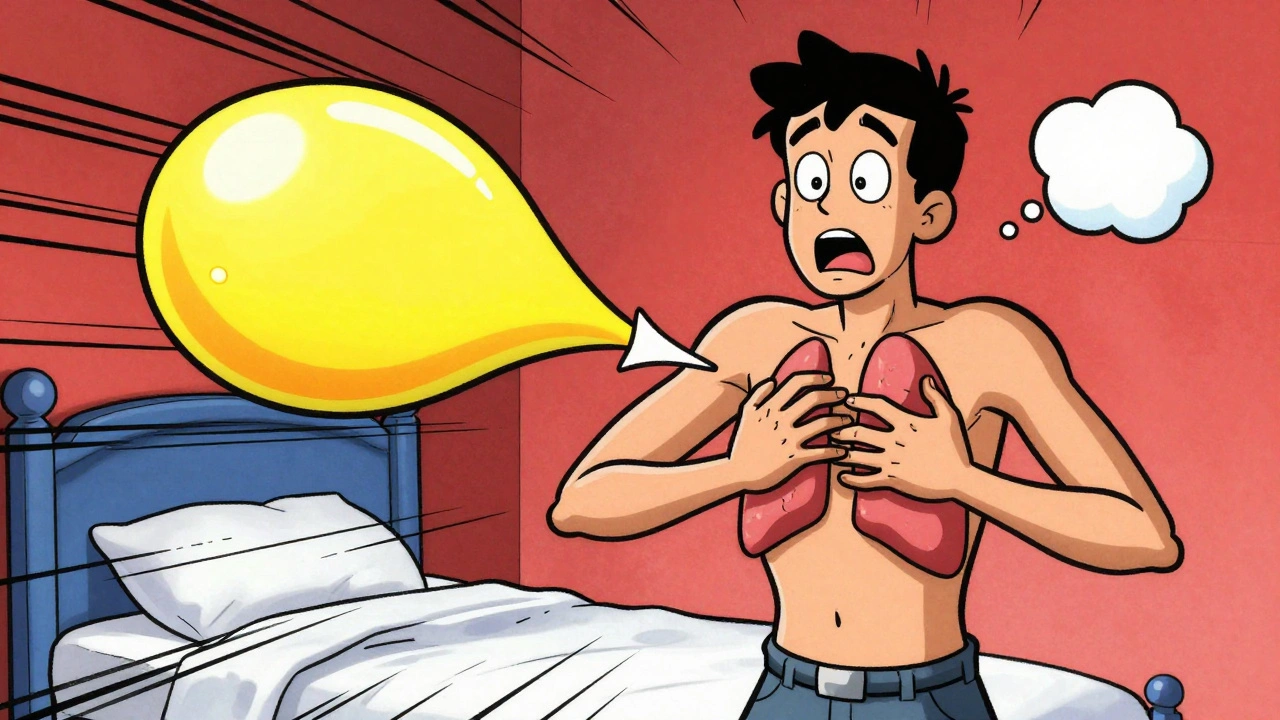
One minute you’re breathing normally. The next, a sharp pain lances through your chest, and you can’t catch your breath. It doesn’t feel like a pulled muscle or heartburn. It feels wrong. That’s often how a pneumothorax starts - sudden, severe, and scary. A collapsed lung isn’t just a medical term; it’s a life-threatening event that can turn deadly in minutes if ignored. You don’t need to be a marathon runner or a smoker to get it. Even healthy teens and young adults can wake up with it after a cough or a sneeze. The key isn’t waiting to see if it gets better. It’s knowing what to look for - and acting fast.
What Exactly Is a Collapsed Lung?
A pneumothorax happens when air leaks out of your lung and gets trapped between the lung and the chest wall. This space, called the pleural space, is normally empty. When air fills it, it pushes on the lung like a balloon being squeezed from the outside. The lung can’t expand fully when you breathe, so your body struggles to get enough oxygen. It’s not the lung bursting - it’s air escaping where it shouldn’t be.
There are four main types:
- Primary spontaneous: Happens in people with no known lung disease. Most common in tall, thin young men, often between 18 and 35.
- Secondary spontaneous: Occurs because of an existing lung problem like COPD, emphysema, cystic fibrosis, or pneumonia. These cases are more dangerous.
- Traumatic: Caused by injury - car accidents, stab wounds, broken ribs, or even CPR.
- Iatrogenic: Triggered by medical procedures like lung biopsies, central line placements, or mechanical ventilation.
Primary cases make up about 70% of all pneumothoraces. But secondary cases are far more deadly - the 30-day death rate jumps from less than 0.2% to over 16% in older patients with lung disease.
Signs You’re Having a Collapsed Lung
The symptoms are hard to ignore - and they come on fast. You won’t mistake them for a bad cold.
- Sharp, stabbing chest pain: This is the #1 sign. It’s localized to one side - usually the right or left - and gets worse when you inhale deeply, cough, or move. About 92% of patients report pain radiating to the same-side shoulder.
- Sudden shortness of breath: You might feel like you’re breathing through a straw. If more than 30% of your lung has collapsed, you’ll be breathless even at rest. With smaller collapses, you might only notice it climbing stairs or walking quickly.
- Fast heartbeat: Your heart races because your body is trying to compensate for low oxygen. A pulse over 134 beats per minute is a red flag.
- Low oxygen levels: Your lips or fingertips may turn blue. Oxygen saturation below 90% on room air means you’re in trouble.
- Difficulty speaking: If you can’t finish a full sentence without gasping, that’s a medical emergency.
In tension pneumothorax - the most dangerous form - the air keeps building up under pressure. It pushes your heart and major blood vessels to the opposite side of your chest. This is rare but deadly. Signs include low blood pressure, extreme breathing difficulty, and sometimes, the trachea (windpipe) visibly shifting away from the affected side. But here’s the critical point: you don’t need to see tracheal shift to act. If you have chest pain, trouble breathing, and a fast heart rate - treat it like tension pneumothorax until proven otherwise.
Emergency Care: What Happens in the ER
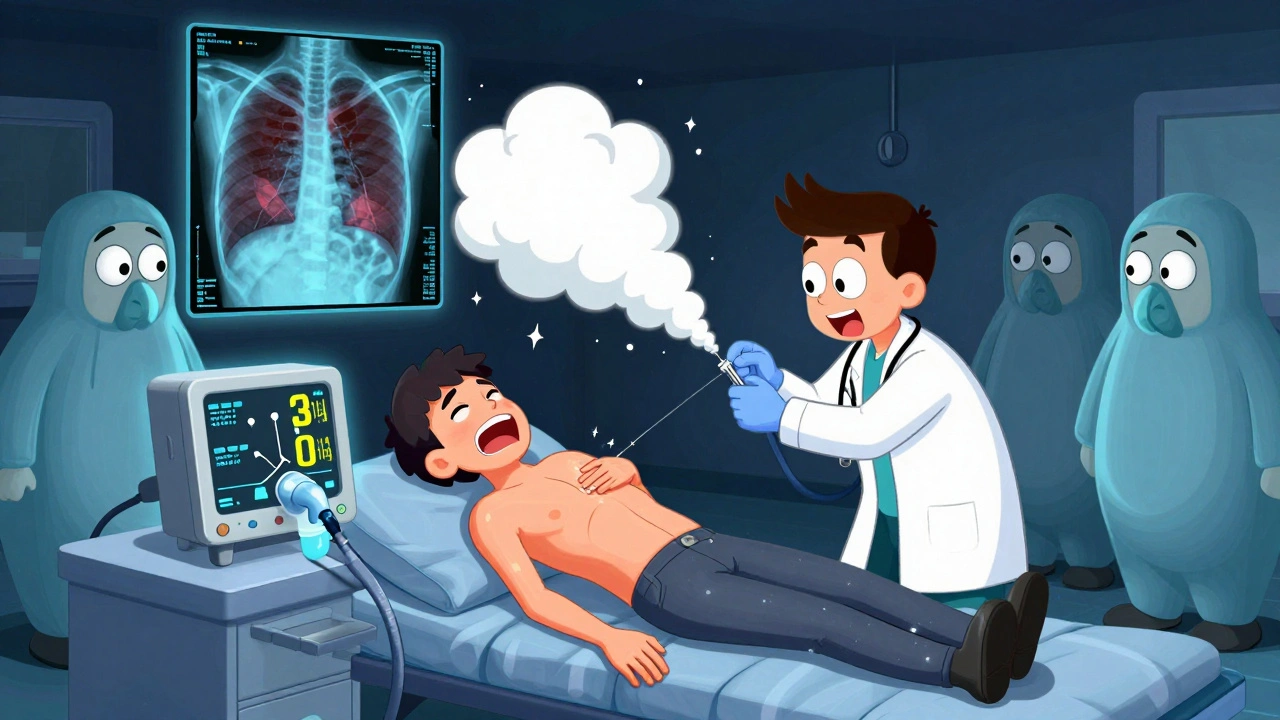
Time is everything. In a tension pneumothorax, every minute counts. The American Heart Association says needle decompression must happen within two minutes of recognizing the signs - no waiting for an X-ray.
Here’s how it typically goes:
- Immediate assessment: Doctors check your breathing, heart rate, blood pressure, and oxygen levels. If you’re unstable - struggling to breathe, low oxygen, or low blood pressure - they skip imaging and go straight to treatment.
- Needle decompression: For tension pneumothorax, a needle is inserted into the chest to release the trapped air. It’s quick, simple, and saves lives.
- Chest tube insertion: For larger collapses or if you’re not improving after needle decompression, a tube (usually 28F) is placed between your ribs to drain the air and let the lung re-expand. This is done under local anesthesia.
- Imaging: After stabilization, a chest X-ray confirms the diagnosis and checks the tube’s position. In trauma cases, ultrasound (E-FAST) is often used first - it’s fast, accurate, and doesn’t expose you to radiation.
Studies show hospitals following strict protocols get patients from arrival to treatment in under 22 minutes for simple cases and under 10 minutes for tension pneumothorax. Delays increase complication risk by 7.2% for every 30 minutes.
How Is It Treated - Beyond the ER
Not every collapsed lung needs a chest tube. Treatment depends on size, cause, and how you’re feeling.
- Small, stable, primary pneumothorax: If the air leak is less than 2 cm on X-ray (about 30% collapse) and you’re breathing okay, doctors may just give you oxygen and watch. Breathing pure oxygen speeds up air absorption - it can clear the leak 3 to 4 times faster. About 82% of these cases heal on their own in two weeks.
- Larger primary or symptomatic cases: Needle aspiration is often tried first. A thin tube is inserted to suck out the air. It works in about 65% of cases. If it fails, a chest tube follows.
- Secondary pneumothorax: Always treated more aggressively. Even small air leaks can be dangerous if your lung is already damaged. Chest tubes are usually placed right away.
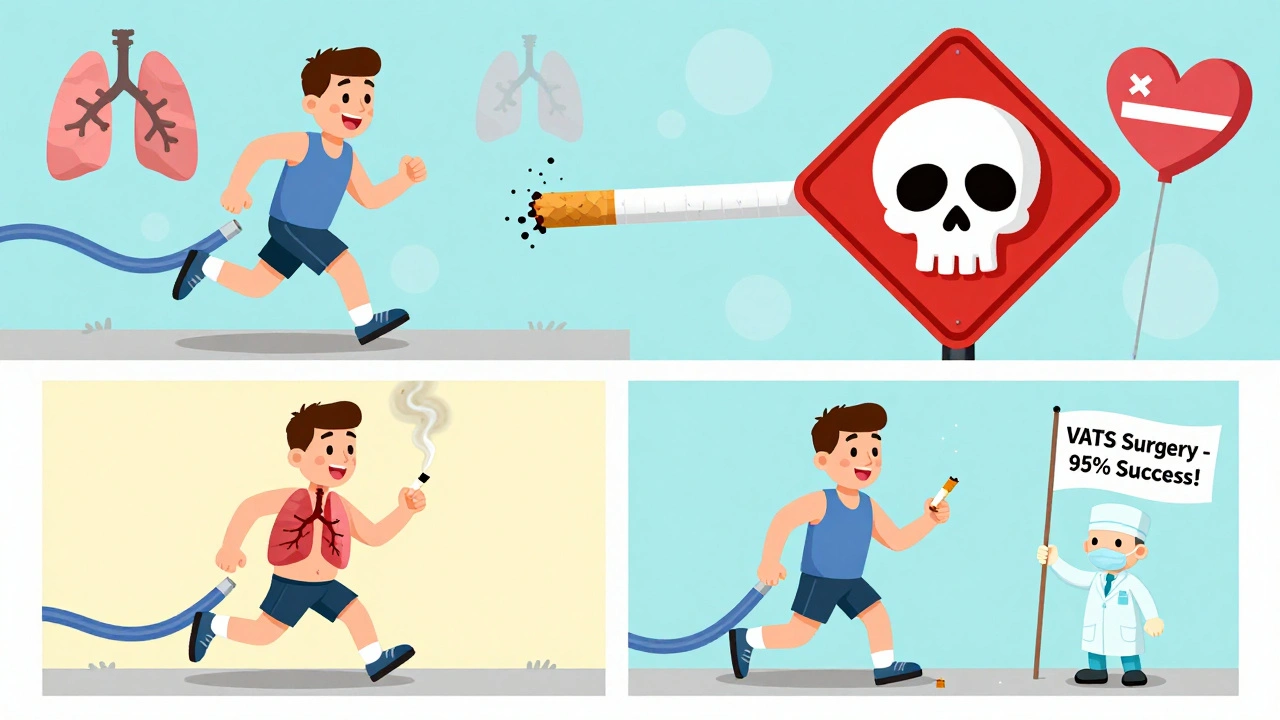
- Recurrent cases: If it happens again, surgery is often recommended. Video-assisted thoracoscopic surgery (VATS) removes the weak spots in the lung and seals the pleural space. Success rate? Over 95% at one year.
Chemical pleurodesis - using talc to stick the lung to the chest wall - works in 88% of cases but causes severe pain in 1 out of 4 people. It’s usually reserved for those who can’t have surgery.
What Happens After You Go Home
Leaving the hospital doesn’t mean you’re out of the woods. Recovery takes time, and mistakes can cost you.
- Stop smoking - now: Smoking increases your risk of recurrence by over 20 times. Quitting cuts that risk by 77% in the first year. This isn’t advice - it’s survival.
- No flying for 2-3 weeks: Air pressure changes during flight can cause the lung to collapse again. The FAA requires clearance before flying after a pneumothorax.
- Avoid scuba diving: Unless you’ve had surgery to prevent recurrence, diving is off-limits. The risk of another collapse underwater is 12.3% - and that’s not worth it.
- Follow-up X-ray: Get a chest X-ray at 4 to 6 weeks. About 8% of people develop delayed complications if they skip this.
- Know your warning signs: If you feel sudden chest pain, new blue lips, or can’t speak in full sentences - call 911. These are the signs of recurrence in 94% of cases.
Patients who get clear discharge instructions are 32% less likely to return to the ER. Don’t assume you’ll remember what the doctor said. Ask for written instructions or a follow-up appointment.
Who’s at Highest Risk?
Some people are far more likely to get a collapsed lung:
- Tall, thin men: Height over 70 inches increases risk by 3.2 times.
- Smokers: More than 10 pack-years raises risk by 22 times.
- Men: 6.5 times more likely than women.
- People with lung disease: COPD, asthma, or prior pneumonia make recurrence and death much more likely.
Recurrence rates are brutal. After one episode, 15-40% of people get it again within two years. After two episodes, the chance of a third is 62%. That’s why doctors often recommend surgery after the second occurrence - especially if you’re young or active.
What You Should Never Do
There are dangerous myths about pneumothorax:
- Don’t wait to see if it gets better. Even small collapses can turn into tension pneumothorax without warning.
- Don’t assume you’re fine if you’re not in pain. Some people have silent pneumothoraces - detected only on CT scans - and can collapse suddenly if placed on a ventilator.
- Don’t skip follow-up. Healing isn’t instant. Without a repeat X-ray, you might not know if the lung fully re-expanded.
- Don’t go back to smoking. Every cigarette you smoke after a pneumothorax is a gamble with your next breath.
Can a collapsed lung heal on its own?
Yes - but only in small, stable cases. If the air leak is less than 30% of the lung and you’re breathing normally, doctors may just give you oxygen and monitor you. About 82% of these cases resolve on their own within two weeks. But if you’re short of breath, in pain, or have underlying lung disease, it won’t heal without treatment. Never assume it’s okay to wait.
Is pneumothorax the same as a pulmonary embolism?
No. A collapsed lung is caused by air leaking into the chest cavity. A pulmonary embolism is a blood clot blocking an artery in the lung. Both cause sudden chest pain and shortness of breath, but they need completely different treatments. A blood clot requires anticoagulants; a collapsed lung needs air removed from the chest. Misdiagnosing one for the other can be deadly.
How long does it take to recover from a pneumothorax?
Recovery depends on the treatment. For small cases treated with oxygen and observation, you may feel better in a few days and fully recover in 1-2 weeks. If you had a chest tube, expect 1-2 weeks of healing, with full recovery in 4-6 weeks. After surgery, most people return to normal activity in 4-8 weeks. But you should avoid heavy lifting and strenuous exercise for at least 6 weeks.
Can you get pneumothorax twice?
Yes - and it’s common. After one episode, 15-40% of people have another within two years. If it happens a second time, the chance of a third is over 60%. That’s why doctors often recommend surgery after two episodes. Without surgery, your risk stays high for life.
Should I avoid exercise after a collapsed lung?
Not forever - but yes, for now. Avoid intense exercise, heavy lifting, and activities that strain your chest for at least 4-6 weeks. Once cleared by your doctor, you can return to most activities. But if you’ve had two episodes, scuba diving and high-altitude sports are permanently unsafe unless you’ve had surgery to prevent recurrence.
Comments (11)
-
Sara Larson December 3, 2025
OMG this is so important!! I had a pneumothorax last year and thought it was just a pulled rib muscle 😅 I almost didn’t go to the ER. If you’re reading this and feel even a little off-GO. Don’t wait. Your lungs don’t text back. 💪❤️

-
Kevin Estrada December 3, 2025
Bro i read this and was like ‘wait so i dont have to be a smoker or a 6ft4 guy to die??’ lmao. i’m 5’10” and had a cough last week and now i’m scared to breathe. why is this not on every tiktok? someone get this to the CDC. 🤡

-
Katey Korzenietz December 5, 2025
Typo in the article: ‘30-day death rate jumps from less than 0.2% to over 16%’ - that’s not ‘over 16%’, it’s 16.2%. And you’re wrong about oxygen speeding absorption - it’s 3x faster, not 3-4. I’ve worked in pulmonology for 17 years. Fix this. 🙄

-
Susan Haboustak December 6, 2025
Another ‘healthy young guy gets pneumothorax’ story. Meanwhile, the real tragedy is people who ignore symptoms because they’re ‘too busy’ or ‘don’t have insurance.’ You think this is rare? It’s not. It’s just invisible until you’re gasping on the floor. And yes, you’re the reason ERs are overloaded.

-
Siddharth Notani December 7, 2025
Thank you for this detailed and scientifically accurate post. I am a respiratory therapist from India, and I see this daily. Many patients delay care due to cultural stigma around hospital visits. Please share this with communities where medical literacy is low. A simple post like this saves lives. 🙏

-
Justin Hampton December 7, 2025
So let me get this straight - you’re telling me I shouldn’t smoke after this? Newsflash: I’ve been smoking for 20 years and I’m still standing. You think your ‘82% healing rate’ means anything to someone who’s had 3 heart attacks? This isn’t a yoga blog. Stop scaring people.

-
Pooja Surnar December 8, 2025
Ummmm so if u r tall n thin n male u r basically a walking time bomb? Why rnt they screening teens for this? This is negligence. Also u say ‘no flying’ but my cousin flew to Bali after one and she’s fine. So what’s the real truth? Or is this just fearmongering??

-
Sandridge Nelia December 9, 2025
This was incredibly helpful. I had a small spontaneous pneumothorax last year and was told to ‘rest and wait.’ I didn’t know about the oxygen trick - my lung re-expanded in 10 days. I’m so glad I found this. For anyone else recovering: take it slow, listen to your body, and don’t feel guilty for needing help.

-
Mark Gallagher December 9, 2025
Why are we letting foreign doctors dictate American medical protocols? In my family, we’ve always treated chest pain with rest and ibuprofen. This ‘needle decompression’ nonsense? That’s how you get infections. We don’t need your European nonsense. America knows best.

-
Pamela Mae Ibabao December 9, 2025
Just FYI - I’m a nurse and I’ve seen people come in with this and say ‘it’s just anxiety.’ One guy died because he waited 4 days. This isn’t dramatic. This is real. Please share this with your family. Even if you think it’s not for you.

-
Sara Larson December 10, 2025
Thank you for sharing your story, Sandridge! I’m so glad you’re okay 💕 And yes - the oxygen trick is legit. My doc said it’s like giving your lung a turbo boost 🚀