
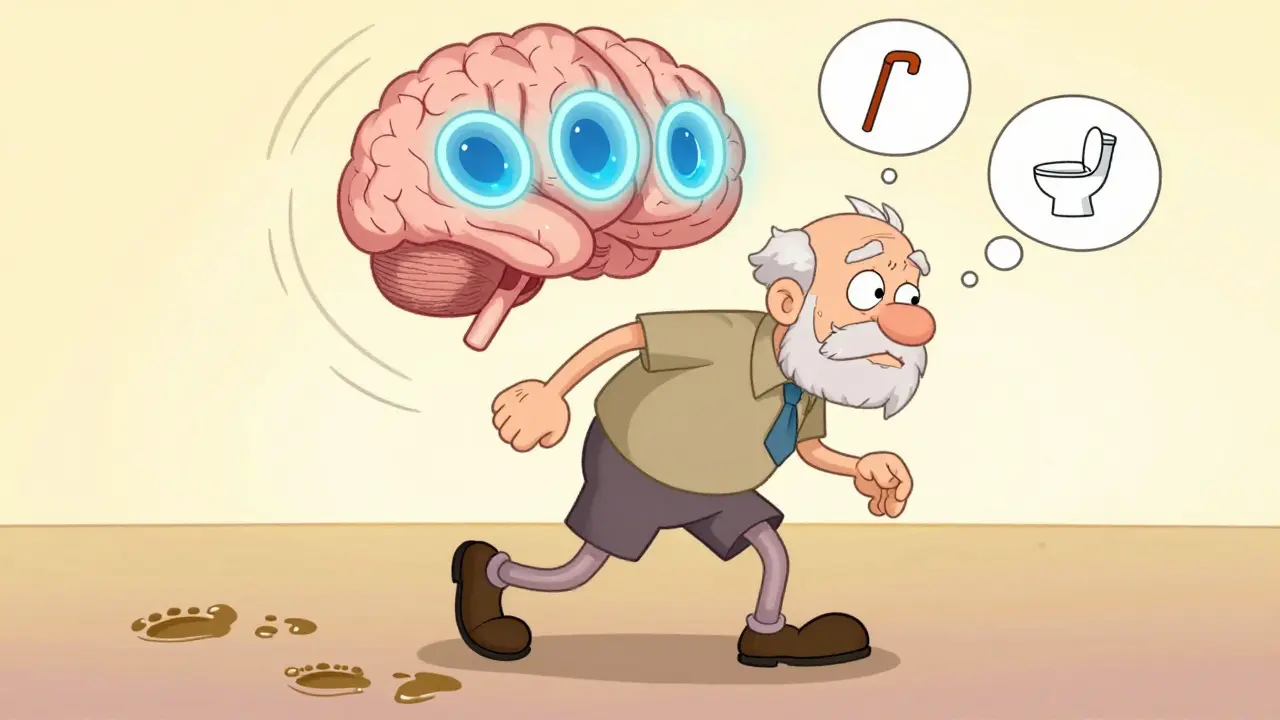
When an older adult starts walking like their feet are stuck to the floor, forgetting names they used to know, and losing control of their bladder, it’s easy to assume it’s just aging. But what if it’s something treatable? That’s the reality of normal pressure hydrocephalus - a condition that mimics dementia but can be reversed with surgery. Yet, most people never hear about it until it’s too late.
What Is Normal Pressure Hydrocephalus?
Normal pressure hydrocephalus, or NPH, happens when too much cerebrospinal fluid (CSF) builds up in the brain’s ventricles. Unlike other types of hydrocephalus, the pressure doesn’t spike. It stays within what doctors call the "normal" range - between 70 and 245 mm H₂O. That’s why it’s so easy to miss. The fluid isn’t causing pressure damage; it’s just crowding the brain, squeezing areas that control walking, thinking, and bladder function. It was first clearly described in 1965 by two neurosurgeons, Salomón Hakim and Raymond Adams. Since then, we’ve learned it affects about 0.4% of people over 65 - and up to 6% of nursing home residents. That’s tens of thousands of older adults in the U.S. alone who might be living with a treatable condition, not just "getting old."The Three Signs You Can’t Ignore
NPH doesn’t show up with one symptom. It shows up as a trio - and you need to see all three to suspect it. But here’s the catch: most people only have one or two.- Gait disturbance - This is the most common and earliest sign. People walk slowly, with short, shuffling steps. Their feet seem glued to the ground. They turn in wide circles, struggle to start walking, and often fall backward. This isn’t just weakness - it’s a brain signal problem. In studies, nearly 100% of confirmed NPH patients have this symptom.
- Cognitive impairment - Think slow thinking, trouble planning, forgetting why you walked into a room, or losing interest in things you used to enjoy. It’s not memory loss like Alzheimer’s. It’s more like your brain is stuck in slow motion. About 73% of NPH patients show this, but it’s often mistaken for dementia.
- Urinary incontinence - This comes later, and only about one-third of patients have it. But when it shows up with the other two, it’s a red flag.
Why It’s So Often Missed
NPH is called the "great masquerader" of geriatric neurology. Doctors see it as Alzheimer’s, Parkinson’s, or just aging. And honestly, the symptoms overlap a lot.- Alzheimer’s starts with memory loss, not walking problems. NPH starts with walking.
- Parkinson’s has tremors and stiffness. NPH has a magnetic gait - like the floor is pulling their feet down.
- Vascular dementia comes after strokes. NPH comes slowly, with no clear event.

How Doctors Diagnose It
There’s no single blood test for NPH. Diagnosis takes a few steps. First, a brain scan - usually an MRI. It shows enlarged ventricles. The key number? Evan’s index. If it’s above 0.3, that’s a sign of ventricular enlargement. MRI also picks up swelling around the ventricles and abnormal fluid flow through the aqueduct - both strong clues. Next, a neuropsychological test. Doctors look at executive function - how well someone plans, switches tasks, or remembers instructions. Tests like the Trail Making Test Part B and Digit Symbol Substitution Test show deficits in 85% of NPH patients. Then comes the CSF tap test. This is critical. A doctor removes 30-50 mL of spinal fluid with a needle in the lower back. Then, they measure how the person walks - before and 30-60 minutes after. If their walking speed improves by 10% or more, it’s a strong sign they’ll respond to a shunt. Studies show this test predicts shunt success with 82% accuracy. Some centers use a more advanced test: external lumbar drainage. A small tube stays in the spine for 2-3 days, draining fluid continuously. If walking and thinking get better during that time, the chances of shunt success jump to 89%.Shunt Surgery: How It Works
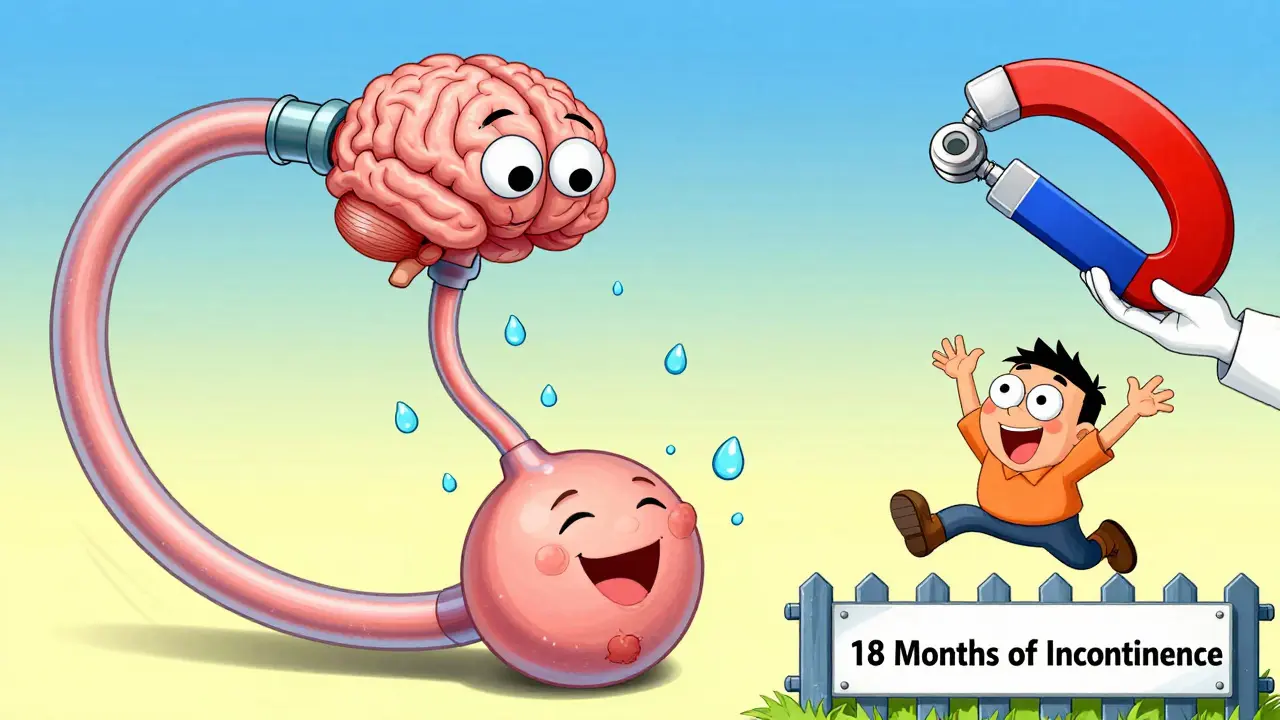
If the tests point to NPH, the only treatment is surgery - a ventriculoperitoneal (VP) shunt. It’s a simple concept: put a tube in the brain’s ventricle, run it under the skin to the belly, and let the body absorb the extra fluid. The system has three parts:- A catheter in the brain
- A catheter in the abdomen
- A valve in between that controls how much fluid drains
Who Benefits Most - and Who Doesn’t
Shunts work for 70-90% of properly selected patients. But not everyone gets better. Success is highest when:- There’s clear gait disturbance
- The CSF tap test shows improvement
- Symptoms have been present for less than 12 months
- Shunt malfunction (15.3% within two years)
- Infection (8.5%)
- Bleeding around the brain (5.7%)
What Happens After Surgery
Recovery isn’t instant. Even if someone feels better right away, it takes weeks for the brain to fully adjust. Physical therapy helps retrain walking. Occupational therapy helps with daily tasks. Follow-up is key. Doctors check the shunt at 2 weeks, 6 weeks, 3 months, and 6 months. They adjust the valve pressure if needed. Many patients need one or two revisions over their lifetime. A 2022 survey by the Hydrocephalus Association of 457 patients showed:- 76% improved walking
- 62% improved thinking
- 58% regained bladder control
- 89% said they were satisfied with the outcome
- 32% needed at least one shunt revision
What’s New in NPH
The field is changing fast. In 2022, the FDA approved the Radionics® CSF Dynamics Analyzer - a device that measures how well the brain absorbs fluid. It’s improving diagnosis accuracy to 89%. In 2023, a new app called the iNPH Diagnostic Calculator went live. It uses 12 clinical factors - walking speed, MRI findings, test results - to predict shunt success with 85% accuracy. Researchers are also testing blood and spinal fluid biomarkers. Three clinical trials are underway to find proteins that signal NPH. Early results show 92% sensitivity. If this works, we could one day diagnose NPH with a simple blood test.What You Should Do
If you or a loved one has:- Unexplained shuffling walk
- Slowed thinking or personality changes
- Bladder control issues that started slowly
Is normal pressure hydrocephalus the same as Alzheimer’s?
No. Alzheimer’s usually starts with memory loss - forgetting names, dates, conversations. NPH starts with walking problems - shuffling, difficulty starting, wide-based steps. Cognitive changes in NPH are more about slow thinking and poor planning, not memory loss. MRI scans also look different. NPH shows enlarged ventricles and fluid buildup; Alzheimer’s shows brain shrinkage. The key difference? NPH can be reversed with a shunt; Alzheimer’s cannot.
Can a CSF tap test diagnose NPH for sure?
Not for sure - but it’s the best predictor we have. Removing spinal fluid and seeing if walking or thinking improves tells doctors if a shunt will likely help. If the person improves by 10% or more in walking speed or cognitive test scores, they have an 82% chance of responding well to surgery. But some people improve temporarily and still don’t benefit from a shunt. That’s why doctors combine this test with MRI and neuropsychological testing.
How long does it take to recover from a shunt surgery?
Most people go home in 2-7 days. But full recovery takes 6-12 weeks. Walking improves first - often within days. Thinking and bladder control take longer, sometimes weeks or months. Physical therapy helps retrain movement. Some patients need multiple valve adjustments in the first year. Patience is key - the brain needs time to adjust to the new fluid balance.
Are shunts permanent? Do they need replacing?
Shunts are meant to be long-term, but they’re not foolproof. About 15% stop working within two years due to blockage or malfunction. Infections happen in about 8.5% of cases. Most patients will need at least one revision over their lifetime. Modern valves are programmable, so pressure can be adjusted without surgery. The average shunt lasts about 6.3 years before needing repair or replacement.
Why isn’t NPH tested for more often?
Because it’s rare and symptoms look like other common conditions - Alzheimer’s, Parkinson’s, aging. Many doctors don’t know the diagnostic criteria. Insurance often denies the CSF tap test or external drainage, which are essential for diagnosis. A 2022 survey found 37% of patients had prior authorization denied for these tests. Without access to these tests, doctors can’t confirm NPH - so they don’t test.
Comments (8)
-
Trevor Whipple January 14, 2026
ok but like… i’ve seen 3 old guys in my dad’s nursing home with this and honestly? they all just got worse after the shunt. one guy started talking to his socks like they were his kids. another peed himself every 20 minutes even after the tube. this isn’t magic, it’s a gamble with a catheter in your brain. why are we acting like it’s a cure-all? it’s not. it’s just another way to spend $80k and hope the brain doesn’t melt.

-
Lethabo Phalafala January 16, 2026
MY MOTHER HAD THIS. I’M STILL SCARRED. SHE WAS WALKING LIKE SHE WAS STUCK IN MOLASSES FOR 18 MONTHS - NO ONE LISTENED. THEN ONE DAY SHE JUST… STOPPED. SLEPT FOR THREE DAYS. WOKE UP AND ASKED FOR PASTA AND SAID SHE FORGOT HOW TO LAUGH. THE SHUNT FIXED HER WALKING IN 48 HOURS. BUT THE MEMORY? NEVER CAME BACK. I’M SO GLAD THIS POST EXISTS. PLEASE - IF YOUR PARENT IS WALKING LIKE A ROBOT, DON’T WAIT. BECAUSE THE BRAIN DOESN’T WAIT.

-
Damario Brown January 17, 2026
so let me get this straight - you’re saying a 70-year-old with a shunt is ‘cured’ of dementia? bro. the brain doesn’t work like that. you drain fluid, sure, but if there’s already neurodegeneration? congrats, you’ve just bought yourself a 6-month grace period before the real dementia kicks in. also, 15% shunt failure? that’s not a complication - that’s a design flaw. and why are we still using 1970s tech to fix a 21st-century problem? this is why medicine is broken.

-
sam abas January 18, 2026
everyone’s acting like this is some revolutionary breakthrough but honestly? it’s just the same old ‘let’s stick a tube in someone’s head and hope for the best’ approach. i’ve read the studies. the ‘improvement’ is usually just temporary motor boost - like giving a tired person caffeine. the cognitive stuff? barely budges. and don’t even get me started on the insurance denials - 37%? that’s not bureaucracy, that’s systemic neglect. also, why is everyone ignoring that 30% of patients get worse after surgery? they just don’t talk about that. because the narrative is ‘miracle cure’ - not ‘risky, expensive, often futile.’

-
John Pope January 19, 2026
isn’t it wild how we’ve turned a biological fluid imbalance into a moral crusade? ‘don’t assume it’s aging’ - as if aging is some moral failing. we’re not fighting a disease here, we’re fighting the fear of death. we put tubes in skulls because we refuse to accept that the body is a temporary vessel. the shunt doesn’t cure NPH - it just delays the inevitable. and yet we glorify it like it’s a spiritual awakening. the real tragedy isn’t NPH. it’s that we’ve forgotten how to let people go with dignity instead of turning them into medical experiments.

-
Clay .Haeber January 20, 2026
oh wow. a shunt. how very… *medical*. next you’ll tell me we should give elderly people IVs of hope and a Spotify playlist of 1950s jazz. let’s be real - if your grandma’s walking like she’s trying to escape a sinkhole, maybe she just needs better shoes and someone to hold her hand. but no, we gotta drill into her skull and install a $50k plumbing system. i mean, sure, it’s ‘reversible’ - but only if you’re rich, white, and have a neurologist who still believes in miracles. congrats, medicine: you turned grief into a capital investment.

-
Priyanka Kumari January 21, 2026
thank you for writing this with such clarity. i’m a nurse in a geriatric unit and i see this every week - families who think their loved one is just ‘forgetful’ when it’s actually a gait issue that’s been ignored for a year. the CSF tap test is underused because it’s ‘invasive’ - but it’s safer than a colonoscopy. i’ve seen patients walk out of the hospital like they’re 40 again. please, if you’re reading this - ask for the test. don’t wait for a ‘definitive diagnosis.’ the window is small, but it’s open. and you deserve to help your person live better, not just longer.

-
Nelly Oruko January 22, 2026This needs to be mandatory reading for every ER doctor.
