
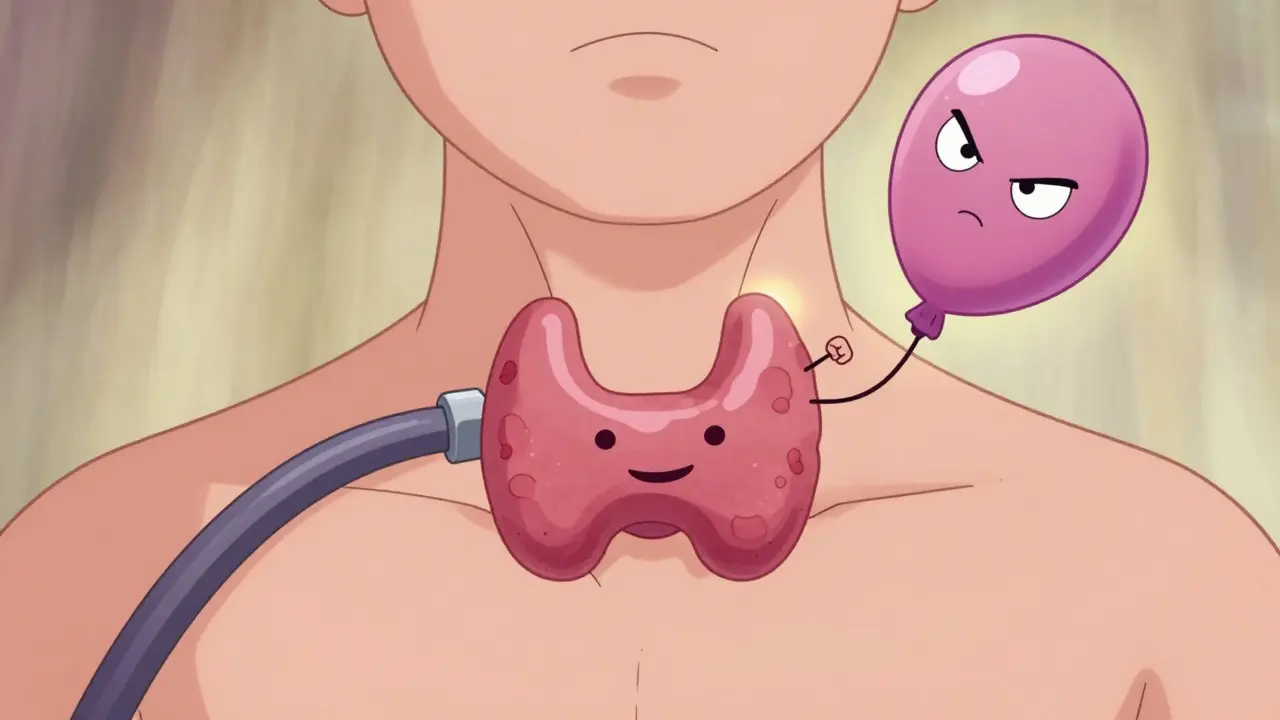
Hashimoto’s thyroiditis is the most common reason people end up with an underactive thyroid in the U.S. It’s not just a simple hormone imbalance - it’s your own immune system turning against your thyroid gland. Think of it like a friendly fire incident inside your body: the immune system, which should protect you, starts attacking the thyroid, slowly destroying its ability to make the hormones your body needs to function. Over time, this leads to hypothyroidism - a condition where your metabolism slows down, energy drops, and everyday tasks feel harder than they should.
How Hashimoto’s Starts and Progresses
First described in 1912 by Japanese doctor Hakaru Hashimoto, this condition doesn’t show up overnight. It creeps in over years. In the beginning, you might feel fine. Your thyroid is still working, just under pressure. But as immune cells keep attacking, the gland gets scarred and shrinks. Eventually, it can’t keep up. That’s when symptoms like fatigue, weight gain, cold intolerance, dry skin, and brain fog start showing up.
Women are 5 to 10 times more likely to develop Hashimoto’s than men. It often shows up between ages 30 and 50, but it can strike at any age. Genetics play a role - if someone in your family has an autoimmune disease like type 1 diabetes, rheumatoid arthritis, or celiac disease, your risk goes up. Environmental triggers like chronic stress, viral infections, or excessive iodine intake can push the immune system over the edge in people who are already predisposed.
What makes Hashimoto’s different from other causes of hypothyroidism is the presence of thyroid antibodies. Most people with this condition have high levels of thyroid peroxidase antibodies (TPOAb). These antibodies are like fingerprints - they tell doctors this isn’t just a random hormone dip. It’s an autoimmune problem. And once they’re present, they usually stay there. That’s why testing for them once is enough. Repeating antibody tests over time doesn’t help guide treatment. The focus isn’t on how high the antibodies are - it’s on how well your thyroid is working right now.
Why TSH Is the Gold Standard for Monitoring
If you’ve been diagnosed with Hashimoto’s, you’ve probably heard the word TSH more times than you can count. TSH stands for thyroid-stimulating hormone. It’s made by your pituitary gland, sitting at the base of your brain. Its job? To tell your thyroid, “Make more hormones.” When your thyroid is weak, your pituitary works overtime, pumping out more TSH to try to get it going. So high TSH = your thyroid isn’t doing its job.
That’s why TSH is the single most important number your doctor checks. The American Thyroid Association and the American Association of Clinical Endocrinologists both say: for primary hypothyroidism - the kind caused by Hashimoto’s - TSH is the most reliable way to know if your treatment is working. You don’t need to check free T4 or T3 every time. Not unless something’s off. The Cleveland Clinic puts it simply: “In a patient with primary hypothyroidism and no suspicion of pituitary abnormality, a serum TSH is sufficient.”
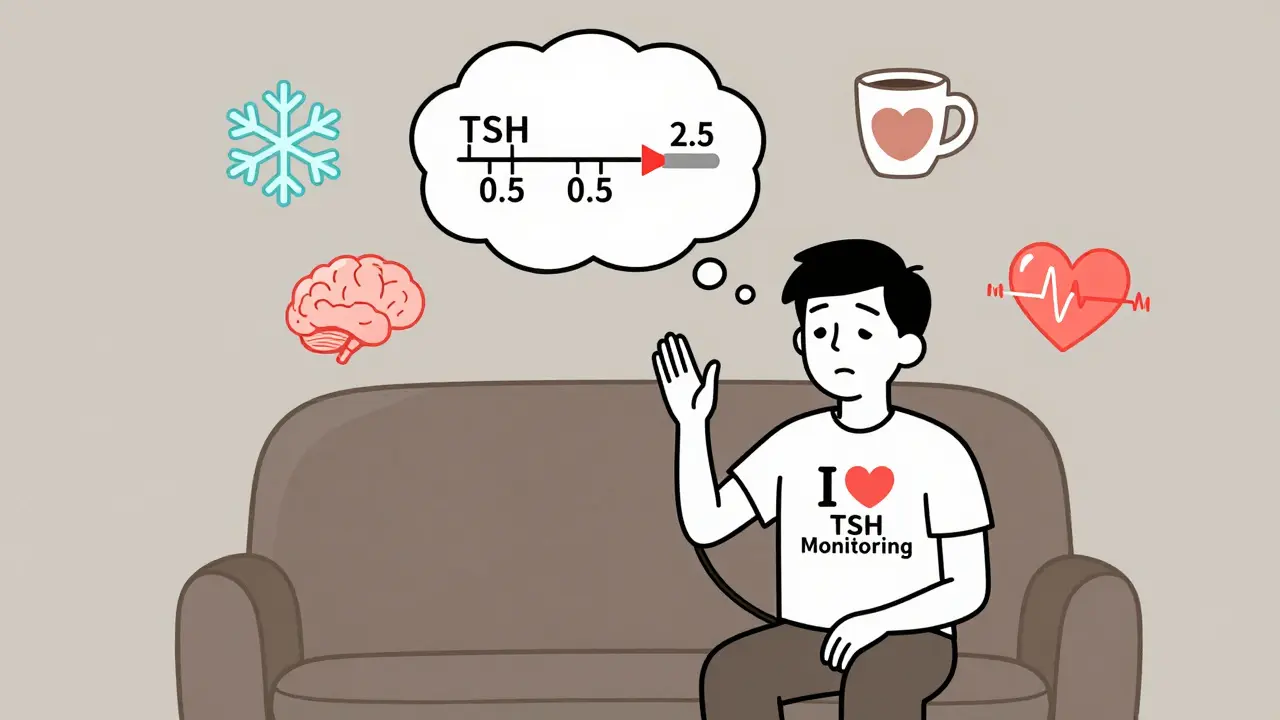
Most labs consider a normal TSH range between 0.4 and 4.0 mIU/L. But here’s the catch: that range is based on the general population. Your ideal level might be lower. Some people feel best with a TSH between 0.5 and 2.5. Others, especially older adults, do fine with levels up to 6.0. The goal isn’t to hit the middle of the range - it’s to find the level where you feel your best, without side effects.
Starting and Adjusting Levothyroxine
Once Hashimoto’s leads to hypothyroidism, the treatment is straightforward: levothyroxine. It’s a synthetic version of T4, the main hormone your thyroid should be making. Brands like Synthroid and Levoxyl are common, but most people take generics - they’re just as effective and cost a fraction of the price.
Doctors usually start with a low dose, especially if you’re older or have heart problems. For a healthy adult, the starting dose is about 1.4 to 1.8 micrograms per kilogram of body weight. That usually means 25 to 50 mcg per day. If you’re just starting out with mild hypothyroidism, you might begin at 25 mcg. If you’re significantly underactive, maybe 75 mcg.
Here’s what most people don’t expect: it takes 6 to 8 weeks for your body to fully adjust to a new dose. Why? Because levothyroxine has a long half-life - it stays in your system for weeks. Your pituitary gland also needs time to respond. If you check your TSH too soon, you’ll just get a misleading number. That’s why your doctor won’t change your dose every few weeks. Waiting 6 to 8 weeks is not just standard - it’s biological necessity.
After the first test, if your TSH is still high, you’ll likely get a small increase - usually 12.5 to 25 mcg. Then you wait again. This back-and-forth can be frustrating. Many patients report feeling worse during dose adjustments - tired, anxious, or bloated. That’s normal. It’s your body recalibrating. The key is patience. Most people find their sweet spot within 3 to 6 months.
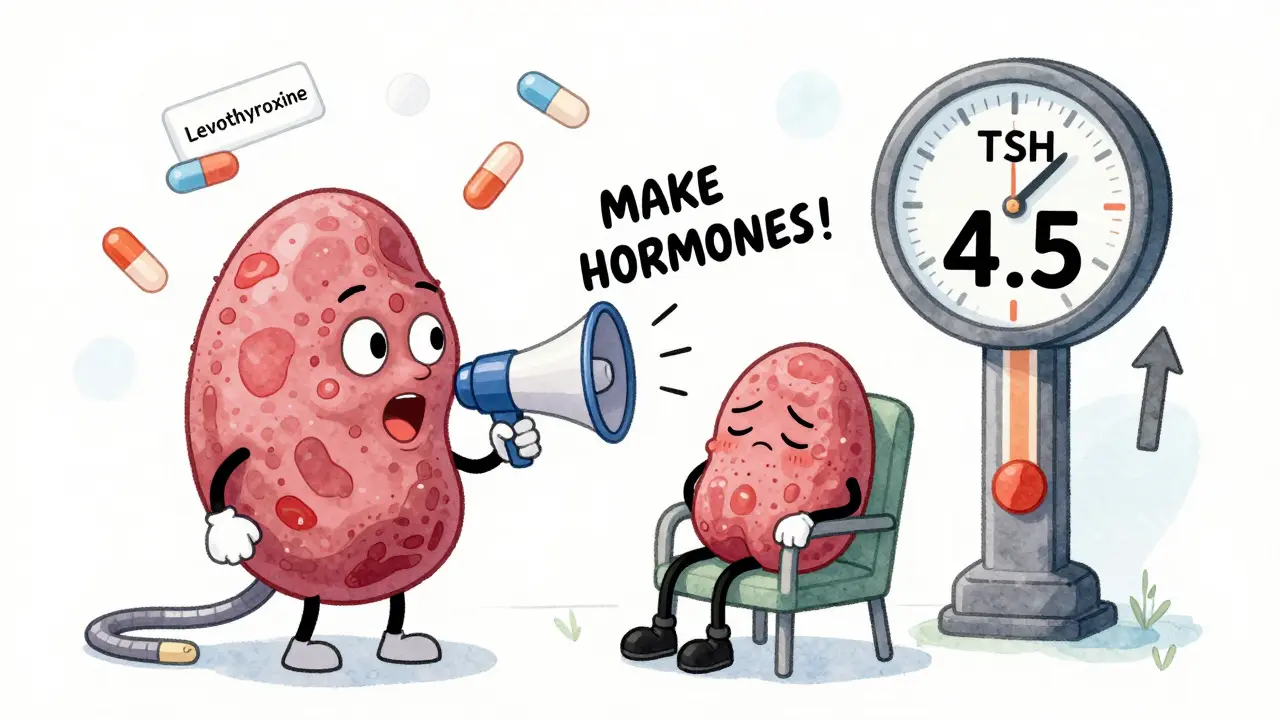
When and How Often to Test
Here’s the testing schedule most doctors follow:
- Test TSH 6 to 8 weeks after starting levothyroxine
- Test again 6 to 8 weeks after any dose change
- Once stable, test once a year
Some guidelines, like those from the American Academy of Family Physicians, say you can test as early as 4 to 6 weeks after starting. But the consensus is clear: 6 to 8 weeks gives the most accurate picture. If you’re pregnant, everything changes. Your body’s demand for thyroid hormone spikes. If you have Hashimoto’s and are pregnant, you’ll need testing every 4 weeks until week 20. After that, every 6 to 8 weeks. Untreated or poorly managed hypothyroidism during pregnancy raises the risk of miscarriage, preterm birth, and developmental issues in the baby.
Other situations that require more frequent testing:
- Starting or stopping estrogen pills, birth control, or hormone therapy
- Beginning or ending iron, calcium, or proton pump inhibitor (PPI) medications - these can block levothyroxine absorption
- Weight loss or gain of more than 10% of your body weight
- Switching levothyroxine brands - even generics can vary slightly in absorption
And yes, the FDA cracked down on levothyroxine manufacturing in 2018 because inconsistent potency between batches used to cause TSH swings. Now, brands have to meet tighter standards. Still, if you switch from one generic to another and notice symptoms returning, tell your doctor. You might need a dose tweak.
What to Watch For - Symptoms of Under- or Over-Treatment
TSH tells you what’s happening inside, but your body tells you how you’re feeling. Don’t ignore symptoms, even if your TSH is “in range.”
If your TSH is too high (under-treated):
- Constant fatigue
- Weight gain despite eating the same
- Depression or brain fog
- Constipation
- Feeling cold all the time
If your TSH is too low (over-treated):
- Anxiety or irritability
- Heart palpitations
- Insomnia
- Unexplained weight loss
- Shaky hands
Some patients insist they feel better with a TSH below 1.0. That’s not always wrong. A 2023 study in JAMA Internal Medicine found that people with a specific gene variant (DIO2) had better energy and mood when their TSH was kept in the lower half of normal. If you’ve been on the same dose for months and still feel off, talk to your doctor about adjusting toward 0.5-2.0 mIU/L - but only if you’re not having side effects.
What Doesn’t Matter - and What You Can Ignore
There’s a lot of noise out there. You’ll hear people say you need to test your T3, your reverse T3, your thyroid antibodies monthly, or that you need natural desiccated thyroid (NDT) instead of levothyroxine. Let’s clear this up.
- Don’t test T3 or reverse T3 routinely. In Hashimoto’s, T3 levels often stay normal even when T4 is low. Your body converts T4 to T3 as needed. Testing T3 adds cost and confusion without changing treatment.
- Don’t retest thyroid antibodies. Once you know you have them, there’s no need to check again. They don’t predict how fast your thyroid will fail or how well you’ll respond to treatment.
- Don’t switch to NDT unless you’ve tried everything else. Natural thyroid extracts (like Armour Thyroid) contain both T4 and T3. But multiple studies, including a 2022 Cochrane Review, show no consistent benefit over levothyroxine alone. They’re harder to dose precisely, and T3 can cause spikes in heart rate. Only consider it if you’ve tried levothyroxine at the right dose and still have symptoms - and even then, it’s not guaranteed to help.
The bottom line: Hashimoto’s is a lifelong condition, but it’s one of the easiest endocrine disorders to manage. You don’t need fancy tests. You don’t need special diets (though some people feel better cutting gluten - that’s personal, not proven). You just need consistent TSH monitoring and the right dose of levothyroxine.
What’s Changing in 2026
Things are moving. The American Thyroid Association is updating its pregnancy guidelines to use trimester-specific TSH targets: 0.1-2.5 in the first trimester, 0.2-3.0 in the second, and 0.3-3.0 in the third. That’s a big shift from the old “keep it under 2.5” rule.
There’s also new home TSH testing kits approved by the FDA, like ThyroChek. But most doctors still recommend lab tests. Why? Because home tests aren’t accurate enough at very low TSH levels - the kind you need to watch for in older adults or those on high doses. Until they improve, stick with your doctor’s lab.
One thing’s certain: the future of Hashimoto’s care isn’t about more tests. It’s about smarter dosing, better patient education, and recognizing that TSH is your best tool - if you use it right.
Can Hashimoto’s be cured?
No, Hashimoto’s thyroiditis cannot be cured. The autoimmune attack on the thyroid continues for life. But the resulting hypothyroidism can be fully managed with daily levothyroxine. Most people live normal, healthy lives once their TSH is properly stabilized. The goal isn’t to eliminate the antibodies - it’s to replace the hormones your thyroid can no longer make.
Why does my TSH keep changing even though I take my pill every day?
Several things can affect how well your body absorbs levothyroxine. Taking it with food, coffee, calcium, iron, or certain heartburn medications like omeprazole can block absorption. Even switching between generic brands can cause small variations. That’s why your doctor asks you to take it on an empty stomach, wait 30-60 minutes before eating, and avoid supplements for several hours. If your TSH keeps drifting, review your routine with your doctor.
Should I take my thyroid medication at night instead of in the morning?
Some studies suggest taking levothyroxine at bedtime may improve absorption for certain people, especially those who struggle with morning absorption due to food or supplements. But consistency matters more than timing. Whether you take it in the morning or night, do it the same way every day - on an empty stomach, with water, and at least 30 minutes before eating. Talk to your doctor before switching times.
I feel fine, but my TSH is 4.5. Should I increase my dose?
Not necessarily. If you have no symptoms and your TSH is just above 4.0, your doctor might choose to watch and wait, especially if you’re over 65. For younger adults, a TSH of 4.5 usually means your dose needs a small increase - but it’s not an emergency. The goal is to balance lab numbers with how you feel. Don’t rush to adjust based on one number. Wait for the 6-8 week retest after any change.
Do I need to avoid gluten if I have Hashimoto’s?
There’s no strong evidence that gluten causes Hashimoto’s or makes it worse for everyone. But some people with Hashimoto’s also have celiac disease - an autoimmune reaction to gluten. If you have symptoms like bloating, diarrhea, or unexplained anemia, get tested for celiac. If you’re negative, going gluten-free won’t help your thyroid. Don’t eliminate entire food groups without a reason - it can lead to nutrient gaps.
Comments (14)
-
Evan Smith January 8, 2026
So let me get this straight - we’re just supposed to ignore the antibodies and trust a single number from a machine that doesn’t know I cried in the shower last Tuesday? Cool. Cool cool cool.

-
Joanna Brancewicz January 9, 2026
TSH is the anchor. Antibodies are just historical artifacts. T3/RT3 testing? Overkill. NDT? Not worth the cardiac rollercoaster. This post nailed it.

-
Lois Li January 10, 2026
I’ve been on levothyroxine for 7 years and still get nervous when my TSH hits 3.8. I feel fine but my brain screams ‘something’s off’. Maybe I’m just anxious. Or maybe my pituitary hates me.

-
christy lianto January 11, 2026
For real though - if you’re still tired after 6 weeks on a new dose, don’t accept ‘it’s normal’. Push for a tweak. Your body isn’t broken - it’s just under-resourced. You deserve to feel like yourself again.

-
Kristina Felixita January 12, 2026
gluten? maybe? i mean i tried it and my bloating went away but then i ate pizza and felt fine so idk??? maybe its all in my head???

-
swati Thounaojam January 13, 2026
My doctor said TSH 4.5 is fine. I’m 32, exhausted, gaining weight. He didn’t listen. I left.

-
Annette Robinson January 15, 2026
Consistency in dosing matters more than timing. Taking it with coffee? That’s like putting diesel in a hybrid. Don’t do it.

-
Luke Crump January 15, 2026
What if the whole TSH paradigm is wrong? What if the pituitary is the problem, not the thyroid? What if we’ve been treating the symptom of a symptom? What if the real cure is… not taking a pill at all?

-
Aubrey Mallory January 16, 2026
That guy who says TSH doesn’t matter? He’s not wrong - he’s just not listening. Your symptoms are data. TSH is data. Both matter. Stop letting dogma silence your body.

-
Dave Old-Wolf January 17, 2026
I took my pill at night for 3 months. My TSH dropped from 4.2 to 1.8. I slept better too. My doctor was skeptical but now he’s asking me how I did it.

-
Prakash Sharma January 17, 2026
Why do Americans waste so much money on pills? In India, we use ashwagandha and yoga. Your thyroid is not a broken machine - it’s a stressed soul.

-
Donny Airlangga January 17, 2026
I had my dose adjusted 3 times in 6 months. Each time I felt worse before better. It’s like your body is learning a new language. Give it time.

-
Molly Silvernale January 18, 2026
Hashimoto’s isn’t a disease - it’s a rebellion. Your immune system is screaming, ‘I’m tired of being ignored!’ And levothyroxine? It’s not a cure - it’s a ceasefire. We’re just buying time… until the next uprising.

-
Ken Porter January 19, 2026
Stop overcomplicating it. Take the pill. Get the TSH. Don’t be a drama queen. You’re not special. Your thyroid isn’t a sacred temple.
