

Beta-Blocker Safety Checker for Asthma
Personalized Safety Assessment
Select your asthma severity and medication to determine if your beta-blocker is safe to use with asthma.
For years, doctors told people with asthma to avoid beta-blockers at all costs. The warning was clear: these heart medications could shut down your airways, trigger a severe asthma attack, or even make your rescue inhaler useless. But today, that advice is changing - and not just a little. New research is flipping the script on what we thought we knew about beta-blockers and asthma. The truth? Beta-blockers aren’t all dangerous for asthmatics. Some can be used safely - if you know which ones and how.
Why Beta-Blockers Were Banned for Asthma
It all started with how these drugs work. Beta-blockers block adrenaline - the hormone that speeds up your heart, raises your blood pressure, and gives you that rush of energy. That’s why they’re used for heart conditions like high blood pressure, after a heart attack, or irregular heart rhythms. But adrenaline doesn’t just act on the heart. It also relaxes the muscles in your lungs, helping you breathe easier. That’s thanks to beta-2 receptors in your airways.
Early beta-blockers like propranolol didn’t care where they acted. They blocked beta-1 receptors (in the heart) AND beta-2 receptors (in the lungs). When those lung receptors got blocked, the airways tightened. That’s bronchospasm - the same thing that happens during an asthma attack. So, if you had asthma and took a non-selective beta-blocker, your breathing could get worse. In some cases, it got dangerously worse.
The British National Formulary (BNF) said it plainly: beta-blockers should usually be avoided in asthma patients. And for decades, that was the rule.
The Shift: Not All Beta-Blockers Are the Same
Here’s the key insight: not all beta-blockers are created equal. There’s a big difference between non-selective and cardioselective ones.
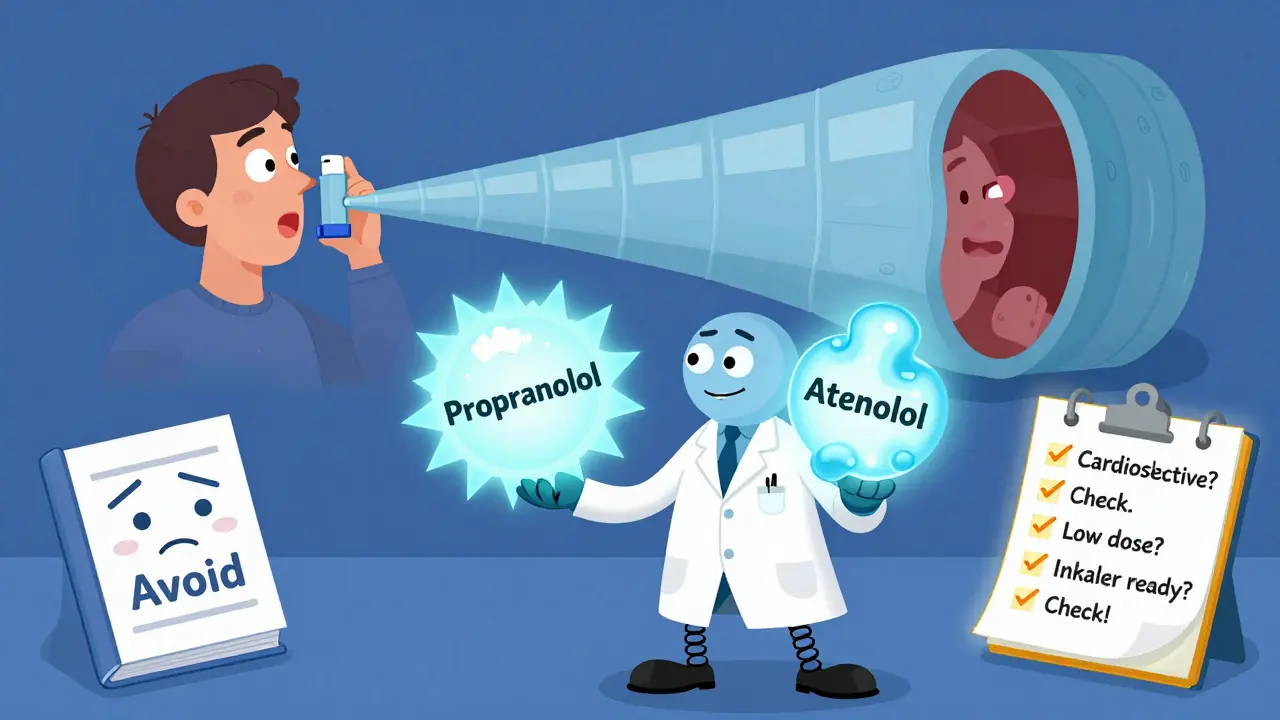
Cardioselective beta-blockers - like atenolol, metoprolol, and bisoprolol - are designed to mostly target the heart. They have 20 times more affinity for beta-1 receptors than beta-2 receptors. That means they leave your lungs mostly alone. This isn’t theory. It’s been tested in real people with asthma.
A meta-analysis of 29 clinical trials looked at what happened when people with asthma or COPD took single doses of these drugs. Those on cardioselective beta-blockers saw their lung function drop by just 7.46% on average - and it bounced right back after using their inhaler. Non-selective ones? A 10% drop. Worse, none of the 240 patients in these studies had increased wheezing or symptoms.
Even more telling: in longer-term studies, people took cardioselective beta-blockers daily for weeks. No one had a spike in asthma attacks. No drop in lung function that didn’t recover. And crucially, their rescue inhalers still worked perfectly.
Atenolol: The Top Choice for Asthma Patients
Among the cardioselective options, one stands out: atenolol. In a direct head-to-head study, 14 hypertensive patients with asthma were given both atenolol and metoprolol. Both lowered blood pressure equally. But atenolol caused significantly less bronchospasm.
Patients on atenolol had:
- More asthma-free days
- Fewer moderate-to-severe wheezing episodes
- Less drop in evening peak flow
That’s not a fluke. A separate review of 330 asthma patients on cardioselective beta-blockers found zero reports of severe bronchospasm or death. The European Journal of Clinical Pharmacology even recommends atenolol as the preferred choice when beta-blockers are needed in asthma patients - especially when paired with a beta-2 stimulant like albuterol.
What About the Old Warnings?
So why do some guidelines still say ‘avoid’? Because caution still matters. The BNF hasn’t changed its stance. It says beta-blockers should only be used in asthma patients if absolutely necessary - and only if the asthma is well-controlled, the drug is cardioselective, the dose is low, and the patient is monitored by a specialist.
That’s not outdated. It’s smart. A person with severe, uncontrolled asthma shouldn’t start beta-blockers without a plan. But for someone with mild to moderate asthma who’s had a heart attack? The risk of not taking a beta-blocker is far greater than the risk of taking the right one.
Post-heart attack, beta-blockers cut cardiovascular death risk by up to 34%. For someone with asthma and heart disease, avoiding them could be deadlier than the risk of bronchospasm.
How Doctors Decide: A Practical Approach
If you have asthma and need a beta-blocker, here’s what actually happens in real clinical practice:
- Start with a cardioselective beta-blocker - atenolol is often first choice.
- Use the lowest effective dose.
- Monitor lung function - FEV1 (a lung test) is checked before and 1-2 weeks after starting.
- Make sure your rescue inhaler (albuterol) is always available and you know how to use it.
- Watch for early signs: coughing, wheezing, or shortness of breath that’s worse than usual.
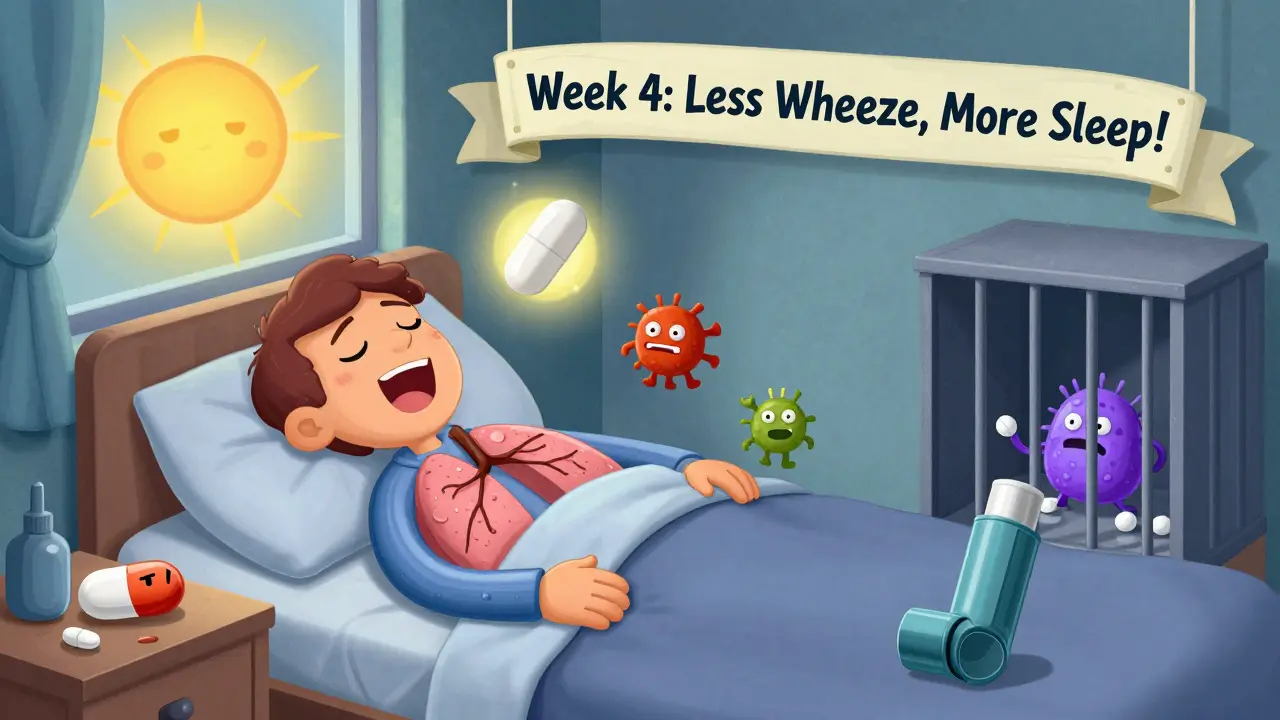
Studies show that even after weeks of daily use, people on cardioselective beta-blockers still respond normally to albuterol. Their airways don’t become resistant. The rescue inhaler still works - because the drug isn’t blocking the lung receptors enough to interfere.
What to Avoid
Some beta-blockers are off-limits for asthma patients:
- Propranolol - non-selective. High risk.
- Nadolol - non-selective. Avoid.
- Timolol - often used in eye drops for glaucoma. Can still be absorbed and cause issues.
- Labetalol - blocks both alpha and beta receptors. Can tighten airways.
If you’re on any of these and have asthma, talk to your doctor. Don’t stop suddenly - but do get a safer alternative.
Long-Term Surprises: Beta-Blockers Might Help Your Lungs
Here’s the most surprising part: long-term use of beta-blockers might actually help asthma - not hurt it.
Animal studies show that while the first few days of beta-blocker use might increase airway sensitivity, after weeks or months, inflammation in the airways goes down. Some beta-blockers, like celiprolol, have even been shown to block the airway-tightening effects of other beta-blockers.
This suggests that for some people, taking a cardioselective beta-blocker long-term might reduce asthma flare-ups over time. It’s not proven yet in large human trials - but it’s a compelling clue that the old fear might be based on short-term reactions, not long-term effects.
Bottom Line: It’s Not ‘Never’ - It’s ‘Carefully’
If you have asthma and need a beta-blocker for your heart, you don’t have to say no. You just need to say yes to the right kind.
Cardioselective beta-blockers - especially atenolol - are safe for most people with mild to moderate asthma. They don’t cause more attacks. They don’t make inhalers useless. And they save lives.
The key? Work with your doctor. Don’t self-prescribe. Don’t assume all beta-blockers are the same. And never skip your rescue inhaler - even if you feel fine.
For millions of people with both heart disease and asthma, this isn’t about choosing between two conditions. It’s about managing both - safely.
Can beta-blockers cause asthma attacks?
Yes - but only certain types. Non-selective beta-blockers like propranolol can trigger bronchospasm by blocking beta-2 receptors in the lungs, leading to airway tightening. Cardioselective beta-blockers like atenolol and bisoprolol are much less likely to cause this because they mostly target the heart. Studies show no increase in asthma symptoms in patients using cardioselective agents under medical supervision.
Is atenolol safe for people with asthma?
Yes, atenolol is considered one of the safest beta-blockers for people with asthma. Direct studies comparing it to metoprolol found that atenolol caused significantly less bronchospasm, fewer asthma symptoms, and better lung function outcomes. It’s often the preferred choice when beta-blockade is needed in asthma patients, especially when combined with a rescue inhaler.
Can I still use my inhaler if I take a beta-blocker?
Yes - if you’re taking a cardioselective beta-blocker. Research shows that rescue inhalers like albuterol remain fully effective. In fact, one study found that patients on bisoprolol had the same bronchodilator response to albuterol as those on placebo. This is not true for non-selective beta-blockers, which can reduce the effectiveness of beta-agonist inhalers.
Are there any beta-blockers I should never take if I have asthma?
Yes. Avoid non-selective beta-blockers like propranolol, nadolol, and timolol, as well as labetalol. These block beta-2 receptors in the lungs and can cause severe bronchospasm. Even timolol eye drops can be absorbed into the bloodstream and pose a risk. Always check with your pharmacist or doctor before starting any new medication.
Do I need to get lung tests before starting a beta-blocker?
If you have asthma and are being considered for a beta-blocker, yes. Your doctor should check your lung function, usually with an FEV1 test, before starting and again after 1-2 weeks. This helps catch any early signs of airway narrowing. If your FEV1 drops more than 20%, the medication may need to be adjusted or changed.
Can beta-blockers help asthma over time?
Emerging research suggests they might. Animal studies show that while short-term beta-blocker use can increase airway sensitivity, long-term use appears to reduce airway inflammation and hyperresponsiveness. One drug, celiprolol, even blocked the airway-tightening effects of other beta-blockers. While human data is still limited, this could mean that for some, long-term cardioselective beta-blocker use may actually improve asthma control.
Comments (13)
-
Elaine Parra March 25, 2026This is such a load of pseudoscience dressed up as medical advice. Beta-blockers have been proven to worsen asthma in clinical settings for decades. The fact that you're pushing atenolol as 'safe' is dangerous. People are going to die because you're oversimplifying complex physiology. Stop pretending this is a breakthrough when it's just wishful thinking.

-
Anil Arekar March 25, 2026While I appreciate the effort to update clinical perspectives, one must approach this with extreme caution. In many parts of the world, including India, access to specialist monitoring is limited. Even if the data suggests safety, real-world implementation without proper follow-up can lead to tragic outcomes. The principle of 'first, do no harm' must remain paramount.

-
Linda Foster March 27, 2026The evidence presented here is compelling and aligns with recent guidelines from the European Respiratory Society. Cardioselective beta-blockers, particularly atenolol, have demonstrated a favorable safety profile in patients with stable, mild-to-moderate asthma. The key remains careful patient selection and monitoring. This is not a blanket endorsement but a nuanced refinement of practice.

-
Rama Rish March 27, 2026my doc put me on metoprolol last year and i was scared to death but my lungs never acted up. i still use my inhaler like normal. maybe the fear is worse than the drug?

-
Kevin Siewe March 27, 2026I’ve had patients with COPD and post-MI on bisoprolol for over five years now. None had worsening respiratory symptoms. The fear around beta-blockers in asthma is real, but it’s often based on outdated data. A well-monitored trial with a cardioselective agent can be life-saving. Don’t let old warnings prevent good care.

-
Darlene Gomez March 28, 2026It’s fascinating how medicine evolves. We used to bleed people for infections, now we’re realizing that blocking one receptor doesn’t mean shutting down an entire system. The body’s compensatory mechanisms are smarter than we thought. Maybe the real danger isn’t the drug-it’s our reluctance to update our thinking.

-
Danielle Arnold March 29, 2026So… you’re telling me the same doctors who told us to avoid these for 40 years are now magically right? 🤔

-
Donna Fogelsong March 31, 2026Big Pharma pushed this narrative because beta-blockers are profitable. The real cause of asthma exacerbations is glyphosate in our food and fluoride in the water. No one talks about the 37 studies funded by AstraZeneca that 'disappear' when you dig deep. The system is rigged. Your inhaler won’t work because the receptors are already poisoned.

-
Seth Eugenne April 1, 2026This is such a relief to read. I’ve been on bisoprolol for a year with asthma and was terrified to tell anyone. Seeing the data reassures me I’m not alone. 🙏 Stay safe, everyone. Your heart and lungs can both be cared for.

-
Alex Arcilla April 3, 2026so like… if i take atenolol and still wheeze… is that the drug or did i just eat too much pizza? idk man. the docs say one thing, the internet says another, and my lungs are just vibin'.

-
Blessing Ogboso April 3, 2026In Nigeria, we have very few pulmonologists and even fewer cardiologists who understand the intersection of asthma and cardiovascular disease. While the science here is sound, the infrastructure to safely implement it is virtually nonexistent. We need education, not just new guidelines. Without trained personnel to monitor FEV1, even the safest drug becomes a risk. This isn't just about pharmacology-it's about equity in healthcare access.

-
Caroline Dennis April 4, 2026The beta-2 receptor blockade threshold is dose-dependent. At therapeutic cardiac doses, selectivity holds. The 7.46% FEV1 drop is statistically insignificant in context. What matters is clinical outcomes: no increase in ER visits, no intubations, no mortality. The data is robust. Stop overinterpreting spirometry.

-
Zola Parker April 4, 2026You say 'cardioselective' like it's magic. But what if your heart is in your lungs? What if your sympathetic nervous system doesn't read the label? Science is a story we tell ourselves until the next study says otherwise. I'll stick with my yoga and turmeric.
