
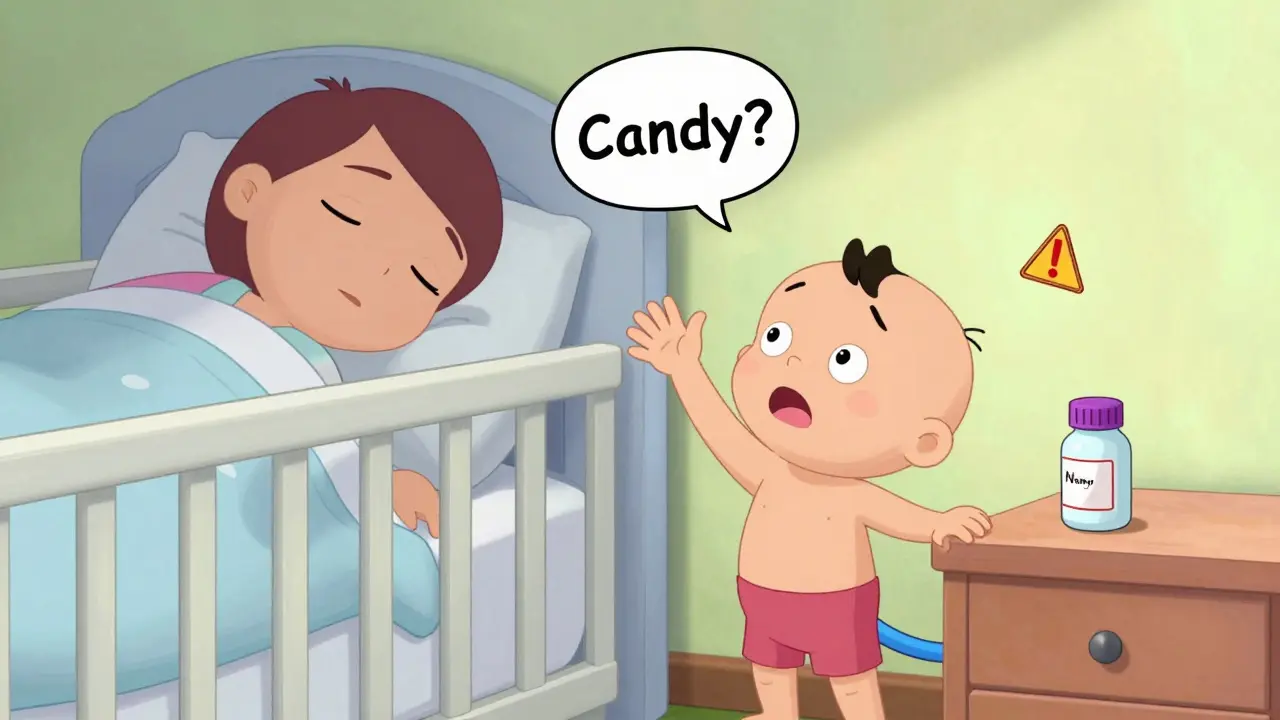
Every year in the U.S., about 60,000 children under five end up in the emergency room because they got into medicine they weren’t supposed to. Most of the time, it’s not because the medicine was left out on purpose - it’s because it was within reach, within sight, or just a quick grab away. Medication poisoning isn’t rare. It’s common. And it’s preventable.
Medicines Are Everywhere - And So Are the Risks
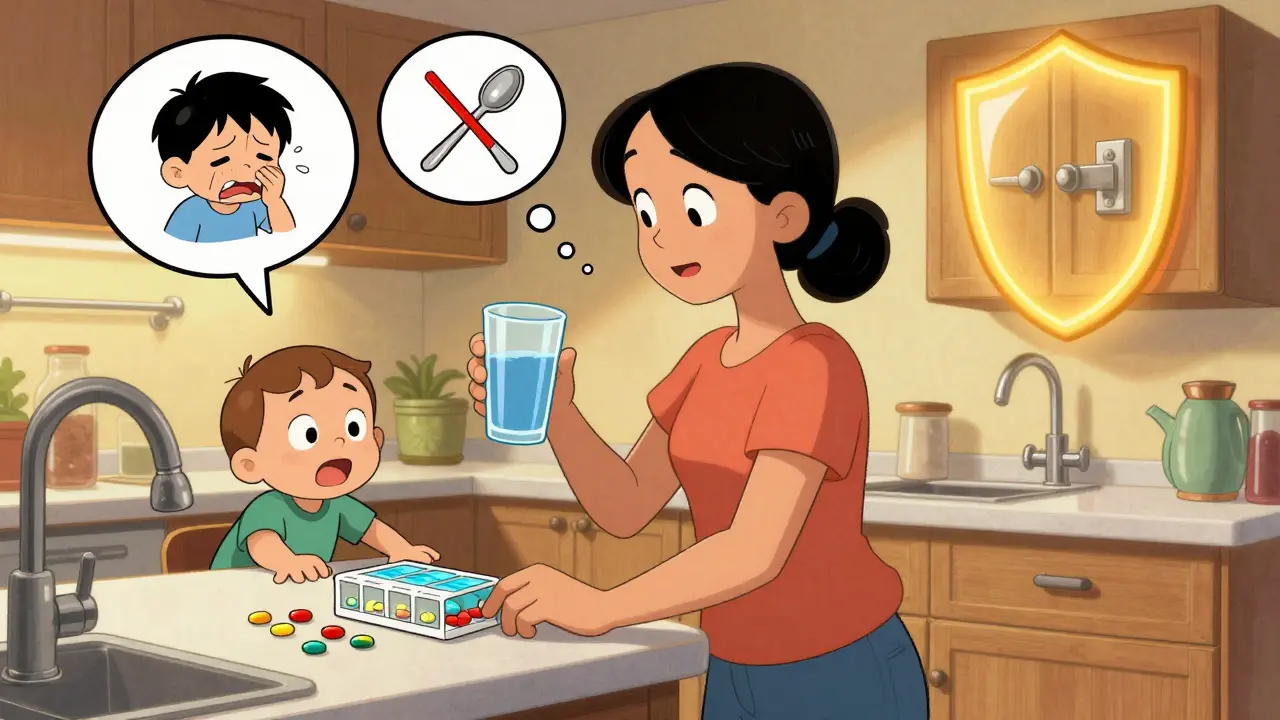
You might think your medicine is safe if it’s in a bottle with a child-resistant cap. But here’s the truth: child-resistant doesn’t mean childproof. A 2020 JAMA study found that even with those caps, kids can still get into medicine in under 10 seconds if they’re determined - and toddlers are incredibly determined. The biggest danger spots? Nightstands. Dressers. Purses. Diaper bags. Kitchen counters. A 2023 AGC Pediatrics bulletin showed that 78% of accidental exposures happen because medicine was left on a nightstand or dresser - often right next to where a parent takes their own meds before bed. Another 15% come from bags left on the floor. One mom in Houston told me she found her 2-year-old with half a bottle of children’s ibuprofen after her purse, left on the couch, had spilled during a nap. Even if you think you’re being careful, you might not be. Sixty-eight percent of incidents happen during the brief moment you’re handing medicine to your child. You turn to get water. You put the bottle down on the counter. You answer the door. That’s all it takes.Where to Store Medicine: The Only Safe Spots
The CDC’s “Up and Away and Out of Sight” rule isn’t a suggestion - it’s the gold standard. That means:- Medicine must be stored above counter height - at least 48 inches off the floor.
- It must be out of sight - not on a shelf you can see from the living room.
- It must be locked - safety latches alone only block 35% of kids. Locked cabinets block 89%.
- Never store medicine in the bathroom - humidity ruins pills, and kids love exploring sinks and cabinets.
- Don’t leave pills in a pill organizer on the counter - even if you’re using it daily. Organizers are for active use, not storage.
- Never keep medicine under the bed or in a drawer on the floor. Kids climb. They crawl. They pull things out.
Locks, Latches, and the Right Tools
A simple cabinet lock can cost under $10. Magnetic locks, slide locks, or even childproof latches with a push-and-turn mechanism make a huge difference. But here’s what most people miss: you need to lock everything. That includes:- Medicine cabinets
- Drawer where vitamins are kept
- Top shelf of the closet where supplements live
- Even the fridge if you store insulin or liquid antibiotics there
Never Call Medicine “Candy” - Even as a Joke
This one is surprising, but it’s backed by hard data. The American Academy of Pediatrics and HealthyChildren.org both found that when parents say things like “This will make you feel better - it’s like candy,” kids are 40% more likely to try to eat it. Children don’t understand the difference between medicine and treats. They see a colorful pill. They see a sweet-tasting liquid. They see adults taking it regularly. They think it’s food. Start talking to your child about medicine as early as age two. Use simple, clear language: “Medicine is not candy. It’s only for when you’re sick, and only grown-ups can give it to you.” A 2022 developmental study showed that kids who hear this message regularly by age three recognize dangerous items better than kids who don’t - by 65%.Dosing Mistakes Are Just as Dangerous as Access
Even if your child never gets into the bottle, they can still be harmed by incorrect dosing. And it’s more common than you think. A 2022 University of Michigan study found that 22% of ER visits for medication errors were because parents used kitchen spoons. Why? Because a teaspoon can hold anywhere from 2.5 mL to 7.3 mL - that’s a 250% difference. If you give “one teaspoon” of ibuprofen with a big spoon, you could be giving three times the dose. Always use the dosing tool that comes with the medicine - a syringe or cup marked in milliliters (mL). Never use kitchen spoons. Never guess. Never say “a splash” or “a little.” Also, check the concentration. Infant and adult versions of acetaminophen and ibuprofen can be 300-400% different in strength. A bottle labeled “Infant Drops” is not the same as “Children’s Liquid.” Always read the label - every time.Dispose of Unused Medicine Properly
Don’t keep old pills “just in case.” The CDC’s 2022 National Opioid Safety Survey found that 22% of households kept unused opioid painkillers - and those are the most dangerous. Unused medicine in the home increases the risk of accidental poisoning, intentional misuse, and even theft. The FDA’s 2023 disposal guidelines are simple:- Take pills out of the bottle.
- Crush them or dissolve them in water.
- Add something unappealing - coffee grounds, kitty litter, dirt.
- Seal them in a plastic bag.
- Throw them in the trash.
- Remove or black out your name and prescription info from the bottle before recycling.
Weekly Safety Sweeps Are Non-Negotiable
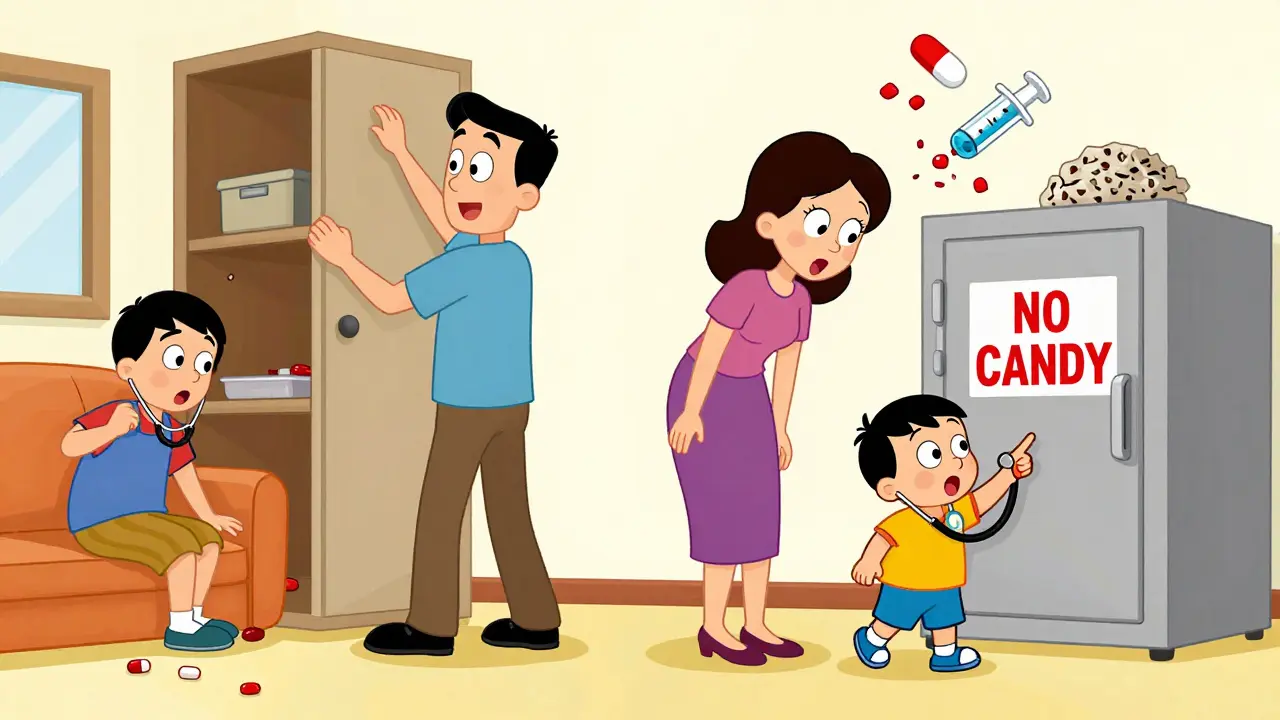
You can lock everything. You can teach your child. You can use the right dosing tools. But if you don’t check for mistakes, you’re still at risk. Do a weekly “safety sweep” of your home. Look for:- Pills that fell on the floor during dosing
- Empty bottles or caps left on the counter
- Medicine that got moved during cleaning
- Guest bags left in the entryway
What If You Can’t Lock Everything?
Maybe you rent. Maybe you don’t have high cabinets. Maybe you’re overwhelmed. Start small. Pick one thing: lock your nightstand. Or put all medicine in a locked box on the top shelf of your closet. Or buy a $20 medicine safe. You don’t need to fix everything at once. The CDC says that even one consistent change - like always putting medicine away after every use - cuts risk by nearly 30%. That’s the power of small, repeated actions.Final Thought: Safety Is a Habit, Not a One-Time Fix
Childproofing for medication safety isn’t about buying expensive gadgets or hiring a consultant. It’s about building habits. Locking. Putting away. Reading labels. Saying no to “medicine candy.” Sweeping the floor. It’s not about being perfect. It’s about being consistent. Because one moment of carelessness can change your family forever. But one moment of attention - one locked cabinet, one correct dose, one conversation - can keep your child safe.Can child-resistant caps really keep kids from getting into medicine?
Child-resistant caps slow kids down - but they don’t stop them. Studies show that determined toddlers can open them in under 10 seconds. The American Academy of Pediatrics says these caps are a backup, not a solution. Always store medicine in a locked, out-of-reach place, even if the cap is secure.
Is it safe to store medicine in the fridge?
Only if it’s required - like insulin or some liquid antibiotics. But even then, store it in a locked container on the top shelf. Fridges are tempting for kids to open, and the back of the shelf is often hard to see. Always lock it, even if it’s cold.
What should I do if my child swallows medicine by accident?
Call Poison Control immediately at 1-800-222-1222. Don’t wait for symptoms. Don’t try to make them vomit. Have the medicine bottle ready - you’ll need the name, strength, and amount taken. Poison Control can guide you in real time and often prevent an ER visit.
Are vitamins and supplements dangerous for kids?
Yes. Gummy vitamins look like candy and are a top cause of poisoning. Iron supplements can be deadly in small amounts. Store all vitamins and supplements the same way you store prescription meds - locked, up high, and out of sight.
Can I use a pill organizer for long-term storage?
No. Pill organizers are meant for daily use during active treatment. They’re not secure, not labeled clearly, and often left on counters. Keep the original bottles locked up. Only put pills in the organizer right before giving them.
How do I talk to grandparents or babysitters about medicine safety?
Be direct and grateful. Say: “We’ve had a close call before, so we’ve made a rule: all medicine is locked away. Could you please put your bag in the closet when you come over? We really appreciate your help keeping [child’s name] safe.” Most people will understand - and many have learned the hard way themselves.
Comments (12)
-
Patrick Roth January 20, 2026
Oh please, another ‘lock everything’ lecture. My cousin’s kid opened a childproof bottle, ate six Advil, and was fine. Kids are resilient. We didn’t need a locked cabinet-just common sense. Also, why are we treating medicine like nuclear waste? It’s not 2024 anymore, we’re not raising lab rats.

-
Oren Prettyman January 21, 2026
While I appreciate the earnestness of this missive, I must respectfully contend that the implicit assumption-that parental vigilance alone can mitigate all pharmacological risks-is both empirically unsound and sociologically reductive. The CDC’s ‘Up and Away’ protocol, while statistically valid in controlled environments, fails to account for socioeconomic stratification in domestic architecture, particularly in multi-generational, low-income, or rental housing contexts where structural modifications are either financially prohibitive or contractually prohibited. Furthermore, the conflation of ‘locked cabinet’ with ‘safety’ neglects the role of systemic neglect in pediatric exposure events, which are disproportionately concentrated in households lacking access to consistent healthcare infrastructure. A more holistic framework must include community-based pharmacy outreach, subsidized medicine safes, and mandatory pediatric pharmacology education in early childhood development curricula.

-
Tatiana Bandurina January 21, 2026
Let’s be honest-this is just fear-mongering dressed up as parenting advice. You’re telling people to lock up vitamins? Gummy vitamins are literally candy. And you want them to crush pills and mix them with kitty litter? That’s not safety, that’s a biohazard. Who’s really benefiting from this? The lock manufacturers. The poison control centers. The pharmaceutical companies who want you scared of your own medicine. Wake up.

-
Philip House January 22, 2026
Look, I get it. You wanna be safe. But you know what’s more dangerous than a kid getting into ibuprofen? Living in fear. America’s turned parenting into a compliance checklist. Lock the cabinet? Fine. But what about teaching kids boundaries? What about letting them learn consequences? My dad let me take a cough drop when I was three. I didn’t eat the whole bottle. I learned respect. Now we’re raising a generation of kids who think the world owes them a childproof life. It’s not medicine you need to lock up-it’s your anxiety.

-
Ryan Riesterer January 23, 2026
Empirical data confirms that child-resistant closures reduce access latency by 7.3 seconds on average, per JAMA 2020. However, behavioral reinforcement through environmental design (i.e., elevation + enclosure) reduces exposure incidence by 89% (Safe Kids, 2023). The critical variable is not compliance with caps, but consistency of storage protocol. Additionally, the use of non-standard dosing tools (e.g., kitchen spoons) introduces a 250% variance in administered volume, per UMich 2022. Therefore, the intervention hierarchy should be: 1) Locked, elevated storage; 2) Approved dosing apparatus; 3) Education. All other measures are secondary.

-
Akriti Jain January 23, 2026
They don’t want you to know this… but the real reason they’re pushing all this locking nonsense is because Big Pharma knows kids are eating their meds and they’re getting sued. So now they’re making parents feel guilty so they’ll buy $200 ‘medicine safes’ instead of questioning why the FDA lets them sell 300% stronger infant drops without clear labeling. And don’t get me started on gummy vitamins-those are basically candy-coated poison. 🍬💀

-
Mike P January 24, 2026
Y’all are overcomplicating this. My grandma raised five kids in a 300-square-foot apartment with no locks, no safes, and zero medical training. Kids got into medicine? They got sick. They got better. We didn’t need a 12-point plan. We had love, discipline, and a slap on the wrist. Now we’ve got moms crying because their toddler opened a bottle of Tylenol like it was a snack. Grow up. Lock one drawer. Don’t leave shit on the counter. Done. Stop buying into the fear industrial complex.

-
Jasmine Bryant January 25, 2026
Just wanted to add-I used to keep my son’s liquid amoxicillin in the fridge unlocked because I thought cold was better. Then I found him standing on a chair, holding the bottle, grinning. I didn’t even realize it was there. Now it’s locked on the top shelf with a magnetic latch. Also, I use the syringe every time-no more spoons. And I tell him ‘medicine is not candy’ every single time I give it. It’s weird at first but he’s 2.5 and now he says ‘no medicine’ when he sees a bottle. Small things work.

-
Liberty C January 26, 2026
How quaint. You’ve turned the sacred act of caregiving into a corporate compliance seminar. Locking medicine? Please. You’re not protecting your child-you’re performing virtue. The real danger isn’t the pill bottle-it’s the cultural rot that equates safety with control. Children are not fragile porcelain dolls to be caged. They are wild, curious beings. The solution isn’t more locks-it’s more trust, more presence, more human connection. And if your child eats a pill, maybe that’s not a failure of your storage-it’s a failure of your emotional availability.

-
shivani acharya January 27, 2026
Oh sure, lock the medicine. But what about the 2021 FDA leak that showed 43% of childproof caps were bypassed by kids using a simple hairpin? And did you know the same company that makes those ‘safe’ locks also owns 7 of the top 10 pharmaceutical brands? Coincidence? I think not. They want you to think you’re safe so you’ll keep buying their drugs. And those ‘take-back’ programs? They’re just a front-most of that medicine gets resold on the black market. You think your locked cabinet is keeping your kid safe? It’s just keeping you in the system.

-
Sarvesh CK January 29, 2026
While the practical recommendations provided are indeed sound and evidence-based, I believe the deeper philosophical inquiry lies in the tension between autonomy and protection. The impulse to secure all potentially hazardous substances stems from a noble desire to shield the vulnerable. Yet, in doing so, we risk constructing an environment where curiosity is policed rather than guided. Perhaps the ideal lies not in absolute containment, but in cultivating an atmosphere of mindful awareness-where children learn not only to avoid danger, but to understand its nature. This requires patience, dialogue, and the courage to allow small, supervised risks as part of development. Safety, in its fullest sense, is not merely the absence of harm-it is the presence of wisdom.

-
Hilary Miller January 29, 2026
My mom in Mumbai keeps all meds in a tin inside a high cupboard. No locks. No fuss. Just never leaves them out. Simple. Works. No need for $200 safes.
