
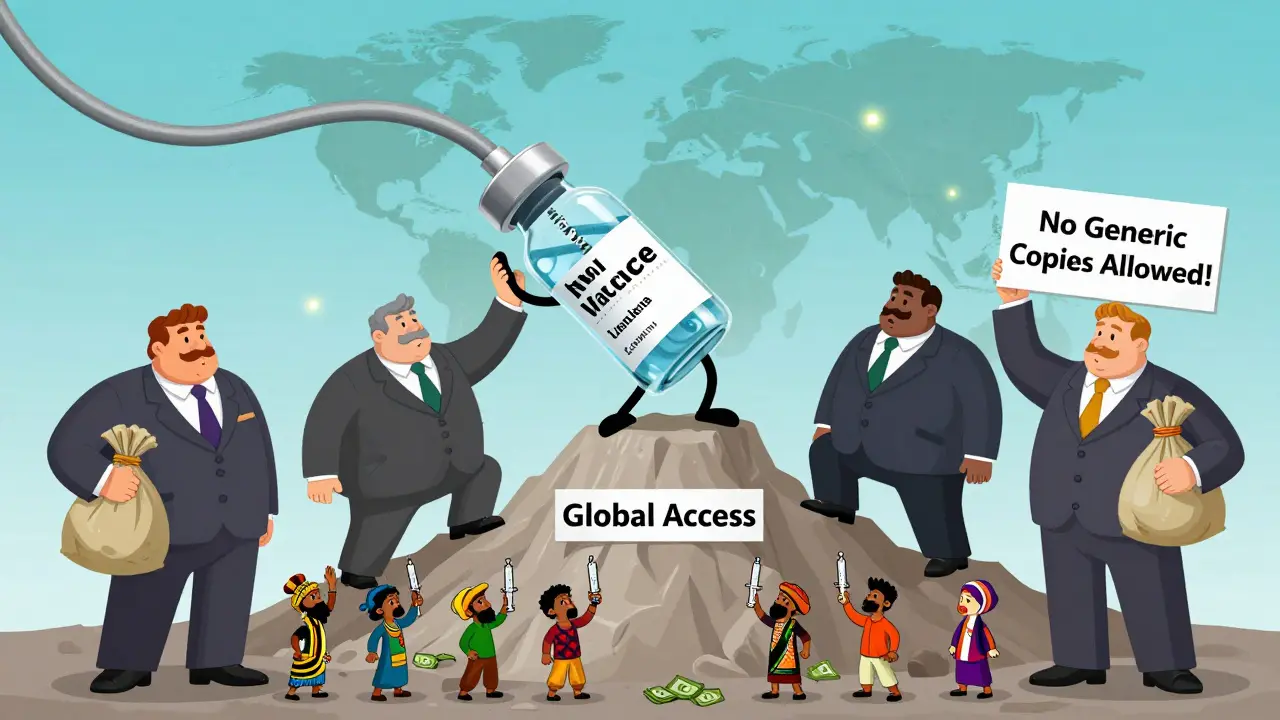
There’s no such thing as a vaccine generic in the way we think of generic pills. You can’t just copy a vaccine like you copy aspirin. Vaccines aren’t chemicals. They’re living systems-complex biological products made from viruses, cells, proteins, or mRNA. That means you can’t simply reverse-engineer them. Even if you have the formula, building the same vaccine from scratch takes years, millions in equipment, and a supply chain few countries can control.
Why Vaccines Can’t Be Generic Like Pills
Generic drugs work because they’re chemically identical to the brand-name version. The FDA lets manufacturers prove they’re the same through simple tests. Not so with vaccines. You can’t test a vaccine for bioequivalence like you test a blood pressure pill. Each batch is alive-grown in cells, purified, stabilized, and tested for safety and potency. One tiny change in temperature, pH, or raw material can ruin the whole batch. That’s why every new vaccine, even if it’s nearly identical to another, needs a full new approval. There’s no shortcut.The World Health Organization calls this a fundamental mismatch. The system built for pills doesn’t work for biologics. That’s why, despite decades of generic drug success, there’s no global market for cheap, off-patent vaccines like there is for HIV or diabetes meds. The Bill & Melinda Gates Foundation says it plainly: “There’s no ‘generics’ vaccine market as there is for drugs.”
Who Makes the World’s Vaccines?
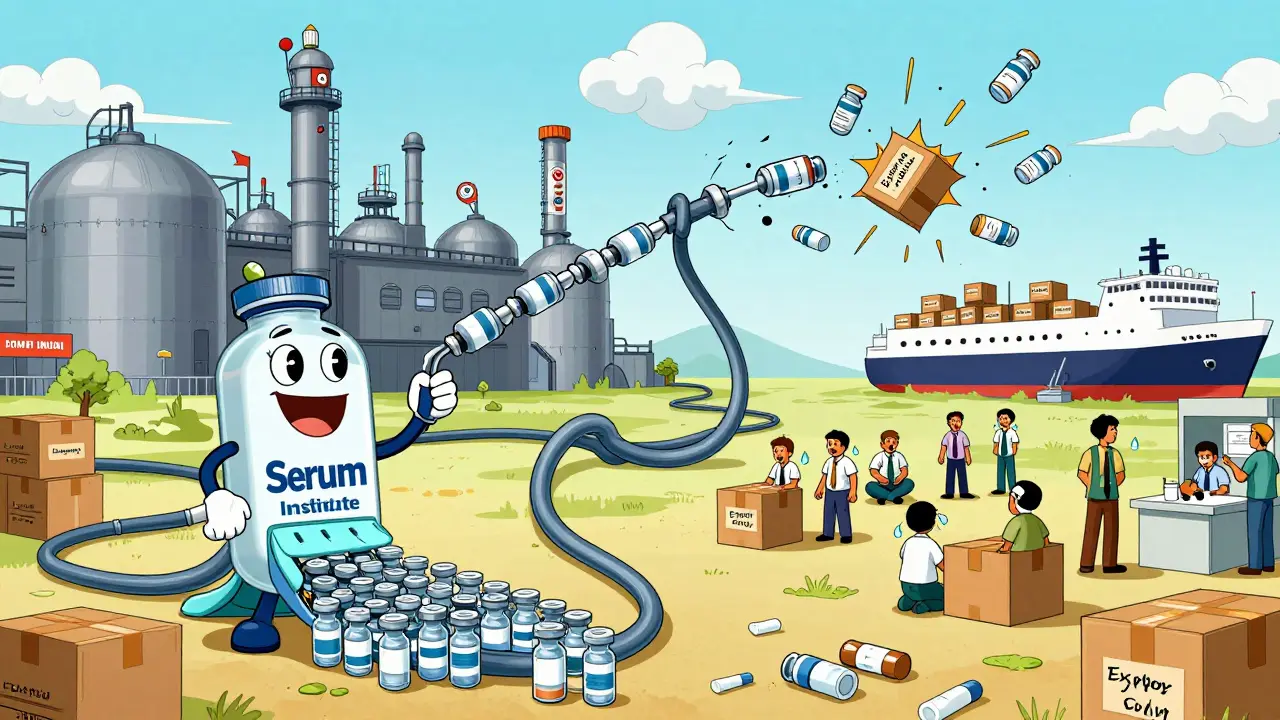
Five companies-GSK, Merck, Sanofi, Pfizer, and Johnson & Johnson-controlled 70% of the global vaccine market in 2020. That’s $38 billion in revenue, mostly from high-income countries paying premium prices. Meanwhile, low- and middle-income countries were left scrambling. During the early days of the COVID-19 pandemic, high-income nations, representing just 16% of the world’s population, bought up 86% of the first doses available.India stands out as the exception. It produces 60% of the world’s vaccines by volume. The Serum Institute of India alone makes 1.5 billion doses a year-more than any other company on Earth. It’s the main supplier of DPT, measles, and BCG vaccines to the WHO. But even India’s massive output couldn’t keep up when global demand hit 11 billion doses during the pandemic. And here’s the twist: India makes most of these vaccines for export. It imports 70% of the critical raw materials needed to make them-from China.
The Hidden Supply Chain Crisis
Making a vaccine isn’t just about the factory. It’s about the materials that go into it. For mRNA vaccines, you need lipid nanoparticles-tiny fat bubbles that carry the genetic code into your cells. Only five to seven companies in the entire world can make these at scale. When the U.S. restricted exports of these materials during India’s 2021 surge, global vaccine production dropped an estimated 50%. That wasn’t a glitch. It was a system failure.Temperature control is another bottleneck. Some mRNA vaccines need to be stored at -70°C. Few clinics in rural Africa or Southeast Asia have freezers that cold. In the Democratic Republic of Congo, health workers received doses that would expire in two weeks-with no way to transport or store them safely. That’s not a manufacturing problem. That’s a logistics collapse.
Even the equipment is scarce. The WHO set up a technology transfer hub in South Africa to help African countries make their own mRNA vaccines. It got technical help from BioNTech. But after 18 months, they still couldn’t get the right machines or materials. The delay wasn’t because they didn’t know how. It was because no one could ship them the parts.
Why Local Production Isn’t Growing Fast Enough
Building a vaccine plant isn’t like opening a pharmacy. It takes $200 million to $500 million and five to seven years. The African Union estimates it will take $4 billion and 10 years just to get Africa making 60% of its own vaccines by 2040. That’s a long time when children are still dying from preventable diseases.India has over 500 manufacturers of active pharmaceutical ingredients (APIs)-the raw chemical components of pills. But for vaccines, it’s different. Even though India exports 70% of its vaccine production, it still imports most of the key materials. That makes it vulnerable. When India banned vaccine exports during its own Delta wave in April 2021, global supply froze. Countries relying on Indian-made doses-like those in Africa and Latin America-were left with nothing.
And here’s the irony: Africa produces less than 2% of its own vaccines but imports 99%. Meanwhile, it’s home to some of the world’s most skilled vaccine scientists and production facilities. The problem isn’t talent. It’s capital. No bank will fund a vaccine factory in a low-income country when the return on investment is uncertain and the margins are razor-thin.
Price Isn’t the Main Problem-Access Is
People think the issue is price. That if only vaccines were cheaper, everyone could afford them. But the real issue is availability. The Serum Institute sells the AstraZeneca COVID-19 vaccine for $3-$4 a dose. Western companies charge $15-$20. That’s a big difference-but it’s not why millions went unvaccinated. It’s because the doses never arrived.Gavi, the global vaccine alliance, reports that even after years of “differential pricing” for poor countries, the pneumococcal vaccine still costs over $10 per dose. That’s not because manufacturers won’t lower prices. It’s because they can’t produce enough to meet demand at lower margins. The economics don’t add up. Building a factory costs half a billion dollars. Selling a dose for $4 doesn’t cover that unless you make billions of doses. And no one will make billions unless they’re sure they’ll sell them.
What’s Being Done-and Why It’s Not Enough
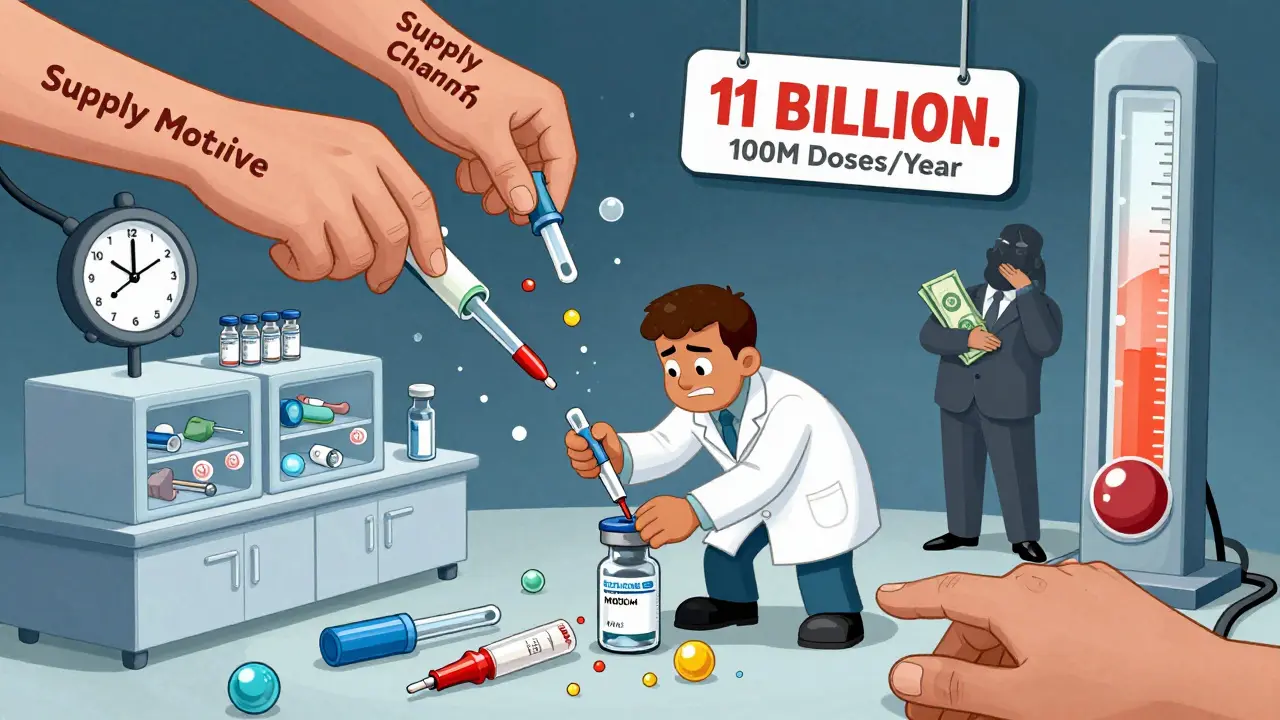
There are efforts to fix this. The WHO’s mRNA hub in South Africa started producing vaccines in September 2023. That’s progress. But it’s making 100 million doses a year. The world needs 11 billion. That’s less than 1% of demand.The U.S. FDA launched a pilot in 2025 to speed up approvals for generic drugs made and tested in America. The goal? Reduce dependence on China and India for APIs. But that’s for pills. No such program exists for vaccines. And even if it did, it wouldn’t solve the core problem: you can’t just copy a vaccine. You have to build an entire ecosystem around it.
Dr. Nahathai Thitisawakulchai from the WHO says technology transfer is key-but only if it’s done right. You can’t just hand over a manual. You need training, equipment, supply chains, and regulatory support. And you need time. No country can build this overnight.
The Real Barrier: Profit vs. Public Health
The biggest obstacle isn’t science. It’s incentives. Pharmaceutical companies invest billions because they expect to recoup that money through high prices and exclusive markets. Low-income countries can’t pay those prices. So manufacturers don’t prioritize them.Dr. Lucica Ditiu from the Stop TB Partnership puts it bluntly: “Any country potentially capable of establishing manufacture is likely to focus on national needs and not on export nor development aid.” That’s not greed. It’s survival. When a country faces its own outbreak, it will hoard what it has. That’s what happened in India in 2021. That’s what happened in the U.S. with masks and PPE.
Meanwhile, Médecins Sans Frontières found that in April 2021, 83% of the 1.1 million COVID-19 vaccine doses delivered to Africa went to just 10 countries. The other 23 African nations vaccinated less than 2% of their people. That’s not a supply issue. That’s a political one.
Where Do We Go From Here?
The path forward isn’t about making more generic vaccines. It’s about making more vaccine makers. That means funding factories in Africa, Southeast Asia, and Latin America. It means sharing not just technology-but equipment, training, and raw material access. It means governments and global institutions stepping in to guarantee demand so private companies feel safe investing.India showed it’s possible. The Serum Institute proved you can make billions of doses at low cost-if you have the infrastructure, the supply chain, and the market certainty. But India’s model isn’t replicable without massive public investment and international cooperation.
By 2025, low- and middle-income countries will still be 70% dependent on imported vaccines, according to Gavi. That’s not progress. That’s a broken system.
The truth is, we have the science. We have the talent. We even have the manufacturing capacity in places like India and South Africa. What we don’t have is the political will to treat vaccines like a public good-not a product for profit.
Can vaccines be made as generics like pills?
No. Vaccines are biological products, not chemical compounds. Unlike generic pills, they can’t be proven equivalent through simple tests. Each vaccine requires a full new approval process because even small changes in manufacturing can affect safety and effectiveness. There’s no abbreviated pathway like the FDA’s ANDA for small-molecule drugs.
Why is India so important in global vaccine production?
India produces 60% of the world’s vaccines by volume and supplies 70% of the vaccines used by the WHO. Companies like the Serum Institute of India make billions of doses annually of DPT, measles, and other essential vaccines at low cost. But India imports 70% of its vaccine raw materials from China, making its supply chain vulnerable. It also exports 70% of its production, meaning domestic shortages can disrupt global supply.
Why can’t low-income countries just build their own vaccine factories?
Building a vaccine plant costs $200-500 million and takes 5-7 years. It requires specialized equipment, ultra-cold storage, and access to rare raw materials like lipid nanoparticles-only a handful of companies make these globally. Even with technical training, countries struggle to source parts and meet regulatory standards. Without guaranteed demand or public funding, private investors won’t take the risk.
How did the pandemic expose vaccine inequity?
High-income countries bought 86% of the first COVID-19 vaccine doses, despite making up only 16% of the global population. In Africa, 83% of the 1.1 million doses delivered through COVAX went to just 10 countries. Meanwhile, 23 African nations vaccinated less than 2% of their people. Export bans, like India’s in April 2021, cut global supply by half. These weren’t accidents-they were symptoms of a system designed for profit, not equity.
Is the WHO’s mRNA hub in South Africa solving the problem?
It’s a step forward, but far from a solution. The hub began producing mRNA vaccines in September 2023 after 18 months of delays, mostly due to supply chain issues. But its annual capacity is only 100 million doses-less than 1% of global needs. It shows technology transfer is possible, but scaling it requires massive investment and international coordination that doesn’t yet exist.
What’s the biggest barrier to better vaccine access?
The biggest barrier isn’t science or cost-it’s incentives. Pharmaceutical companies invest in vaccines expecting high returns. Low-income countries can’t pay premium prices, so manufacturers don’t prioritize them. Without guaranteed global demand, public funding, and shared infrastructure, private companies won’t build factories where the market is weak. Vaccines need to be treated as a public good, not just a commodity.
Comments (15)
-
Jeane Hendrix January 7, 2026
It’s wild how we treat vaccines like they’re just pills with extra steps. You can’t just slap together mRNA and call it a day - the lipid nanoparticles alone are a nightmare to scale. And don’t even get me started on the cold chain. I read a report where a clinic in Malawi had to use a motorcycle fridge just to keep doses from going bad. It’s not a tech gap. It’s a moral one.

-
Rachel Wermager January 8, 2026
Let’s be clear - bioequivalence is a regulatory fiction for biologics. The FDA’s ANDA pathway was designed for small molecules with single active ingredients. Vaccines are complex, dynamic systems with batch-to-batch variability measured in log units. You can’t validate a ‘generic’ vaccine with HPLC and dissolution profiles. You need full immunogenicity trials, potency assays, and stability studies across multiple lots. The system isn’t broken - it’s just being misapplied.

-
Katelyn Slack January 9, 2026
wait so if india makes 60% of vaccines but gets 70% of its raw materials from china… that’s like building a house but renting the bricks? 😅

-
Venkataramanan Viswanathan January 10, 2026
As someone who grew up in a village where the only vaccine available was the one brought by the WHO van, I’ve seen the consequences of this system. We didn’t lack will - we lacked access. The Serum Institute saved millions, but when export bans hit, children went unvaccinated for months. It’s not about cost. It’s about sovereignty. We need local production, not charity.

-
Saylor Frye January 10, 2026
Let’s be honest - if you can’t afford a $500M plant and a decade of regulatory paperwork, you shouldn’t be making vaccines. This isn’t a moral failing. It’s capitalism. The world doesn’t need more vaccine factories. It needs fewer people pretending they can run one.

-
Beth Templeton January 10, 2026
So vaccines aren’t generic. Got it. Next you’ll tell me water isn’t just H2O.

-
Tiffany Adjei - Opong January 11, 2026
Wait so the real problem is profit? Wow. Who knew? Maybe if pharma didn’t spend $10B on ads and $500M on CEO yachts we could afford to make vaccines for actual humans. Also - why does India import 70% of its raw materials? Because China controls the supply chain and everyone else is too busy pretending they’re not dependent on authoritarian regimes for life-saving tech. Hypocrisy level: max.

-
Ryan Barr January 12, 2026
Biologics are hard. End of story.

-
Indra Triawan January 13, 2026
It’s not about vaccines. It’s about the illusion of control. We think we can engineer our way out of death - but the truth is, we’re just rearranging the deck chairs on the Titanic while the icebergs melt. The real tragedy isn’t the lack of doses. It’s that we still believe the system can be fixed without dismantling the entire structure of global capital.

-
Lily Lilyy January 15, 2026
Every child deserves a vaccine. Every country deserves the tools to make them. Let’s fund the factories. Let’s share the tech. Let’s stop treating health like a luxury. We have the power. We just need the will. Together, we can build a world where no parent has to wait for a shot to save their child.

-
Susan Arlene January 17, 2026
so like… if you can’t copy a vaccine like a pill… then why are we even pretending we can make ‘generic’ ones? maybe we just need to stop calling them that and start calling them what they are - complex biotech products that need whole ecosystems to exist. and then maybe we’ll stop being shocked when it doesn’t work

-
Mukesh Pareek January 18, 2026
India’s model is not scalable. It’s a temporary patch. The Serum Institute is a miracle of efficiency - but it’s built on exploitative supply chains, low labor costs, and political tolerance for regulatory arbitrage. Without those, it collapses. You can’t replicate this in Africa or Latin America without systemic subsidies and geopolitical leverage. This isn’t a manufacturing problem. It’s a colonial one.

-
Ashley S January 20, 2026
Why is this even a debate? Pharma is evil. They hoard vaccines. They make billions. Kids die. That’s the whole story. Stop overcomplicating it. Just make them free.

-
Leonard Shit January 21, 2026
the fact that we’re still talking about this in 2025 after a global pandemic… it’s not just sad. it’s embarrassing. we had the science. we had the money. we had the capacity. but we chose profit over people. and now we’re surprised when the system breaks? come on.

-
Gabrielle Panchev January 21, 2026
Okay, but let’s not pretend this is just about vaccines - this is about the entire global health infrastructure being designed to serve the Global North’s interests while extracting labor, raw materials, and data from the Global South. The mRNA hub in South Africa? Cute. But they still can’t get the lipid nanoparticles because the patents are held by German and American firms who won’t license them without profit guarantees. Meanwhile, African scientists are trained to replicate systems they can’t control. It’s not technology transfer - it’s tech colonialism with a smiley face.
