
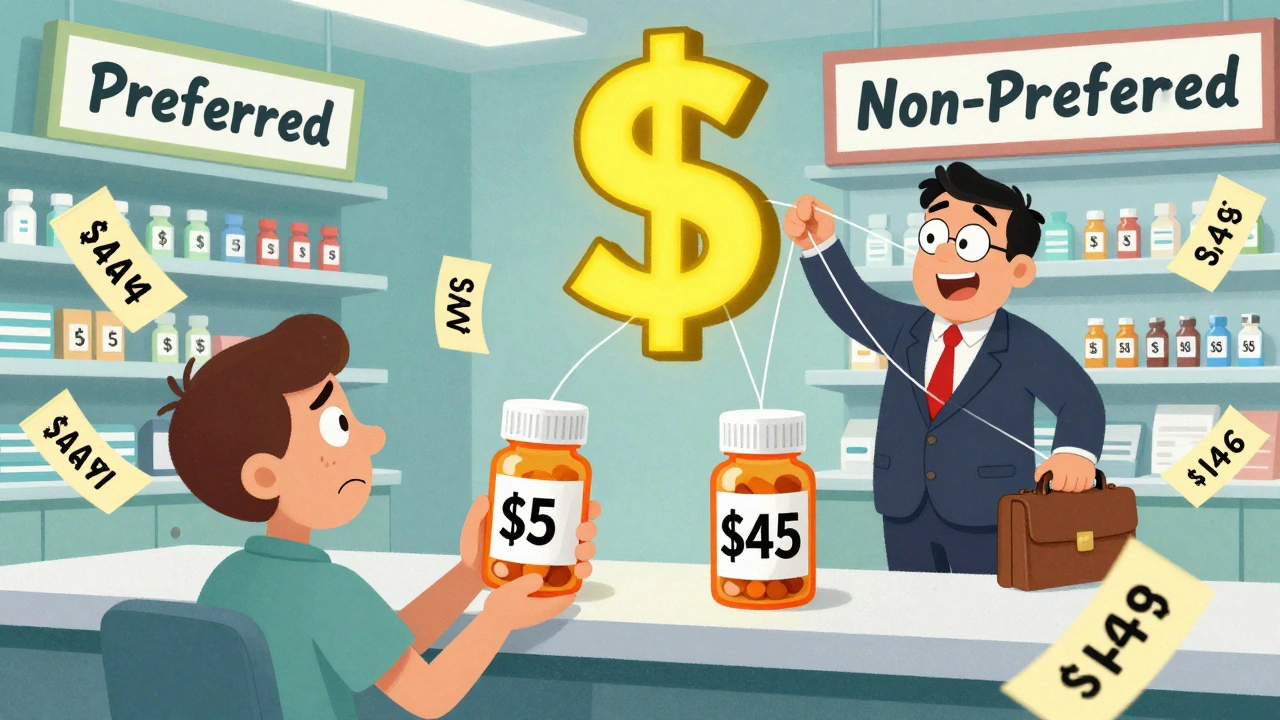
You fill your prescription for levothyroxine, the generic version of Synthroid, and expect to pay $5. Instead, the pharmacist hands you a bill for $45. You ask why. They shrug. Your doctor says all generics are the same. But your wallet says otherwise. This isn’t a mistake. It’s the system.
How Tiered Copays Work
Most health plans don’t charge the same amount for every drug. Instead, they use a system called tiered copays. Think of it like a pricing ladder. Each rung is a tier, and each tier has a different price tag. The lower the tier, the cheaper your out-of-pocket cost.- Tier 1: Preferred generics - usually $0 to $15 for a 30-day supply.
- Tier 2: Preferred brand-name drugs - $25 to $50.
- Tier 3: Non-preferred brand-name drugs - $60 to $100.
- Tier 4 and 5: Specialty drugs - often 20% to 40% of the total cost, sometimes hundreds or thousands per month.
Why Your Generic Is in Tier 3
Here’s the part that trips people up: not all generics are created equal in the eyes of your insurer. Even though two pills have the same active ingredient, same dosage, same manufacturer (or different ones), your plan may still charge more for one. Why? Because it’s not about the drug. It’s about the contract. PBMs negotiate rebates with drug manufacturers. The company that pays the biggest rebate gets its generic placed in Tier 1. The one that doesn’t pay enough? It lands in Tier 2 or even Tier 3 - even if it’s chemically identical. For example, if your plan used to cover one brand of generic atorvastatin (the cholesterol drug) for $5, but the manufacturer stopped offering a big enough rebate, the PBM might move it to Tier 2 with a $15 copay. Meanwhile, a different generic version of the same drug - made by a company that gave a better deal - stays at $5. This isn’t rare. About 12% to 18% of generic drugs are in higher tiers because of their cost, complexity, or rebate status, not because they’re less effective.The Real Reason: Rebates, Not Results
A lot of patients assume that if a drug is in a higher tier, it must be stronger, newer, or better. That’s not true. As Dr. Dennis G. Smith, former head of Medicaid and CHIP services, put it: “Preferred status has nothing to do with clinical superiority - it’s entirely about the rebates and discounts PBMs negotiate.” In 2023, Avalere Health found that 68% of generic drugs moved to higher tiers were due to expired rebate deals - not safety concerns, not efficacy issues. It’s pure business. This creates a strange situation: two identical pills, same box, same label, same doctor’s prescription - but one costs three times more because the manufacturer didn’t cut the right deal.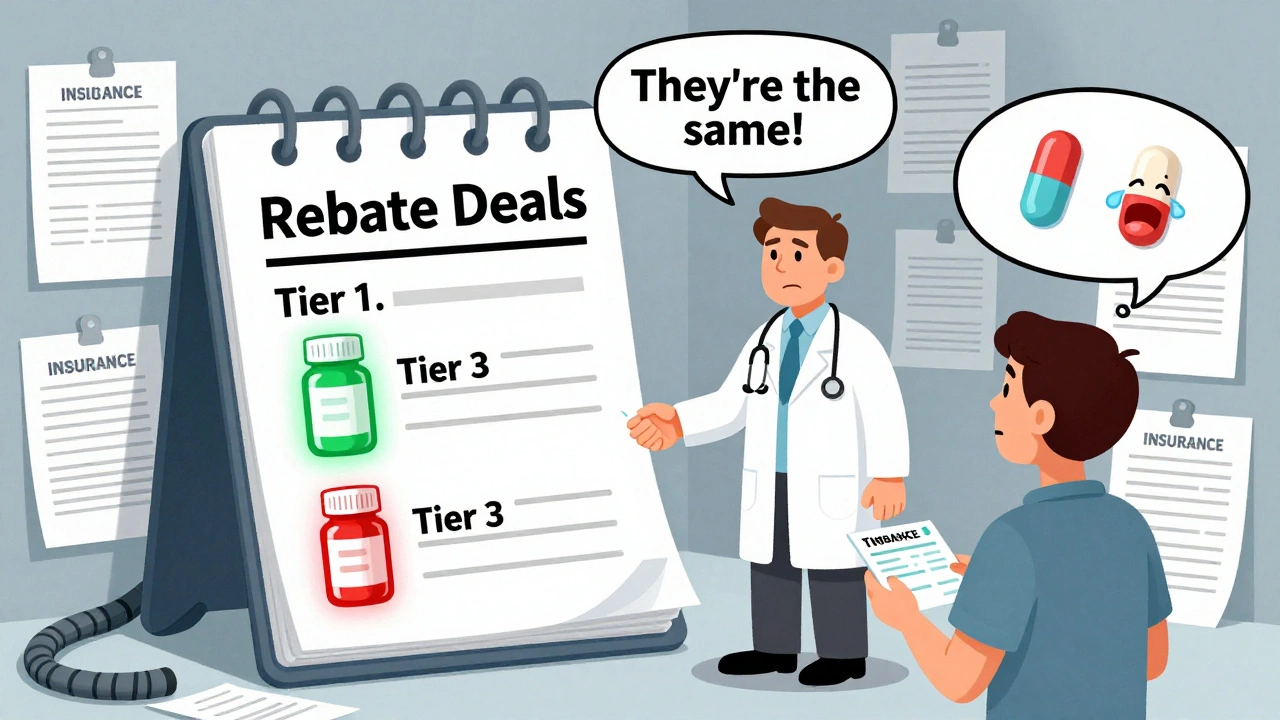
What Happens When You Get the Wrong Generic
Sometimes, you don’t even choose. Pharmacists are trained to substitute generics automatically - and they often pick the one with the lowest cost to the plan, not the one your doctor prescribed. This is called a “therapeutic interchange.” A 2024 survey by the Patient Advocate Foundation found that 41% of insured adults had a generic drug suddenly cost more than expected. Of those, 68% couldn’t get a clear answer from their insurer. One Reddit user, “PharmaPatient87,” wrote: “My levothyroxine went from $5 to $45 overnight. My doctor says they’re all the same. So why am I paying more?” The answer? Your plan switched which generic they prefer. You didn’t change. The drug didn’t change. The contract did.Specialty Generics Are the New Problem
A growing number of generic drugs are classified as “specialty.” These aren’t pills you pick up at your corner pharmacy. They’re complex medications - often injectables or those used for rare conditions like rheumatoid arthritis or multiple sclerosis. Even when they’re generics, they can fall into Tier 4 or 5. That means you pay 25% to 40% of the total cost. For a drug that costs $8,000 a month, that’s $2,000 to $3,200 out of pocket. Adalimumab (Humira) has several generic versions now. But because they’re biologics, they’re treated as specialty drugs. Even though they’re cheaper than the brand, your copay might still be sky-high.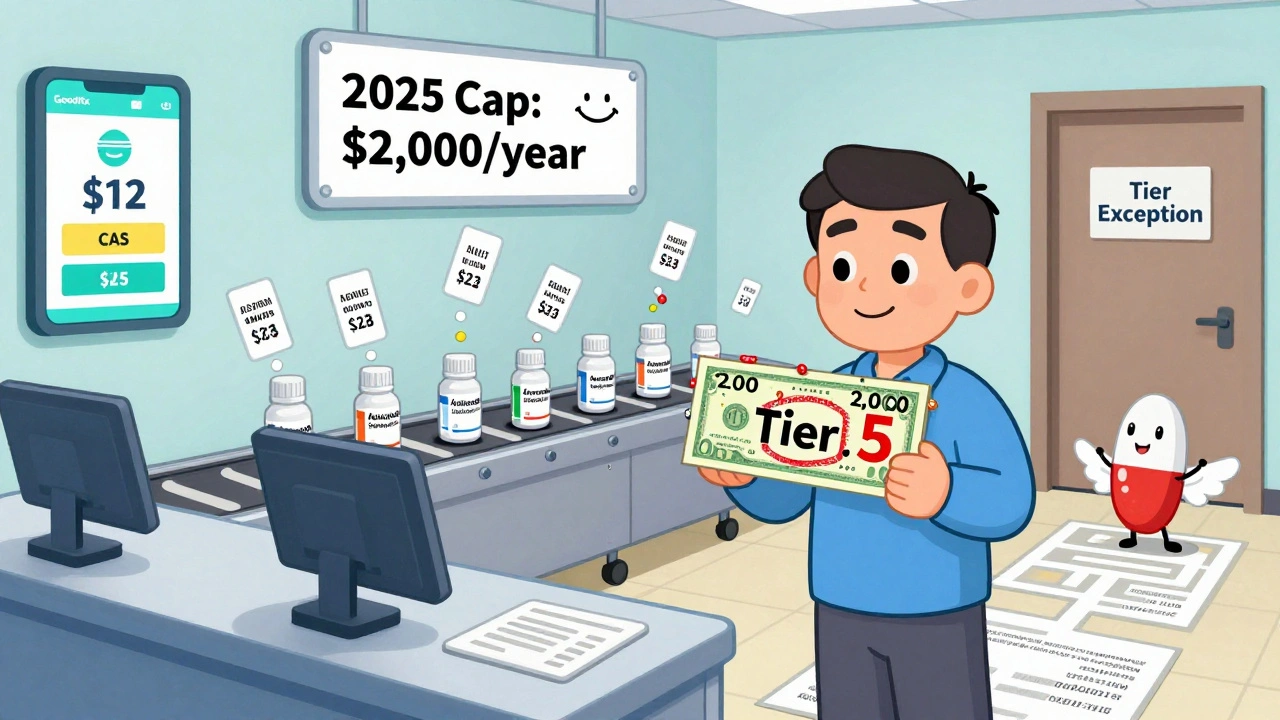
How to Fight Back
You don’t have to accept this. Here’s what you can do:- Check your plan’s formulary. Every year, usually in October, insurers update their drug lists. Look up your medication on your insurer’s website. See which tier it’s in.
- Ask your pharmacist. They can tell you if there’s a lower-cost generic alternative that’s still approved for your condition.
- Request a tier exception. If your drug moved to a higher tier and you’re stable on it, ask your doctor to file a “tier exception” request. Many are approved - especially if you’ve been on the drug for years.
- Use GoodRx or SmithRx. These tools show you cash prices and sometimes beat your copay. A $45 copay might be $12 cash.
- Look for manufacturer assistance. Many drugmakers offer coupons or patient assistance programs. For specialty drugs, these can cover 20% to 50% of the cost.
What’s Changing in 2025
The Inflation Reduction Act kicks in next year. For Medicare Part D enrollees, your out-of-pocket drug costs will be capped at $2,000 a year. That’s huge. But here’s the catch: tiered systems are still in place. The cap doesn’t eliminate tiers - it just limits how much you pay in total. Meanwhile, PBMs are starting to simplify. Some plans are moving from five tiers to four. UnitedHealthcare, for example, now has a “generic value tier” where common drugs like lisinopril and atorvastatin are $0. But that only applies to high-volume generics. Less common ones? Still priced higher. The bigger trend? More biosimilars - generic versions of biologic drugs - entering the market. These will be tiered too. And insurers will keep using rebates to decide which ones go where.What You Need to Know
- Generic doesn’t always mean cheap. Your copay depends on your plan’s contract, not the pill’s chemistry. - If your generic suddenly costs more, it’s likely due to a rebate change, not a clinical reason. - Always check your formulary before filling a prescription - especially if you’re on a chronic medication. - Don’t assume your pharmacist will pick the best option for you. Ask. - You have rights. File exceptions. Use cash price tools. Ask for help. This system isn’t broken - it’s working exactly as designed. But it’s designed to save money for insurers and PBMs, not to make sense for patients. Understanding how it works is the first step to not getting stuck with the bill.Why is my generic drug more expensive than the brand-name version?
It’s rare, but it happens. This usually occurs when the brand-name drug is in a lower tier because the manufacturer pays a large rebate to your insurer’s Pharmacy Benefit Manager (PBM). Meanwhile, the generic version you’re getting might be from a manufacturer that doesn’t offer a rebate - so it’s placed in a higher tier. The generic is chemically identical, but the contract isn’t.
Can my pharmacist switch my generic without telling me?
Yes, in most cases. Pharmacists are allowed to substitute a generic for a brand-name drug unless your doctor writes “dispense as written” or “no substitution.” They can also switch between generics based on what’s cheapest for the plan - even if you’ve been on one for years. Always ask what you’re being given.
How do I find out which tier my drug is on?
Log into your insurer’s website and search their formulary. Most have a drug lookup tool. You can also call customer service and ask for your plan’s current formulary document. Medicare plans update theirs every October. Commercial plans may change mid-year - so check regularly.
What’s the difference between preferred and non-preferred generics?
There’s no clinical difference. Both contain the same active ingredient, dosage, and meet FDA standards. The terms “preferred” and “non-preferred” are purely financial - they reflect which manufacturer gave the PBM the best rebate. Preferred generics are cheaper for you because the insurer got a better deal.
Can I appeal if my drug is moved to a higher tier?
Yes. You or your doctor can file a “tier exception” or “formulary exception” request. You’ll need a letter from your provider explaining why you need this specific drug - especially if switching caused side effects or reduced effectiveness. Approval rates are around 60% to 70% when supported by medical documentation.
Are there tools to find cheaper alternatives?
Yes. Use GoodRx, SingleCare, or SmithRx’s tier comparison tool. These show cash prices and sometimes beat your copay. For specialty drugs, check the manufacturer’s patient assistance program. Many offer free or low-cost medication to eligible patients. In 2023, these programs covered 22% of specialty drug costs for people who applied.
Comments (14)
-
Donna Anderson December 12, 2025
so i just got hit with a $40 copay for my metformin and i thought i was getting a deal?? 😭 this system is straight up wild.

-
sandeep sanigarapu December 13, 2025
Generic drugs are chemically identical. The pricing is purely a business decision. Patients suffer while PBMs profit. This is not healthcare-it is commerce disguised as care.

-
Robert Webb December 15, 2025
I’ve been on levothyroxine for 12 years. Last year, my copay jumped from $7 to $38 overnight. I called my insurer, they said ‘the rebate deal expired.’ I asked if the pill changed. They said no. I asked if my body changed. They said no. So why am I paying five times more? Because some corporate negotiator decided to cut a better deal with a different manufacturer. It’s not about my health. It’s about their spreadsheet. And now I’m stuck choosing between my medication and my rent. This isn’t a glitch-it’s the design. And the worst part? No one’s accountable. No one gets fired for this. Everyone just shrugs and says ‘that’s how it is.’

-
matthew dendle December 15, 2025
generic my ass theyre all the same but one pays better to the pbm so now im paying 50 bucks for thyroid med that should cost 5 smh

-
wendy b December 16, 2025
Actually, the real issue here is that patients don't understand the intricate dynamics of pharmaceutical supply chain economics-PBMs operate under a rebate-driven model that incentivizes cost-shifting, not clinical efficacy. You're conflating chemical equivalence with financial alignment, which is a fundamental misunderstanding of market-based healthcare systems.

-
Rob Purvis December 17, 2025
Wait-so if two pills are chemically identical, why does the system treat them differently? That’s not just unfair-it’s illogical. And why do pharmacists get to swap them without telling us? I had a friend get switched to a generic that gave her nausea for three weeks. No one warned her. No one apologized. Just ‘it’s the same drug.’ No, it’s not the same if it makes you sick. And who’s checking for that? No one. The system is broken, and it’s not even trying to fix itself.

-
Laura Weemering December 19, 2025
I just feel… so powerless. Like my body is a ledger and my medication is a line item that got moved to the red column. I cry every time I open my mail and see the bill. I don’t even have the energy to call anymore. I just… pay. And then I sit there and wonder if I’m worth less than a rebate contract.

-
Reshma Sinha December 21, 2025
Formulary tiers are a structural flaw in U.S. healthcare delivery. The absence of transparent pricing mechanisms creates asymmetric information asymmetry between patient and insurer, resulting in adverse selection dynamics. Patients are not agents of cost optimization-they are passive subjects of algorithmic arbitrage.

-
Katherine Rodgers December 22, 2025
Wow, you actually thought generics were supposed to save you money? lol. You must be new here. Welcome to America, where your meds are priced like luxury handbags and your doctor’s advice is just a suggestion.

-
Vivian Amadi December 23, 2025
My husband’s blood pressure med went from $5 to $60. He’s 58. He doesn’t have a trust fund. He works 60 hours a week. And now he’s skipping doses because he can’t afford it. This isn’t a ‘system’-it’s a death sentence with a copay.

-
Jimmy Kärnfeldt December 23, 2025
It’s heartbreaking, isn’t it? We’re told medicine is about healing, but it’s really about contracts and rebates. I wish we could fix this. I really do. But even just knowing the truth-that the pill didn’t change, the deal did-feels like a small victory. You’re not crazy. You’re not overreacting. You’re just paying for someone else’s profit margin. And that’s not your fault.

-
john damon December 24, 2025
bro this is wild 😭 i just found out my insulin generic costs more than the brand bc the pbm got a better deal from the brand 😳

-
Lisa Stringfellow December 24, 2025
So let me get this straight: the system is designed to make you pay more for the exact same thing… and you’re supposed to be grateful because it ‘lowers overall spending’? Who? Not me. Not my bank account. Not my anxiety. This isn’t efficiency. It’s exploitation dressed up in corporate jargon.

-
Levi Cooper December 26, 2025
Why are we letting these PBMs run our healthcare? In my country, we don’t let middlemen decide who gets to live or die based on a rebate. This isn’t capitalism-it’s medical feudalism. And if you’re not mad about this, you’re not paying attention.
