
When norovirus hits, it doesn’t just make people sick-it shuts down nursing homes, schools, hospitals, and even cruise ships. In the U.S., it causes 19 to 21 million cases every year, making it the #1 cause of vomiting and diarrhea outbreaks. And here’s the scary part: you only need to swallow 18 virus particles to get infected. That’s less than a drop of water. It spreads fast, survives for weeks on doorknobs and countertops, and laughs at hand sanitizer.
How Norovirus Spreads (And Why It’s So Hard to Stop)
Norovirus doesn’t need much to thrive. It rides on dirty hands, contaminated food, and even the air when someone vomits. Most outbreaks happen because one person gets sick, and others touch the same surfaces-like a toilet handle, a sink, or a meal tray-and then touch their mouth. About 62% of outbreaks come from direct person-to-person contact. Another 23% come from food, especially leafy greens, sandwiches, and anything handled after cooking. The rest? Dirty water or surfaces. The virus doesn’t care if you’re healthy or not. It starts shedding before you even feel sick. And after you recover? You can still spread it for at least 48 hours. For older adults or people with weak immune systems, that window can stretch to weeks. That’s why just waiting for symptoms to disappear isn’t enough. You have to treat every case like a fire-put it out fast, or it spreads.Stop the Spread: The Only Handwashing That Works
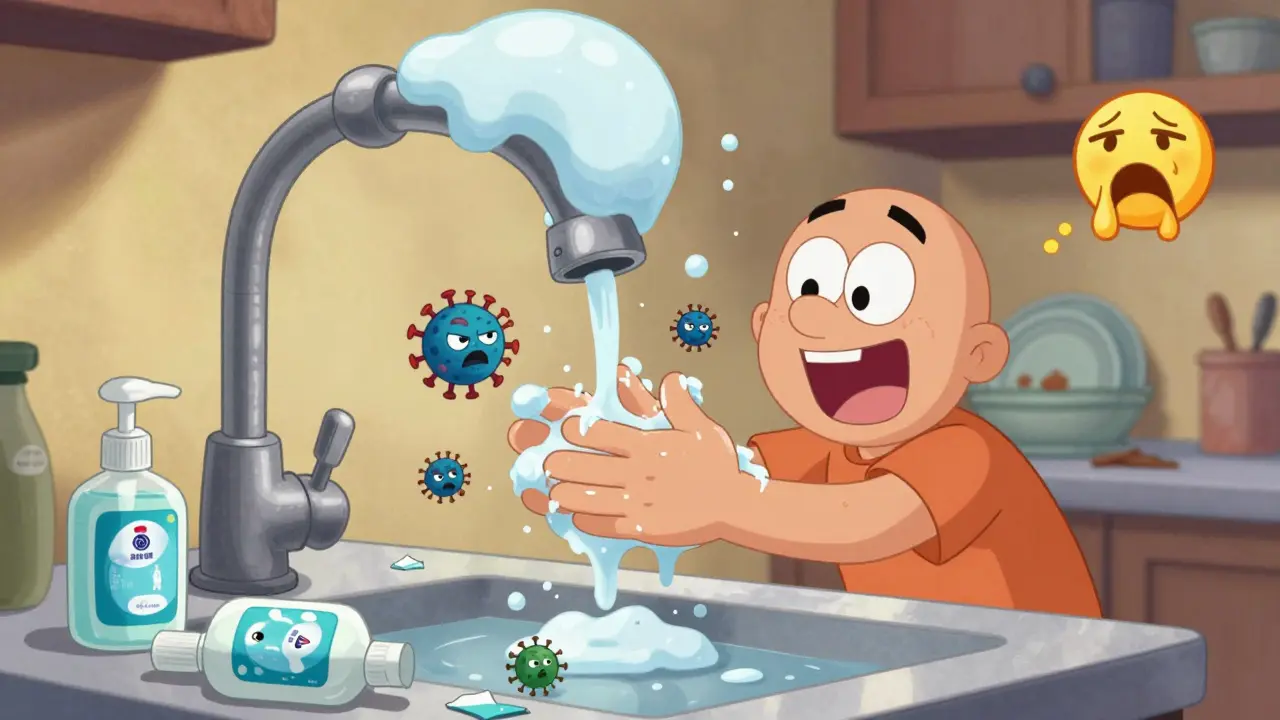
You’ve heard it a thousand times: wash your hands. But here’s the truth most people miss-alcohol-based hand sanitizer does almost nothing against norovirus. The virus has a tough outer shell that alcohol can’t break. That’s why the CDC says: if you want to stop norovirus, you need soap and water. Use warm water. Scrub for at least 20 seconds. That’s about the time it takes to sing "Happy Birthday" twice. Pay attention to your thumbs, under your nails, and between your fingers. Wash after using the bathroom, after changing diapers, before eating, and before preparing food. In healthcare settings, staff must wash their hands every single time they leave a patient’s room-even if they wore gloves. During an outbreak, handwashing stations should be placed right outside affected areas. If staff are too busy to wash properly, they’ll skip it. And when that happens, the outbreak grows. Simple fixes-like posting signs with timers or having a supervisor check hand hygiene-can cut transmission by 30% or more.Deep Cleaning: Bleach Is Your Best Friend
Norovirus survives on surfaces for up to 12 days. It laughs at regular cleaners. You can’t just wipe down a counter with a disinfectant wipe and call it done. You need something strong: chlorine bleach. The CDC recommends mixing 1,000 to 5,000 parts per million (ppm) of chlorine bleach. That’s 5 to 25 tablespoons of household bleach per gallon of water. Use it on high-touch surfaces: door handles, bed rails, light switches, toilet flushers, faucets, and remote controls. Clean these surfaces at least twice a day during an outbreak. For vomiting or diarrhea accidents, don’t just mop it up. Put on gloves and a mask. Cover the mess with paper towels. Pour bleach solution on it. Let it sit for 10 minutes. Then wipe it up with fresh towels. Dispose of everything in a sealed bag. Afterward, wash your hands-again, with soap and water. Some hospitals now use hydrogen peroxide vapor machines to sterilize entire rooms after an outbreak. These machines kill 99.9% of the virus. But for most homes, schools, and small clinics, bleach is still the most reliable tool.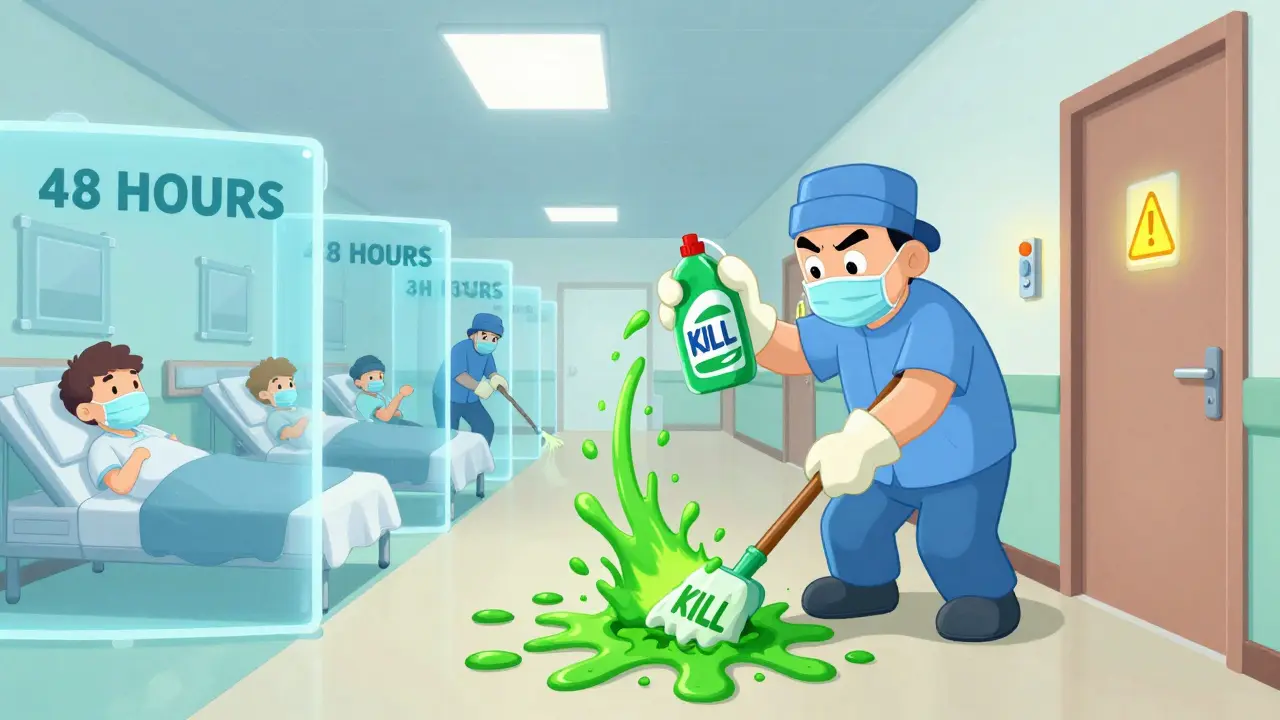
Isolation and Cohorting: Keep the Sick Apart
If someone has vomiting or diarrhea, they need to be isolated. In a hospital or nursing home, that means a private room. If you don’t have enough private rooms, group sick people together in one area. Don’t move them around. Don’t let them go to group meals or activities. Keep them away from healthy people for at least 48 hours after their last symptom. This isn’t just about comfort-it’s about stopping the chain. A single outbreak in a nursing home can cost $5,000 to $15,000 in extra staff, cleaning, and lost revenue. And for elderly patients, norovirus can lead to pneumonia, kidney failure, or death. In long-term care facilities, outbreaks spike in winter. That’s when staff are tired, rooms are cold, and people are packed close together. The solution? Cancel group activities. Limit visitors. Only allow essential visitors, and make sure they wash their hands before entering. Facilities that train visitors on infection control see 35% fewer new cases.Food Safety: No More Handling Food While Sick
Food handlers are one of the biggest sources of norovirus outbreaks. Someone with a stomach bug prepares a salad. They don’t wash their hands. Someone else eats it. Boom-outbreak. Anyone with vomiting or diarrhea must stay home. Not just until they feel better. Not just until the vomiting stops. They need to stay out of the kitchen for at least 48 hours after the last symptom. In healthcare settings and senior centers, that rule extends to 72 hours. Raw foods like lettuce, sprouts, and shellfish are common culprits. Even cooked food can get contaminated if it’s handled after cooking. Always wash produce. Cook food to safe temperatures. And never, ever let someone with symptoms near food.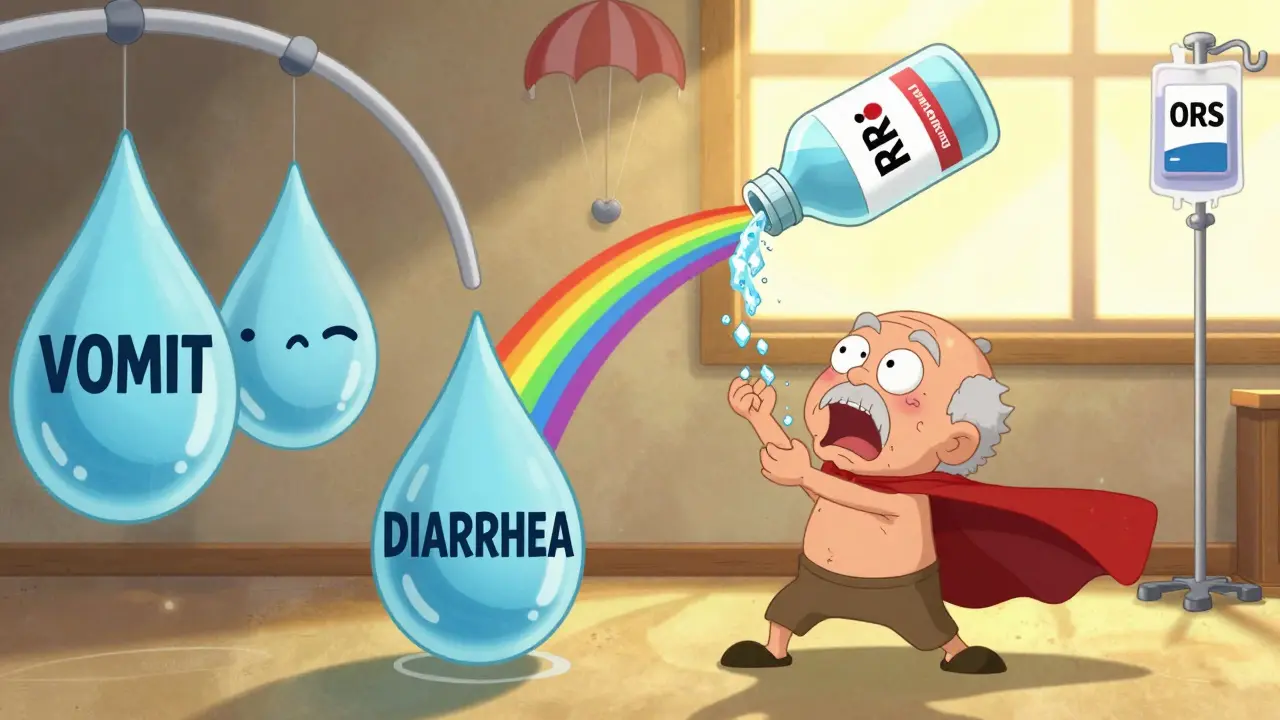
Hydration: The Most Important Treatment
Norovirus doesn’t kill you by itself. It kills you by making you lose too much fluid. Vomiting and diarrhea drain your body of water and electrolytes. Dehydration is the real danger-especially for kids, the elderly, and people with chronic illnesses. The first line of defense? Oral rehydration solution (ORS). This isn’t just water. It’s a precise mix of salt, sugar, and potassium. WHO and CDC recommend solutions with 50-90 mmol/L sodium, 75-100 mmol/L glucose, and 20-25 mmol/L potassium. You can buy it at any pharmacy (brands like Pedialyte or Liquid I.V.), or make your own: mix 1 liter of clean water with 6 teaspoons of sugar and half a teaspoon of salt. Give small sips often-every 5 to 10 minutes. For children, give 50-100 mL after each episode of vomiting or diarrhea. For adults, aim for at least 2 liters a day. If someone can’t keep fluids down, or shows signs of severe dehydration (dry mouth, no urine for 8+ hours, dizziness, confusion), they need IV fluids right away. In nursing homes, staff should check residents every 4 to 6 hours for signs of dehydration: sunken eyes, dry skin, low urine output, or unusual sleepiness. Elderly people don’t feel thirsty like younger people. By the time they say they’re thirsty, they’re already in trouble.What Doesn’t Work (And Why You Should Avoid It)
Many people try to fight norovirus with the wrong tools:- Hand sanitizer-useless against norovirus. Only soap and water work.
- Antibiotics-norovirus is a virus. Antibiotics don’t touch it.
- Anti-vomiting drugs-like ondansetron. These can mask symptoms, making it harder to spot outbreaks. They’re not recommended for routine use.
- Home remedies-ginger tea, lemon water, or honey won’t stop the virus. They might soothe your stomach, but they won’t prevent spread or fix dehydration.
What’s Coming Next
There’s good news on the horizon. A vaccine from Takeda showed 46.7% effectiveness in early trials and could be approved by 2025. Until then, we’re stuck with the basics: clean hands, clean surfaces, and staying hydrated. Meanwhile, health departments are getting smarter. Wisconsin rolled out a real-time outbreak tracker in January 2023. Now, they know about outbreaks within 24 hours instead of 72. That means faster responses, fewer cases, and fewer deaths. The bottom line? Norovirus isn’t going away. But it’s not unbeatable. With the right steps-soap, bleach, isolation, and fluids-you can stop it cold. You don’t need fancy gear or expensive tech. You just need to do the simple things, every time, without exception.Can you get norovirus more than once?
Yes. There are many strains of norovirus, and immunity from one strain only lasts a few months. You can get infected again, even within the same season. That’s why outbreaks keep happening-people think they’re immune after one bout, but they’re not.
How long should someone stay home after norovirus symptoms stop?
Stay home for at least 48 hours after vomiting and diarrhea stop. For food handlers, healthcare workers, or those in long-term care, stay home for 72 hours. Even if you feel fine, you can still spread the virus. It’s better to be safe than to cause an outbreak.
Is norovirus dangerous for healthy adults?
For most healthy adults, norovirus is unpleasant but not life-threatening. Symptoms usually last 1-3 days. But dehydration can happen fast, especially if you’re not drinking enough. The real danger is spreading it to vulnerable people-babies, older adults, or those with weak immune systems-who can get seriously ill or die.
Can you catch norovirus from the air?
Yes. When someone vomits, tiny virus particles can become airborne and land on surfaces or be inhaled. That’s why it’s critical to clean up vomit immediately with bleach and wear a mask if you’re helping. The virus can also spread through aerosols from diarrhea, especially in poorly ventilated spaces.
Do I need to wash all my clothes if someone in my house has norovirus?
Yes. Wash clothes, bedding, and towels that were exposed to vomit or diarrhea in hot water with detergent. Add bleach if the fabric allows it. Dry on high heat. The virus can survive on fabric for days. Don’t shake dirty laundry-it can spread virus particles into the air.
Are there any natural remedies that help with norovirus?
No natural remedy stops norovirus or prevents its spread. Rest and hydration are your best tools. Ginger tea or peppermint may ease nausea, but they don’t kill the virus. Don’t rely on supplements, essential oils, or herbal teas-they won’t help you recover faster or stop you from infecting others.
Comments (12)
-
Isabella Reid January 16, 2026
Finally, someone laid out the facts without fluff. I work in a nursing home and this is exactly what we’ve been fighting against. Hand sanitizer? Useless. Bleach? Non-negotiable. People still try to skip handwashing because it’s ‘too much work.’ But when someone dies because we cut corners, no one remembers how hard we tried-they just blame the system.

-
swarnima singh January 16, 2026
so like… if i wash my hands but still touch my face after? is it even worth it?? like why do we even try?? the world is just a giant germ buffet and we’re all just snacks 😔

-
Kasey Summerer January 17, 2026
Alcohol sanitizer doesn’t work? Wow. I guess my $12 hand gel collection is just a very expensive paperweight. 🤦♂️

-
kanchan tiwari January 17, 2026
THIS IS A GOVERNMENT COVER-UP. NOROVIRUS ISN’T REAL. IT’S JUST THE CDC’S WAY OF MAKING US BUY BLEACH SO THEY CAN SELL MORE TOXINS. THEY’RE HIDING THE TRUTH ABOUT THE 5G VIRUS THAT MAKES YOU VOMIT. I SAW IT ON A TIKTOK VIDEO WITH A DOCTOR IN A LAB COAT. 🚨

-
Bobbi-Marie Nova January 18, 2026
Ugh, I just had this last month. My whole family got it after a potluck. We’re all fine now, but holy cow, the cleaning? The isolation? The sheer *effort*? I’m just glad we didn’t have to deal with it in a hospital. Seriously, if you’re sick-STAY HOME. It’s not that hard.

-
Allen Davidson January 19, 2026
People don’t realize how much this costs the healthcare system. One outbreak in a long-term care facility can shut down an entire wing. Staff get reassigned, patients get moved, morale tanks. It’s not just about hygiene-it’s about logistics, training, and accountability. We need mandatory infection control certs for everyone who touches food or patients. No exceptions.

-
john Mccoskey January 21, 2026
Let’s be brutally honest here. The entire public health infrastructure is built on performative compliance. You post signs about handwashing, you buy fancy disinfectant wipes, you have weekly ‘hygiene awareness’ meetings-and yet, the same people who roll their eyes at the posters are the ones who touch doorknobs after using the bathroom and then grab a sandwich. The problem isn’t the virus. The problem is human nature. We optimize for convenience, not survival. We’re not failing because we lack tools-we’re failing because we lack discipline. And discipline is a cultural artifact, not a policy.

-
Ryan Hutchison January 21, 2026
Why are we even talking about this like it’s some big mystery? In America, we have the resources to stop this. We have bleach. We have soap. We have running water. If people in other countries can do it, why can’t we? It’s not rocket science. It’s just basic responsibility. Stop blaming the virus. Start blaming the lazy.

-
Samyak Shertok January 23, 2026
Wait… so you’re telling me that after I get norovirus, I’m still contagious even after I feel better? That’s ridiculous. I mean, I’m not a walking biohazard. I’ve got a *body*, you know? I’m not a virus vending machine. This is just fearmongering disguised as science. Also, I heard the real cause is GMO kale. Just saying.

-
Joie Cregin January 25, 2026
I remember when my grandma got it last winter. She didn’t even know she was sick until she couldn’t get out of bed. We didn’t know how to clean right-we used Lysol wipes and thought we were safe. She ended up in the hospital for dehydration. Now I keep ORS packets in my pantry like toilet paper. And I wash my hands like I’m scrubbing off a crime scene. It’s not dramatic-it’s just love in action.

-
Isabella Reid January 26, 2026
Joie, that hit me right in the chest. My aunt had the same thing. We didn’t know about the 48-hour rule. She went back to work too soon and infected half the office. We all thought she was ‘just being tough.’ Turns out, she was just being dangerous.
-
Melodie Lesesne January 26, 2026
My mom’s a nurse and she still uses hand sanitizer like it’s magic. I had to show her the CDC guidelines. She cried. Said she’d been doing it wrong for 20 years. We made a poster for her unit: ‘Soap. Water. 20 Seconds. No Exceptions.’ She put it right by the sink. I think it’s working.
