
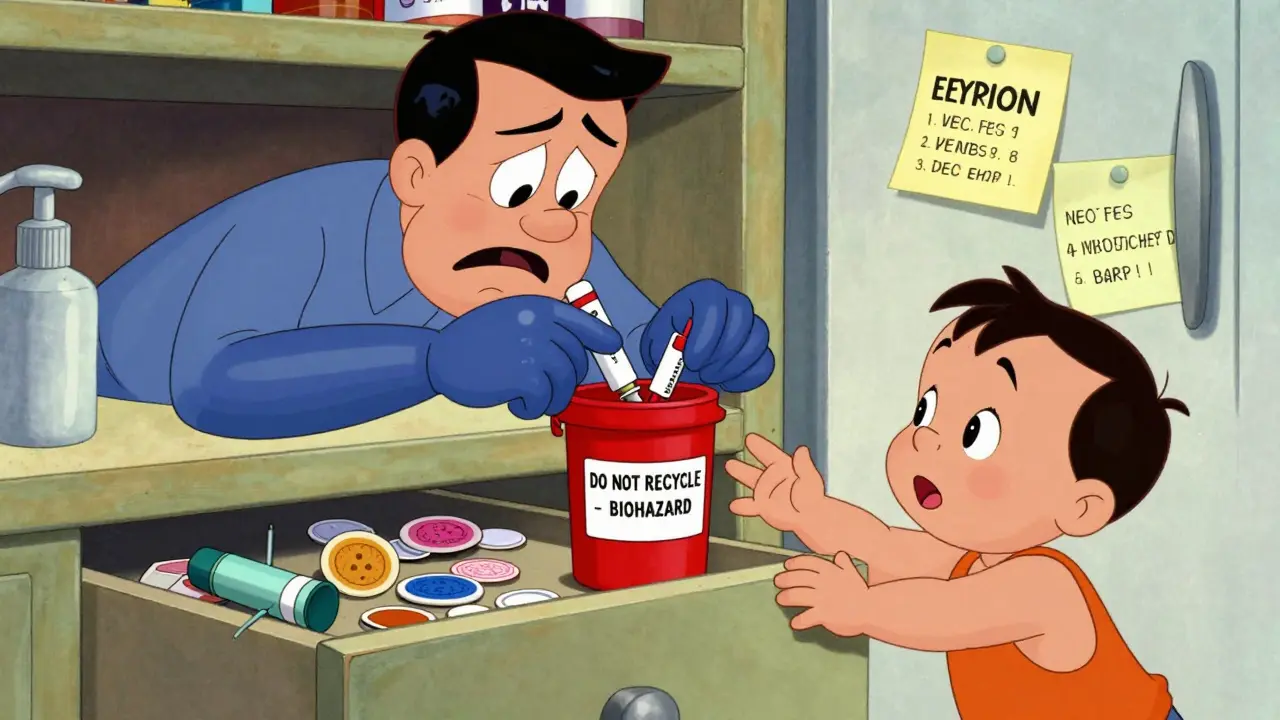
Expired EpiPens, inhalers, and medicated patches aren’t just old medicine-they’re potential hazards. Left in a drawer or tossed in the trash, they can poison kids, hurt pets, contaminate water, or even be stolen for misuse. You wouldn’t leave a loaded gun lying around. Don’t treat these devices any differently.
Why Proper Disposal Matters
An expired EpiPen might look harmless, but it still contains epinephrine-a powerful drug that can cause dangerous side effects if accidentally injected. Inhalers are pressurized cans that can explode if crushed or thrown into a fire. Medicated patches, especially fentanyl ones, still hold enough drug to kill an adult if someone else sticks it on their skin. The FDA says 12% of accidental poisonings in kids come from improperly thrown away meds. That’s not a small risk. It’s a preventable one.How to Dispose of Expired EpiPens
EpiPens are medical sharps because they have a hidden needle. You can’t just throw them in the trash like a pill bottle. Here’s what to do:- Take it back to your doctor or allergist. Most offices have a sharps container and will take expired EpiPens when you pick up a new one. No questions asked.
- Use a pharmacy with a sharps take-back program. Not all do, so call ahead. CVS, Walgreens, and some independent pharmacies offer this service. Ask if they accept auto-injectors-some only take needles, not the whole device.
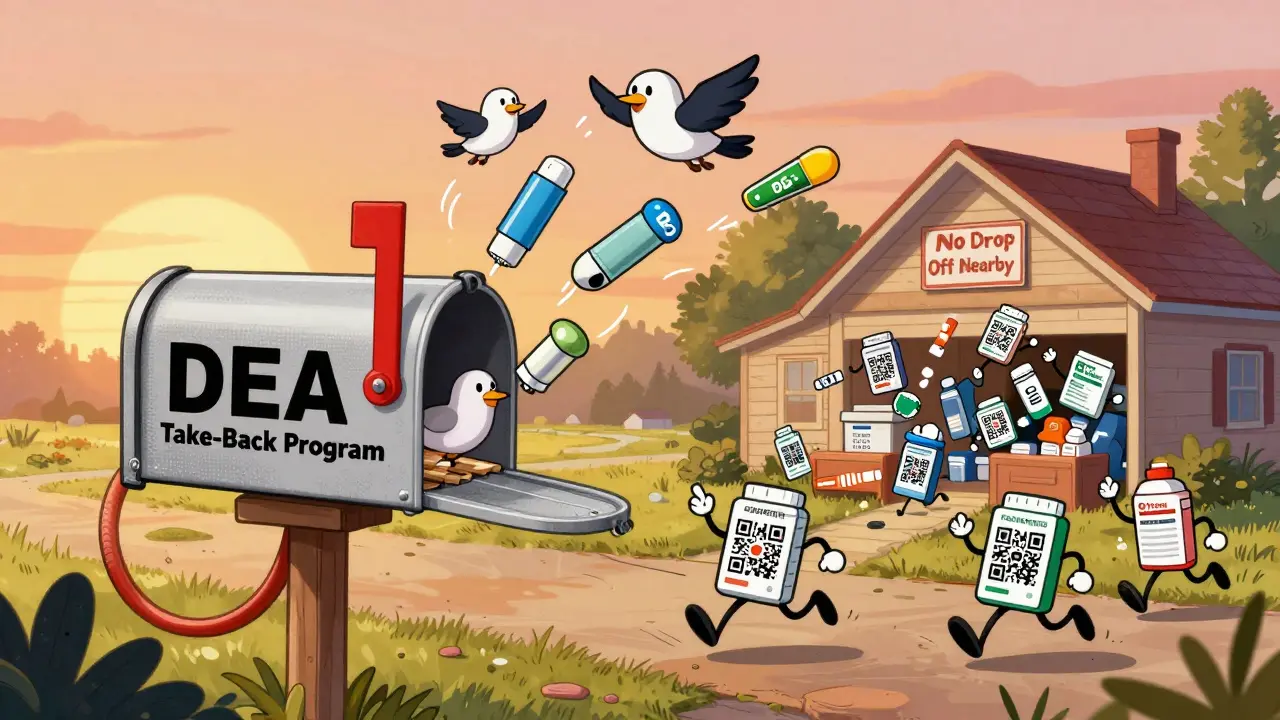
- Find a DEA take-back location. Go to deas takeback day website and search for nearby drop-off sites. These are often police stations, hospitals, or pharmacies.
- If you must store it at home, put it in a rigid, puncture-proof container like a plastic laundry detergent bottle. Label it clearly: "SHARPS - DO NOT RECYCLE - BIOHAZARD." Keep it out of reach of children and pets.
Don’t try to remove the needle, cut it open, or flush it. That’s dangerous and illegal in many places. California requires you to use a mail-back program or drop-off center-no trash disposal allowed. Texas lets you throw it in the trash if it’s in a sealed, labeled container. Know your state rules.
How to Dispose of Inhalers
Inhalers are tricky. They’re pressurized, contain propellants (some of which are greenhouse gases), and can’t be recycled like a soda can. The FDA warns they can explode if punctured or heated.- Check the label. Some inhalers say "do not puncture" or "do not incinerate." Follow those instructions.
- Call your local waste authority. Many cities have special collection days for aerosols. New York City, for example, accepts them at Household Special Waste Drop-Off Sites.
- Ask your pharmacy. Only about half of Walgreens locations take back inhalers. CVS doesn’t accept them at all. Don’t assume-call first.
- If no take-back option exists, empty the inhaler by spraying it into the air outdoors until no more mist comes out. Then remove the metal canister (if possible) and dispose of it in the regular trash. The plastic mouthpiece can go in recycling if your program accepts #5 plastic.
Don’t throw an unemptied inhaler in the trash. That’s a fire hazard. Don’t burn it. Don’t put it in your curbside recycling bin unless your city specifically says it’s allowed.
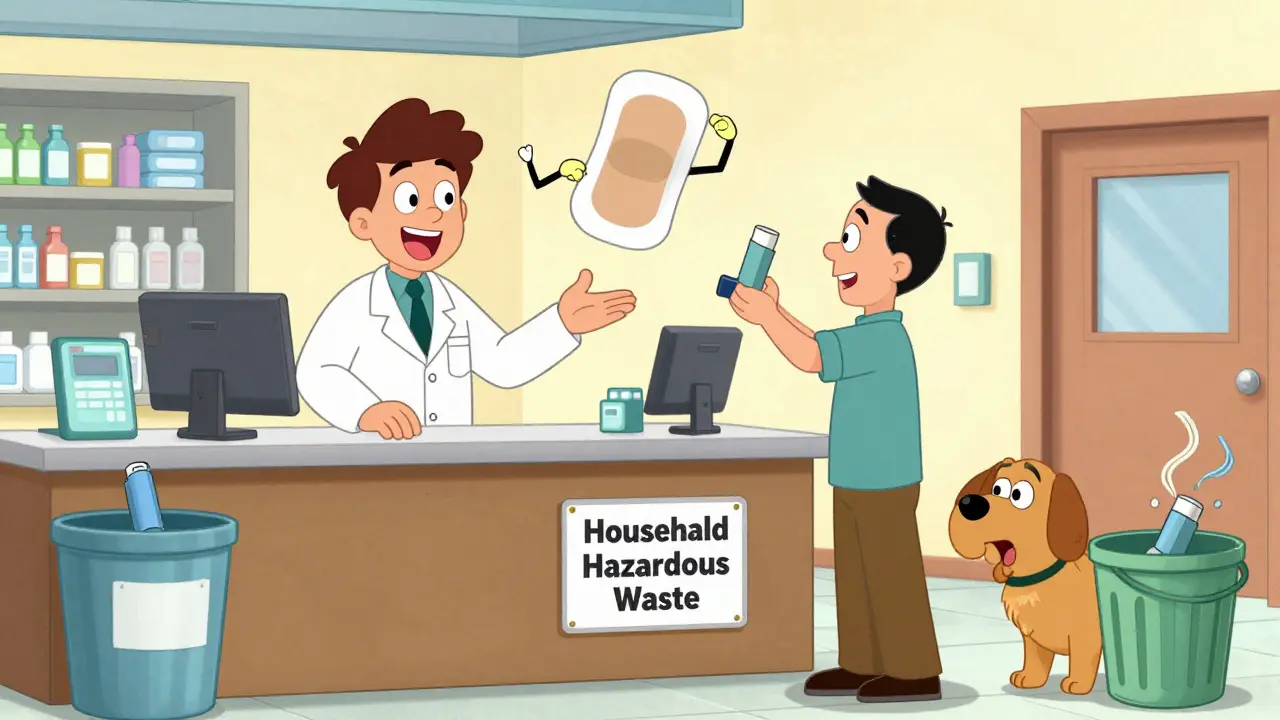
How to Dispose of Medicated Patches
Patches are the most dangerous to dispose of improperly. Even after use, they still contain 50% or more of their original drug. Fentanyl patches, in particular, can be lethal if handled by someone else.- For high-risk patches (fentanyl, buprenorphine, etc.), fold the patch in half with the sticky sides together. Then flush it down the toilet. The FDA has a list of 15 medications that should be flushed immediately to prevent accidental exposure. Fentanyl patches are on that list.
- For other patches (nicotine, lidocaine, etc.), fold the patch sticky side in, place it in a sealed container, mix it with used coffee grounds or cat litter, and throw it in the trash. This makes it unappealing and unusable.
- Don’t flush patches unless the label or FDA says so. Flushing non-listed patches can pollute waterways. The EPA found pharmaceuticals in 80% of tested U.S. waterways.
- Use DisposeRx® packets if available. Sold at 3,900 CVS locations, these packets turn pills and liquids into a gel when mixed with water. But they don’t work for patches. Stick to folding and flushing or mixing with litter.
What About DEA Take Back Days?
The DEA runs two National Prescription Drug Take Back Days every year-usually in April and October. In October 2022, they collected nearly a million pounds of medication across 5,800 locations. These events accept EpiPens, inhalers, and patches. You don’t need to be a patient or show ID. Just bring your expired meds.If you miss the event, don’t wait. Use the DEA’s online locator to find permanent drop-off sites near you. Rural areas are often underserved-only 37% of rural counties have permanent collection points, compared to 89% of urban ones. If you live in a remote area, ask your pharmacist about mail-back programs.
What NOT to Do
Here are the most common mistakes:- Don’t throw EpiPens in the trash without a sharps container.
- Don’t flush patches unless they’re on the FDA’s flush list.
- Don’t assume your pharmacy takes everything-ask first.
- Don’t try to dismantle an EpiPen or inhaler.
- Don’t recycle inhaler canisters or EpiPen casings.
A Reddit user from Houston shared: "My CVS said they only take pills, not auto-injectors." That’s not unusual. Many staff aren’t trained on sharps disposal. Don’t take "no" for an answer-ask for the pharmacy manager or call ahead.
How to Stay Prepared
Set a monthly reminder to check your medicine cabinet. Write expiration dates on a sticky note and put it on your fridge. Keep a dedicated sharps container in your bathroom or kitchen. They cost $5-$15 at pharmacies and last for years.When you get a new EpiPen or inhaler, ask your pharmacist: "Where do I take the old one?" Most will point you to the right place. If they don’t know, ask for the medical director. You’re not being difficult-you’re being responsible.
What’s Changing in 2026?
California passed SB 212 in 2024, requiring drug makers to pay for disposal programs. That means more drop-off boxes, more mail-back kits, and better labeling. EpiPen packaging now includes QR codes that link to disposal instructions. Other states are following. The goal? By 2030, every American should have access to safe, free disposal within 10 miles of home.Right now, 73% of people don’t know their state’s rules. You can change that. Share this info with family, friends, and neighbors. A single EpiPen in the wrong hands can be deadly. Proper disposal saves lives.
Can I throw expired EpiPens in the trash?
Only if you live in a state like Texas that allows it-and even then, you must place it in a rigid, puncture-proof container labeled "SHARPS" and "DO NOT RECYCLE." In most states, including California and New York, it’s illegal. Always use a take-back program if possible.
Can I flush my nicotine patch?
No. Only patches on the FDA’s flush list-like fentanyl-should be flushed. Nicotine patches should be folded sticky-side-in, placed in a sealed container, and mixed with cat litter or coffee grounds before trashing. Flushing non-listed patches pollutes water.
Does CVS take back inhalers?
No, CVS does not accept inhalers for disposal. Walgreens accepts them at about half of its locations. Always call ahead. Your best bet is your local household hazardous waste program or a DEA take-back site.
What if I can’t find a drop-off site near me?
Check safeneedledisposal.org for mail-back programs. Some states offer free prepaid mailers for sharps. For inhalers, empty them outdoors until no mist comes out, then separate the plastic and metal parts. Recycle the plastic if your program allows it, and trash the metal canister. For patches, fold and flush (if FDA-listed) or mix with cat litter.
Is it safe to store expired meds at home?
Only temporarily, and only if stored safely. Keep EpiPens in a locked, labeled sharps container out of reach of children and pets. Keep patches and inhalers in a high cabinet. Never leave them in a purse, car, or bathroom drawer. The longer you wait, the higher the risk of accidental exposure.
Comments (10)
-
Drew Pearlman January 10, 2026
Man, I never realized how many of us are just tossing these things in the trash like they’re old coffee grounds. I’ve got an expired EpiPen in my glove compartment right now-thanks to this post, I’m dropping it off at the pharmacy tomorrow. Seriously, if we can recycle soda cans, why can’t we recycle life-saving meds properly? It’s not that hard. Just take five minutes. Your kid, your neighbor’s dog, or some random person who finds it in a dumpster might thank you later.
And hey, I’m gonna start putting expiration dates on sticky notes on my fridge too. I’ve got three kids and a golden retriever who thinks every pill is a treat. This is the kind of info that should be mandatory in schools. Like, right after algebra and before PE.
Also, props to the guy who mentioned the QR codes on new EpiPens. That’s actually genius. Why didn’t anyone think of that sooner? Pharma companies finally doing something useful for once.
I’ve been meaning to get one of those sharps containers for ages. $12? That’s less than a latte. Worth every penny if it keeps my toddler from sticking a needle in his eye. Seriously, folks-this isn’t just responsibility. It’s love.
And if you live in a rural area and can’t find a drop-off? Don’t give up. Call your county health department. They’ll help. I did. They sent me a prepaid mailer. No joke. We’re all in this together.
Thanks for writing this. I shared it with my book club. We’re gonna make it our next ‘action item.’ We’re not just here to drink wine and judge each other’s knitting-we’re here to save lives.
Also, side note: I just called my CVS. They said no to inhalers. So I called the manager. She said, ‘Oh, we do that at the main branch.’ Always ask for the manager. It’s like magic.
Anyway. I’m done ranting. But seriously-do the thing. Your future self will high-five you.
And if you’re reading this and thinking ‘I’ll do it later’-you’re the person who leaves the oven on. Just do it now. Please.
Love you all. Stay safe.

-
Catherine Scutt January 12, 2026
You people are ridiculous. Just flush the damn patch if it’s fentanyl. Everyone else is overcomplicating this. I’ve seen people spend 20 minutes folding patches like origami. It’s not a craft project. It’s a drug. If you’re that worried, don’t have it in your house in the first place.

-
Darren McGuff January 13, 2026
As a paramedic in London, I’ve pulled expired EpiPens out of kids’ toy boxes more times than I can count. One kid in Manchester got injected by his 4-year-old brother who thought it was a ‘magic pen.’ He survived. Barely. The hospital bill? £18,000. The trauma? Unquantifiable.
Don’t wait for a disaster to act. The ‘fold and flush’ rule for fentanyl patches? Non-negotiable. I’ve seen adults OD from a patch they found in their grandkid’s diaper bag. One patch. One minute. One dead person.
And inhalers? Please. Empty them outside. Don’t just toss them in the bin. That canister? It’s basically a bomb if it hits a compactor. I’ve seen fire trucks respond to ‘mystery explosions’ in recycling trucks. Turns out, it was a half-full albuterol inhaler.
Yes, CVS doesn’t take them. Yes, your local dump might not either. But there’s always a way. Call your local NHS pharmacy. Ask for the ‘return and dispose’ scheme. They’ll guide you. No judgment. Just help.
This isn’t about being perfect. It’s about being aware. One small action-like calling ahead before you toss something-can save a life. Or two. Or ten.
And if you’re reading this and thinking ‘I’m too busy’-you’re the reason this problem exists. Take 90 seconds. Do the right thing. Your community is counting on you.

-
Ashley Kronenwetter January 15, 2026
Thank you for providing a clear, evidence-based guide to the safe disposal of controlled medical devices. The inclusion of state-specific regulations and references to FDA and EPA guidelines demonstrates a commendable level of diligence. I would only suggest adding citations for the 12% accidental poisoning statistic and the 80% waterway contamination figure, as these are critical data points that lend authority to the message. Additionally, the term ‘emotional vampire’ in the user traits section is inappropriate and should be removed from any public-facing material. Professionalism matters.

-
Chris Kauwe January 15, 2026
Let’s be real-this is what happens when you let bureaucrats and bleeding-heart liberals run healthcare. The government should stop micromanaging how we dispose of our own medicine. If you’re too stupid to keep your EpiPen away from your toddler, maybe you shouldn’t have kids. And flushing patches? That’s just environmental terrorism. We’re not in California, where they think recycling is a religion.
Meanwhile, real Americans are just trying to survive. I’ve got a job, a mortgage, and three kids. I don’t have time to hunt down a ‘DEA drop-off site’ like it’s a secret cult meeting. Just let me throw it in the trash. If someone else wants to be a hero, fine. But don’t guilt-trip me because I don’t want to spend my Saturday playing pharmacist.
Also, ‘mail-back programs’? That’s a scam. They charge you $15 to send back a $20 device. The pharmaceutical companies are laughing all the way to the bank. Wake up, sheeple.

-
Meghan Hammack January 16, 2026
Y’all. I just threw out my dad’s old inhaler last week. I had no idea. I thought you just toss it. I’m so mad at myself.
But guess what? I just called my local pharmacy. They said, ‘Bring it in Monday. We’ve got a box for it.’ I cried. Not because I’m weak-because someone finally made it easy.
So if you’re reading this and you’re scared or confused? Don’t panic. Just call. Just ask. Don’t wait. Don’t overthink it. You don’t need to be perfect. You just need to care.
I’m telling my mom. I’m telling my sister. I’m telling my neighbor who’s got dementia and keeps her patches in her purse.
You’re not alone. We’ve got this.

-
RAJAT KD January 18, 2026
Flushing fentanyl patches is the only responsible choice. Any other method risks lives. The FDA list exists for a reason. Do not overcomplicate. Act now. This is not debatable.

-
Matthew Maxwell January 19, 2026
It’s appalling that we’ve reached a point where the average citizen must be educated on basic pharmacological safety. This should be taught in middle school, not posted on Reddit by strangers with good intentions. The fact that 73% of Americans don’t know their state’s disposal laws is a national failure of public health infrastructure. The CDC, FDA, and DEA are collectively negligent. Until pharmaceutical manufacturers are held financially and legally accountable for the lifecycle of their products, this will continue. We are not babysitters for lazy corporations. Demand systemic change, not just individual compliance.

-
Pooja Kumari January 19, 2026
I just read this and I’m crying. Not because I’m sad-because I feel so guilty. I’ve got my grandma’s fentanyl patches in my nightstand. She passed last year. I couldn’t bring myself to throw them out. I thought… I thought if I kept them, she was still here somehow.
But then I remembered how she used to say, ‘Honey, if you love me, don’t let me hurt someone.’
I just folded them, stuck them in a ziplock with coffee grounds, and put them in the trash. I cried while I did it. I’m not okay. But I did the right thing.
Thank you for this. I didn’t know I needed it. I didn’t know I was carrying this around. I feel lighter now.
To everyone else who’s holding onto something they shouldn’t-please, let it go. Not because you have to. But because you love the people still here.
I’m sharing this with my whole family. Every single one. Because this isn’t just about medicine. It’s about grief. And love. And not letting pain become someone else’s tragedy.

-
Jacob Paterson January 20, 2026
Oh wow. Another ‘save the world’ post. Let me guess-you also recycle your toilet paper and compost your tears? You’re the kind of person who corrects people’s grammar in grocery lines. Congrats. You’ve turned a public health issue into a virtue-signaling contest.
And you’re mad that CVS doesn’t take inhalers? Maybe you should’ve called them before you posted this 3,000-word manifesto. Or maybe, just maybe, you’re the problem. People don’t need another lecture. They need simple, clear options. Not guilt. Not drama. Just a box to drop it in.
Meanwhile, I’m just trying to get my kid to eat broccoli. But sure, let’s all take a 45-minute walk to a ‘DEA drop-off’ because you think this is a moral crusade.
Next post: How to properly dispose of your expired hope.
