
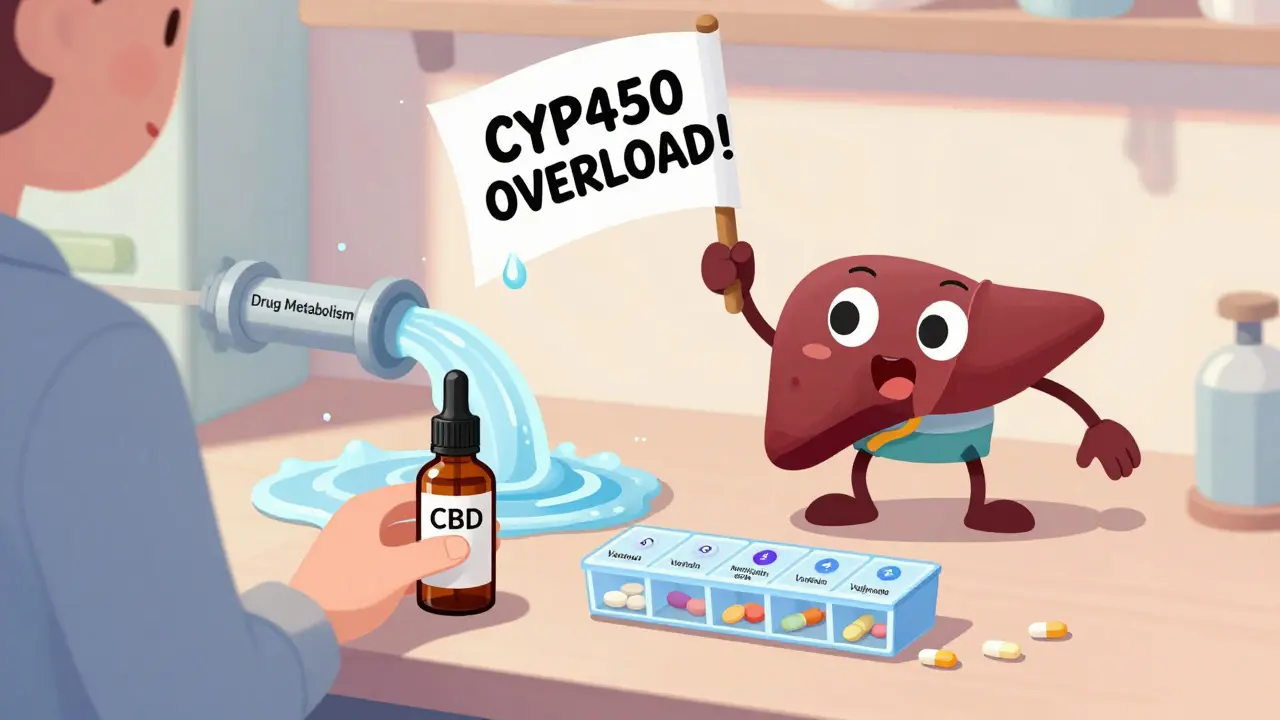
More than 1 in 5 adults in the U.S. now use CBD products - for sleep, pain, or anxiety. But if you’re also taking prescription medication, you could be at risk for a hidden, potentially dangerous interaction. It’s not hype. It’s science. And it’s happening right now, in kitchens and medicine cabinets across the country.
Why CBD Can Change How Your Medications Work
Your body breaks down most prescription drugs using a group of liver enzymes called cytochrome P450, or CYP450. This system handles about 95% of all medications on the market. CBD doesn’t just pass through this system - it shuts it down, at least partially. CBD is a powerful inhibitor of two key enzymes: CYP3A4 and CYP2C19. When these enzymes are blocked, your body can’t process other drugs the way it normally would. That means those drugs stay in your system longer, building up to higher levels than intended. Think of it like pouring syrup into a drain - it slows everything down. This isn’t theoretical. In clinical studies, CBD increased blood levels of the epilepsy drug clobazam by up to 300%. For patients on warfarin, a blood thinner, CBD has caused dangerous spikes in INR levels - a measure of how long blood takes to clot - leading to uncontrolled bleeding. One case report described a man on warfarin who started using CBD oil and ended up in the ER with internal bleeding.Medications That Can Turn Dangerous With CBD
Not all drugs are equally risky. The real danger comes with medications that have a narrow therapeutic index - meaning the difference between a safe dose and a toxic one is very small. These are the ones you can’t afford to get wrong.- Warfarin - Used to prevent strokes and blood clots. CBD can make it too strong, increasing bleeding risk. Seven documented cases required emergency dose changes.
- Amiodarone - A heart rhythm drug. CBD can cause toxic buildup, leading to lung or liver damage.
- Levothyroxine - For hypothyroidism. Even small changes in absorption can throw your metabolism off, causing fatigue, weight gain, or heart palpitations.
- Valproate, Lamotrigine, Clobazam - Anti-seizure medications. CBD raises their levels, which can cause drowsiness, dizziness, or liver injury.
- Tacrolimus and Sirolimus - Immunosuppressants used after organ transplants. CBD can push levels into toxic ranges, increasing infection risk. The Portland Clinic advises avoiding CBD entirely if you’re on these.
The Grapefruit Test: A Simple Way to Spot Risk
If your pill bottle says “Avoid grapefruit or grapefruit juice,” that’s your red flag. Both grapefruit and CBD block the same enzyme - CYP3A4. That’s not a coincidence. It’s a warning label written in biology. About 85 prescription medications carry this grapefruit warning. That includes statins like atorvastatin (Lipitor), blood pressure meds like amlodipine (Norvasc), and even some anti-anxiety drugs like buspirone. If your medication has that warning, CBD isn’t worth the gamble. You don’t need to memorize every drug name. Just check your labels. If you’re unsure, ask your pharmacist. They see these interactions every day.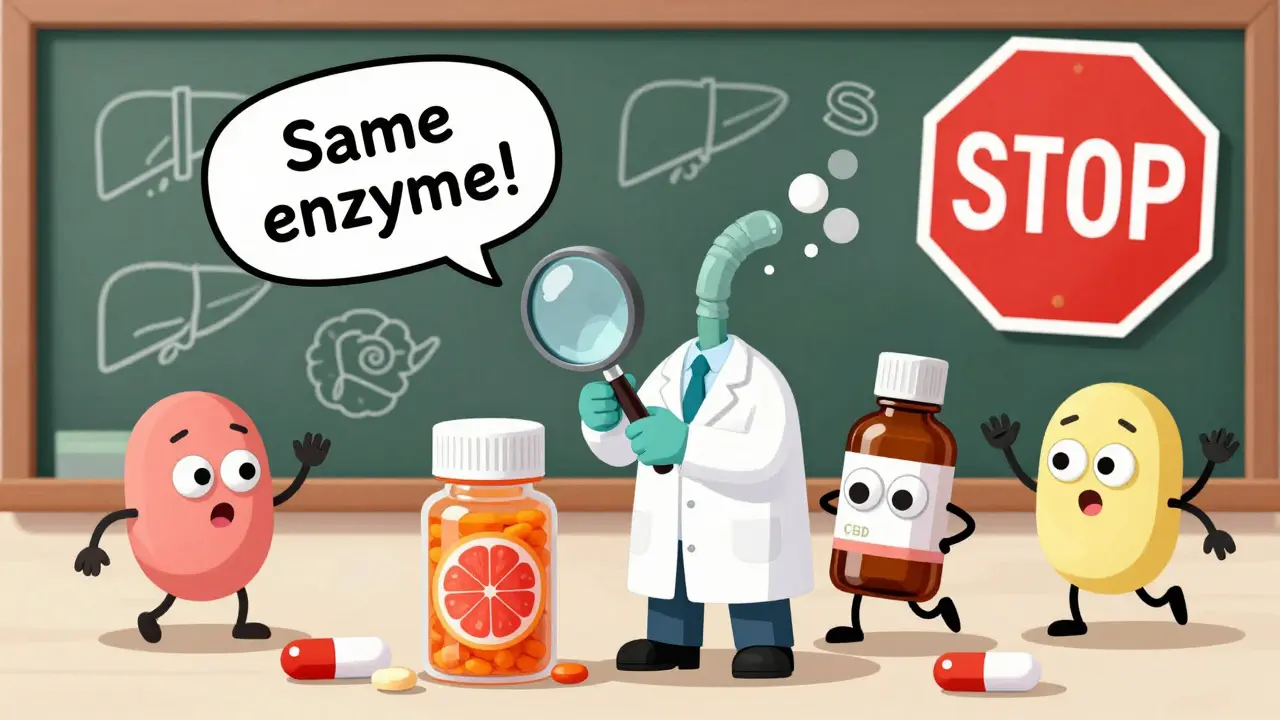
CBD Can Hurt Your Liver - Especially With Other Drugs
The FDA approved Epidiolex, a prescription CBD product, for severe childhood epilepsy. But in clinical trials, about 20% of patients developed elevated liver enzymes - a sign of liver stress. That risk goes up when CBD is mixed with other liver-metabolized drugs. People with existing liver conditions - like fatty liver disease or hepatitis - are at even greater risk. The Epidiolex prescribing guide says CBD is contraindicated in patients with moderate to severe liver impairment. If you’ve ever been told your liver enzymes are high, don’t start CBD without talking to your doctor. And it’s not just about enzymes. CBD can also cause drowsiness. Combine that with opioids, benzodiazepines (like Xanax), sleep aids, or even alcohol, and you’re stacking sedatives. That increases the risk of falls, car crashes, or even respiratory depression.What You Should Do If You’re Taking Medications
If you’re on any prescription drug and thinking about trying CBD, here’s what to do - not what to guess.- Make a full list of every medication, supplement, and herb you take - including over-the-counter stuff like Benadryl or ibuprofen.
- Check for grapefruit warnings on every pill bottle or prescription label.
- Talk to your pharmacist before taking your first CBD dose. They can run a quick interaction check and tell you if it’s safe.
- Start low and go slow - if your doctor says it’s okay. Begin with 5-10 mg per day. Don’t jump to 50 mg or more.
- Space out timing - take your medication and CBD at least 4 hours apart. This gives your liver time to process one before the other hits.
- Get blood tests if you’re on warfarin, valproate, tacrolimus, or other high-risk meds. Your doctor may need to check levels before and after starting CBD.
What Doesn’t Work - And Why
Some people say, “I take a tiny amount of CBD, so it’s fine.” But even low doses can interfere with drugs. A 2023 study found that 10 mg of CBD daily still inhibited CYP3A4 enough to affect drug metabolism. It’s not about quantity - it’s about mechanism. Others think, “I use topical CBD, so it won’t affect my pills.” That’s a myth. While skin absorption is low, some CBD still enters the bloodstream - enough to interact with liver enzymes. Topicals aren’t risk-free. And no, “natural” doesn’t mean safe. CBD is a potent bioactive compound. Just because it comes from a plant doesn’t make it harmless. If it were, the FDA wouldn’t have issued warnings about it.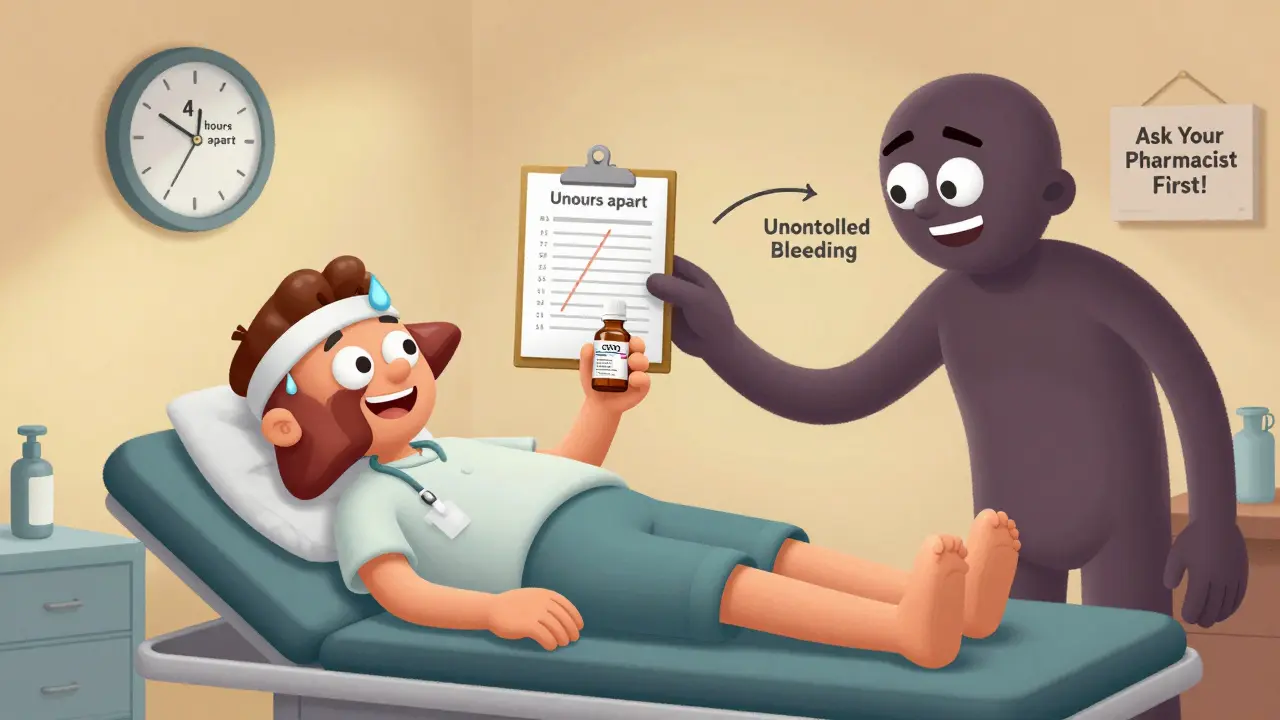
What’s Changing in 2026
Regulation is catching up. In February 2024, the FDA announced new rules requiring CBD product labels to include clear warnings about drug interactions. By Q3 2024, all major brands must state: “May interact with prescription medications. Consult your doctor before use.” Third-party testing is also improving. In 2020, only 32% of CBD brands provided lab reports. Now, 68% do. Look for a Certificate of Analysis (COA) that shows cannabinoid content and contaminants like heavy metals or pesticides. But even a clean product can still interact with your meds - purity doesn’t equal safety. A free tool called CANN-DIR, developed by Penn State researchers, now lets you search for known CBD-drug interactions. Just type in your medication, and it shows you the risk level. It’s not perfect, but it’s a start.When to Say No to CBD
There are times when CBD isn’t just risky - it’s a bad idea.- You’re on warfarin, tacrolimus, or sirolimus.
- You have liver disease or elevated liver enzymes.
- You’re taking multiple medications with grapefruit warnings.
- You’re scheduled for surgery - CBD can interfere with anesthesia.
- You’re pregnant, breastfeeding, or caring for a child on medication.
Bottom Line
CBD isn’t the villain. But it’s not harmless either. If you’re on prescription medication, it’s a wildcard. The science is clear: it can raise drug levels to dangerous points, damage your liver, and cause serious side effects. Don’t rely on YouTube videos or Instagram influencers. Don’t assume “it’s natural, so it’s safe.” Talk to your doctor. Bring your CBD bottle to your pharmacist. Get blood tests if needed. Your life isn’t worth guessing. If you’re not on any medications, CBD may be fine for you. But if you are? Stop guessing. Start asking.Can I take CBD with my blood pressure medication?
It depends. Some blood pressure meds - like amlodipine, diltiazem, and verapamil - carry grapefruit warnings, meaning CBD could raise their levels dangerously. Others, like lisinopril or metoprolol, are less likely to interact. But you can’t assume safety. Always check with your pharmacist or doctor before combining CBD with any blood pressure drug.
Does CBD interact with antidepressants?
Yes, some do. CBD can interfere with antidepressants metabolized by CYP2D6 or CYP3A4, including sertraline (Zoloft), fluoxetine (Prozac), and trazodone. This may increase side effects like dizziness, nausea, or serotonin syndrome - a rare but life-threatening condition. If you’re on an SSRI or SNRI, talk to your doctor before using CBD.
Is it safe to use CBD if I’m on thyroid medication?
No, not without monitoring. CBD can alter how your body absorbs levothyroxine, causing your thyroid levels to swing. One study showed patients on levothyroxine had abnormal TSH levels after starting CBD. If you’re on thyroid medication and want to try CBD, get your TSH tested before and 4-6 weeks after starting.
How long does CBD stay in my system?
CBD’s half-life is 18 to 32 hours, meaning it takes about 2-5 days to fully clear your body after stopping. But its enzyme-blocking effect can last longer - especially with daily use. Even if you stop taking CBD, it may still affect your medications for several days. That’s why spacing doses isn’t always enough - you need to plan ahead.
Can I use CBD if I’m on seizure meds?
Only under strict medical supervision. Epidiolex - a prescription form of CBD - is FDA-approved for certain seizure disorders. But it’s dosed precisely and monitored with blood tests. Over-the-counter CBD isn’t regulated the same way. Using it with other seizure drugs like valproate or clobazam can raise their levels too high, causing extreme drowsiness or liver damage. Never self-medicate with CBD if you have epilepsy.
What should I do if I already took CBD with my meds and feel weird?
Stop taking CBD immediately. If you feel unusually drowsy, dizzy, nauseous, or notice unusual bruising or bleeding, contact your doctor or go to the ER. Bring your CBD product with you - the label and ingredients matter. Don’t wait to see if it passes. Some interactions can escalate quickly.
Comments (14)
-
Jake Nunez January 11, 2026
CBD might seem harmless, but if you're on warfarin or any heart med, you're playing Russian roulette with your liver. I've seen too many people think 'natural' means 'safe'-until they're in the ER with uncontrolled bleeding. Don't be that guy.

-
Michael Marchio January 11, 2026
It's fascinating how people will swallow a $40 bottle of CBD oil labeled '100% organic' but won't take five minutes to read the fine print on their blood pressure medication. The CYP450 system isn't some abstract biochemistry concept-it's the reason your pills work. CBD doesn't just 'interfere'-it hijacks your entire metabolic pathway. And no, taking it 'at night' doesn't magically fix it. The enzyme inhibition lasts longer than your hangover after a weekend binge. If your doctor hasn't brought this up, they're either asleep at the wheel or they've never heard of Epidiolex's clinical trial data. Either way, you're on your own.

-
lisa Bajram January 11, 2026
OMG YES. I was on levothyroxine and started CBD for anxiety-felt like a zombie for three weeks. My TSH went from 2.1 to 8.9. My pharmacist caught it before my endocrinologist even saw me. 🙌 Don't wait until you're dizzy and gaining 10 lbs-check your meds against the grapefruit rule. Also, if your CBD brand doesn't have a COA? Burn it. No exceptions. You deserve to feel like yourself, not a lab rat.

-
Ted Conerly January 12, 2026
If you're on meds and thinking about CBD, just pause for a second. Talk to your pharmacist-they’re the real MVPs. I used to think I knew better, until my dad’s INR spiked after he started CBD oil. He was lucky. Don’t be like me. Start low, ask questions, get tested. Your body will thank you.

-
Faith Edwards January 12, 2026
It is profoundly disconcerting that the American public has come to regard pharmacological interventions as optional, whimsical, and subject to anecdotal validation. The cytochrome P450 system is not a suggestion-it is a biological imperative. The fact that individuals are casually self-administering a potent enzyme inhibitor without medical supervision is not merely irresponsible-it is a public health failure of epic proportions. One does not casually mix botanical extracts with life-sustaining pharmaceuticals and then claim ignorance when the consequences manifest. This is not wellness. This is negligence dressed in hemp.

-
Jay Amparo January 14, 2026
I live in India and we don’t have much CBD here, but I’ve seen friends in the US get into trouble with this. My cousin was on epilepsy meds and tried CBD for ‘better sleep’-ended up in hospital with tremors. Please, if you’re on meds, don’t guess. Ask. There’s no shame in asking. Your health matters more than being ‘on trend’.

-
Lisa Cozad January 16, 2026
Just got back from my pharmacist and they showed me a chart of all my meds that interact with CBD. I had no idea my anxiety pill was on the list. I’m canceling my CBD subscription. Better safe than sorry. Thanks for the heads-up, OP.

-
Saumya Roy Chaudhuri January 16, 2026
You people are clueless. CBD isn't just a 'supplement'-it's a pharmaceutical-grade compound. The FDA didn't approve Epidiolex for nothing. And if you think topical CBD is safe, you clearly never took organic chemistry. The skin absorbs more than you think. Even 5% bioavailability is enough to inhibit CYP3A4. I’ve reviewed 37 clinical papers on this. You're not ‘being natural’-you're being dangerously uninformed.

-
anthony martinez January 17, 2026
So let me get this straight… I can’t have grapefruit with my statin, but I can have CBD oil? That’s like saying ‘you can’t drink gasoline, but ethanol is fine.’

-
Mario Bros January 17, 2026
Been using CBD for months with my blood pressure med. No issues. Maybe it's just me? I take it at night and my BP is actually better. Maybe it's not as bad as they say?

-
Jaqueline santos bau January 18, 2026
Oh my god, I knew someone would get hurt. I told my sister last year not to mix CBD with her seizure meds and she laughed at me. Now she’s on a feeding tube because her liver shut down. I’m not mad-I’m just heartbroken. People need to stop treating their bodies like TikTok experiments.

-
chandra tan January 18, 2026
My uncle in Texas uses CBD for back pain. He’s on warfarin. His doctor told him to stop. He didn’t. Last month he had a bleed in his brain. He’s okay now, but he’s on oxygen. Don’t be him.

-
Jake Kelly January 20, 2026
Thanks for laying this out so clearly. I’ve been on levothyroxine for 12 years and was thinking about trying CBD for sleep. Not anymore. I’ll call my endocrinologist tomorrow.

-
Ritwik Bose January 21, 2026
Thank you for this comprehensive, scientifically grounded post. As someone who has studied pharmacology, I appreciate the emphasis on CYP450 inhibition and the practical guidance. The grapefruit test is brilliant-simple, actionable, and universally applicable. I will share this with my family and colleagues. Safety should never be an afterthought.
