
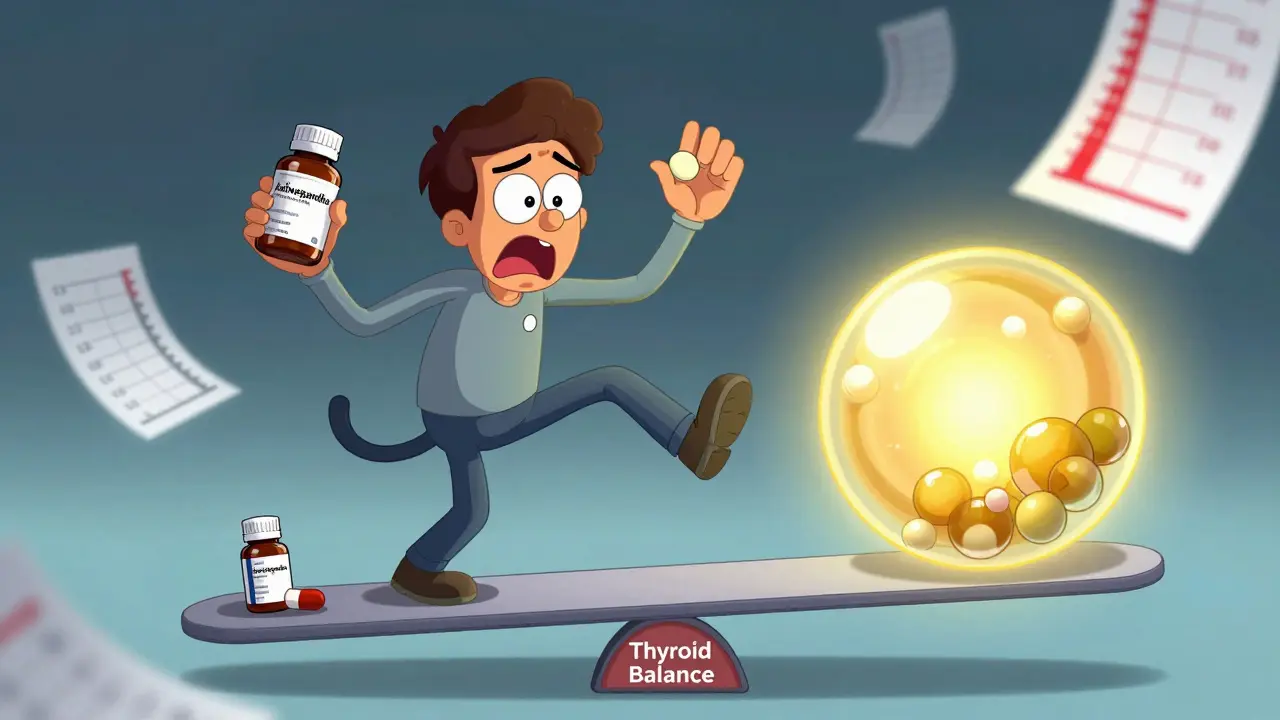
Many people turn to ashwagandha for stress, sleep, or low energy - and it’s easy to see why. This ancient herb has been used for thousands of years in Ayurvedic medicine, and today, it’s one of the most popular supplements in the U.S. But if you’re taking thyroid medication like levothyroxine (Synthroid), ashwagandha could be quietly pushing your hormone levels into dangerous territory. The problem isn’t just theoretical. Real patients have ended up in the ER with racing hearts, insomnia, and shaking hands - all because they didn’t know ashwagandha can act like an extra dose of thyroid hormone.
How Ashwagandha Affects Your Thyroid
Ashwagandha doesn’t just calm your nerves - it also stimulates your thyroid. The active compounds in it, called withanolides, interact with your hypothalamic-pituitary-thyroid (HPT) axis. In simple terms, it tells your body to make more thyroid hormone. A 2018 clinical trial with 50 people with subclinical hypothyroidism showed that taking 600 mg of standardized ashwagandha daily for eight weeks increased T3 (the active thyroid hormone) by 41.5%, T4 by 19.6%, and even raised TSH by 17.5%. That last one might sound odd - if your thyroid is underactive, why would TSH go up? Because the body was trying to compensate. But when you’re already on thyroid medication, that extra push becomes a problem.
Think of your thyroid hormone levels like a balance scale. Levothyroxine is the precise weight on one side, carefully calibrated by your doctor to keep you feeling normal. Ashwagandha adds weight to the other side - without you knowing how much. And since supplements aren’t regulated like drugs, the amount of withanolides in your bottle could be anywhere from 1.2% to 7.8%. One brand might give you a gentle nudge. Another might shove you off the scale entirely.
What Over-Replacement Actually Looks Like
Over-replacement means your thyroid hormone levels are too high - medically called iatrogenic hyperthyroidism. It’s not just a lab number. It’s palpitations that wake you up at 3 a.m. It’s anxiety so sharp you can’t sit still. It’s unexplained weight loss, sweating through your clothes, and a tremor in your hands you can’t control. The American Association of Clinical Endocrinologists documented 12 cases in 2023 where patients on levothyroxine took ashwagandha and ended up with T4 levels above 25 mcg/dL. The normal range? 4.5 to 12.0. TSH dropped below 0.01 mIU/L - essentially, the thyroid was completely shut down by the body’s own feedback loop.
One patient on the Thyroid Help Forum, who went by ‘ThyroidWarrior,’ took 500 mg of ashwagandha daily with 100 mcg of levothyroxine. After six weeks, their TSH crashed from 1.8 to 0.08. They developed heart palpitations and couldn’t sleep. They had to go to urgent care. Their doctor had to lower their levothyroxine dose - and told them to stop the supplement immediately.
And it’s not rare. A 2022 survey of over 1,200 thyroid patients found that nearly 1 in 5 who took ashwagandha experienced symptoms of hyperthyroidism. Nearly 30 of them were hospitalized for heart rhythm problems. The FDA’s adverse event database recorded 47 cases of thyroid dysfunction linked to ashwagandha between 2019 and 2022 - and 32 of those involved people on thyroid meds.
Why Doctors Say: Don’t Mix Them
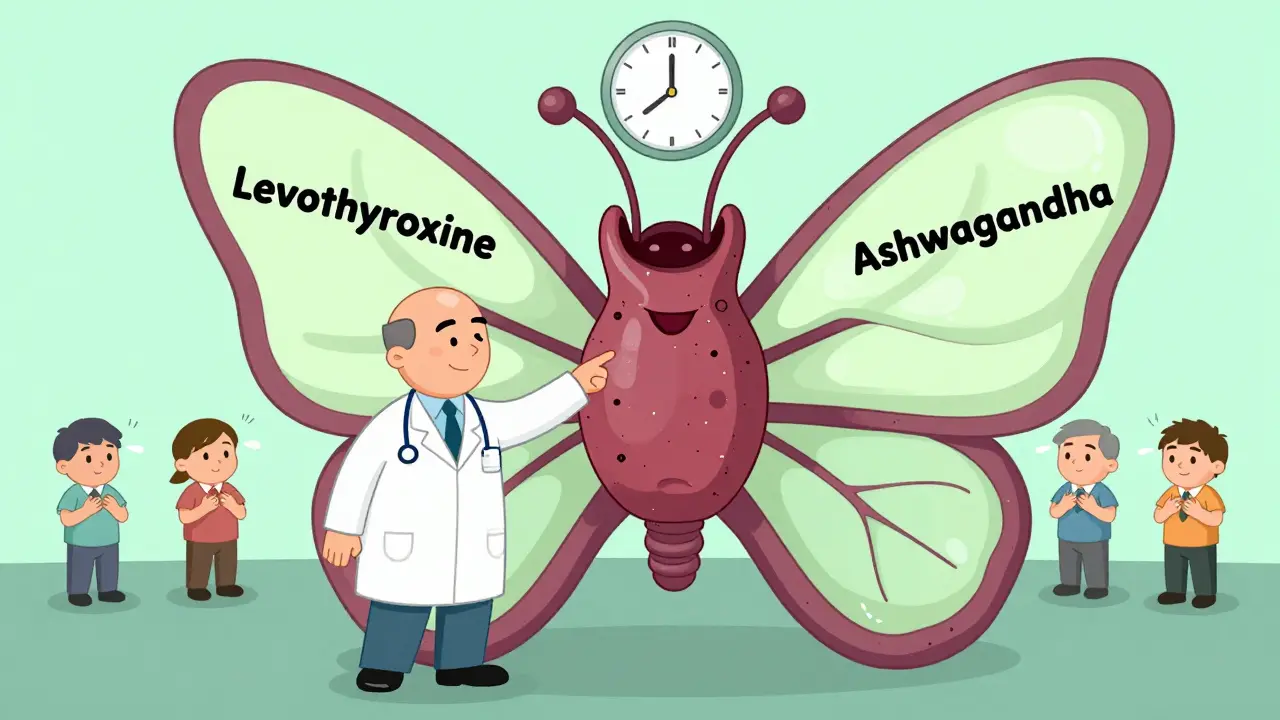
Endocrinologists at Mayo Clinic, UCLA, and Cedars-Sinai all agree: if you’re on thyroid medication, avoid ashwagandha. Dr. Angela Leung at UCLA put it bluntly: “Ashwagandha can tip the delicate balance of thyroid hormone replacement.” Dr. Mary Hardy, who studies integrative medicine, says the therapeutic window for thyroid meds is razor-thin. Add an unregulated herb, and you’re gambling with your health.
Even if you feel better on ashwagandha - say, less anxious or sleeping better - that doesn’t mean it’s safe. The symptoms you’re enjoying could be masking a dangerous rise in hormone levels. And here’s the catch: the effects don’t disappear when you stop taking it. Ashwagandha has a half-life of about 12 days. That means it can keep influencing your thyroid for two to three weeks after your last dose. If you get your blood tested during that time, your numbers will look skewed - and your doctor might think you need a higher or lower dose of levothyroxine when you actually don’t.
What If You’re Not on Medication?
Some people with untreated hypothyroidism report feeling better on ashwagandha alone. One Reddit user, ‘HypoThyroidHope,’ saw their T4 rise from 5.2 to 8.7 mcg/dL over three months. That’s a real improvement - but it’s not a cure. Their levels still weren’t in the normal range, and they didn’t have a doctor monitoring them. That’s the danger. Without regular testing, you won’t know if you’re approaching hypothyroidism, hyperthyroidism, or something in between. And if you eventually need medication, your doctor will have to work backward through the mess ashwagandha left behind.
Also, ashwagandha isn’t the only herb that does this. Other adaptogens like ginseng, licorice root, and bladderwrack can also affect thyroid function. But ashwagandha is the most studied and the most commonly used - which is why it’s the biggest concern.

What Should You Do?
If you’re on thyroid medication and already taking ashwagandha, don’t panic. But do act. Stop taking it. Wait at least 30 days - because the effects linger - then ask your doctor to retest your TSH, free T4, and free T3. Your dose may need adjustment.
If you’re thinking about starting ashwagandha, talk to your endocrinologist first. Don’t assume it’s safe just because it’s natural. The FDA doesn’t test supplements for safety or interaction risks. The Dietary Supplement Health and Education Act of 1994 lets manufacturers sell products without proving they’re safe to take with prescription drugs.
Some doctors suggest waiting four hours between taking ashwagandha and your thyroid pill. But there’s no solid evidence this works. The real solution is simple: don’t mix them. If you need stress relief, try proven alternatives - meditation, regular exercise, cognitive behavioral therapy, or even prescription options like low-dose SSRIs if anxiety is severe. There are safer ways to manage stress than risking your thyroid health.
The Bigger Picture
Ashwagandha is a $1.1 billion industry. It’s marketed as a cure-all for modern stress. But that marketing often leaves out the fine print. The American Medical Association has asked the FDA to require black box warnings on ashwagandha products - the same kind of warning you see on powerful prescription drugs. So far, the supplement industry has pushed back. Meanwhile, the European Medicines Agency already requires warning labels on all ashwagandha products sold in the EU.
The NIH is funding a $2.3 million study to better understand this interaction. Results won’t be out until late 2024. But we already have enough data to know this: if you’re on thyroid medication, ashwagandha isn’t worth the risk. Your thyroid is too important. Your hormones are too precise. And the consequences of over-replacement - heart damage, bone loss, muscle wasting - are serious and sometimes permanent.
There’s no shortcut to thyroid health. It’s not about finding the next miracle herb. It’s about consistency, monitoring, and working with your doctor - not against your own biology.
Can ashwagandha replace my thyroid medication?
No. While some people with untreated hypothyroidism report improved symptoms after taking ashwagandha, it does not reliably normalize thyroid hormone levels. It cannot replace levothyroxine or other prescribed thyroid medications. Stopping your medication to use ashwagandha alone can lead to worsening symptoms, organ damage, or dangerous hormonal swings. Always consult your doctor before making changes to your treatment plan.
How long does ashwagandha stay in your system?
Ashwagandha has a half-life of approximately 12 days, meaning it takes about two to three weeks for most of it to clear from your body. This is why experts recommend stopping ashwagandha for at least 30 days before getting thyroid blood tests. Otherwise, your results may show artificially high hormone levels, leading to incorrect dose adjustments.
Is it safe to take ashwagandha if I have Hashimoto’s?
If you have Hashimoto’s and are on thyroid medication, ashwagandha is not recommended. Hashimoto’s is an autoimmune condition that often leads to hypothyroidism, and most patients require lifelong thyroid hormone replacement. Ashwagandha can increase thyroid hormone production, which may cause over-replacement and trigger symptoms of hyperthyroidism. It may also stimulate immune activity in unpredictable ways, potentially worsening autoimmune flares.
What supplements are safe to take with thyroid medication?
Some supplements are generally considered safe when taken at the right time. Iron, calcium, and magnesium can interfere with levothyroxine absorption, so they should be taken at least four hours apart. Vitamin D and B12 are often needed by thyroid patients and can be taken safely with meals, separate from medication. Probiotics and omega-3s have no known interaction with thyroid meds. Always check with your doctor before adding any new supplement - even ones labeled “natural” or “safe.”
What should I do if I think ashwagandha is affecting my thyroid?
Stop taking ashwagandha immediately. Contact your doctor and ask for a full thyroid panel: TSH, free T4, and free T3. If you’re experiencing symptoms like rapid heartbeat, chest pain, extreme anxiety, tremors, or unexplained weight loss, seek medical attention right away. Do not wait for your next routine appointment. Over-replacement can lead to serious complications, including atrial fibrillation and bone density loss.
Comments (11)
-
Kim Hines December 17, 2025
This is terrifying. I’ve been taking ashwagandha for sleep and didn’t even know it could mess with my thyroid.

-
Kitty Price December 18, 2025
Thank you for writing this. I’ve been on levothyroxine for 8 years and started ashwagandha last winter. I thought my anxiety was just stress - turns out it was my thyroid going haywire. Stopped it 3 weeks ago and my heart stopped racing. 🙏

-
Tiffany Machelski December 20, 2025
i had no idea this was a thing. i took ashwagandha for 4 months and my doc kept lowering my dose thinking i was overmedicated. turns out it was the herb. i feel so dumb.

-
sue spark December 22, 2025
People think natural means safe but that’s not true at all. Plants have powerful chemistry. Ashwagandha isn’t tea, it’s a hormone modulator. This post should be required reading for anyone on thyroid meds

-
Cassandra Collins December 23, 2025
Big Pharma doesn’t want you to know this because herbs don’t have patents. Ashwagandha’s been used for 5000 years but the FDA and drug companies are scared of natural cures. They’re hiding the truth to keep you buying pills. And now they’re trying to silence people who speak up. Wake up.

-
SHAMSHEER SHAIKH December 25, 2025
As an Ayurvedic practitioner with over two decades of clinical experience, I must emphasize: ashwagandha is not a benign herb. It is a potent adaptogen with documented thyromimetic activity. Its use in patients on levothyroxine is contraindicated without rigorous biochemical monitoring. The 2018 trial referenced is not an outlier - it is a predictable pharmacological interaction. The HPT axis is exquisitely sensitive to phytochemical modulation. Moreover, the variability in commercial preparations - ranging from 1.2% to 7.8% withanolides - renders dosing unpredictable. In my practice, I have seen three patients in the past year present with subclinical thyrotoxicosis following ashwagandha use. All resolved upon discontinuation and retesting after 30 days. I urge clinicians to routinely screen for herbal supplement use in hypothyroid patients - and to educate them that "natural" does not equate to "risk-free."

-
Colleen Bigelow December 25, 2025
Why is the FDA letting this happen? They regulate aspirin like it’s nuclear material but let some guy in a garage in Florida sell ashwagandha with no testing? This is why America is falling apart - we’ve abandoned science for vibes. The EU requires warnings? Good. We should ban this stuff until it’s FDA-approved like real medicine. And stop calling it "supplement" - it’s a drug. Call it what it is.

-
Mike Smith December 26, 2025
Thank you for sharing this. I’m a nurse practitioner and I’ve seen this exact scenario too many times. Patients come in with palpitations, weight loss, insomnia - we run labs, find TSH undetectable, and they say, "I just started this herbal thing." We need to make this part of every new patient intake. It’s not just about thyroid - it’s about patient safety. Please, if you’re on meds, talk to your provider before adding anything. Even "harmless" herbs.

-
Randolph Rickman December 28, 2025
I’ve been on levothyroxine for 15 years. I started ashwagandha because I read it "helps with stress." I didn’t feel any different - until I had a panic attack at work and my heart felt like it was trying to escape my chest. My endocrinologist said my T4 was 23. I had no idea. I stopped it immediately. It took six weeks for my numbers to normalize. I’m now a believer in this warning. If you’re on thyroid meds, don’t risk it. There are safer ways to manage stress. I started yoga and therapy. I feel better than ever - and my thyroid is stable.

-
James Rayner December 30, 2025
It’s funny how we’ll trust a pill from a lab but fear a plant from the earth. But the truth is, plants are where most drugs come from. Digitalis from foxglove. Aspirin from willow bark. Ashwagandha isn’t magic - it’s chemistry. And chemistry doesn’t care if it’s in a capsule or a root. We need more education, not fear. But also… maybe don’t mix them. 🤔

-
Dylan Smith December 30, 2025
I’m so glad someone finally said this. I’ve been telling my clients for years but no one listens. Ashwagandha is not harmless. It’s a thyroid stimulant. If you’re on levothyroxine, you’re already replacing what your body can’t make. Adding another stimulant is like stepping on the gas while your cruise control is on. You’re not going faster - you’re going off a cliff. I’ve had two patients hospitalized for atrial fibrillation because of this. Please stop. Your thyroid is not a suggestion. It’s a life-support system.
