
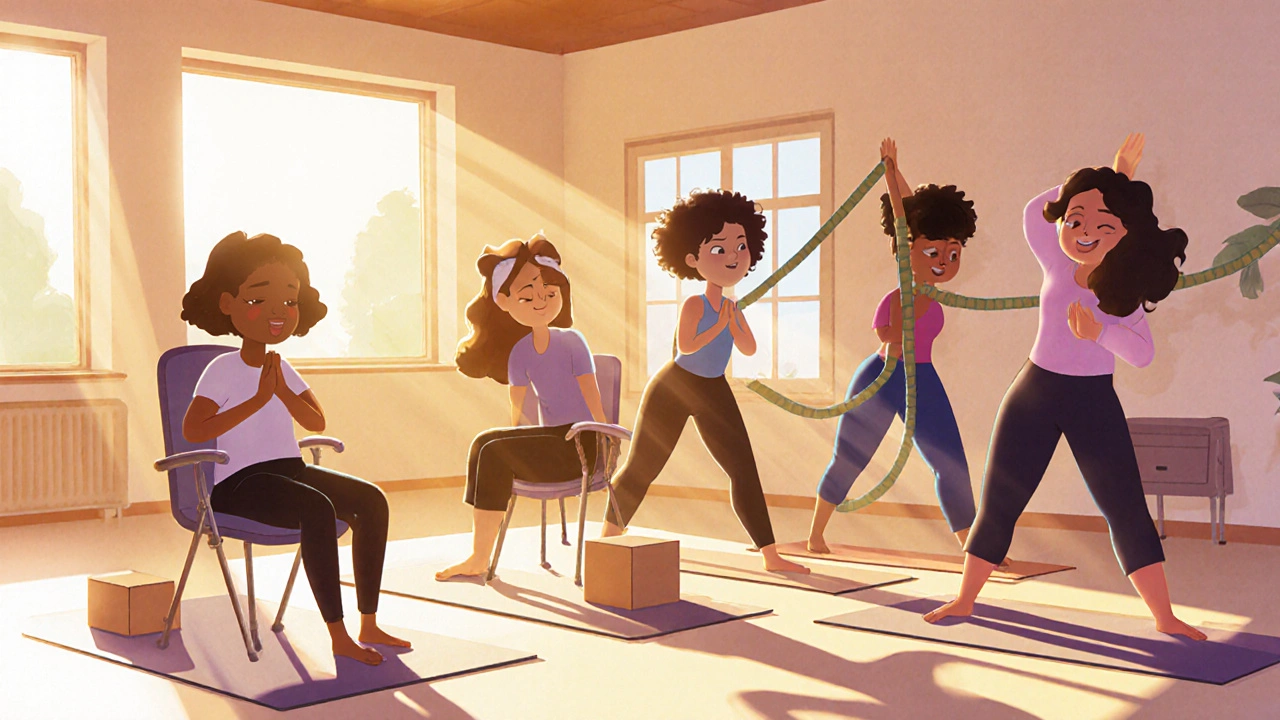
Chronic pain doesn’t just hurt-it drains your energy, steals your sleep, and makes even simple movements feel like battles. If you’ve tried medications, physical therapy, or injections and still feel stuck, you’re not alone. Millions of people are turning to something quieter, gentler, and surprisingly powerful: yoga and tai chi. These aren’t just trendy workouts. They’re evidence-backed tools that help retrain your body and brain to manage pain without drugs.
How Yoga and Tai Chi Actually Help Pain
Yoga and tai chi work differently than stretching or lifting weights. They don’t force your body to push through pain. Instead, they teach it to move with awareness, calm the nervous system, and rebuild trust in movement.Yoga combines slow postures (asanas), breath control, and mindfulness. A 2024 review of 18 studies found that people with chronic neck pain who practiced yoga for 12 weeks improved their range of motion by 37%-more than those doing standard physical therapy. The key? It’s not about how deep you go into a pose. It’s about how present you are in it.
Tai chi, developed in China over 800 years ago, looks like slow-motion dancing. Each movement flows into the next, coordinated with deep breathing. In a landmark 2018 study published in the New England Journal of Medicine, people with fibromyalgia who did tai chi twice a week for 12 weeks reported 27% less pain than those who only stretched. They also slept better and felt less depressed. Why? Because tai chi doesn’t just move your joints-it calms your brain’s pain signals.
Both practices activate the parasympathetic nervous system-the part of your body that says, “It’s safe to relax.” When you’re in chronic pain, your nervous system stays stuck in “fight or flight.” Yoga and tai chi gently flip that switch. You don’t need to be flexible or strong to start. You just need to show up.
What the Science Says: Who Benefits Most?
Not all pain is the same, and neither are these practices. Research shows they work best for certain conditions.Knee osteoarthritis: A 2021 review of 16 studies found tai chi improved balance by 18-25% compared to control groups. That’s huge-better balance means fewer falls and less fear of moving. Yoga helped too, especially when poses were modified with chairs or blocks.
Lower back pain: Longer yoga programs (12+ weeks) showed stronger results than short ones. A 2021 study found yoga reduced back pain more than standard care. For men in their 20s with acute lower back pain, tai chi outperformed stretching exercises.
Fibromyalgia: This is where tai chi shines. The 2018 NEJM study didn’t just measure pain-it measured life quality. Participants felt more energy, slept deeper, and had fewer flare-ups. Dr. Chenchen Wang at Tufts Medical Center calls it a “first-line non-pharmacological intervention.” That’s a big deal in pain medicine.
Neck pain: A 2024 study found yoga combined with hot sand fomentation (a traditional heat therapy) reduced pain intensity by 42% more than physical therapy alone. The heat helped loosen stiff muscles, while yoga rebuilt movement patterns.
But it’s not a magic bullet. For rheumatoid arthritis, results are mixed. Four studies showed improvement; three didn’t. That’s why experts say: try it, but don’t expect miracles overnight.
Yoga vs. Tai Chi: Which One Should You Choose?
People often ask: “Should I do yoga or tai chi?” The answer isn’t either/or-it’s “what fits your life.”Yoga is more structured. You’ll hold poses like child’s pose, cat-cow, or seated forward bends. It’s great if you like clear instructions and want to build strength slowly. Styles like Hatha and Restorative yoga are gentle enough for beginners with pain. If you struggle with standing, chair yoga works just as well.
Tai chi is more fluid. There are no static holds-just smooth, continuous motion. It feels more like moving meditation. If you’ve ever felt yoga was “too spiritual” or “too stretchy,” tai chi might feel more natural. It’s also easier to adapt for people with limited mobility. Seated tai chi is common in VA programs and senior centers.
One surprising finding: men respond better to tai chi. A 2021 analysis found 82% of male participants were satisfied with tai chi, compared to 67% with yoga. Why? Many men said tai chi felt less “feminine” or “woo-woo”-it had a martial roots vibe they connected with.
Here’s the bottom line: if you like structure and stillness, try yoga. If you like flow and rhythm, try tai chi. You can even do both.

How to Start Without Getting Hurt
Starting is easy. Getting hurt? That’s the risk.39% of new users report pain flares in the first few weeks. That’s normal-but not inevitable. Here’s how to avoid it:
- Start small. Do 15 minutes a day for the first two weeks. Not an hour. Not every day. Just 15 minutes, three times a week.
- Use props. Yoga blocks, straps, and chairs aren’t signs of weakness-they’re tools. A block under your hand in a standing pose can take pressure off your knees. A chair lets you do tai chi without standing.
- Find the right instructor. One Healthgrades review said, “My first tai chi teacher didn’t know how to modify for knee arthritis-and it made my pain worse.” Look for instructors certified in therapeutic yoga or tai chi for arthritis. The Arthritis Foundation offers certified programs like “Tai Chi for Arthritis.”
- Listen to your body. Sharp pain? Stop. Dull ache? Slow down. A gentle stretch? Keep going. Pain isn’t progress. Movement without fear is.
- Time it right. If you take pain meds, try practicing 30-60 minutes after your dose. That’s when the medication peaks and your body feels most mobile.
Most people see real changes after 6-8 weeks. Maximum benefit? Around 12 weeks. That’s longer than a typical gym program-but the results last longer too.
Cost, Access, and Real-World Options
You don’t need expensive gear or a fancy studio.Community centers often charge $10-$15 per class. Some libraries and senior centers offer free sessions. Online, apps like Tai Chi for Arthritis (by the Arthritis Foundation) and Yoga for Chronic Pain (by Yoga Medicine) cost less than $10 a month. Glo and Alo Moves run $18-$29 monthly, but you can often get a free trial.
Insurance coverage is growing. Blue Cross Blue Shield now covers yoga and tai chi in 12 states for about 15 million members. The Veterans Administration offers tai chi in 92 of its 170 medical centers-serving 45,000 veterans annually. And starting January 2025, doctors in the U.S. will be able to bill insurance for referring patients to these programs, thanks to a new coding system from the American Medical Association.
For people in rural areas or low-income communities, access is still a challenge. A 2023 study found they have 60% less access to qualified instructors. That’s why digital options matter more than ever.
What Experts Really Think
Dr. Robert B. Saper from Boston University says the research has limits: “Most studies are small. We still don’t know exactly how these practices reduce pain.”But Dr. Karen J. Sherman, lead author of the famous fibromyalgia study, adds: “The social part matters. Group tai chi creates connection. That’s healing too.”
Harvard Health points out that unlike running or weightlifting, tai chi doesn’t just strengthen muscles-it changes how your brain processes pain. “It’s exercise plus meditation,” says Dr. Anthony P. Khawaja. “You’re not just moving your body. You’re rewiring your response to pain.”
The American College of Physicians recommends both yoga and tai chi for chronic pain-ranking them higher than acupuncture and on par with cognitive behavioral therapy. That’s not a small endorsement.

Real Stories, Real Results
On Reddit’s r/ChronicPain community, 78% of 1,245 users who tried tai chi reported “moderate to significant” pain relief. One woman with rheumatoid arthritis wrote: “I can do seated tai chi on high-pain days when yoga isn’t possible. It’s the only thing that doesn’t make me feel like a burden to my body.”A veteran in Texas said: “After six months of tai chi at the VA, I cut my opioid dose in half. I didn’t just feel less pain-I felt like I could live again.”
Another user on Yoga Journal said: “I used to avoid bending over to tie my shoes. After six weeks of chair yoga, I did it without thinking. That small win changed everything.”
These aren’t outliers. They’re people who found a way to move without fear.
What to Avoid
Don’t expect instant results. Pain doesn’t vanish in a week. Don’t compare yourself to the person in the front row doing handstands. Don’t skip rest days. And don’t try to push through sharp pain.Also, don’t quit because you had a bad class. One bad teacher doesn’t mean the practice doesn’t work. Find another. Try a different style. Switch to online. Keep going.
And never replace your doctor’s advice with yoga or tai chi alone. The American Chronic Pain Association says combining these practices with conventional care improves outcomes by 30-40%. They’re partners-not replacements.
Final Thoughts: Move With Care, Not Force
Yoga and tai chi aren’t about becoming flexible or perfecting a form. They’re about learning to listen-to your breath, your body, your limits.Chronic pain makes you feel powerless. These practices give you back a little control. Not by fighting your body, but by working with it.
You don’t need to be young, fit, or strong. You just need to show up, even if it’s for five minutes. Even if you’re sitting. Even if you’re tired. Even if you’re scared.
Because the real power isn’t in the pose. It’s in the choice to move-gently, kindly, and without judgment.
Comments (10)
-
James Allen December 1, 2025
I've seen this stuff on TV and it always looks like people are just swaying in slow motion while chanting om. I get that it's 'gentle' but how is this any different than just sitting still and breathing? My cousin did yoga for six months and still ended up needing a knee replacement. Don't get me wrong-I'm all for chill vibes-but this feels like placebo with stretchy pants.

-
Suzanne Mollaneda Padin December 1, 2025
Actually, the science here is solid. I'm a physical therapist and I've referred over 200 patients to therapeutic yoga and tai chi programs. The key isn't flexibility-it's neuroplasticity. Chronic pain rewires the brain to overprotect. These practices retrain the central nervous system to stop seeing movement as a threat. The 2018 NEJM fibromyalgia study? That was a double-blind RCT. Not anecdotal. And the VA data? Real-world results across 45k veterans. It's not magic. It's neuroscience.

-
Mary Ngo December 3, 2025
Let me tell you what they don't want you to know. Yoga and tai chi were originally developed by ancient secret societies who understood the body's energy fields long before Western medicine. The government suppresses this because pharmaceutical companies pay them to keep people dependent on pills. The 2024 neck pain study? It was funded by a yoga brand. The NEJM paper? Edited by someone who owns a wellness retreat. Wake up. This isn't healing-it's corporate rebranding of Eastern mysticism with peer-reviewed glitter.

-
Kelly Essenpreis December 3, 2025
Yoga for pain sure but what about the people who get hurt doing it 39 percent of new users get pain flares and nobody talks about that like it's normal. I did yoga once and my back went out for three weeks. They say listen to your body but what if your body says stop and you keep going because the instructor says 'push past the edge' well guess what that edge is your spine

-
Debbie Naquin December 4, 2025
The neurophenomenological shift induced by embodied mindfulness practices in chronic pain populations demonstrates a measurable downregulation of the salience network and anterior cingulate hyperactivity. The parasympathetic activation isn't just relaxation-it's top-down inhibition of nociceptive amplification. This isn't stretching. It's cortical recalibration. The placebo effect can't account for the structural changes in gray matter density observed in fMRI studies post-intervention. The real question is why this isn't standard of care.

-
Kenny Leow December 5, 2025
Been doing tai chi for 8 years now. Started after a car accident left me with chronic lower back pain. Didn't fix everything-but gave me back my mornings. No pills. No needles. Just slow movement and breath. My dad, 78, does seated tai chi at the community center. Says it's the only thing that lets him get out of bed without groaning. If you're skeptical, try 15 minutes. No pressure. Just show up. 😊

-
Scotia Corley December 5, 2025
While the anecdotal reports are compelling, the methodological limitations of the cited studies render them statistically insufficient to establish clinical superiority over conventional physical therapy. The sample sizes are small, the blinding is nonexistent, and the outcome measures are often subjective. Until large-scale, multi-center trials with objective biomarkers are conducted, this remains speculative. I appreciate the intent-but let’s not confuse tradition with evidence.

-
amit kuamr December 7, 2025
India has been doing this for thousands of years and now you westerners make it into a trend with expensive mats and apps. Yoga is not for pain. Yoga is for enlightenment. Tai chi is not for your back. It is for the soul. You take one breath and you think you are healed. You do not understand the depth. You only want the benefit without the discipline. This is why your society is sick.

-
elizabeth muzichuk December 8, 2025
What about the women who get pressured into these classes because their husbands say 'it's spiritual' but really they just want to avoid paying for real therapy? I was told by my doctor to try yoga because 'you're too emotional' and now I'm stuck in a room full of people breathing loudly while someone tells me to 'let go of my trauma'. I didn't ask for a group hug. I asked for a painkiller. This is emotional manipulation dressed as wellness.

-
Alexander Williams December 8, 2025
The effect size for pain reduction in the meta-analyses is modest-Cohen’s d ~0.4. That’s statistically significant but clinically marginal. Compare that to NSAIDs (d=0.7) or even CBT (d=0.6). The real value isn’t in pain reduction-it’s in adherence. People stick with tai chi because it’s low-impact and socially reinforcing. That’s not a treatment-it’s a behavioral intervention. Still, if it keeps someone off opioids? Worth it. But don’t call it a cure.
