
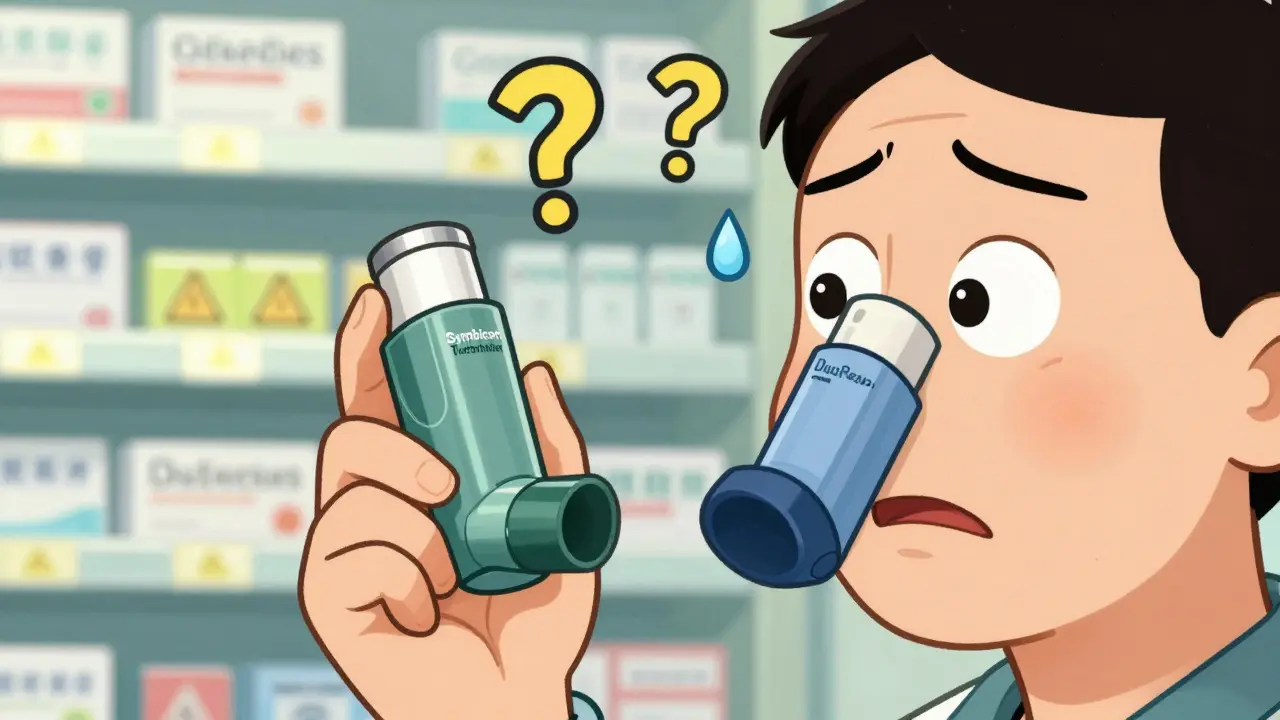
When you’re managing asthma or COPD, your inhaler isn’t just a tool-it’s your lifeline. But what happens when your pharmacy swaps your branded inhaler for a cheaper generic version without warning? It’s happening more often. And while the price might be lower, the risks aren’t always clear. Respiratory combination inhalers deliver two drugs in one device-usually a corticosteroid to reduce inflammation and a long-acting bronchodilator to open airways. Brands like Symbicort, Advair, and Dulera have been around for years. Now, generics are popping up. But unlike pills, these inhalers aren’t interchangeable just because the chemicals match.
Why Inhalers Are Different From Pills
Think of a pill. You swallow it. Your body breaks it down. The active ingredient enters your bloodstream. Generic versions must prove they deliver the same amount of drug at the same rate. That’s bioequivalence. Simple. Now think of an inhaler. The drug doesn’t just go into your blood. It has to land in your lungs. And how it gets there depends almost entirely on the device. A pressurized metered-dose inhaler (pMDI) needs you to press the canister and breathe in slowly at the same time. A dry powder inhaler (DPI) like a Turbuhaler or Spiromax? You have to inhale hard and fast to pull the powder out. If you don’t, the drug sticks to your throat or the device. You get no benefit. And you might even get thrush or hoarseness.A 2020 study found that 76% of patients switched from a Turbuhaler to a Spiromax without training used the new device incorrectly. That’s not a small number. That’s three out of four people. And when you’re not using your inhaler right, your symptoms don’t improve. Your risk of flare-ups goes up. Your emergency room visits go up. The cost savings from the generic? Gone.
Device Differences You Can’t Ignore
Not all generics are created equal. Some are exact copies of the original device. Others? Not even close. Take DuoResp Spiromax. It contains the same drugs as Symbicort Turbohaler: budesonide and formoterol. But the device? Totally different. The Turbohaler uses a twist mechanism to load a dose. The Spiromax uses a side slider. One requires a single breath. The other needs a sharp, forceful inhale. The priming steps? Different. The way you hold it? Different. The sound it makes when you use it? Different.Patients don’t notice these differences until they’re struggling to breathe. One Reddit user wrote: “I got switched to Spiromax. Didn’t know I had to breathe harder. I thought it was broken. My asthma got worse. I ended up in the ER.” That’s not rare. A 2021 study showed patients switched without training had a 22% increase in asthma exacerbations within six months. That’s not a glitch. That’s a systemic failure.
Regulations Are All Over the Map
In the U.S., the FDA says: if the generic inhaler is approved, it’s safe to substitute without extra training. They believe the drug delivery is equivalent. But their own data contradicts this. A 2023 draft guidance now admits that some combination inhalers need clinical endpoint studies to prove real-world effectiveness-not just lab measurements.In Europe, the EMA takes a harder line. They require direct comparisons of lung deposition, pharmacokinetics, and sometimes even clinical outcomes. They won’t approve a generic unless it’s proven to work just as well in real patients-not just in test chambers.
The UK’s NICE guidelines are even clearer: don’t switch inhalers without a consultation. Why? Because multiple studies show worsening control after automatic substitution. In Norway, 62% of patients use generic inhalers. In France, it’s 22%. The difference? France requires doctors to prescribe by brand name. No substitution unless the patient agrees-and gets trained.

What Happens When You’re Switched Without Warning
You might not realize you’ve been switched until your symptoms get worse. A 2022 survey by Asthma UK found that 57% of patients felt confused after being given a new inhaler. One in three had an emergency visit within three months. On Drugs.com, Symbicort Turbohaler has a 6.2/10 rating. The generic Spiromax? 4.8/10. Common complaints: “Harder to use,” “Feels less effective,” “I don’t know how to breathe right.”It’s not just patients. Pharmacists and doctors are caught in the middle. A 2022 survey showed only 28% of U.S. community pharmacies consistently offer device-specific training when substituting inhalers. Why? Time. Most pharmacists have 2-3 minutes to fill a prescription. Teaching inhaler technique takes 10-15 minutes. And in many places, they’re not required to do it.
How to Protect Yourself
If you use a combination inhaler, here’s what you need to do:- Always check the device when you pick up your prescription. If it looks or feels different, ask. “Is this the same one I’ve been using?”
- Ask for a demonstration. Don’t assume you know how to use it. Even if you’ve used the same inhaler for years, a new device requires retraining.
- Use the teach-back method. After your provider shows you how to use it, do it yourself. If you fumble, they’ll know you need more help.
- Track your symptoms. If you notice more wheezing, more rescue inhaler use, or more nighttime symptoms after a switch, contact your doctor immediately.
- Know your rights. In many states, you can refuse a substitution. Ask your pharmacist: “Can I keep my original brand?”
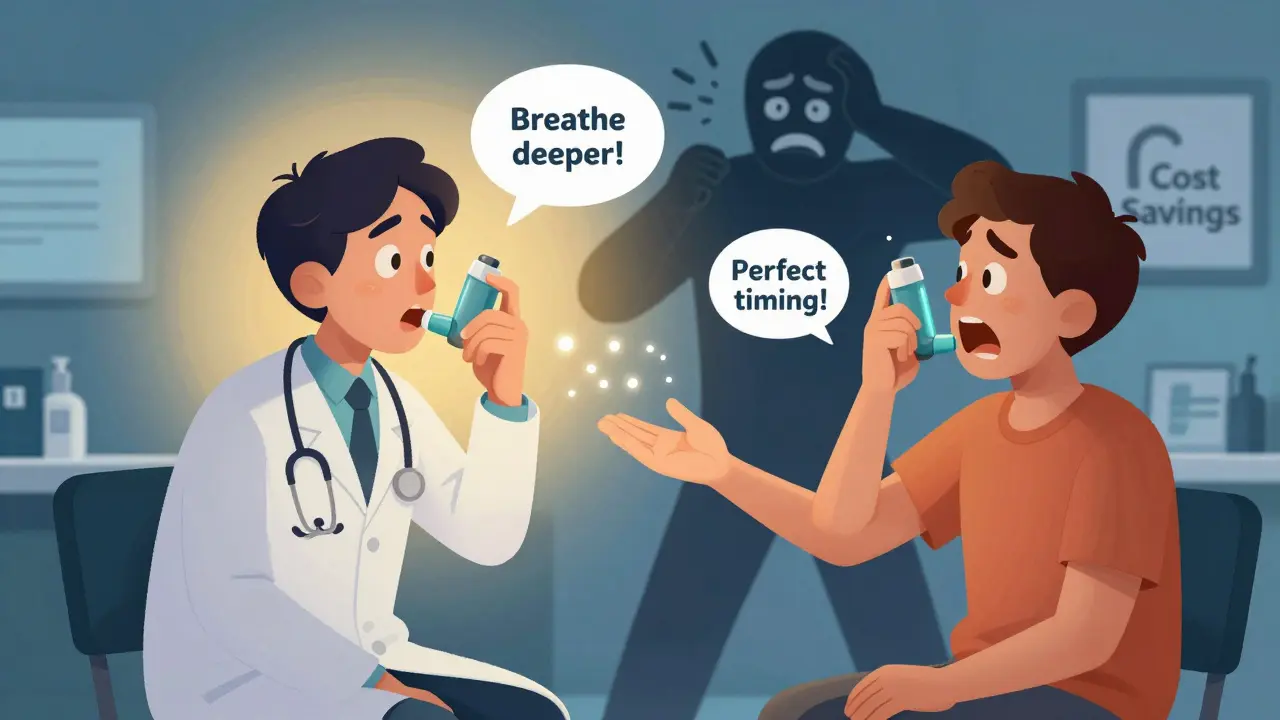
Some patients report success with generics-when they get proper training. One 2022 study found that 89% of patients who received direct instruction from their provider used the generic device correctly. That’s the key. It’s not the generic. It’s the lack of support.
What’s Changing in 2026
The tide is turning. The Global Initiative for Asthma (GINA) updated its 2023 guidelines to say: “Device familiarity and correct technique should be prioritized over generic substitution.” The FDA is now allocating $25 million to research best practices for inhaler substitution. Smart inhalers-devices with sensors that track your breathing pattern and give feedback-are becoming more common. A 2022 JAMA study showed that when patients got real-time feedback on their technique, exacerbations dropped by 33%.By 2027, nearly half of all combination inhalers will have generic versions. That means more switches. More confusion. More avoidable hospitalizations-unless we fix the system.
The Bottom Line
Generic substitution for pills saves money. For inhalers, it can cost lives. The drug inside matters. But the device? It matters more. You can’t trust a generic just because it’s cheaper. You need to know how to use it. And you need to be heard when you say, “This isn’t working.”If your inhaler changes, don’t assume it’s the same. Ask questions. Demand training. Track your symptoms. Your lungs can’t afford to guess.
Can I ask my pharmacist to keep my brand-name inhaler instead of switching to a generic?
Yes. In most U.S. states, you have the right to refuse a generic substitution. Ask your pharmacist: “Can I get the brand-name version?” Some insurance plans may require prior authorization, but you can still request it. If your doctor writes “Dispense as Written” or “Do Not Substitute” on the prescription, the pharmacy must honor it. This is especially important for combination inhalers, where device differences can affect your health.
Why do some generic inhalers cost so much less than others?
The price difference often reflects how closely the generic matches the original device. Some generics are exact copies of the branded inhaler’s mechanism, which requires more engineering and costs more to produce. Others use a cheaper, simpler design that may not work the same way. A generic that uses a different inhaler type (like switching from a Turbuhaler to a Spiromax) can be significantly cheaper because the manufacturer doesn’t have to replicate the original’s complex internal structure. But lower cost doesn’t mean better value if it leads to improper use and worse outcomes.
Are there any signs that my inhaler isn’t working right after a switch?
Yes. If you notice more frequent use of your rescue inhaler (like albuterol), more nighttime coughing or wheezing, reduced ability to exercise, or more asthma flare-ups, these are red flags. You might also feel the medication “sticking” in your throat or notice a sour taste-signs the drug isn’t reaching your lungs. If you’re unsure whether you’re using the new device correctly, ask your provider for a quick check. Don’t wait for an emergency.
Can I use a spacer with a generic inhaler?
It depends on the device. Spacers work well with pressurized metered-dose inhalers (pMDIs), which are common in older combination inhalers. But dry powder inhalers (DPIs)-like Turbuhaler or Spiromax-don’t work with spacers. The powder can’t flow through them. If you’ve been using a spacer with your old inhaler and get switched to a DPI, you’ll need to learn a new technique. Always confirm with your provider whether your new device supports spacer use.
What should I do if I’ve been switched to a generic and my symptoms got worse?
Contact your doctor immediately. Don’t assume it’s just “getting used to it.” Worsening symptoms after a device switch are a medical concern, not a normal adjustment. Bring your new inhaler to your appointment. Ask your provider to demonstrate the correct technique and compare it to your old one. If the new device isn’t working for you, your doctor can request a return to your original brand or prescribe an alternative that matches your needs. Your health comes before cost savings.
Future-proof your care: keep a note in your phone with the exact name of your inhaler, its device type, and how to use it. When you refill, compare the picture. If it’s different, speak up. Your lungs won’t tell you when something’s wrong until it’s too late.
Comments (12)
-
Colin Pierce January 28, 2026
I’ve been on Symbicort for 8 years. Last month my pharmacy switched me to Spiromax without telling me. I thought my asthma was getting worse-turns out I was breathing wrong. Took me three days to realize I wasn’t inhaling hard enough. Went back to the doc, got trained, and now it’s fine. But nobody warned me. This needs to be standard practice.
Pharmacists are overworked, yeah, but 2 minutes to hand over a life-saving device? That’s not a system-it’s a gamble.

-
Phil Davis January 28, 2026
So the FDA says it’s fine. But if I handed you a screwdriver and said ‘it’s the same as a hammer’ because both have metal handles… you’d call me an idiot. Why do we treat inhalers any differently?

-
Irebami Soyinka January 30, 2026
USA still sleeping on this?? 😒
My cousin in Nigeria got switched to generic and ended up in ICU. No training. No warning. Just a new box with a weird button. They don’t even teach inhaler technique in med school here. Meanwhile, you guys have $25 million for research? Bro, fix the damn system first. 🇳🇬🔥

-
doug b January 30, 2026
If you’re on a combo inhaler, don’t just grab it and go. Check the device. Ask how to use it. If they can’t show you, walk out. Your lungs aren’t a lab experiment. This isn’t hard.
And if your insurance pushes generics? Tell them no. Write ‘Do Not Substitute’ on the script. Simple.

-
Mel MJPS January 31, 2026
I switched to a generic last year and was so scared I’d mess up. I recorded myself using it on my phone and sent it to my nurse. She said I was doing it right-but I wouldn’t have known without asking. Seriously, if you’re unsure, just reach out. No shame in asking.
And yes, your pharmacist probably won’t have time to teach you. But you can ask for a 5-minute demo. Most will do it if you ask nicely.

-
Katie Mccreary January 31, 2026
Let’s be real. You’re not ‘saving money’-you’re just shifting the cost to the ER. And the people paying? The ones who can’t afford to miss work or take time off to learn a new device. This isn’t innovation. It’s exploitation dressed up as efficiency.

-
SRI GUNTORO January 31, 2026
People like you who blame the system are just avoiding responsibility. If you can’t figure out how to use a simple inhaler, maybe you shouldn’t be trusted with one at all. My grandmother uses hers perfectly. No training needed. Just common sense.

-
Jess Bevis February 1, 2026
Just saw this in a clinic in Chicago. A kid, 12, handed a Spiromax and said ‘I think it’s broken.’ He’d been using it wrong for 3 weeks. Mom didn’t know how to help. No one told them. This isn’t about drugs. It’s about dignity. We treat people like machines.

-
Rose Palmer February 3, 2026
It is imperative to underscore that the substitution of respiratory combination inhalers constitutes a significant clinical variable that may adversely affect therapeutic outcomes. The absence of standardized patient education protocols across healthcare delivery systems represents a systemic deficiency that demands immediate regulatory intervention and mandatory training requirements for all dispensing personnel.
Furthermore, the FDA’s current regulatory framework, which relies on bioequivalence metrics derived from in vitro testing, is demonstrably insufficient to ensure clinical equivalence in real-world usage scenarios. A paradigm shift toward patient-centered outcome-based evaluation is not merely advisable-it is ethically obligatory.

-
Kathy Scaman February 3, 2026
My mom’s on Advair. Got switched to a generic last year. She cried because she thought she was dying. Turned out she was just using it wrong. We watched a YouTube video together. Now she’s fine. But why did it take that? Why didn’t the pharmacy just say ‘hey, this is different’?

-
Anna Lou Chen February 5, 2026
The entire paradigm of pharmaceutical substitution is a neoliberal fiction. The inhaler isn’t a commodity-it’s a phenomenological interface between biopolitics and bodily autonomy. When you reduce a complex pulmonary delivery system to a cost-per-unit metric, you’re not optimizing healthcare-you’re enacting a Foucauldian biopower mechanism that pathologizes non-conformity in technique as patient failure.
And let’s not forget: the device asymmetry isn’t accidental. It’s designed. The corporate logic of obsolescence demands that you become dependent on retraining, on new prescriptions, on new visits. The system doesn’t want you to be stable. It wants you to be managed.

-
Mindee Coulter February 6, 2026I got switched and didn’t say anything for months. Then I had a flare-up. Turned out I was breathing too slow. Just ask for a demo. It’s 5 minutes. Your lungs will thank you.
