

Metformin Side Effect Predictor
How Your Stomach Tolerates Metformin
Answer a few questions to see which metformin formulation is likely to work best for you based on clinical data.
Your Recommendation
78% success rateMost Likely Option:
Extended-Release (XR)
Based on your symptoms, XR reduces GI irritation by 25-30% on average.
Why This Works For You:
Your diarrhea and bloating symptoms are significantly reduced with XR (studies show 15-30% improvement).
Next Steps:
Discuss with your doctor about switching to XR. Start with 500 mg once daily to minimize side effects.
For millions of people with type 2 diabetes, metformin is the first pill they ever take. It works. It’s cheap. And for many, it causes stomach trouble - a lot of it. Diarrhea. Nausea. Bloating. Cramps. These aren’t just minor annoyances. They’re the #1 reason people stop taking metformin altogether. That’s where the debate between metformin extended-release and metformin immediate-release comes in. One promises gentler digestion. The other is the old standard. So which one actually helps your stomach more?
Why Metformin Upsets Your Stomach
Metformin doesn’t sit quietly in your gut. It’s absorbed in the upper small intestine, and that process irritates the lining of your digestive tract in about 20 to 30% of users. The more of it your body gets at once, the worse it tends to be. That’s why immediate-release (IR) metformin - taken two or three times a day - often hits hard. You swallow a 500 mg or 850 mg tablet, and within 2 to 3 hours, your system gets a full blast. Your gut reacts. Diarrhea kicks in. You’re stuck at home. You skip the next dose. Then your blood sugar spikes. It’s a vicious cycle.How Extended-Release Metformin Works Differently
Extended-release (XR) metformin is designed to avoid that spike. Instead of dumping the full dose all at once, it slowly releases the drug over 8 to 12 hours. Think of it like a time-release capsule that drips metformin into your system instead of pouring it. This means your body gets smaller, steadier amounts of the drug, mostly absorbed higher up in the gut where it’s meant to work. The result? Less irritation, less chaos. Studies show XR metformin reaches peak levels in your blood around 7 to 8 hours after taking it - compared to just 3 hours for IR. That slower pace makes a measurable difference. In a 2004 study of patients switched from IR to XR, gastrointestinal side effects dropped by over 30%. Diarrhea fell from nearly 29% to just 17.5%. That’s not a fluke. It’s a pattern.The Numbers Don’t Lie - But They’re Not Perfect
A 2021 meta-analysis of 2,347 patients across seven studies found that XR formulations reduced overall GI side effects by 15.3% compared to IR. That’s a big jump. But here’s the catch: not everyone feels better. Some people actually get worse. In the same studies, nausea was slightly more common with XR - 4.6% vs. 2.8% with IR. Why? Because even though the drug comes out slower, some people’s guts are just more sensitive to the prolonged exposure. One Reddit user wrote: “I switched to XR thinking it’d help. Instead, I got constant nausea I never had on IR. Went back to splitting my IR dose - way better.” Patient reviews back this up. On Drugs.com, metformin IR has a 5.8/10 rating, with 32.7% of users citing GI issues. Metformin XR scores 6.9/10, with only 21.4% reporting problems. That’s a clear trend. But 8.3% of users who switched to XR said their symptoms got worse. So while XR helps most, it doesn’t help everyone.
What Real Doctors Say
The American Association of Clinical Endocrinologists (AACE) says XR is preferred over IR for better tolerability. The American Diabetes Association (ADA) recommends it for patients who can’t handle IR. NICE in the UK explicitly advises XR for those with GI side effects. But not all experts are convinced. Dr. John Reinstatler, in a 2012 review, warned that the benefit might be overstated - especially since XR costs 25% to 35% more. And the European Association for the Study of Diabetes (EASD) says the improvement is “statistically significant but may not be clinically meaningful for all.” Here’s the real takeaway: If your stomach is wrecked on IR, switching to XR is worth trying. If you’re fine on IR, there’s no need to switch - especially if cost is a concern.Cost and Accessibility
A 30-day supply of generic metformin IR costs about $8 to $10. Generic XR? Around $12 to $15. That gap has narrowed since 2020 as more XR generics hit the market. But for people paying out-of-pocket, that extra $5 a month adds up. Still, the cost of not taking metformin is higher. A 2022 study of nearly 19,000 patients found that those on XR were 18.3% more likely to stick with their medication after a year. That’s 2.1 extra months of treatment on average. Better adherence means better blood sugar control. Better control means fewer complications down the road - heart attacks, kidney damage, nerve problems.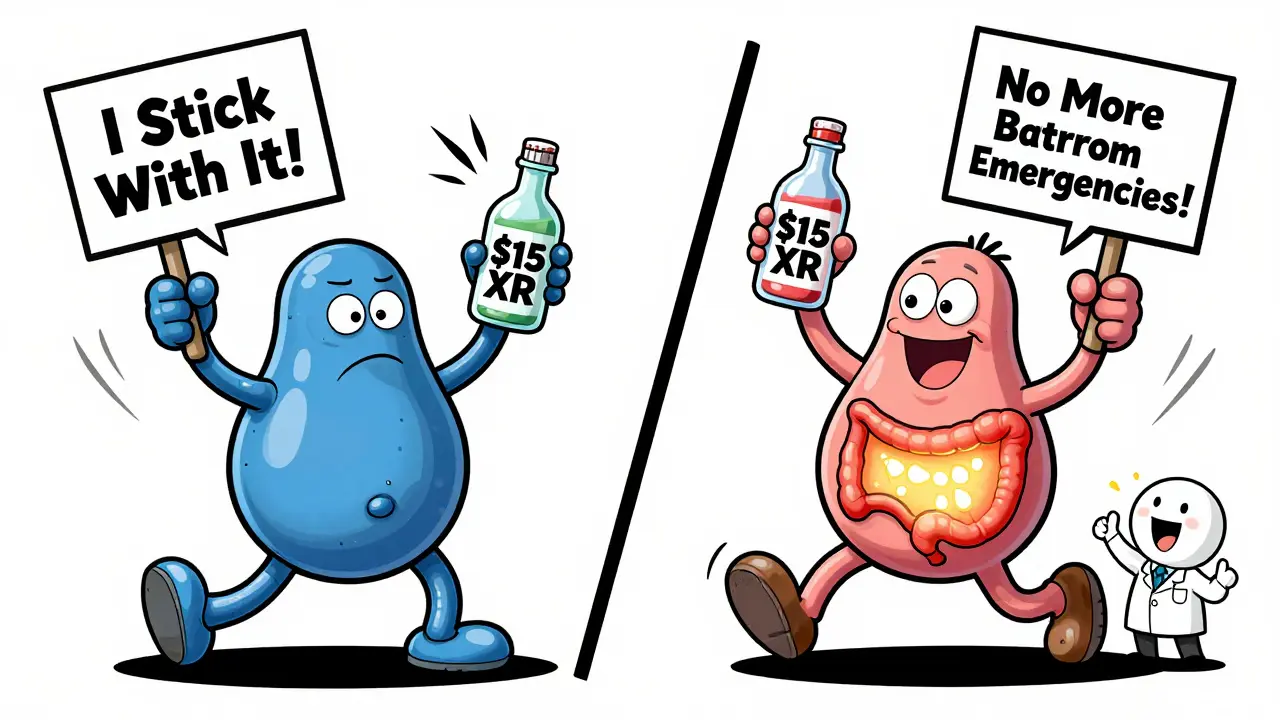
How to Maximize Tolerability - No Matter Which Form You Take
Whether you’re on IR or XR, how you take it matters just as much as what you take.- Start low. Begin with 500 mg once daily. Don’t jump to 1,000 mg right away.
- Take it with food. Always. Even if you’re on XR. Food slows absorption and reduces irritation.
- Go slow with increases. Wait a full week before upping your dose. A 2024 study showed this cuts initial GI side effects by 42%.
- Split IR doses. If you’re on IR and still struggling, try 500 mg with breakfast and 500 mg with dinner instead of one 1,000 mg pill. Many find this works better than switching to XR.
What’s New in 2025?
In 2023, the FDA approved a new XR formulation called Metformax XR, which uses pH-dependent release technology. Early data suggests it reduces GI side effects another 12-15% compared to older XR versions. It’s not widely available yet, but it’s coming. Also, the MET-XR trial - a 24-month study with 1,200 patients - is wrapping up in early 2024. Final results will give us the clearest picture yet on long-term GI differences. If the data holds, XR could become the default for everyone, not just those with side effects.Who Should Choose Which?
- Choose metformin XR if: You’ve had diarrhea, nausea, or cramps on IR. You want to take just one pill a day. You’re willing to pay a little more for better comfort and higher adherence.
- Stick with metformin IR if: You tolerate it fine. You’re on a tight budget. You’re okay taking two pills a day. You’ve tried XR and didn’t feel better - or felt worse.
There’s no single right answer. It’s about your body, your budget, and your life. But if your stomach is making you quit metformin, XR is the most proven solution we have right now.
Is metformin extended-release better for your stomach than immediate-release?
Yes, for most people. Extended-release (XR) metformin releases the drug slowly over 8 to 12 hours, reducing the spike that irritates the gut. Studies show a 15% to 30% drop in diarrhea and nausea compared to immediate-release (IR). About 68% of patients who switch from IR to XR report noticeable improvement in stomach symptoms. But about 8% say their symptoms got worse - so it’s not a guaranteed fix.
Does metformin XR cause less diarrhea?
Yes. In clinical trials, diarrhea dropped from 28.6% with IR to 17.5% with XR. Real-world data from patient reviews on Drugs.com and TuDiabetes confirm this trend - fewer people report diarrhea on XR. The slow release means less metformin hits your gut at once, which reduces irritation. If diarrhea is your main issue, XR is your best bet.
Can you switch from metformin IR to XR safely?
Yes, and it’s often recommended if you’re having GI side effects. You can switch directly from the same total daily dose - for example, 1,000 mg IR twice daily becomes 2,000 mg XR once daily. No dose adjustment is needed. But if you’ve been on IR for years and your stomach is fine, there’s no reason to switch. Always check with your doctor first.
Why does metformin XR sometimes cause nausea?
Even though XR reduces overall GI irritation, the prolonged exposure to metformin in the upper gut can trigger nausea in some people. This is more common with XR than IR - about 4.6% vs. 2.8% in studies. If you didn’t have nausea before but get it after switching, it might be the formulation. Try taking it with a larger meal or splitting the dose. If it persists, go back to IR.
Is metformin XR worth the extra cost?
If you’re struggling with side effects, yes. Generic XR costs about $12-$15 a month, compared to $8-$10 for IR. That’s a $5 difference. But XR users are 18% more likely to keep taking their medication after a year. Better adherence means better blood sugar control, fewer complications, and lower long-term healthcare costs. If your stomach is wrecking your routine, the extra cost pays for itself.
What’s the best way to start metformin to avoid stomach problems?
Start with 500 mg once a day, taken with your evening meal. Wait a full week before increasing to 1,000 mg. Then wait another week before going to 1,500 mg or 2,000 mg. This slow titration cuts initial side effects by 42%. Whether you choose IR or XR, this approach works. Don’t rush it. Your gut needs time to adjust.
Comments (12)
-
Celia McTighe December 27, 2025
OMG I switched to XR last year and my stomach finally stopped rebelling 😭 I was on IR for 2 years and thought I’d never tolerate it. Now I take one pill at dinner and actually forget I’m diabetic sometimes. Life-changing. Also, food. Always eat with it. Even if it’s just a banana. 🍌

-
Bradly Draper December 27, 2025
i had the same thing. ir made me run to the bathroom every 20 mins. xr? barely a burp. took me 3 tries to find the right dose but now i’m good. no more panic when i leave the house.

-
James Hilton December 28, 2025
XR is just metformin’s way of saying ‘i’m too cool to dump all my chaos at once.’

-
Debra Cagwin December 29, 2025
For anyone feeling overwhelmed by this decision - you’re not alone. Start slow, listen to your body, and don’t feel guilty if XR doesn’t work. Your health isn’t a competition. You’re doing better than you think.

-
Mimi Bos December 29, 2025
so i switched to xr and now i get nauseous at 3am?? like wtf?? i thought this was supposed to be the ‘gentle’ version??

-
Ryan Touhill December 30, 2025
Let’s be clear - the pharmaceutical industry is pushing XR not because it’s inherently superior, but because the patent on IR expired. The marginal benefit is statistically insignificant, and yet we’re incentivized to pay 35% more. This isn’t medicine - it’s monetized suffering.

-
ANA MARIE VALENZUELA January 1, 2026
Of course XR causes more nausea - it’s just prolonged exposure to a drug your gut never wanted in the first place. People think ‘slow release’ means ‘gentle,’ but it’s really just ‘stupidly persistent.’ If you’re going to poison your gut, do it fast and get it over with.

-
Payton Daily January 2, 2026
Think about it: metformin isn’t just a drug - it’s a mirror. It shows you how much your body resists control. IR is like a slap. XR is like a slow choke. Both are punishment. The real question isn’t which form - it’s why we’re still relying on a 60-year-old drug that treats symptoms but never the cause. We’re just rearranging deck chairs on the Titanic, folks.

-
oluwarotimi w alaka January 4, 2026
They say XR is better but what they don’t tell you is that Big Pharma owns the Nigerian clinics too. They push XR because it’s more expensive - and because they know we’re too poor to argue. I took IR for 4 years. No problems. Then my doctor switched me to XR ‘for my health.’ Now I’m paying $20 a month and still pooping in the bushes. This is colonial medicine.

-
Teresa Marzo Lostalé January 5, 2026
It’s funny how we treat our bodies like machines you can just swap parts in and out. XR isn’t magic. It’s just time. Time to let your gut adjust. Time to stop rushing. Time to realize healing isn’t about the pill - it’s about the rhythm you build around it. 🌿

-
Kelsey Youmans January 6, 2026
It is imperative to underscore that the pharmacokinetic advantages of extended-release formulations are empirically validated across multiple randomized controlled trials, as referenced in the 2021 meta-analysis published in the Journal of Clinical Endocrinology & Metabolism. Furthermore, adherence metrics demonstrate statistically significant improvements in persistence rates, which correlate directly with long-term glycemic control outcomes. One must not discount the clinical significance of these findings, even in the face of anecdotal counter-narratives.

-
Sydney Lee January 8, 2026
It’s fascinating how people reduce complex physiology to ‘which pill is gentler.’ The real issue is metabolic inertia. Metformin doesn’t ‘irritate’ your gut - your gut is screaming because your insulin resistance has turned your microbiome into a warzone. XR doesn’t fix that. It just muffles the noise. And if you’re not addressing the root - diet, sleep, stress - then you’re just paying for a quieter scream.
