
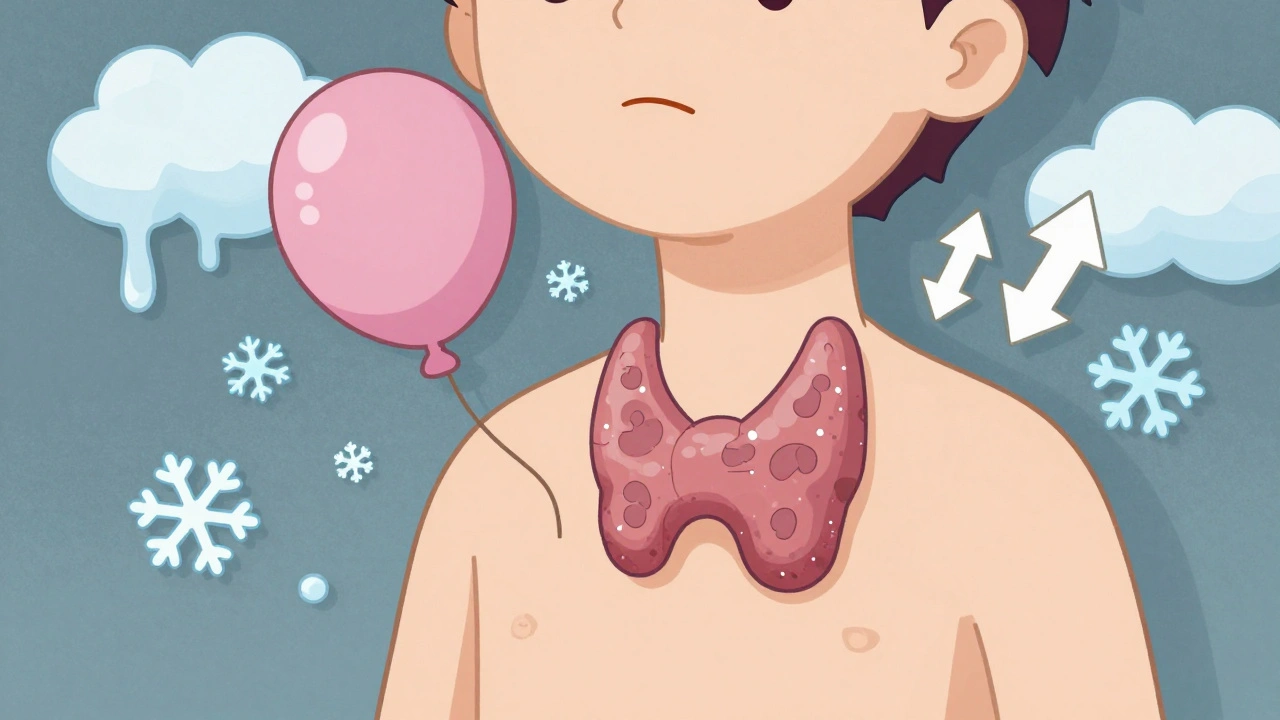
When your thyroid slows down, your whole body feels it. Fatigue that won’t quit. Weight gain even when you’re eating less. Cold hands in a warm room. These aren’t just signs of aging or stress-they could be symptoms of hypothyroidism, a condition where your thyroid gland doesn’t make enough hormones to keep your metabolism running right.
What Exactly Is Hypothyroidism?
Your thyroid is a small butterfly-shaped gland in your neck. It’s in charge of making hormones-mainly T4 and T3-that tell your cells how fast to work. When it’s underactive, your body’s engines sputter. Everything slows: digestion, heart rate, brain function, even how fast your hair grows. About 30 million Americans have hypothyroidism. It’s far more common in women-up to 7 times more likely than in men-and the risk jumps sharply after age 60. In fact, one in five women over 60 has it. Most cases aren’t sudden; they creep in over months or years. That’s why so many people think they’re just getting older, when really, their thyroid is failing. The biggest cause? Hashimoto’s thyroiditis. That’s an autoimmune disease where your immune system attacks your own thyroid. It’s responsible for 90% of all spontaneous cases in the U.S. Other causes include thyroid surgery, radioactive iodine treatment (often used for hyperthyroidism), and radiation therapy for head or neck cancer. In rare cases, the problem isn’t the thyroid at all-it’s the pituitary gland not telling the thyroid to work.How Do You Know If You Have It?
Symptoms are messy and overlap with lots of other conditions. But here’s what’s most common:- 95% of people feel constant fatigue
- 85% can’t stand the cold, even in mild weather
- 75% gain 5 to 10 pounds without changing diet or activity
- 60% get stuck with constipation
- 50% notice dry skin, brittle nails, or thinning hair
Levothyroxine: The Gold Standard Treatment
The only proven, reliable treatment for hypothyroidism is levothyroxine. It’s a synthetic version of T4, the hormone your thyroid should be making. Your body converts it into T3 as needed. It’s not a cure-it’s a replacement. You’ll likely take it for life. Dosing isn’t one-size-fits-all. For a healthy adult under 50, doctors usually start with 1.6 mcg per kilogram of body weight. That’s roughly 100 to 150 mcg a day for most people. But if you’re over 50, or have heart disease, they’ll start much lower-25 to 50 mcg-and increase slowly. Too much too fast can trigger heart rhythm problems. The goal? Get your TSH into the 0.5 to 4.5 mIU/L range. For most people, that’s enough to feel normal again. But it’s not just about numbers. If you still feel tired, foggy, or cold even with a “normal” TSH, your dose might still need tweaking.
How to Take Levothyroxine Right
This pill is simple-but if you mess up the timing, it won’t work. Here’s what actually matters:- Take it on an empty stomach, 30 to 60 minutes before breakfast
- Use only water-no coffee, no juice, no milk
- Avoid calcium, iron, or antacids for at least 4 hours after
- Take it at the same time every day
What Happens If You Don’t Treat It?
Untreated hypothyroidism doesn’t just make you feel bad. It raises your risk for serious problems:- 25% develop high cholesterol-LDL above 160 mg/dL-boosting heart disease risk by 30%
- 15% get nerve damage, leading to numbness or tingling in hands and feet
- Women face 2 to 3 times higher miscarriage risk and up to 30% infertility
- Left unchecked for years, life expectancy drops by 5 to 10 years
Special Cases: Pregnancy, Older Adults, and More
Pregnancy changes everything. Your body needs 25 to 50% more thyroid hormone. If you’re pregnant or planning to be, your TSH target drops to under 2.5 mIU/L in the first trimester. Left unmanaged, it can affect your baby’s brain development. For people over 85, the goal isn’t to chase a perfect TSH. Too low can strain the heart. Doctors often aim for 4 to 6 mIU/L. It’s not about being “normal”-it’s about feeling well without risking heart problems. Some people ask about combination therapy-taking both T4 and T3. But large studies show no consistent benefit. The American Thyroid Association doesn’t recommend it for most people. Stick with levothyroxine unless your doctor has a very specific reason to try something else.
Why Some People Still Feel Off-Even on Meds
You’re taking your pill. Your TSH is in range. But you still feel tired. You’re not alone. About 25% of patients report persistent symptoms despite “normal” labs. Sometimes, it’s absorption. Maybe you’re taking it with food. Maybe you’re on a proton-pump inhibitor for acid reflux-those reduce levothyroxine uptake. Sometimes, it’s a slow metabolism. Or maybe your body isn’t converting T4 to T3 well. Rare, but possible. Other times, it’s not your thyroid at all. Low vitamin D, iron deficiency, or sleep apnea can mimic hypothyroid symptoms. A good doctor will check those too. Don’t give up. Keep tracking your symptoms. Bring a journal to your appointments. Note energy levels, mood, weight, and sleep. That data helps more than any single lab value.What to Expect Over Time
It takes time. Most people notice a little more energy in 2 to 3 weeks. Full improvement? That takes 6 to 8 weeks. That’s why doctors wait 6 to 8 weeks after a dose change to retest TSH. Rushing it leads to over- or under-treatment. Once you’re stable, you’ll need a blood test once a year. More often if you’re pregnant, elderly, or changing medications. Cost? Generic levothyroxine runs $4 to $30 a month in the U.S. Brand-name Synthroid is $30 to $60. Insurance usually covers it. If you’re paying full price, use GoodRx or SingleCare-many pharmacies offer it for under $10.Living Well With Hypothyroidism
You can live a full, active life with hypothyroidism. The key is consistency. Take your pill the same way every day. Get your labs done on time. Don’t skip appointments. Many people find support through groups like the American Thyroid Association or Thyroid Change. They offer up-to-date guides, symptom trackers, and even advice on talking to your doctor. And remember: this isn’t your fault. It’s not because you didn’t eat right or exercise enough. It’s biology. And it’s treatable. The science is clear: levothyroxine works. When taken correctly, 85% of patients report major improvements in energy and mood within 3 to 6 months. Life expectancy returns to normal. Your brain clears up. Your skin softens. Your cold hands warm up. You’re not broken. You’re just missing a hormone. And that’s easy to fix.Can you cure hypothyroidism?
No, hypothyroidism can’t be cured in most cases-it’s a lifelong condition. But it can be perfectly managed with daily levothyroxine. Once the right dose is found, symptoms disappear and long-term health returns to normal. The only exceptions are temporary cases like postpartum or subacute thyroiditis, which may resolve on their own after months.
Does levothyroxine cause weight loss?
Levothyroxine won’t make you lose weight if you’re already at a healthy dose. It replaces what your body is missing, so it restores your normal metabolism-not speeds it up. Most people lose the extra 5 to 10 pounds they gained from untreated hypothyroidism, but only if they combine medication with healthy eating and movement. Taking more than prescribed won’t help and can be dangerous.
Can you take levothyroxine at night?
Yes, some people do. A few studies show nighttime dosing works just as well as morning, as long as you take it on an empty stomach and wait at least 3 hours after your last meal. The key is consistency-take it at the same time every day, whether morning or night. Talk to your doctor before switching.
Why does my TSH keep changing?
TSH can fluctuate due to many things: inconsistent pill timing, interactions with food or supplements, changes in weight, stress, or even seasonal variation. If your TSH jumps up and down, check your routine. Are you taking it with coffee? Are you skipping doses? Are you taking calcium or iron close to your pill? Fix those first before asking for a dose change.
Is generic levothyroxine as good as brand-name?
Yes, for most people. The FDA requires generics to be within 90-110% of the brand’s potency. But some patients report feeling better on one brand over another-often because switching between brands causes small fluctuations. If you’re stable on a generic, stay on it. If you switch brands and symptoms return, tell your doctor. Stick to one formulation unless there’s a reason to change.
How long until I feel better on levothyroxine?
Most people notice small improvements in energy and mood within 2 to 3 weeks. Full symptom relief usually takes 6 to 8 weeks. That’s because it takes time for your body to rebuild its hormone balance. Don’t expect instant results. Patience and consistency are key.
Comments (12)
-
David Palmer December 11, 2025
So basically my tiredness and cold hands aren't just because I'm lazy and forgot to buy a coat? Wow.

-
Paul Dixon December 11, 2025
This is actually super helpful. I've been feeling off for months and thought it was just burnout. Gonna ask my doc about TSH next visit.

-
Vivian Amadi December 12, 2025
STOP taking generic levothyroxine. You're poisoning yourself. Only Synthroid works. I've been on it for 12 years and I'm fine. Your doctor is lazy if they gave you anything else.

-
Jimmy Kärnfeldt December 13, 2025
Just wanted to say this post saved me. I thought I was just getting older. Now I know it's not my fault. Took me 3 years to get tested. Don't wait like I did.

-
Ariel Nichole December 13, 2025
Thanks for sharing this. I'm just starting my journey with this and it's nice to see someone explain it so clearly.

-
john damon December 14, 2025
Levothyroxine is a game changer 🙌 I took mine at night and now I'm not a zombie by 3pm 😴➡️⚡

-
matthew dendle December 16, 2025
Why do people even care about this? Just eat more kale and stop being weak

-
Stephanie Maillet December 17, 2025
It's fascinating how such a tiny gland can control so much... and yet, we treat it like an afterthought in medicine. The body is an ecosystem, not a machine. We fix one thing, ignore the others-stress, sleep, gut health-and wonder why people still feel off. Levothyroxine helps, yes-but it's not the whole story. Sometimes, the pill just gives you the bandwidth to finally address the real stuff.

-
Michaux Hyatt December 17, 2025
For anyone reading this and feeling overwhelmed: start with the basics. Take your pill at the same time every day, no coffee for an hour after, and track your symptoms in a notebook. You don't need to be perfect-just consistent. I’ve helped dozens of people get their lives back with just these two things.

-
Sylvia Frenzel December 18, 2025
Why are we medicating everyone instead of fixing the food supply? Glyphosate in our water, soy in everything, fluoride in the teeth paste-this is all environmental. Levothyroxine is just a band-aid on a bullet wound.

-
Raj Rsvpraj December 19, 2025
As an Indian, I find it amusing that Americans treat thyroid as some exotic condition. We’ve had this for centuries-Ayurveda has remedies. You just need to stop eating processed sugar and learn to breathe properly. This pharmaceutical dependency is a Western delusion.

-
Jack Appleby December 21, 2025
Actually, the reference to "90% of Hashimoto’s patients test positive for antibodies" is misleading-it's closer to 95% in modern ELISA assays, and the cutoff for TSH should be 2.5, not 4.0, per the 2023 ATA guidelines. Also, "subclinical" is a misnomer; it's not "sub" anything-it's the earliest stage of autoimmune destruction. Your doctor doesn't know this, but now you do.
