
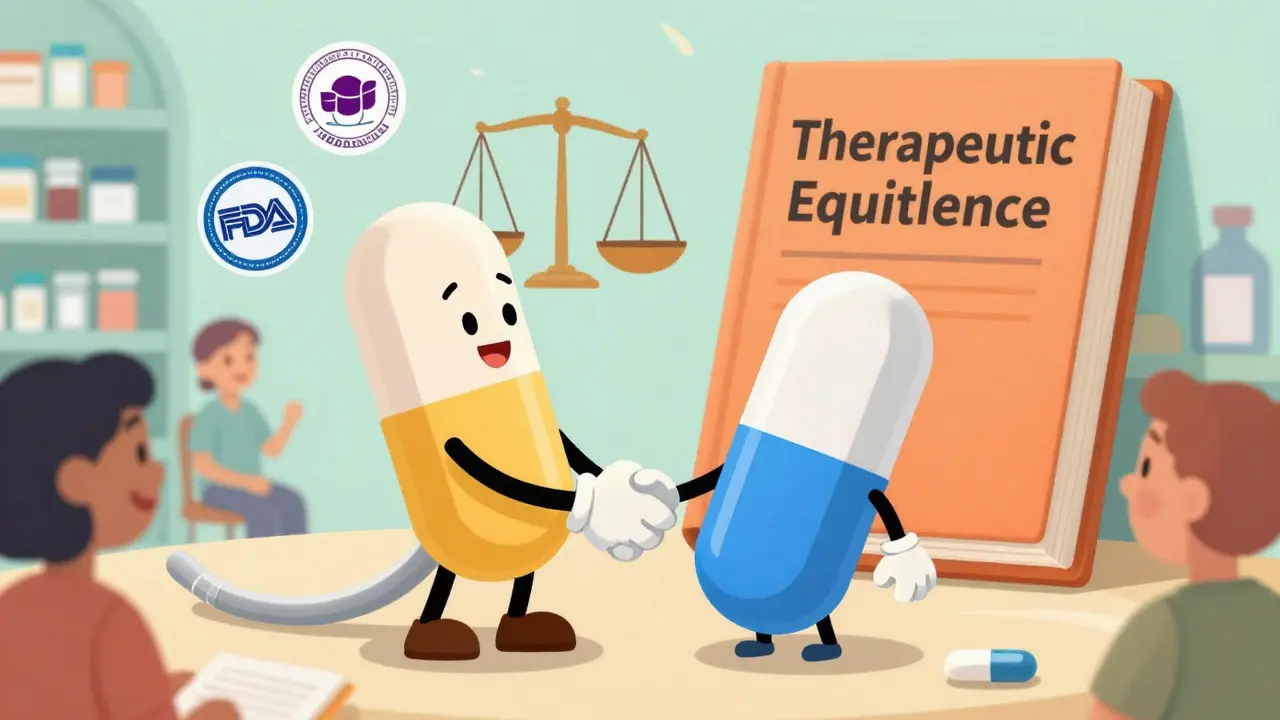
When you pick up a prescription, you might see two names on the label: one you recognize from TV ads, and another that’s cheaper but looks different. You might wonder - is the generic version really the same? Can you trust it? The answer isn’t just yes - it’s backed by science, strict regulations, and decades of real-world use. The FDA doesn’t just approve generic drugs because they’re cheaper. It approves them because they have to meet the same safety and effectiveness standards as the original brand-name drug.
What the FDA Actually Requires
The FDA doesn’t accept generic drugs based on trust. It demands proof. Every generic drug must be pharmaceutically equivalent to its brand-name counterpart. That means the same active ingredient, in the same strength, same dosage form (pill, injection, cream), and same way of getting into your body (oral, injectable, etc.). This isn’t a suggestion - it’s written into federal law under 21 CFR 314.94(a).
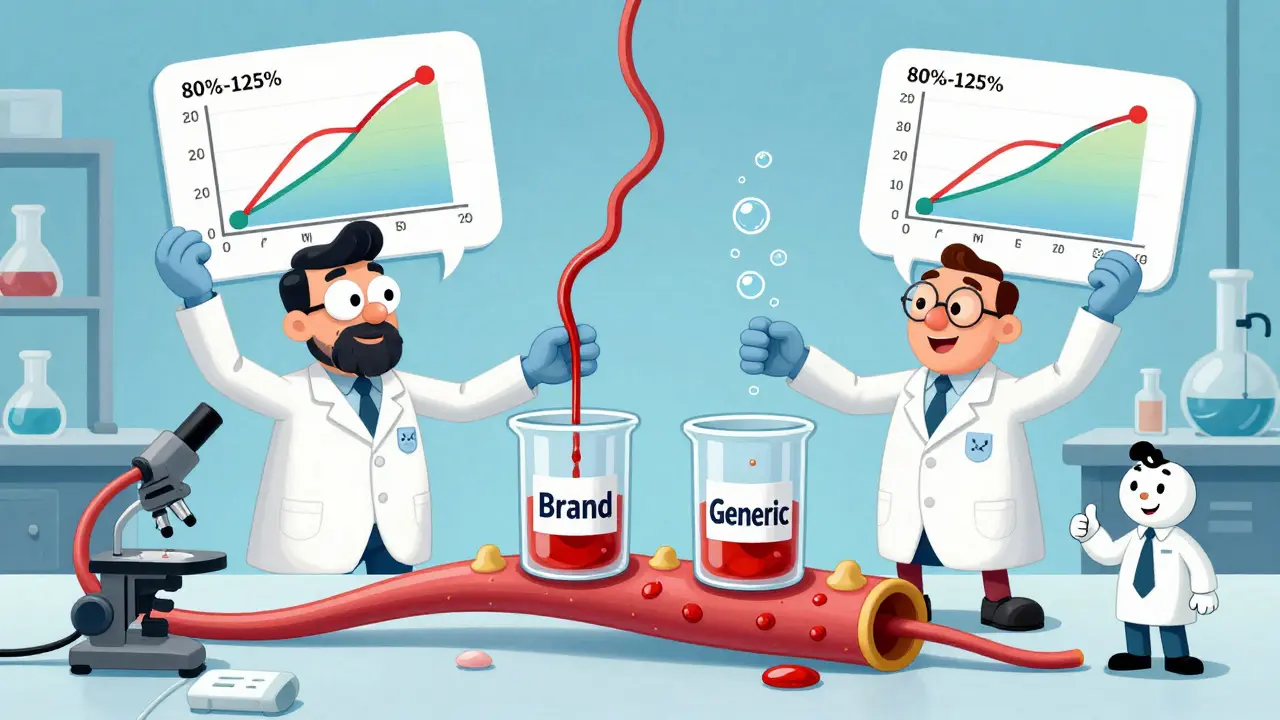
But pharmaceutical equivalence isn’t enough. The real test is bioequivalence. This is where the FDA looks at how your body absorbs and uses the drug. A generic must deliver the same amount of active ingredient into your bloodstream at the same rate as the brand-name drug. The standard? The 90% confidence interval for two key measurements - Cmax (peak concentration) and AUC (total exposure) - must fall between 80% and 125% of the brand drug’s values. In plain terms: your body processes the generic almost identically to the original.
For drugs with a narrow therapeutic index - like warfarin, levothyroxine, or cyclosporine - the bar is even higher. The FDA requires the confidence interval to be tighter: 90% to 111%. These are drugs where even small differences in blood levels can cause serious side effects or treatment failure. The FDA doesn’t cut corners here.
Manufacturing: No Compromises
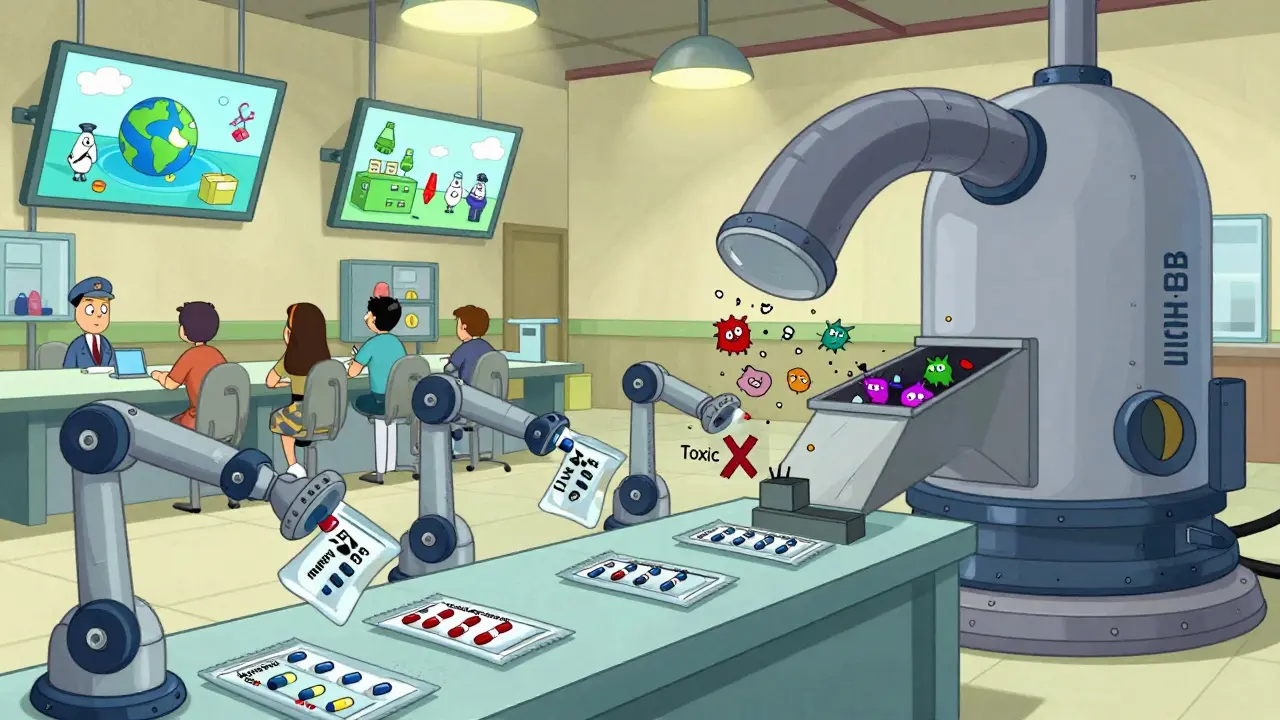
Generics aren’t made in back-alley labs. They’re made in facilities that must follow Current Good Manufacturing Practices (cGMP). These rules are identical for brand-name and generic manufacturers. The FDA inspects these sites - whether they’re in Ohio or in India - with the same scrutiny. Facilities must document every step: how equipment is cleaned, how ingredients are tested, how batches are stored. Records are kept for years and can be reviewed at any time.
Impurities are tightly controlled. The FDA follows international guidelines (ICH Q3B and ICH M7) that set limits for toxic substances. For example, a genotoxic impurity can’t exceed 1.5 micrograms per day. That’s less than a grain of salt. If a generic drug has even one impurity above the limit, it’s rejected.
Dissolution testing - how quickly the drug breaks down in your body - must match the brand drug exactly. If the brand pill dissolves in 15 minutes, the generic must too. The FDA doesn’t allow shortcuts here. Stability testing is also required: the drug must remain effective and safe for its entire shelf life, typically 12 to 24 months under real-world conditions.
Labeling: Same Information, Different Packaging
The label on a generic drug must say the same thing as the brand-name label - same warnings, same side effects, same dosing instructions. The only differences allowed are things like the manufacturer’s name, package size, color, shape, or inactive ingredients (like dyes or fillers). These don’t affect how the drug works. The FDA calls this "therapeutic equivalence." And it’s not just a label claim - it’s backed by data.
The FDA’s Orange Book is the official list of approved generic drugs with therapeutic equivalence ratings. An "AB" rating means the generic is fully equivalent. If a generic gets an "AB" rating, you can use it with full confidence. There are over 20,000 approved generic products in the Orange Book today.
Why Some People Still Doubt Generics
Even with all this science, some patients report differences. You’ll find Reddit threads where people say their generic levothyroxine made them feel worse. Or that their generic seizure medication didn’t work as well. These aren’t made up. But they’re rare - and often not what they seem.
A 2022 study in JAMA Internal Medicine looked at 38,000 Medicare patients taking statins. It found no difference in heart attack risk or hospitalization between brand and generic versions. Another analysis of 12,500 patient reviews on Drugs.com showed 87% reported no difference in effectiveness for cardiovascular generics.
So why do some people feel different? Sometimes it’s the inactive ingredients. A person with a corn allergy might react to a generic version that uses corn starch, while the brand uses potato starch. Or a patient might be sensitive to a dye. These aren’t drug failures - they’re individual reactions to non-active components.
For drugs like levothyroxine, even tiny variations in absorption - due to food, timing, or gut health - can make someone feel off. The generic might be perfectly bioequivalent, but if you take it with coffee instead of water, or switch brands frequently, your thyroid levels can fluctuate. The FDA requires generics for these drugs to be within 90-111% of the brand, but that still leaves room for small differences in how your body responds.
Complex Drugs: The Harder Cases
Not all drugs are pills. Inhalers, eye drops, creams, and injectables are far more complex. A generic inhaler must match not just the drug, but the size of the particles, the spray pattern, and how long the drug stays in the lungs. The FDA reports that 25% more ANDAs for these complex products get rejected than for simple pills.
Take insulin pens or biologic drugs like Humira. These aren’t just chemicals - they’re large, complex molecules made from living cells. The FDA is still developing ways to prove they’re equivalent. That’s why some biologic generics (called biosimilars) are still rare and expensive. The FDA has launched initiatives like the Complex Generic Drug Products Initiative to improve testing methods. It’s investing $50 million through 2027 to build better tools for this.
One big change? In 2022, the FDA proposed a rule that lets generic manufacturers update safety labels before the brand-name maker does. For decades, only the original drugmaker could add new warnings. Now, if a generic company finds a new risk, they can alert patients faster. This is a major shift in patient safety.
How Fast Are Generics Approved?
It takes 18 to 36 months to get a generic approved. The process includes developing the drug, running bioequivalence studies (usually with 24 to 36 healthy volunteers), submitting the ANDA, and waiting for FDA review. The median review time is about 10 months. The FDA has cut approval times by 35% since 2012 thanks to the Generic Drug User Fee Amendments (GDUFA), which gives the agency more resources to review applications faster without lowering standards.
Each bioequivalence study costs $1 to $2 million. That’s why generics are cheaper - not because they’re made with lower quality, but because they don’t have to repeat the 10-year, $1 billion clinical trials that brand-name drugs go through.
Generics in the Real World
Generics make up 90% of all prescriptions filled in the U.S. - over 8 billion in 2022. Yet they account for only 23% of total drug spending. That’s billions saved every year. Hospitals use generics for 98% of treatments where an equivalent exists. Insurance companies push them because they work. And the FDA doesn’t approve them unless they do.
Even in tricky areas like epilepsy, neurology, and heart disease, studies show generics perform just as well. A 2021 survey of 500 neurologists found 68% had full confidence in generic antiepileptic drugs. The same can’t be said for complex MS treatments - only 42% felt confident. That’s not because generics are unsafe - it’s because we’re still learning how to test them.
What’s Next?
The FDA is moving toward using artificial intelligence to predict harmful impurities. A pilot program with MIT is testing machine learning models to flag potential toxins before they even show up in lab tests. This could cut approval times and catch risks earlier.
More product-specific guidances are being released - over 1,800 so far. Each one gives manufacturers exact instructions on how to prove equivalence for specific drugs. The latest? One for semaglutide injection, released in October 2023.
And the FDA is inspecting more overseas facilities. Since 2020, inspections of foreign plants have increased by 22%. That’s because most generic drugs are made outside the U.S. The FDA doesn’t trust the word of a manufacturer - it checks the factory.
Generics aren’t second-rate. They’re the result of one of the most tightly regulated, scientifically rigorous processes in medicine. The FDA doesn’t lower its standards for cheaper drugs - it applies the same standards with the same rigor.
Are generic drugs as safe as brand-name drugs?
Yes. The FDA requires generic drugs to have the same active ingredient, strength, dosage form, and route of administration as the brand-name drug. They must also prove bioequivalence - meaning your body absorbs and uses them the same way. Manufacturing must follow the same strict quality standards (cGMP), and impurity levels are held to the same limits. Thousands of studies and real-world data confirm that generics are just as safe.
Why do generic drugs look different?
Generic drugs can look different because the law allows changes in color, shape, size, and inactive ingredients (like fillers or dyes). These don’t affect how the drug works - they’re just there to make the pill different from the brand name, which protects trademark rights. If you’re allergic to a dye or filler, you might react to one generic but not another. Always check the inactive ingredients list on the label.
Can I switch between different generic brands?
For most drugs, yes. If both are rated "AB" in the FDA’s Orange Book, they’re considered interchangeable. But for narrow therapeutic index drugs like levothyroxine or warfarin, it’s better to stick with one brand. Even small changes in absorption can affect your dose. Talk to your pharmacist or doctor before switching.
For most drugs, yes. If both are rated "AB" in the FDA’s Orange Book, they’re considered interchangeable. But for narrow therapeutic index drugs like levothyroxine or warfarin, it’s better to stick with one brand. Even small changes in absorption can affect your dose. Talk to your pharmacist or doctor before switching.
Do generic drugs take longer to work?
No. Bioequivalence testing ensures that the time it takes for the drug to reach peak levels in your blood (Cmax) and how much gets absorbed (AUC) is the same as the brand drug. If the brand works in 30 minutes, the generic will too. If you feel a delay, it’s likely due to food, stomach emptying, or other factors - not the drug itself.
Why are some generics more expensive than others?
Price differences come from competition, supply, and manufacturing costs - not quality. If only one company makes a generic, it can charge more. Once more companies enter the market, prices drop. A generic made in a facility with high inspection standards might cost more to produce, but it’s still held to the same safety rules. Always ask your pharmacist about the source if you’re concerned.
Comments (10)
-
Aisling Maguire February 27, 2026I work with drug impurities for a living and let me tell you - the FDA’s limits are insane. Like, 1.5 micrograms of a genotoxic thing? That’s less than a grain of salt. I’ve seen labs struggle to even detect that. The fact that generics pass this? Wild. And yeah, the inspections? They show up unannounced. No warning. Just cops in lab coats showing up with clipboards. I’ve seen plants shut down over a single batch. It’s not just regulation - it’s obsession.

-
Sneha Mahapatra February 28, 2026I used to be scared of generics until my mom switched to the generic version of her thyroid med. She was fine. Really. But I get why people worry. It’s not about the science - it’s about the *feeling*. Like when your pill looks different, you think something’s off. But the body doesn’t care about color. It cares about chemistry. And that’s where the FDA nails it. 🌿

-
bill cook March 1, 2026You think the FDA is protecting you? Nah. They’re protecting Big Pharma. Generics are cheaper because they’re made in places with no labor laws. I’ve seen the reports. The inspectors? They get paid by the same companies they inspect. It’s a shell game. And don’t even get me started on India.

-
Byron Duvall March 2, 2026They say bioequivalence is 80-125%. That’s a 45% swing. 45%! That’s not the same. That’s like saying a 100mph car is equivalent to a 145mph car because they both have four wheels. And then they say ‘but it’s fine!’ What kind of logic is this? I’m not taking a gamble with my heart meds. You think they’d let you fly a plane with a 45% variance in fuel efficiency? No. So why are we okay with this?

-
Full Scale Webmaster March 4, 2026Let’s be real. The whole generic drug system is a Ponzi scheme disguised as public health. The FDA doesn’t ‘approve’ generics - they rubber stamp them because they’re overwhelmed. The studies? 24 healthy volunteers? That’s not medicine, that’s a focus group. Real patients have diabetes, kidney issues, gut problems - none of that gets tested. And then they slap an AB rating on it like it’s a gold star. Meanwhile, my cousin had a seizure after switching generics. They said ‘it’s just your body adjusting.’ Bullshit. It was the damn filler. And now the FDA lets generic makers update labels BEFORE the brand? That’s not safety - that’s liability dumping. They’re trying to shift blame while keeping the profits. I’ve read the internal emails. It’s all about cost. Always cost.

-
Angel Wolfe March 6, 2026Generics are fine if you’re fine with your meds being made in a factory where the air smells like burnt plastic and the workers are paid in rice. The FDA? They’re just a front for Wall Street. They let Chinese and Indian plants run wild because they’re too busy chasing their own paychecks. And don’t even mention biosimilars - those are just Frankenstein drugs with fake labels. We’re being sold poison with a smile and a sticker that says ‘FDA approved.’

-
Sophia Rafiq March 6, 2026Bioequivalence 80-125% is legit. The math checks out. Cmax and AUC? Standard PK/PD stuff. The real issue is adherence. People switch generics every month and blame the drug when their levels fluctuate. Also - inactive ingredients matter. Corn starch. Dyes. Lactose. If you’re allergic, you’re not allergic to the drug - you’re allergic to the filler. That’s not the FDA’s fault. That’s why we need better labeling. Simple.

-
Martin Halpin March 7, 2026You know what’s wild? The FDA lets generics change their label BEFORE the brand name. That’s like letting Walmart change the ingredients on a Coca-Cola bottle before Coke does. And they call that progress? That’s not safety - that’s chaos. And then they pat themselves on the back for ‘faster approvals.’ What’s faster? Cutting corners? Or cutting costs? Because those are the same thing. I’ve worked in pharma. I’ve seen the reports. The ‘equivalence’ studies? Half the time they’re done with expired equipment. The FDA doesn’t inspect - they audit paperwork. And they approve based on signatures. Not science. That’s not oversight. That’s a favor.

-
Eimear Gilroy March 9, 2026I’m a pharmacist. I’ve filled thousands of generics. I’ve had patients cry because they ‘felt different’ after switching. I get it. But here’s the thing - 99% of the time, it’s not the drug. It’s the change. The shape. The size. The new pill that doesn’t fit in their hand like the old one. Or the fact they took it with coffee instead of water. Or they forgot to take it at the same time. We tell them: ‘It’s the same medicine.’ But we don’t say: ‘Your brain is freaking out because it’s used to a blue pill.’ That’s psychology. Not pharmacology. We need better counseling. Not more regulations.

-
Ajay Krishna March 10, 2026I come from a country where generics are the only option. We don’t have brand-name drugs. We have generics. And guess what? People live. They heal. They get better. The science isn’t perfect - but neither is the system that says only rich people deserve brand-name meds. The FDA’s standards? They’re high. And they’re global. If a drug passes, it’s safe. Not because it’s cheap. But because the rules are strict. And if someone has a reaction? It’s not the generic. It’s the individual. We need to talk more about that - not fear.
