

Cetirizine to Levocetirizine Dose Converter
Equivalent Levocetirizine Dose
Switching Guidelines
When switching from cetirizine to levocetirizine:
- 5 mg cetirizine = 2.5 mg levocetirizine
- 10 mg cetirizine = 5 mg levocetirizine
- Take levocetirizine as prescribed (usually once daily)
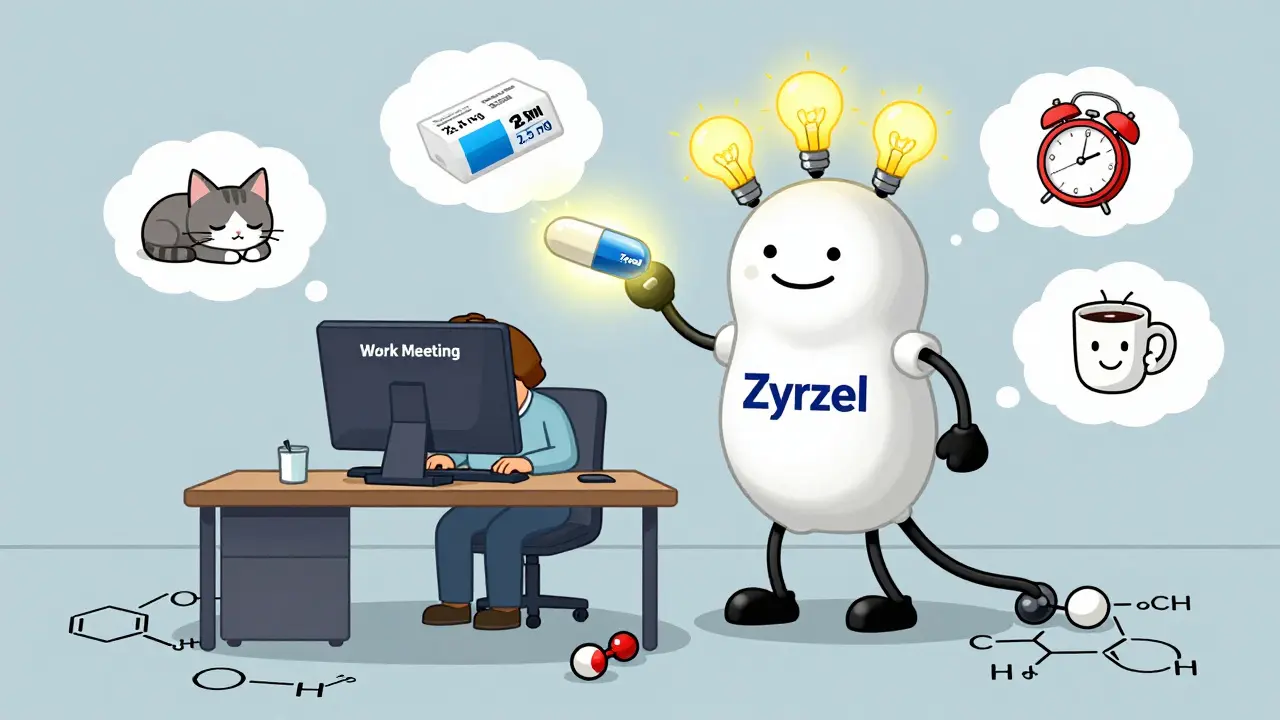
When you're dealing with sneezing, runny nose, or itchy skin from allergies, you want relief - not a nap. Two popular antihistamines, cetirizine and levocetirizine, are often compared because they’re so similar. But one key difference separates them: Cetirizine is a racemic mixture containing both active and inactive molecules, while levocetirizine is just the active part. This small chemical change affects how sleepy you feel - and whether you can function at work or school after taking it.
What’s the real difference between cetirizine and levocetirizine?
At first glance, they look like twins. Both treat hay fever, hives, and other allergic reactions. Both work for 24 hours. Both are sold over-the-counter. But here’s the catch: Cetirizine is a 50-50 mix. Half of it is levocetirizine - the part that blocks histamine and stops allergies. The other half is dextrocetirizine - a mirror-image molecule that does almost nothing for allergies but might still affect your brain.
Levocetirizine, sold as Xyzal, is just the clean, pure version of that active half. Think of it like filtering out the junk from a juice blend. You get the same benefits with less baggage. That’s why levocetirizine is called a third-generation antihistamine - it’s a refined version of cetirizine’s second-generation formula.
Does levocetirizine really cause less drowsiness?
Yes - and the science backs it up. A 2008 study in PubMed tested 18 healthy volunteers who got either cetirizine 5 mg, levocetirizine 2.5 mg, or a placebo. Both drugs blocked histamine just as well. But the group taking levocetirizine showed fewer signs of brain fog and slowed reaction times. The study concluded that levocetirizine delivers the same allergy relief at half the dose - with less impact on alertness.
Real-world data matches this. On Drugs.com, users rated levocetirizine higher for side effects (6.7/10) than cetirizine (5.8/10). Common feedback? “I used to crash after Zyrtec. Xyzal lets me stay awake.” One Reddit user wrote: “Switched after my boss noticed I was nodding off in meetings. Didn’t know it was the medicine until I tried Xyzal.”
But here’s the twist: not everyone feels drowsy. Many people take cetirizine and never sleep through their Zoom calls. A WebMD reviewer said: “Zyrtec works better for me - and I’m not sleepy at all.” That’s because sensitivity varies. Some people’s brains are more sensitive to the inactive component in cetirizine. Others metabolize it faster. It’s personal.
Dose comparison: How much is enough?
You can’t swap them 1-for-1. That’s where people get confused.
- 5 mg of cetirizine = 2.5 mg of levocetirizine
- 10 mg of cetirizine = 5 mg of levocetirizine
So if you’re switching from Zyrtec 10 mg to Xyzal, you don’t need two pills - just one 5 mg tablet. Taking too much levocetirizine won’t help more - it just increases side effect risk. Both are meant to be taken once daily, with or without food.
Levocetirizine comes in 2.5 mg and 5 mg tablets. Cetirizine is available in 5 mg and 10 mg tablets, syrups, and dissolvable tablets. The lower dose of levocetirizine makes it easier for kids or people with kidney issues to use safely.
Side effects: What else should you watch for?
Both drugs are generally safe. But here’s what each one brings to the table:
| Side Effect | Cetirizine | Levocetirizine |
|---|---|---|
| Drowsiness | More common - affects 14% of users | Less common - affects 6% of users |
| Headache | 12% | 10% |
| Sore throat | 8% | 7% |
| Dry mouth | 10% | 9% |
| Fatigue | 11% | 5% |
Data from FDA reports and clinical trials show cetirizine causes drowsiness in about 1 in 7 users. Levocetirizine does so in about 1 in 16. That’s a 57% drop in risk. It’s not zero - but it’s meaningful.
Other side effects like headaches or dry mouth are nearly identical. Neither causes liver damage, heart issues, or serious reactions in healthy adults. But if you have kidney disease, both need lower doses. Always check with your doctor if you’re on other medications.
Cost and availability: Is the extra price worth it?
Here’s the practical side: cetirizine (Zyrtec) costs about $13 for 30 tablets of 10 mg. Levocetirizine (Xyzal) runs around $14.50 for 30 tablets of 5 mg. At first glance, they’re nearly the same price - but you’re getting half the active ingredient in Xyzal. So if you take 5 mg of levocetirizine, you’re paying about the same as 10 mg of cetirizine.
But here’s the catch: many insurance plans cover cetirizine better. Generic versions are cheaper. Some pharmacies offer Zyrtec for under $5 with coupons. Xyzal is still mostly brand-name or generic-only in lower doses. If you don’t feel drowsy on cetirizine, there’s no reason to pay more.
Market data shows cetirizine is still the top choice - held 28% of the U.S. antihistamine market in 2023. Levocetirizine holds 15%. But among working adults who say they’re tired all day, Xyzal adoption is 58%. That tells you who’s switching - and why.
Who should choose which?
Not everyone needs to upgrade. Here’s how to decide:
- Choose levocetirizine if: You get drowsy on cetirizine, work with machines or drive, are a parent who needs to stay alert, or have mild kidney issues.
- Stick with cetirizine if: You’ve tried it and feel fine, you’re on a tight budget, or you’re treating a child (it’s more commonly prescribed for kids).
Experts like Dr. Michael Foggs of the American College of Allergy say: “If someone says Zyrtec makes them sleepy, I switch them to Xyzal. It’s not a big change - just half the dose - and they’re usually happier.” But Dr. Robert Naclerio from the University of Chicago warns: “Don’t assume levocetirizine is better for everyone. For many, the difference is too small to justify the cost.”
What about long-term use?
Both are safe for daily use over months or years. The FDA approved them for long-term treatment of chronic hives and allergic rhinitis. No evidence shows they cause tolerance, addiction, or organ damage. But if you’re taking them every day for more than 6 months without improvement, it’s time to see an allergist. You might have something else going on - like nasal polyps, mold sensitivity, or non-allergic rhinitis.
New developments are coming. In 2023, combo pills with levocetirizine and montelukast (a leukotriene blocker) hit the market. They’re designed for people who need extra help with congestion. Extended-release versions are also in testing. The future? Personalized dosing based on genetics - not just trial and error.
What if you’re still sleepy?
Even levocetirizine can make you tired - especially if you’re sensitive, take it with alcohol, or have liver or kidney problems. If you’re still drowsy:
- Take it at night instead of in the morning
- Avoid alcohol and sedatives
- Try loratadine (Claritin) - it’s even less likely to cause drowsiness
- Check your kidney function - poor clearance increases side effects
Some people just need a different class of drug. Fexofenadine (Allegra) is another non-sedating option. Or try a nasal spray like fluticasone - it works locally and rarely causes drowsiness.
Is levocetirizine stronger than cetirizine?
No - it’s not stronger. It’s more targeted. Levocetirizine 2.5 mg works just as well as cetirizine 5 mg because it’s the pure active ingredient. You don’t need more - just cleaner chemistry.
Can I take both together?
No. They work the same way. Taking both increases side effects without extra benefit. It’s like doubling your dose of one drug. Stick to one.
Is one better for kids?
Cetirizine is more commonly used in children because it’s been studied longer and comes in syrup form. Levocetirizine is approved for kids 6 months and up, but it’s less commonly prescribed. Always follow your pediatrician’s advice.
Does levocetirizine work faster?
No. Both reach peak levels in the blood within about an hour. Neither works instantly - they’re not like decongestants. Give them 24 hours to build up.
Can I switch from cetirizine to levocetirizine tomorrow?
Yes. You can switch directly. Just use half the dose: 5 mg of cetirizine becomes 2.5 mg of levocetirizine. No tapering needed. Monitor for side effects for a few days.
What’s next?
If you’ve tried both and still have symptoms, it’s not the antihistamine - it’s the allergy itself. See an allergist. They can test for triggers like dust mites, pollen, or pet dander. Sometimes, the real fix isn’t stronger medicine - it’s removing the cause.
For now, if drowsiness is your biggest problem - try levocetirizine. If cost matters more - stick with cetirizine. Both are solid choices. The difference isn’t magic. It’s just chemistry - and a little less sleepiness.
Comments (8)
-
Tony Shuman February 17, 2026
Let me get this straight - you’re telling me I should pay more for half the dose just because some study says I *might* feel less sleepy? Bro, I’ve been taking Zyrtec for 12 years, worked three night shifts in a row, and still outsmarted my cat in a game of who-can-nap-longest. This isn’t science - it’s pharmaceutical marketing dressed up like a TED Talk.
Levocetirizine? Sounds like a word a chemist made up to justify a 40% price hike. I’ll stick with the $5 generic while you’re overpaying for a label that says ‘premium brain fog reduction.’

-
Logan Hawker February 17, 2026
While I appreciate the granular pharmacokinetic breakdown, I must point out that the very premise - that ‘dextrocetirizine’ is merely ‘inactive’ - is a reductive oversimplification rooted in binary pharmacological thinking. The enantiomeric impurity, while ostensibly non-H1-antagonistic, may still exert allosteric modulation on CNS GABAergic pathways via off-target binding - a phenomenon poorly captured in placebo-controlled trials with n=18.
Moreover, the assertion that ‘levocetirizine delivers the same allergy relief at half the dose’ ignores the entourage effect of chiral isomer synergy. One might argue that the racemate’s ‘baggage’ is not waste - but rather, a modulatory scaffold. This is why, in clinical practice, I’ve observed superior mucosal stabilization in chronic rhinitis patients on full-spectrum cetirizine - particularly those with concomitant mast cell activation syndrome.
And while we’re at it - why is no one discussing the CYP3A4 polymorphism variance across ethnic populations? Your ‘real-world data’ from Drugs.com is statistically contaminated by American overconsumption bias. In India, where dosing is typically 5mg QD for both, the drowsiness differential is negligible. This isn’t chemistry - it’s cultural pharmacoeconomics.

-
Prateek Nalwaya February 19, 2026
Man, I read this whole thing while sipping chai and staring out my balcony in Mumbai - and honestly? It’s like someone took a chemistry textbook, mixed it with a Reddit AMA, and then added a dash of ‘I just want to stop sneezing without falling asleep.’
I tried Zyrtec once - crashed hard during my 3pm class. Switched to Xyzal - stayed awake, didn’t feel like a zombie. But then again, I’m small, eat spicy food daily, and my liver probably processes drugs like a Ferrari. Not everyone’s the same.
What struck me? The cost thing. In India, generic cetirizine is like $1 for 10 tablets. Xyzal? Not even available in most towns. So yeah - if you’re in the US and can afford it, go for the cleaner version. But don’t act like it’s a miracle drug. It’s just… less junk in the same engine.
Also - if you’re still sleepy? Maybe it’s not the medicine. Maybe it’s the 7 hours of TikTok-scrolling before bed. Just saying.

-
Oliver Calvert February 19, 2026
Key point missed: the 14% vs 6% drowsiness numbers are from trials with healthy volunteers. Real-world users? Many are already fatigued from allergies, sleep apnea, or stress. The drug isn’t making them sleepy - it’s the final straw.
Also, kidney function matters. If you’re over 60 or have even mild renal impairment, both drugs accumulate. Levocetirizine’s lower dose helps - but if your eGFR is below 50, you need to reduce both. Don’t assume ‘less drowsiness’ means ‘safer’.
And stop calling it ‘third-generation.’ That’s just marketing. Both are second-gen. Levocetirizine is just the purified enantiomer. No magic. Just chemistry.
Bottom line: if you’re fine on cetirizine, don’t switch. If you’re drowsy, try levocetirizine. But don’t expect miracles. And always check with your pharmacist - they know what’s really going on.

-
Kancharla Pavan February 19, 2026
You people are so naive. You think this is about chemistry? It’s about control. The pharmaceutical industry doesn’t want you to know that cetirizine has been around since 1987 - cheap, effective, and widely tested. They invented ‘levocetirizine’ not to help you - but to extend patents, jack up prices, and keep you dependent on branded products while they profit off your ignorance.
And now you’re all sitting here praising ‘Xyzal’ like it’s some kind of divine intervention? Wake up. You’re being played. The ‘6% drowsiness’? That’s self-reported. People don’t admit to being sleepy on meds - they blame their jobs, their kids, their ‘stress.’
Meanwhile, in countries where generics are actually regulated - like India - doctors prescribe cetirizine without hesitation. Why? Because it works. And because they’re not trying to sell you a $15 bottle of the same molecule with a fancy name.
Stop being a consumer. Start being a skeptic. And if you’re still sleepy? Maybe you need less sugar. Less screen time. Less anxiety. Not a more expensive pill.

-
Dennis Santarinala February 20, 2026
Just wanted to say - I switched from Zyrtec to Xyzal after my 5-year-old started acting like a zombie after school. No joke. She’d zone out during homework. We thought it was ADHD. Turns out? It was the dextro part of cetirizine. Switched to 2.5mg Xyzal - she’s now running around like a squirrel on espresso. No more ‘nap time’ at 3pm.
Cost? Yeah, it’s a bit more. But my wife and I both take it now - and we’re both sleeping better at night because we’re not exhausted from the meds. Sometimes, paying a little more means you’re not paying with your energy.
Also - I took it at night for a week to test. Didn’t feel groggy in the morning. So yeah. It works. And I’m not some rich guy - I work retail. This isn’t luxury. It’s sanity.

-
Adam Short February 20, 2026
Let’s be honest - this whole debate is a distraction. In Britain, we’ve got NICE guidelines that say: ‘For uncomplicated allergic rhinitis, use non-sedating antihistamines - loratadine or cetirizine.’ No mention of levocetirizine. Why? Because the difference is negligible for most people.
And don’t get me started on the ‘third-generation’ nonsense. That’s American hype. We don’t need another branded pill with a longer name and a higher price tag. If it ain’t broke - don’t fix it with a 40% markup.
Also - why is no one talking about the environmental cost? More pills = more plastic = more landfill. Cetirizine is cheaper, more accessible, and has a smaller footprint. Choose wisely - not just for your brain, but for the planet.

-
Sam Pearlman February 20, 2026
Okay but what if you’re the person who gets drowsy on *both*? I tried Xyzal. Tried Zyrtec. Tried Claritin. Tried Allegra. Still feel like a wet sock after lunch. So I just take a nap. And I’m not ashamed.
Look - allergies are exhausting. The meds help. But they don’t fix the root cause. Maybe we should be talking less about which pill is less sleepy and more about why we’re all so allergic in the first place. Pollen levels are insane. Air quality is trash. We’re drowning in dust mites and mold.
Maybe the real upgrade isn’t the drug - it’s a HEPA filter. Or a humidifier. Or moving out of your cousin’s basement. Just saying.
