
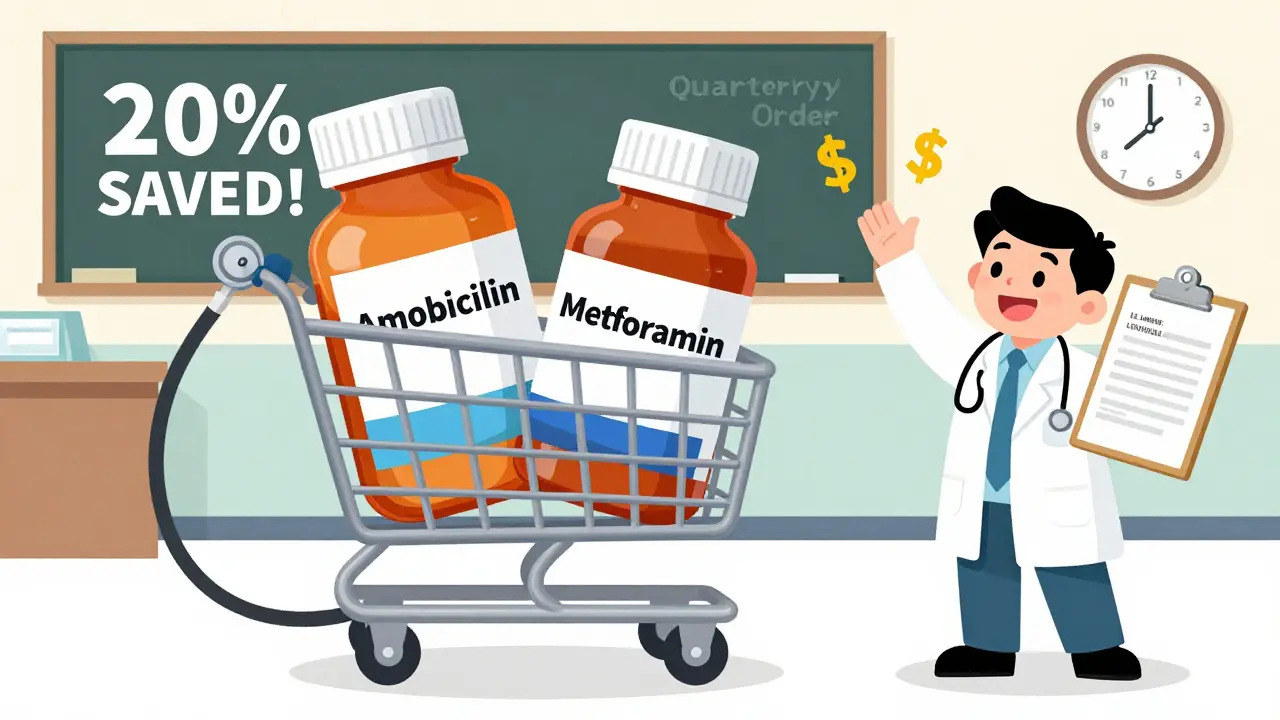
When you walk into a clinic or urgent care center, you rarely think about how much the medications cost the provider. But behind the scenes, bulk purchasing of generic drugs is one of the biggest levers for cutting costs-without sacrificing care. For practices that prescribe common medications like antibiotics, lidocaine, or metformin, buying in bulk isn’t just smart-it’s essential. And the savings? They’re real. One Texas urgent care cut its injectable drug costs by 20% in just two months by switching to quarterly bulk orders and using short-dated stock. That’s not luck. That’s strategy.
How Bulk Purchasing Actually Works
Bulk purchasing means buying large quantities of generic drugs at once to get a better price per unit. It’s not new, but the system behind it is complex. The foundation was laid in 1984 with the Hatch-Waxman Act, which made it easier for generic drug makers to get FDA approval without repeating expensive clinical trials. Since then, generics have exploded-making up 90% of all prescriptions in the U.S. But they only account for about 25% of total drug spending. Why? Because the rest of the money goes to middlemen, not the manufacturers. The real savings come from volume discounts. If you buy 1,000 units of a drug like amoxicillin, you might get a 5-15% discount. But if you buy 10,000 units? That jumps to 20-30%. These aren’t guesses. They’re standard industry practices backed by data from the Academy of Managed Care Pharmacy. The key is knowing which drugs to buy in bulk. Not all generics are equal. High-use medications like saline solutions, corticosteroids, and oral antibiotics are perfect candidates. Low-use specialty drugs? Not so much.Who’s Selling and How Much Do You Save?
There are three main ways to buy generics in bulk: primary wholesalers, secondary distributors, and state buying pools. Primary wholesalers-McKesson, Cardinal Health, and AmerisourceBergen-control about 85% of the market. But their discounts? Often just 3-8%. That’s barely better than retail pricing. They make their money by keeping prices high and then offering small discounts to lock you in. Secondary distributors like Republic Pharmaceuticals are where the real savings happen. These companies buy in massive volumes and pass the savings on. Practices that switch to them report 20-25% savings on high-volume generics. They also offer something primary wholesalers don’t: short-dated stock. These are drugs with 6-12 months left before expiration. They’re perfectly safe, but the manufacturer needs to move them fast. So they sell them at 20-30% off. One Ohio clinic slashed its injectable costs by 25% using this method. The catch? You have to manage inventory tightly. If you don’t use the drugs before they expire, you lose money. Then there are multi-state purchasing pools like the National Medicaid Pooling Initiative and Sovereign States Drug Consortium. These let states team up to buy in bulk. The savings? Around 3-5% more than if they bought alone. That might sound small, but when you’re spending millions, it adds up fast.What PBMs Are Doing (And Why It’s Complicated)
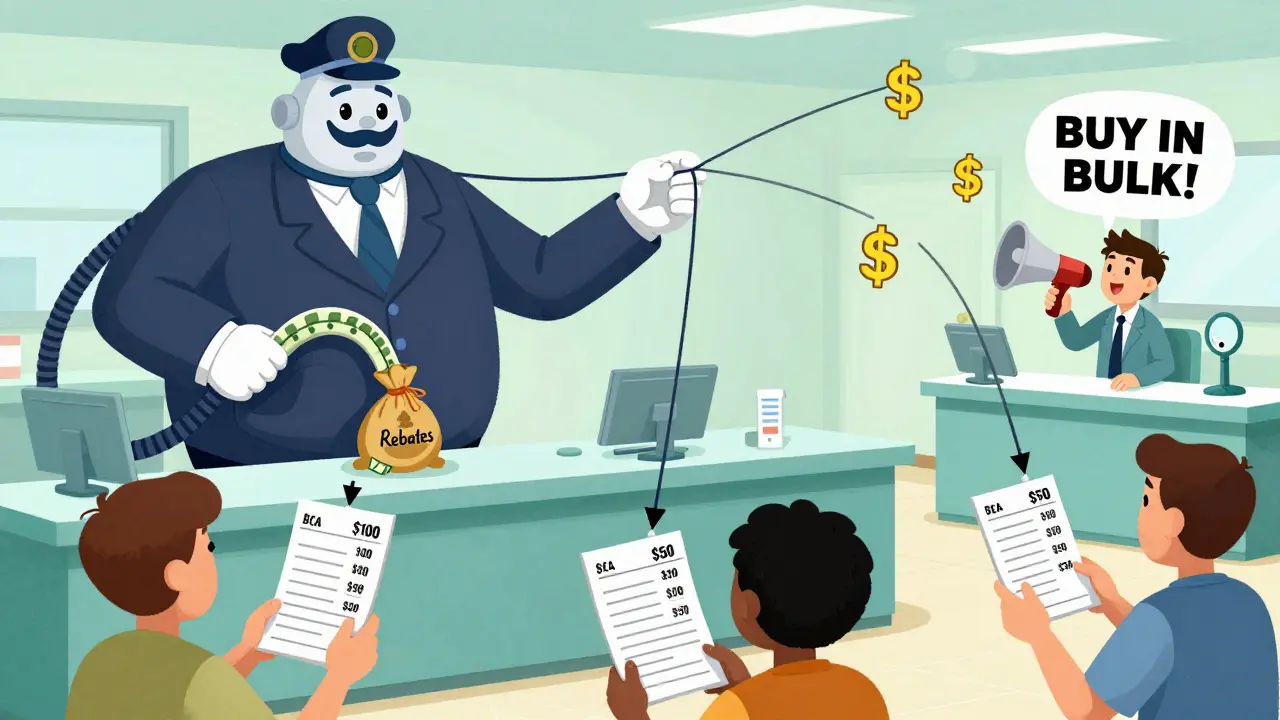
Pharmacy Benefit Managers (PBMs) are the middlemen between insurers, pharmacies, and drug makers. They negotiate rebates-sometimes as high as 40%-on generic drugs. Sounds great, right? Not always. Here’s the problem: PBMs don’t always pass those rebates on to you. According to USC Schaeffer Center research, only 50-70% of the rebate money ends up in the hands of the health plan or employer paying for the drugs. The rest stays with the PBM. That’s why a plan might pay $100 for a prescription, get a $40 rebate, and still charge you $30 out-of-pocket. The discount exists, but it’s hidden. New rules are starting to change that. As of January 2024, the top three PBMs are rolling out point-of-sale discount programs. These automatically apply the negotiated price at the pharmacy counter-no extra card, no paperwork. For common generics like metformin or atorvastatin, patients are seeing out-of-pocket costs drop by 30-50%. That’s a win for patients. But for providers buying in bulk, it’s still the secondary distributors that deliver the biggest savings on inventory.
What Works Best-And What Doesn’t
Bulk purchasing isn’t a one-size-fits-all fix. It works brilliantly for certain drugs and fails miserably for others. Best for: High-volume, low-cost generics like antibiotics (amoxicillin, azithromycin), lidocaine, saline, metformin, atorvastatin, and oral corticosteroids. These are prescribed daily in urgent cares, dermatology, and podiatry clinics. Buying them in bulk cuts costs fast. Not for: Low-use specialty drugs, drugs in shortage, or anything with unstable supply. The FDA reported nearly 300 active generic drug shortages as of November 2023. If you commit to buying 10,000 units of a drug that suddenly becomes scarce, you’re stuck. And if you’re buying short-dated stock, you need a system to track expiration dates. One clinic manager said they lost $1,200 in expired meds before they got their inventory tracking right.How to Start Buying in Bulk-Step by Step
If you’re ready to save money, here’s how to do it without chaos:- Identify your top 15-20 drugs. Look at your last six months of prescriptions. Which 10% of drugs make up 60-70% of your medication spend? That’s your target list.
- Compare suppliers. Get quotes from your current wholesaler and at least one secondary distributor. Ask about short-dated stock options and minimum order sizes.
- Start small. Pick one or two drugs to test. Order 2,000-5,000 units instead of your usual monthly amount. Track usage and expiration dates.
- Set up inventory tracking. Use a simple spreadsheet or low-cost software to log receipt dates and expiration dates. Set alerts for drugs expiring in 30 days.
- Scale up. Once you’ve nailed the process, expand to your next five drugs. Most practices see full savings within 4-6 weeks.
Common Pitfalls and How to Avoid Them
Not everyone gets it right. Here’s what goes wrong-and how to fix it:- Buying too much too soon. Don’t order 10,000 units of a drug you only use 500 of per month. Start with 2-3 months’ supply.
- Ignoring expiration dates. Short-dated stock saves money, but only if you use it. Dedicate 5-10 hours a month to inventory checks.
- Overlooking cash flow. Bulk buying means paying more upfront. Make sure you have 15-25% more working capital ready.
- Not tracking savings. Write down your old cost per unit and your new cost. If you’re not saving at least 15%, something’s off.
The Bigger Picture
Bulk purchasing alone won’t fix the broken drug pricing system. The U.S. spends $122 billion a year on generics, but manufacturers still pocket 41% of every $100 spent. PBMs, wholesalers, and middlemen take the rest. The Inflation Reduction Act’s new Medicare price negotiations could cut those costs even further-projected to save $6 billion in 2026 alone. But for clinics, urgent cares, and small practices, bulk purchasing is the most powerful tool you have right now. It’s not about politics. It’s about practicality. You can’t control drug list prices. But you can control how you buy.Frequently Asked Questions
Is bulk purchasing safe for patients?
Yes. Generic drugs bought in bulk are identical to those bought individually. The FDA requires all generics to meet the same standards for safety, strength, and quality. Short-dated stock is also safe-as long as it’s used before expiration. Many clinics have used short-dated stock for years without a single adverse event.
Can small clinics benefit from bulk purchasing?
Absolutely. You don’t need to be a hospital. Even small practices can save 15-25% by buying just 2-3 high-use generics in bulk. Many secondary distributors offer flexible minimums-sometimes as low as 500 units. The key is focusing on the drugs you actually use every day.
Do I need special software to manage bulk inventory?
Not necessarily. Many clinics start with a simple Excel sheet or Google Sheets, tracking drug name, quantity received, expiration date, and usage. Free or low-cost inventory tools like MedMij or SimplePractice have built-in tracking. The goal isn’t fancy tech-it’s consistency. Check your stock weekly and use older stock first.
Why don’t all clinics use bulk purchasing?
Many don’t know it’s an option. Others are locked into contracts with primary wholesalers. Some fear the administrative work. But clinics that try it report higher margins, less stress over drug shortages, and more control over their supply chain. The biggest barrier is inertia-not cost.
What if a drug goes into shortage after I buy in bulk?
That’s why you avoid bulk buying for drugs with unstable supply. Stick to generics with consistent availability. Check the FDA’s Drug Shortage Database monthly. If a drug you’ve ordered in bulk suddenly goes short, you’re still covered-you’ve already got it on hand. That’s an advantage, not a risk.
Are there legal risks with buying from secondary distributors?
Not if you choose a licensed distributor. All reputable secondary distributors like Republic Pharmaceuticals are licensed by the FDA and state boards. As of 2024, 37 states have specific regulations for these distributors. Ask for their license number and verify it with your state pharmacy board. Avoid anyone who won’t provide documentation.
Comments (8)
-
Wendy Claughton January 18, 2026
Just wanted to say this is the kind of practical, grounded insight we need more of in healthcare.
It’s not flashy, but it’s real.
Small clinics saving 20% on amoxicillin? That’s dignity.
Not politics. Not lobbying. Just smart logistics.
Thank you for writing this.
It’s rare to feel seen in this space.
And yes - short-dated stock is safe.
I’ve used it for years.
And no, patients haven’t turned into zombies.
They just got their prescriptions faster and cheaper.
Also - why are we still pretending PBMs are heroes?
They’re middlemen with Excel sheets and 40% rebates they don’t pass on.
It’s not complicated.
It’s corrupt.
But you? You’re doing the work.
Keep going.

-
rachel bellet January 18, 2026
The structural inefficiencies in pharmaceutical distribution are a textbook case of rent-seeking behavior masked as ‘supply chain optimization.’
Primary wholesalers operate as oligopolistic gatekeepers, leveraging contract lock-in and information asymmetry to extract marginally higher spreads while suppressing competitive entry.
Secondary distributors, by contrast, function as arbitrageurs exploiting volume differentials and expiration arbitrage - a legitimate, market-driven corrective mechanism.
Moreover, the FDA’s 90% generic penetration rate is misleading without context: it reflects volume, not value.
Meanwhile, PBMs engage in spread pricing and clawback schemes that directly inflate out-of-pocket costs despite nominal rebate structures.
The Inflation Reduction Act’s point-of-sale reforms are tokenistic - they address symptoms, not root causes.
True reform requires breaking the PBM-wholesaler duopoly and mandating pass-through transparency.
Until then, clinics that bypass the system via secondary distributors are engaging in ethical resistance.
Not rebellion - rational adaptation.

-
Stacey Marsengill January 20, 2026
Ugh. I’ve seen this before.
You think you’re being clever, buying ‘short-dated’ stuff like it’s a thrift store bargain.
But you’re playing Russian roulette with people’s health.
One batch goes bad? One kid gets a bad reaction?
And suddenly your ‘savings’ become a lawsuit.
And then what? You’ll blame the ‘system’ again?
It’s not about saving $500 a month.
It’s about being responsible.
And if you’re so proud of your spreadsheet, maybe you should be a pharmacist.
Not a clinic owner.
Just sayin’.
Also - who even trusts these ‘secondary distributors’? They’re not even on the map.
It’s sketchy.
And you’re proud of it?
Shame.

-
Aysha Siera January 21, 2026
They want you to think this is about savings.
But it’s not.
It’s a trap.
They’re testing how fast you’ll swallow the lie.
Secondary distributors? Licensed? Please.
Who really owns them?
Big Pharma.
They push you to buy bulk so you become dependent.
Then they cut supply.
Then you pay double.
They want you to think you’re smart.
But you’re just another pawn.
Check the FDA database.
Every shortage starts with a ‘bulk buy’.
They’re setting you up.
And you’re thanking them.
Wake up.
They’re not saving you.
They’re owning you.

-
Pat Dean January 23, 2026
Let me get this straight - you’re proud of buying drugs from some fly-by-night distributor because it saves you 25%?
Meanwhile, American manufacturers are getting crushed.
We used to make these pills here.
Now we’re importing them from who-knows-where under the radar?
And you call that patriotism?
It’s not ‘smart’ - it’s surrender.
Where’s the pride in American-made medicine?
Why are we outsourcing our health to shadow suppliers?
This isn’t innovation.
This is giving up.
And you’re celebrating it?
Pathetic.

-
Jay Clarke January 24, 2026
Okay but like… imagine if your boss told you to buy 10,000 pens because they’re on sale.
You do it.
Then you realize you only use 500 a year.
Now your closet is full of pens.
And you’re still paying rent.
And your printer is broken.
So what’s the point?
Same thing with drugs.
Buying in bulk is cool until you’re stuck with expired lidocaine and a $1200 loss.
And don’t even get me started on PBMs.
They’re the real villains.
But hey - at least you got a spreadsheet.
Good job.
Now go cry into your Excel chart.

-
Selina Warren January 25, 2026
STOP.
Just stop.
You’re not saving money - you’re enabling a broken system.
Buying bulk doesn’t fix PBMs.
It doesn’t fix supply chains.
It just lets you feel like a hero while the whole thing burns.
Real change isn’t in spreadsheets.
It’s in policy.
It’s in breaking monopolies.
It’s in forcing PBMs to pass rebates through.
It’s in making manufacturers pay fair prices.
Not in hoarding expired antibiotics.
That’s not strategy.
That’s desperation dressed up as wisdom.
And I’m tired of it.

-
Robert Davis January 26, 2026
Interesting. But I think you missed something.
There’s a reason primary wholesalers dominate.
They’re regulated.
They’re audited.
They have compliance teams.
Secondary distributors? They’re barely on the radar.
One audit, one expired batch, one patient complaint - and your license is gone.
And then what? You’re out of business.
And your staff? They’re unemployed.
And your patients? They’re scrambling.
So yes - you save 20% now.
But what’s the cost of failure?
And have you calculated that?
I doubt it.
Because you’re focused on the discount.
Not the disaster.
That’s the real risk.
And nobody talks about it.
