
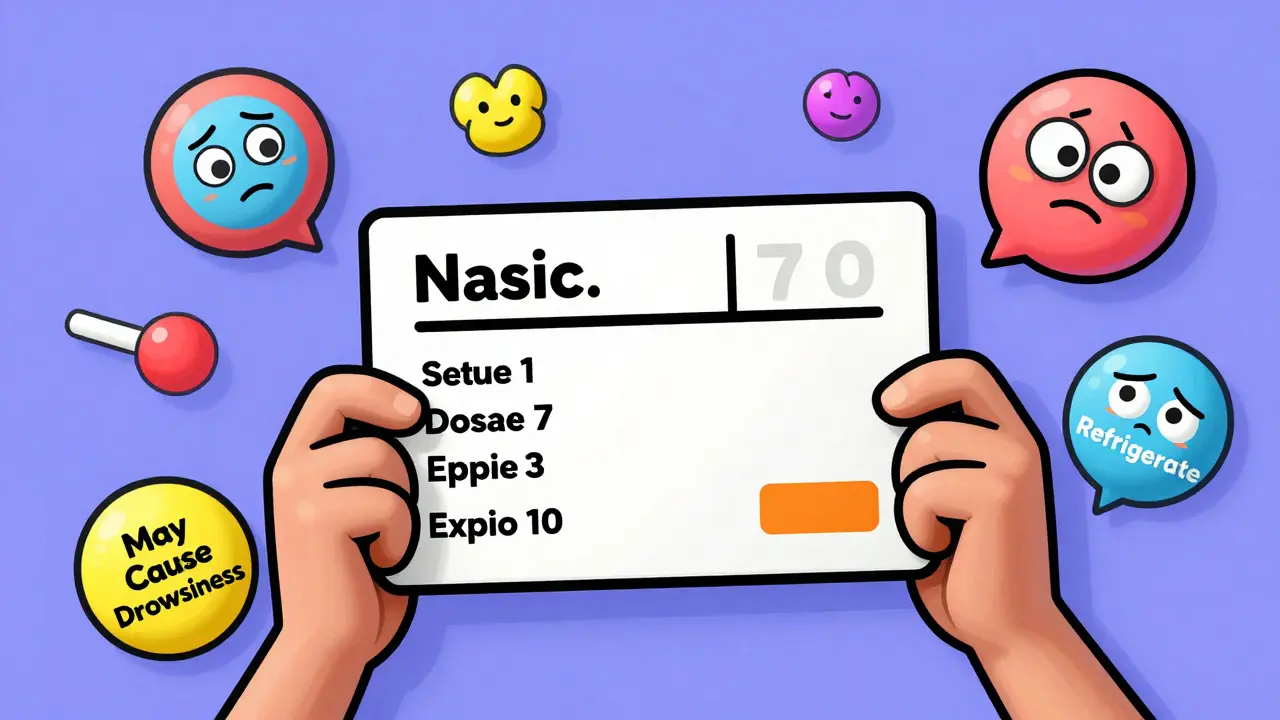
Every time you pick up a prescription, you’re handed a small piece of paper that could mean the difference between getting better and ending up in the hospital. Yet most people glance at it, shove it in their bag, and hope for the best. That’s risky. Prescription labels aren’t just bureaucratic paperwork-they’re your safety manual. And if you don’t read them right, you could be taking the wrong dose, mixing dangerous drugs, or using expired medicine without even knowing it.
What’s on Your Prescription Label?
Your prescription label has twelve key parts. You don’t need to memorize them all, but you should know what each one means before you take your first pill.Your full name is printed clearly at the top. This isn’t just for show. It stops someone else in your house from accidentally grabbing your medicine. If it says "John Smith" and you’re Jane Smith, don’t take it. Call the pharmacy right away.
The medication name shows up twice: once as the brand name (like "Lipitor") and once as the generic name ("atorvastatin"). The generic name is the actual drug, no matter who makes it. Some pharmacies use the generic name first-others use the brand. Either way, learn both. If your pill looks different than last time, check the name. It might be a different brand, or worse, the wrong drug.
The prescription number (Rx#) is a mix of letters and numbers. It’s your prescription’s ID. Use this number when you call to refill. If you don’t know it, the pharmacy can look it up, but having it handy saves time.
The prescriber’s name tells you who ordered the medicine. It could be your doctor, a nurse practitioner, or even a dentist. If you didn’t see that person recently, ask why they prescribed it. Sometimes, prescriptions get mixed up during busy clinic days.
The strength tells you how much medicine is in each pill, drop, or teaspoon. It’s written like "20 mg" or "5 mL." This is where mistakes happen. A 10 mg pill is not the same as a 20 mg pill. Never assume your last prescription was the same strength. Always check.
The quantity says how many pills or how much liquid you got. If you were supposed to get 30 tablets but only got 15, call the pharmacy. Missing pills could mean a mistake-or worse, someone stole them.
The discard or expiration date is the last day the medicine works as it should. Most prescriptions expire one year after they’re filled, unless the label says otherwise. After that, the drug can lose strength or even break down into harmful substances. Never take expired medicine.
The instructions are the most important part. They tell you when, how, and how often to take the medicine. But they’re often confusing. "Take twice daily" doesn’t mean every two hours. It means every 12 hours-like morning and night. "Take as needed" means only when you feel symptoms, not every hour. A study by the NIH found that 79% of people misread these instructions. If it says "take with food," don’t take it on an empty stomach. If it says "avoid sunlight," don’t sit outside without sunscreen.
Refill information tells you how many times you can get more without a new prescription. If it says "Refills: 3," you have three more turns at the pharmacy. Once they’re gone, you need to call your doctor. Don’t wait until you’re out-plan ahead.
Auxiliary labels are those small stickers with icons or bold words: "May cause drowsiness," "Refrigerate," "Do not crush." These aren’t suggestions. They’re safety rules. If your label says "Avoid alcohol," drinking even one beer could make you sick. If it says "Refrigerate," leaving it on the counter could ruin it.
The National Drug Code (NDC) is a 10- or 11-digit number. It’s not for you to use, but it’s there so pharmacists can track the exact drug, manufacturer, and package size. If you ever need to report a problem with your medicine, this number helps them find it.
Pharmacy contact info is on the bottom: name, phone, address. Save this number in your phone. If you have any question-big or small-call them. Pharmacists are trained to explain labels. They don’t mind.
What Most People Get Wrong
You’re not alone if you’re confused. The biggest mistakes happen with dosage instructions."Take twice daily" gets misread as "every two hours" by 23% of people with low health literacy. That’s dangerous. Taking a medicine too often can overdose you. "Take one tablet every 4 to 6 hours as needed" means you can take up to 4 doses in 24 hours-not 6. Always count the maximum allowed per day.
"Take on an empty stomach" means no food for one hour before and one hour after. If you eat right before, the drug might not absorb properly. "Take with food" means eat something-even a cracker-when you take it. This keeps your stomach from getting upset.
"Take in the morning" doesn’t mean right after you wake up. It means any time before noon. "Take at bedtime" means right before you lie down, not an hour before. Timing matters for how the drug works in your body.
And don’t ignore the auxiliary labels. "May cause dizziness" means don’t drive or climb ladders. "Avoid grapefruit" means no juice, no fruit, no supplements. Grapefruit can make some blood pressure and cholesterol drugs dangerously strong.
How to Check Your Label Before Taking Medicine
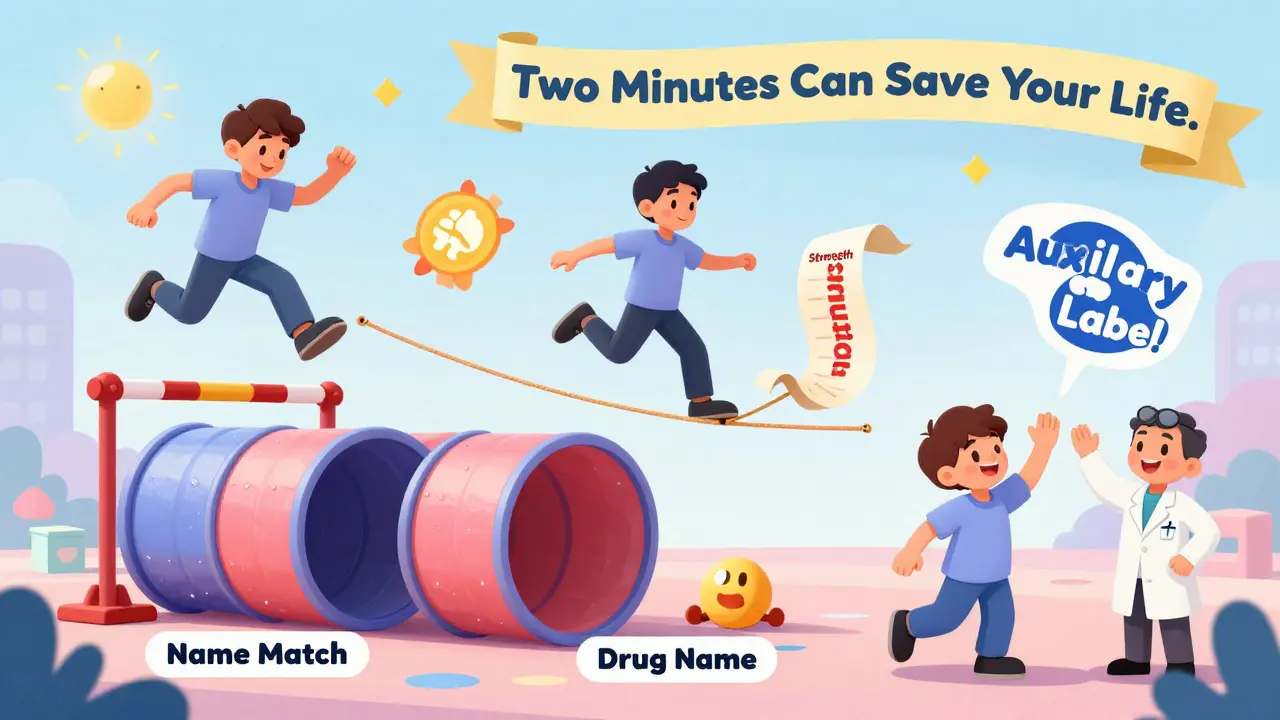
Before you swallow anything, do this quick five-step check:- Match your name-Is it spelled exactly right? No nicknames, no missing initials.
- Check the drug name-Does it match what your doctor told you? Look up the generic name if you’re unsure.
- Confirm the strength-Is it the same as your last refill? If not, ask why.
- Read the instructions-Say them out loud. "Take one tablet by mouth twice daily, morning and night." If it doesn’t make sense, call the pharmacy.
- Look for special notes-Is there a sticker about food, alcohol, driving, or refrigeration? Follow them.
Take two minutes. It’s not a waste of time. It’s your insurance against a mistake that could land you in the ER.

What to Do If You’re Still Confused
If you’re not sure-even after reading it twice-don’t guess. Call the pharmacy. Ask to speak to the pharmacist. They’re required to explain your meds if you don’t understand.Bring your label with you when you visit your doctor. Say: "I’m not sure what this means. Can you walk me through it?" Most doctors appreciate the question. It shows you’re taking your health seriously.
Ask for a printed copy of the drug’s patient information sheet. It’s usually available at the pharmacy. It’s longer, but it explains side effects, warnings, and what to do if you miss a dose.
Some pharmacies now offer QR codes on labels. Scan it with your phone and watch a short video in your language explaining how to take the medicine. These videos cut confusion by 40% in trials. Ask your pharmacy if they offer this.
Why This Matters More Than You Think
Medication errors are one of the top causes of hospital visits in the U.S. Every year, 1.5 million people are hurt because they took the wrong dose, the wrong drug, or the drug at the wrong time. About two-thirds of those errors could have been avoided if the patient had understood their label.It’s not just about pills. It’s about your life. Taking blood pressure medicine at the wrong time can spike your pressure. Mixing painkillers with alcohol can stop your breathing. Forgetting to refrigerate insulin can make it useless. These aren’t "what ifs." These are real dangers that happen every day.
And it’s not just older people. Young adults, parents, students-all of us get confused. The U.S. Department of Education found that 88% of adults struggle with health information. That includes prescription labels. You’re not dumb. The labels are often poorly written.
But you can fix that. By learning to read them, you take control. You stop being a passive patient. You become an active partner in your care.
What’s Changing in Prescription Labels
The FDA started pushing for clearer labels in 2014. They banned phrases like "take as directed" and "use as needed" without clear limits. Now, labels must say exactly how many times to take it per day.By 2025, most U.S. pharmacies will offer digital labels through apps. You’ll get reminders, videos, and even alerts if your medicine interacts with something else you’re taking. But until then, the paper label is still your main tool.
And while technology helps, nothing replaces a human conversation. If you’re unsure, ask. Always.
Final Tip: Make It a Habit
Make checking your prescription label part of your routine. Every time you get a new one, pause. Read it out loud. Compare it to the last one. Ask one question. Do this every time-even if you’ve taken the same drug for years.Medicines change. Your body changes. Your other meds change. What was safe last year might not be safe today.
Don’t let a tiny label become your biggest risk. Take the time. Read it. Understand it. Call if you’re stuck. Your health depends on it.
Comments (15)
-
Dorine Anthony December 18, 2025
Been there. Took my grandma’s blood pressure pill by accident once. Thought they looked the same. Ended up in the ER with a headache and a lecture from the pharmacist. Now I always check the name and strength. Don’t be lazy-your life isn’t a gamble.

-
Aadil Munshi December 19, 2025
Let’s be real-most of these labels are written by lawyers who’ve never taken a pill in their life. ‘Take as needed’? Needed for what? When? How much? The system’s broken. They’d rather you call them than fix the damn label. But hey, at least now you know how to survive it.

-
Frank Drewery December 19, 2025
This is the kind of post that should be mandatory reading for everyone over 16. I work in a clinic and see people mix up antibiotics with painkillers all the time. Not because they’re stupid-because the labels are confusing as hell. Seriously, if you read this and actually check your next script, you’re already ahead of 80% of the population.

-
Sajith Shams December 21, 2025
You think this is bad? Try getting a prescription in India. The label’s in three languages, half the text is handwritten, and the pharmacist yells the instructions across the counter while someone’s crying in the waiting room. You don’t read the label-you survive it. Still, this guide’s better than anything I’ve seen stateside.

-
Nicole Rutherford December 22, 2025
Wow. Someone finally wrote this without sounding like a corporate pamphlet. Most health content is either condescending or terrifying. This? Straight facts. No fluff. No ‘you should feel empowered’ nonsense. Just: here’s what’s on the paper, here’s what happens if you ignore it. Thank you.

-
Ashley Bliss December 24, 2025
I used to think I was fine until my mom nearly died from a drug interaction because she took her cholesterol med with grapefruit juice. She didn’t even know it was on the label. The sticker was faded. The pharmacist didn’t say a word. Now I scan every label like it’s a bomb defusal manual. If you’re not doing this, you’re one bad decision away from a funeral.

-
Danielle Stewart December 25, 2025
Just shared this with my 19-year-old niece who’s on birth control and antidepressants. She thought ‘take once daily’ meant ‘whenever I remember.’ We sat down. We read it together. She cried. Then she thanked me. This isn’t just advice-it’s a lifeline for people who’ve been failed by the system.

-
Dev Sawner December 25, 2025
While the article is technically accurate, it fails to address the systemic issue: pharmaceutical companies intentionally obfuscate labeling to avoid liability. The FDA’s 2014 guidelines are toothless. They mandate clarity, but not comprehension. Until pharmacists are legally required to verbally confirm understanding, this remains performative education.

-
Glen Arreglo December 27, 2025
As someone who’s lived in five countries, I can say this: American labels are actually among the clearest. In Germany, they use tiny font and Latin terms. In Mexico, instructions are scribbled on the back. Here? You’ve got color-coded stickers, NDC codes, QR videos. It’s not perfect, but it’s the best we’ve got. Stop complaining-use the tools.

-
benchidelle rivera December 28, 2025
I work in pharmacy. I’ve seen people take 12 pills at once because they thought ‘take as needed’ meant ‘take until you feel better.’ I’ve seen diabetics leave insulin on the counter for weeks. I’ve seen parents give their kids adult-strength cough syrup because the bottle said ‘10 mL.’ This isn’t about intelligence. It’s about access, education, and systemic neglect. Thank you for writing this. Please share it everywhere.

-
Meenakshi Jaiswal December 30, 2025
Pro tip: If you’re on more than three meds, make a simple chart. Name, strength, time, purpose, special notes. Keep it on your fridge. Update it every refill. I taught my 72-year-old uncle how to do this. He hasn’t missed a dose in two years. It takes 10 minutes. It saves lives.

-
shivam seo December 31, 2025
Why are we even talking about this? In Australia, we have a national digital script system. You scan your ID, your phone gets a push notification with dosage, interactions, and a video. No paper. No confusion. America’s still using 1980s tech while the rest of the world moved on. Fix the system, not the people.

-
Moses Odumbe January 1, 2026
Just scanned the QR code on my new antidepressant label. Video was in Spanish, my mom’s first language. She cried. Said she finally understood why she felt dizzy. This right here? This is what healthcare should look like. 🙏

-
Isabel Rábago January 1, 2026
If you’re still confused after reading this, you shouldn’t be taking pills at all. You’re a danger to yourself and others. This isn’t hard. It’s not rocket science. It’s reading. If you can’t read a label, maybe you shouldn’t be trusted with medication. Period.

-
William Liu January 2, 2026
This is why I always call my pharmacist. They’re the unsung heroes. I once asked why my blood sugar med looked different. Turned out the generic switched manufacturers. They walked me through the change, showed me the side effect differences, and even emailed me a printable version. People forget-pharmacists are there to help. Use them.
