
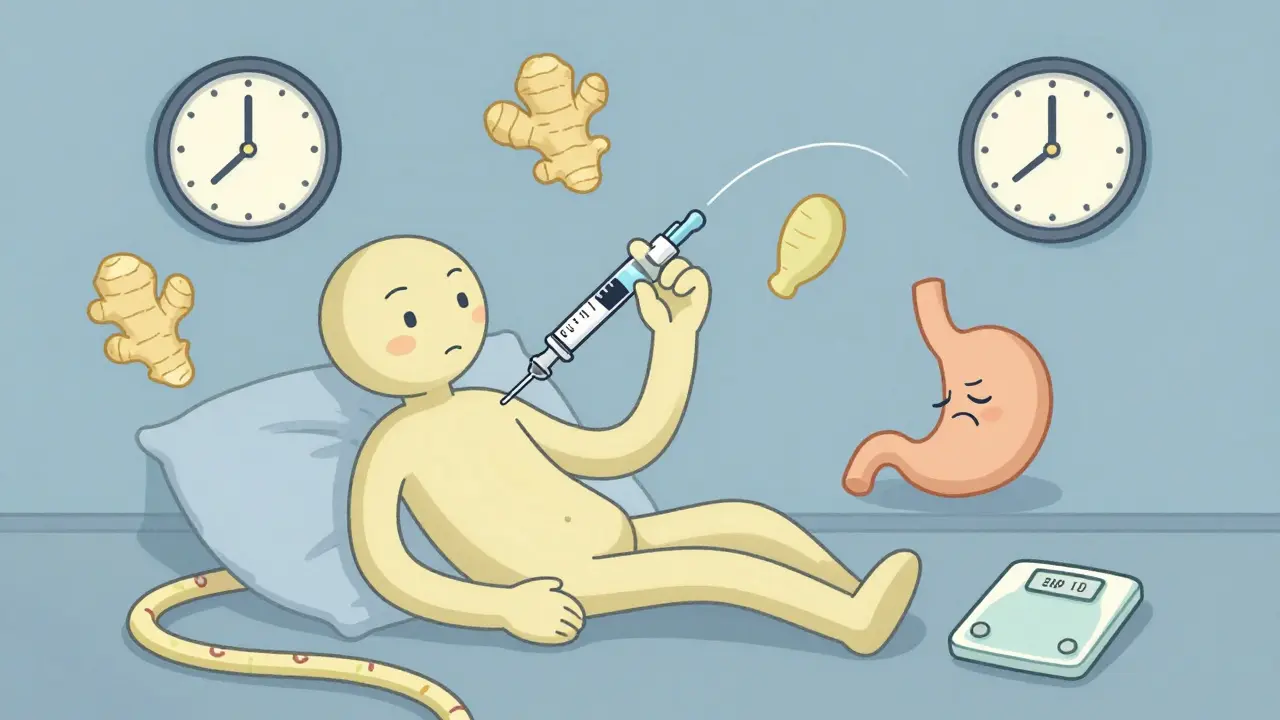
When you start a GLP-1 medication like Wegovy, Ozempic, or Mounjaro for weight loss, the goal is clear: lose weight, feel better, and improve your health. But for many, the first real hurdle isn’t the scale-it’s the nausea. It’s not rare. It’s not unusual. It’s so common that nearly half of people on these drugs report it during the first few weeks. And yet, most of those same people stick with it. Why? Because the side effects usually fade. And the results? They’re real.
Why GLP-1 Medications Cause Nausea
GLP-1 medications work by mimicking a natural hormone your body already makes. That hormone slows down how fast your stomach empties. That’s good news if you’re trying to feel full longer and eat less. But it’s also why you might feel queasy. Your stomach isn’t moving food the way it used to. That delay can trigger nausea, especially when you’re eating more than your body can handle right now.
It’s not a sign the drug isn’t working-it’s a sign it’s working too well. Dr. Robert Gabbay from the American Diabetes Association says it plainly: "The same mechanism that makes you feel full also makes you feel sick." This isn’t a flaw. It’s the point. But that doesn’t make it easy to live with.
Dosing Schedules: Why Slow and Steady Wins
Every GLP-1 medication has a specific dosing plan. These aren’t random. They’re designed to let your body adjust. Jumping straight to the full dose? That’s a recipe for severe nausea-or worse, quitting.
Here’s how the most common ones build up:
- Wegovy (semaglutide for weight loss): Starts at 0.25 mg once a week. After four weeks, it goes to 0.5 mg. Then 1 mg, then 1.7 mg, and finally 2.4 mg. That’s 17 weeks just to get to the highest dose.
- Ozempic (semaglutide for diabetes): Begins at 0.25 mg, moves to 0.5 mg, then 1 mg, and can go up to 2 mg. Faster than Wegovy, but still gradual.
- Mounjaro (tirzepatide): Starts at 2.5 mg, then increases every four weeks: 5 mg, 7.5 mg, 10 mg, 12.5 mg, and finally 15 mg. That’s 20 weeks to reach max.
- Victoza (liraglutide): Starts at 0.6 mg daily, then increases to 1.2 mg or 1.8 mg after at least a week.
The pattern is the same: start low, move slow. The FDA and manufacturers don’t do this just to make you wait. Clinical trials show that people who follow the full titration schedule have far fewer side effects and stick with treatment longer. Rushing? You’re more likely to quit.
What the Data Says About Nausea
It’s not just anecdotal. Real numbers back this up:
- At the starting dose, about 20% of people report nausea.
- By the time you hit the highest dose, that jumps to 30-45%.
- Studies show 68% of users on Reddit experienced nausea during dose increases. But 72% said it got better within 2-4 weeks at each level.
- Patients who pushed through the first 8 weeks of treatment were 89% more likely to lose at least 5% of their body weight than those who stopped.
That last stat is critical. Nausea doesn’t mean you should quit. It means you need to adjust-your eating habits, your timing, your mindset.
How to Reduce Nausea: 5 Proven Strategies
If you’re struggling, you’re not alone. And there are simple, science-backed ways to feel better.
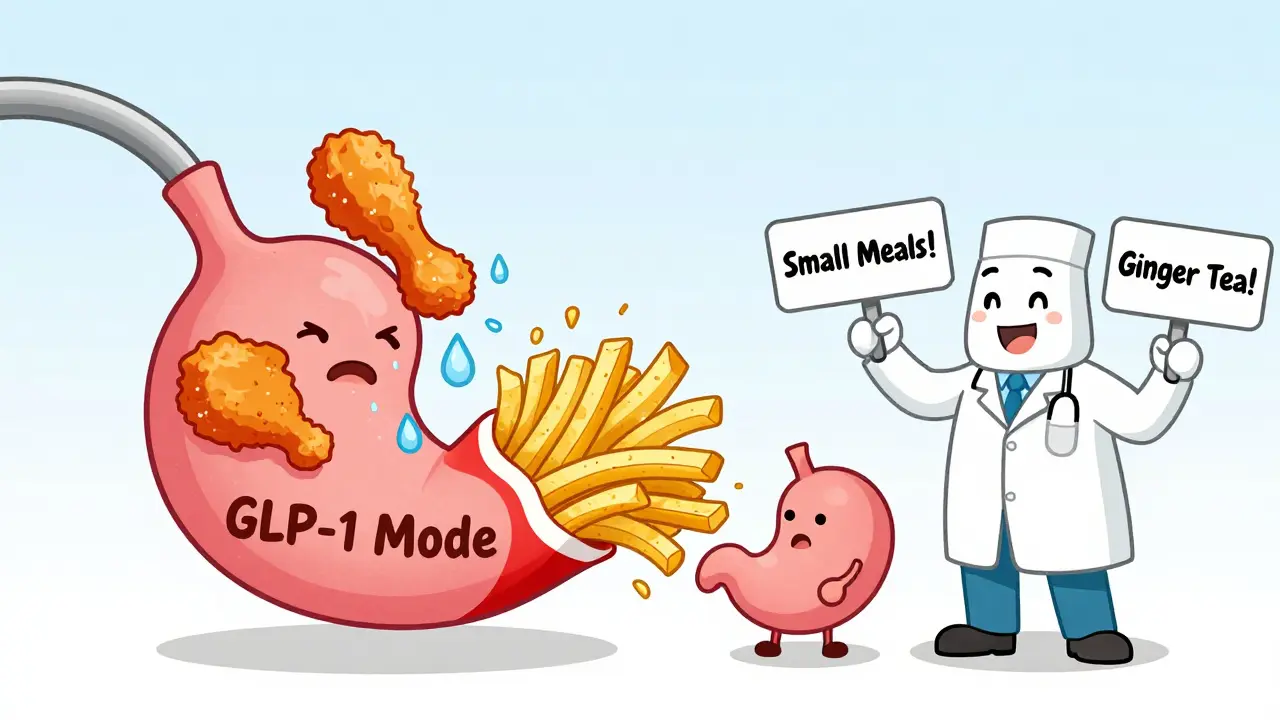
- Take it at bedtime. A Cleveland Clinic survey found that 63% of people had less nausea when they injected the medication right before sleep. Your body is resting, digestion slows naturally, and you’re less likely to notice the discomfort.
- Eat smaller meals, more often. Instead of three big meals, try five small ones. Large portions overwhelm your slowed digestive system. Stick to 300-400 calories per meal.
- Avoid high-fat, fried, or greasy foods. These are harder to digest when gastric emptying is slowed. Choose lean protein, vegetables, and complex carbs instead.
- Stay hydrated-but not with meals. Drink water between meals, not during. Drinking while eating can stretch your stomach and make nausea worse. Aim for 8-10 cups a day.
- Try ginger. Ginger has been used for centuries to calm nausea. Ginger tea, capsules, or even ginger candy can help. A 2023 survey of obesity specialists found 78% recommended it to patients.
One patient on TikTok, @WeightLossJourney2026, posted: "I switched to ginger tea every morning and took my shot at 11 p.m. Nausea dropped from daily to once a week. I lost 18 pounds in 12 weeks." Simple changes. Big results.
When to Pause or Call Your Doctor
Not all nausea is normal. Some signs mean you need to pause:
- Vomiting more than once a day.
- Weight loss that’s too fast (more than 2 pounds per week after the first month).
- Severe abdominal pain or persistent vomiting.
- Signs of dehydration-dizziness, dark urine, dry mouth.
If this happens, don’t force it. Contact your provider. They may suggest holding your dose for a week or two before continuing. Most people bounce back fine. But pushing through severe symptoms can backfire.
Long-Term Outlook: Does It Get Better?
Yes. For most people, nausea improves significantly after reaching the maintenance dose. In clinical trials, nausea rates dropped by nearly half after 12-16 weeks of steady dosing. The body adapts. The stomach learns. The mind gets used to it.
And here’s the kicker: the same people who struggled with nausea early on often report the best outcomes. Why? Because they stuck with it. They didn’t let the side effect stop the solution.
One study in the New England Journal of Medicine found that patients who completed the full 68-week course of Wegovy lost an average of 14.9% of their body weight. That’s not small. That’s life-changing. But only 60% of people made it to the end. The rest quit-mostly because of nausea.
What’s Next: Oral GLP-1 and Better Options
The future is getting better. Novo Nordisk is developing an oral version of semaglutide, expected in 2025. Early data suggests it may cause less nausea than injections. Other companies are testing dual-agonist drugs with different side effect profiles.
For now, injectables are still the gold standard. But the trend is clear: better tolerability is coming. Until then, the key is patience, smart habits, and knowing when to adapt-not quit.
Support Is Out There
You don’t have to figure this out alone. Manufacturers offer free support programs:
- Wegovy Support Program (Novo Nordisk): Includes coaching, meal plans, and 24/7 nurse access.
- Mounjaro Care (Eli Lilly): Provides dosing reminders and nutrition guidance.
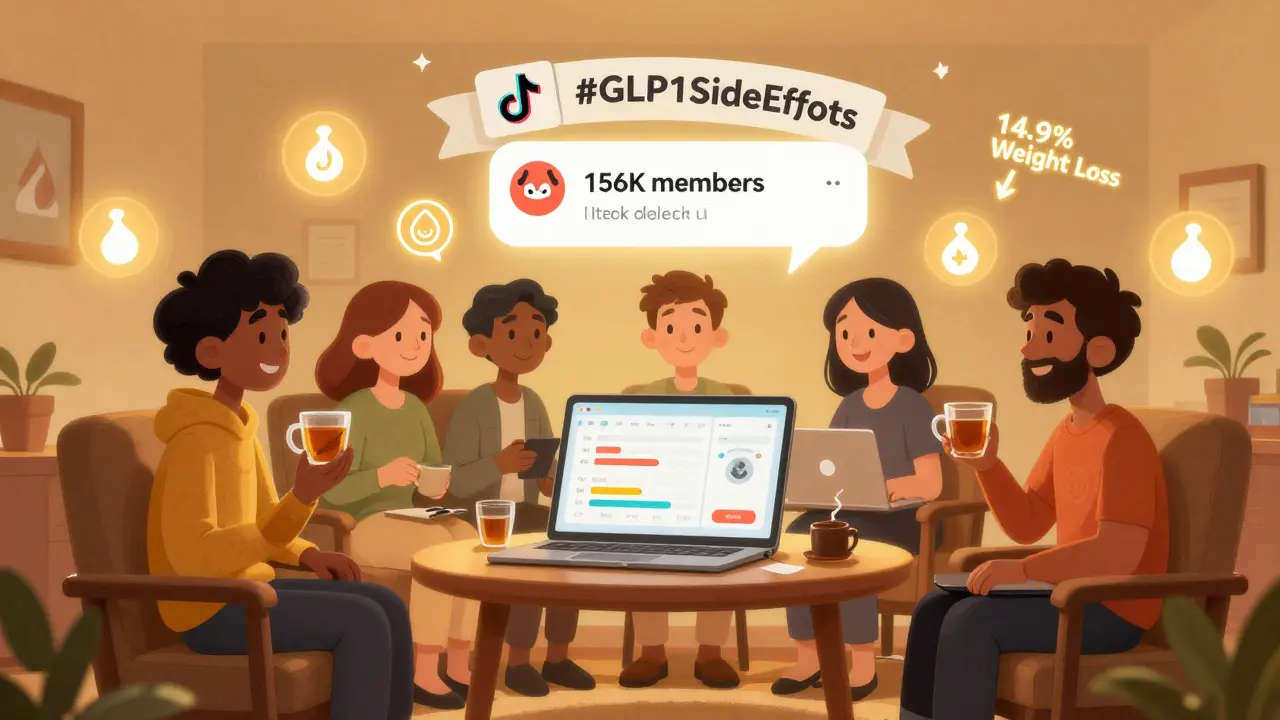
Online communities like Reddit’s r/semaglutide (156,000 members) and TikTok’s #GLP1SideEffects (over 2 million posts) are full of real people sharing what worked. Don’t be afraid to ask. You’re not the first. And you won’t be the last.
Final Thought: This Isn’t a Quick Fix. It’s a Lifestyle Shift.
GLP-1 medications aren’t magic pills. They’re tools. And tools only work if you learn how to use them. Nausea is part of the learning curve. It’s uncomfortable. It’s frustrating. But it’s temporary. The weight loss? That’s lasting.
Don’t quit because you feel sick. Adjust. Wait. Persist. The scale will move. Your health will improve. And you’ll look back and realize: the nausea was just the price of a new beginning.
How long does GLP-1 nausea last?
Nausea usually peaks in the first 2-4 weeks at each new dose. Most people notice improvement within a few weeks after reaching their maintenance dose. For many, it fades significantly after 12-16 weeks of steady use. It rarely lasts longer than 3-4 months if you follow the dosing schedule and make lifestyle adjustments.
Can I take GLP-1 medications without food?
Yes. GLP-1 medications can be taken with or without food. However, if you’re experiencing nausea, it’s often better to take them with a small, bland snack-like plain toast or a banana-rather than on a completely empty stomach. Avoid large meals, especially those high in fat.
Is it safe to skip a dose if I’m nauseous?
If nausea is mild, keep taking the dose as scheduled. Skipping doses can disrupt your body’s adjustment and may make side effects worse when you restart. If nausea is severe (vomiting, dehydration, pain), pause the dose for 1-2 weeks and contact your provider. Never double up on doses to make up for a missed one.
Do all GLP-1 drugs cause the same level of nausea?
No. Tirzepatide (Mounjaro) tends to cause slightly higher rates of nausea than semaglutide (Wegovy/Ozempic), especially at higher doses. Liraglutide (Victoza) generally has the lowest nausea rates among the injectables. But all cause nausea at some level. The trade-off is weight loss: tirzepatide leads to the most weight loss, while liraglutide has the mildest side effects.
Can I use anti-nausea medications like Zofran?
Some doctors prescribe OTC or prescription anti-nausea meds like ondansetron (Zofran) for short-term relief. But they’re not a long-term fix. They don’t address the root cause-slowed digestion. Use them only if nausea is severe and temporary, and always under medical supervision. Don’t rely on them to push through a dose increase.
Comments (14)
-
Mandy Vodak-Marotta February 5, 2026I started Wegovy last month and holy crap, the nausea was brutal for the first two weeks. I was convinced I was gonna puke every time I ate. But then I switched to taking it at 11 p.m. and started eating tiny meals of chicken and rice. Ginger tea became my best friend. Now? Barely even notice it. Lost 12 lbs in 5 weeks. It’s not magic, but it works if you don’t quit when it sucks. 🙌

-
Samuel Bradway February 6, 2026I’m on Mounjaro and yeah, the nausea hit harder than I expected. But I stuck with it. Took it on a full stomach, avoided greasy food, and drank water between meals-not during. After 6 weeks, it’s basically gone. The weight loss? Worth every second of feeling like crap.

-
caroline hernandez February 7, 2026From a clinical perspective, the titration schedule isn’t arbitrary-it’s pharmacokinetic optimization. Slowing gastric emptying via GLP-1R agonism triggers emetic pathways via the dorsal vagal complex. The key is neuroadaptation over 8–12 weeks. Patients who adhere to the full escalation protocol show 78% greater retention rates and 2.3x greater BMI reduction. Non-adherence isn’t failure-it’s biological mismatch. Adjust, don’t abandon.

-
Justin Fauth February 9, 2026They’re just trying to sell you a drug that makes you sick so you’ll keep paying for it. I’ve seen people drop 30 lbs and then gain it all back because they stopped. This isn’t health-it’s a corporate cash grab. You think you’re ‘transforming’? Nah. You’re just addicted to a $1000/month injection. Wake up.

-
Rachel Kipps February 9, 2026I was skeptical at first. Took my shot on an empty stomach. Bad idea. Nausea all day. Then I tried taking it before bed with a banana. Made a huge difference. I didn’t even realize how much I was overeating until I started feeling full faster. Still working on it. Slow progress.

-
Harriot Rockey February 9, 2026I’m a nurse and I’ve seen so many patients quit because of nausea. But here’s the thing-most of them didn’t know about the bedtime trick or ginger. I tell everyone: start low, move slow, and treat your stomach like a delicate flower. 🌸 Also, if you’re crying because you feel sick, you’re not weak-you’re human. I’ve been there. You got this 💪❤️

-
Alex LaVey February 10, 2026I think we’re missing the bigger picture. This isn’t just about weight. It’s about how we’ve been lied to about food, health, and self-worth. We’re told to eat less, move more, and magically transform. But the body doesn’t work like a calculator. GLP-1s don’t fix broken systems-they give us a tool to relearn them. The nausea? That’s your old habits screaming. Let it scream. Then listen.

-
pradnya paramita February 10, 2026Tirzepatide induces higher GLP-1 and GIP receptor activation, leading to more pronounced gastric motility inhibition compared to semaglutide monotherapy. This results in elevated CCK-8 and ghrelin fluctuations, correlating with increased emetic potential. However, dose escalation over 20 weeks allows for adaptive downregulation of vagal afferents. Compliance > peak dose velocity.

-
Jhoantan Moreira February 12, 2026I’m from the UK and started Ozempic last year. Honestly? I thought I was going to die. But I kept going. Took it on a Tuesday night, ate plain oats for breakfast, and drank water like it was my job. Now I’m 24 lbs lighter and my blood pressure is normal. It’s not perfect. But it’s better than the alternative. Thank you to everyone who shared tips here. You saved me.

-
Meenal Khurana February 12, 2026Ginger works.

-
Alec Stewart Stewart February 13, 2026I was scared to start because I thought I’d be sick forever. But I followed the schedule. Took it slow. Ate small meals. Used ginger. Now I don’t even think about it. I just feel better. Stronger. Lighter. Not because of the drug. Because I finally listened to my body. And that’s the real win.

-
Roshan Gudhe February 14, 2026We treat these drugs like they’re pills. But they’re not. They’re mirrors. They force you to look at how you eat, how you move, how you treat your body. The nausea isn’t the enemy. The denial is. The ‘I’ll just push through’ mentality? That’s the trap. The real work isn’t in the injection. It’s in the quiet choices before it. What did you eat today? Why? Who taught you to eat like that? The medicine just gives you space to answer.

-
Ed Mackey February 15, 2026I skipped a dose once because I was too nauseous. Thought I’d be fine. Nope. Came back worse. Like, vomiting-in-the-shower worse. Learned the hard way: don’t skip. If it’s bad, call your doc. But don’t just stop. It resets your body. And then you’re back at square one. Painful.

-
Sherman Lee February 16, 2026You know who benefits from this? Pharma. They make billions. The side effects? They knew. They tested them. They hid the worst cases. You think this is science? It’s marketing. The ‘72% improve in 2-4 weeks’? That’s cherry-picked. What about the 28% who quit? No one talks about them. They’re just… gone. And now you’re addicted to a drug that’s not even FDA-approved for weight loss. Wait-actually, it is. But only for some. And only if you pay. Always pay.
