
Why Your Medicine Cabinet Is Probably Not Safe
Most people think their medicine cabinet is fine. It’s clean, it’s closed, and the pills are in their bottles. But here’s the truth: medication storage isn’t about convenience-it’s about survival. In 2021, over 59,000 children under five had accidental exposures to medications, and 87% of those cases happened because the meds were within reach. That’s not luck-it’s poor storage.
And it’s not just kids. Seniors mix up pills. Teens grab painkillers from the bathroom cabinet. Insulin goes bad in the heat. Antibiotics lose potency after a year. The FDA says 82% of pills still work one year past their expiration date-if stored right. But at two years? That drops to 65%. Three years? Down to 42%. You’re not saving money by keeping old meds. You’re risking your health.
Where to Store Medications (And Where Not To)
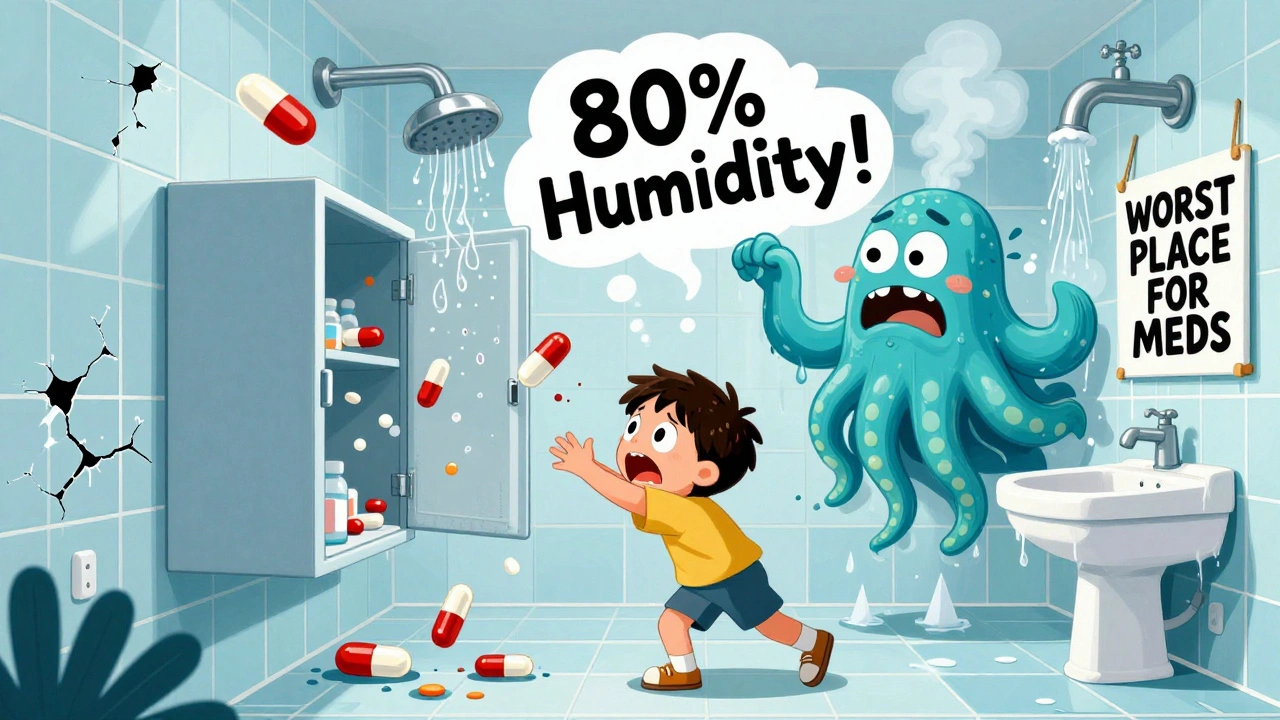
The bathroom? No. The kitchen counter? No. The bedside table? Only if it’s locked. The worst place to store meds is the bathroom. Why? Shower steam raises humidity to 80-90%. That’s worse than a rainforest. Medications break down 30-50% faster in humidity above 60%. The heat from the shower swings the temperature 10-15 degrees. That’s enough to ruin insulin, thyroid pills, and even aspirin.
Instead, pick a cool, dry spot with stable temps-like a linen closet, a bedroom dresser drawer, or a locked cabinet in a powder room. The ideal temperature range is 68-77°F. Humidity? Keep it between 40-50%. If you live in Houston like I do, that means avoiding basements and garages. Humidity spikes in summer. Mold grows. Pills get sticky. Discard them.
Light matters too. Some meds-like nitroglycerin or certain antibiotics-break down when exposed to sunlight. Keep them in their original amber bottles, or store them in an opaque box. Don’t leave them on a windowsill. Ever.
Separate, Label, and Organize
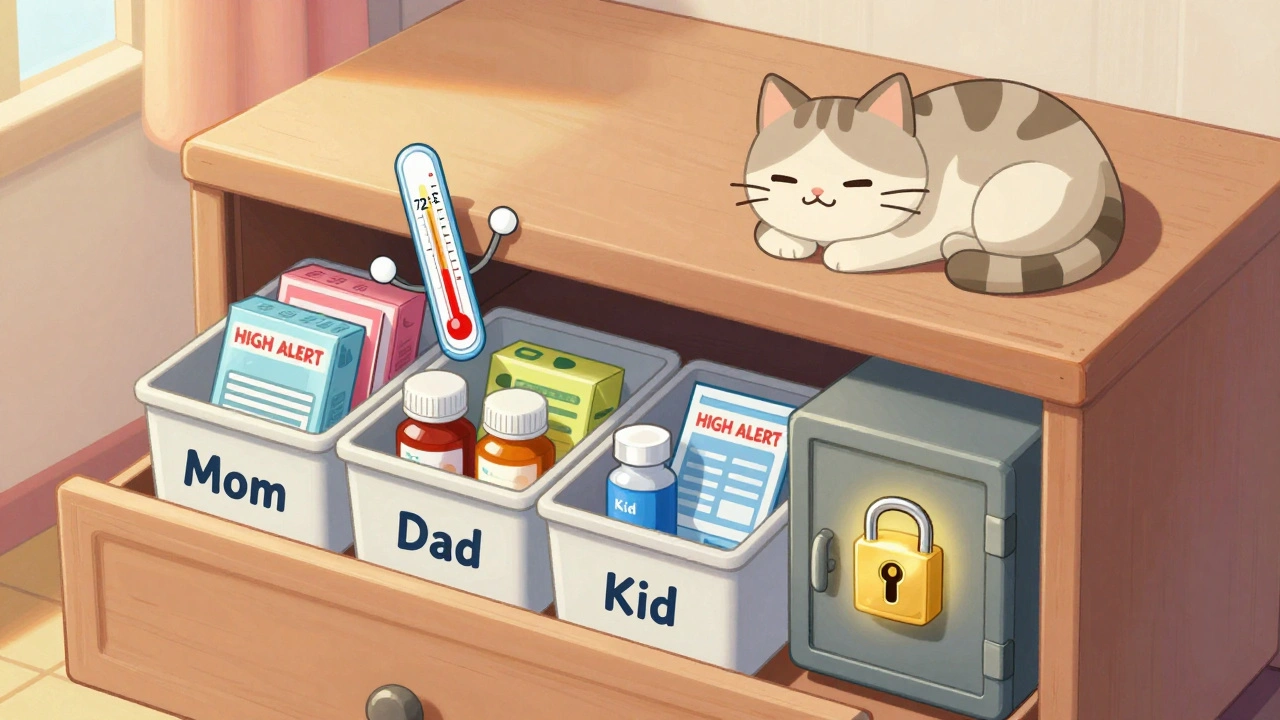
Storing all family members’ meds together is a recipe for disaster. A 2022 study found that separating medications by person reduced accidental mix-ups by 63%. Here’s how to do it:
- Use different shelves, drawers, or bins for each person.
- If you must share a container, use clear plastic bins labeled with names in bold letters.
- Keep high-alert meds-like insulin, warfarin, or opioids-in their own locked box. Label it “HIGH ALERT.”
- Group by type: oral meds in one bin, topical creams in another, inhalers in a separate bag.
North Carolina’s Kaitlyn’s Law requires all medications-even lotions, creams, and supplements-to be kept in original containers with pharmacy labels. That’s not just a rule-it’s a lifesaver. A 2019 UNC study showed that using original packaging reduced medication errors by 72%. Why? Because you can read the name, dose, and instructions. No guessing.
Lock It Down-No Exceptions
Standard medicine cabinets? They’re useless. Consumer Product Safety Commission tests show they stop only 12% of kids. That’s worse than a screen door on a submarine.
What works? A locked box. A safe. A cabinet with a childproof lock. A combination lock is 34% more effective than a key lock because no one forgets the code. The American Academy of Pediatrics says 70% of childhood poisonings happen when meds are left unattended for less than 10 minutes. That’s how long it takes to answer the door or grab a snack.
For households with teens or people with substance use history, lock it even tighter. BeMedWise reports 30% of teens who misuse prescription drugs get them from home. A 2023 Pediatrics study found households using lockboxes had 92% fewer accidental ingestions by kids under five.
And if you have opioids, insulin, or other controlled substances? Double lock them-even if they’re refrigerated. Health Canada’s guidelines say so. So does the Institute for Safe Medication Practices. Don’t be the exception.
Track Expirations Like a Pro
Most households keep at least one expired pill. BeMedWise says 70% do. But here’s what you don’t know: expired meds aren’t just weak-they can be dangerous.
Check every six months. Do it when you change your clocks for daylight saving time. That’s the trick to remembering. Look for:
- Color changes (yellowed pills, cloudy liquids)
- Texture changes (crumbly tablets, sticky ointments)
- Strange smells (sour, chemical, rancid)
Any of these? Pitch it. Even if it’s “just a little past” the date. The FDA says 53% of people can’t tell when a pill’s gone bad. Don’t guess. Discard.
For multi-dose items-like insulin vials or eye drops-mark the date you opened them. Most lose potency after 28-56 days. Write it on the bottle with a Sharpie. Keep a log. A 2022 nursing home study showed that tracking opened dates cut expired medication use by 91%.
Refrigerated Medications: The Fine Print
Not all cold meds are the same. Insulin? Must stay between 36-46°F until opened. Once opened, it can sit at room temperature for 14-56 days, depending on the brand. Check the label. Don’t assume.
Store refrigerated meds away from food. The ISMP Canada study found that keeping meds next to milk or meat led to 85% fewer cross-contamination incidents. That means no more insulin next to leftovers.
Check your fridge daily with a thermometer. The Senior Care Consultant Group says 98% of meds stay stable when temps are logged. Without logs? Only 76% stay effective. Write it down. Even if it’s just a sticky note on the fridge.
Dispose of Old Meds the Right Way
Never flush pills. Ever. The EPA says 60-80% of pharmaceuticals end up in waterways when flushed. A 2021 USGS study found pharmaceutical residues in 80% of U.S. rivers and streams. That’s not just pollution-it’s a public health crisis.
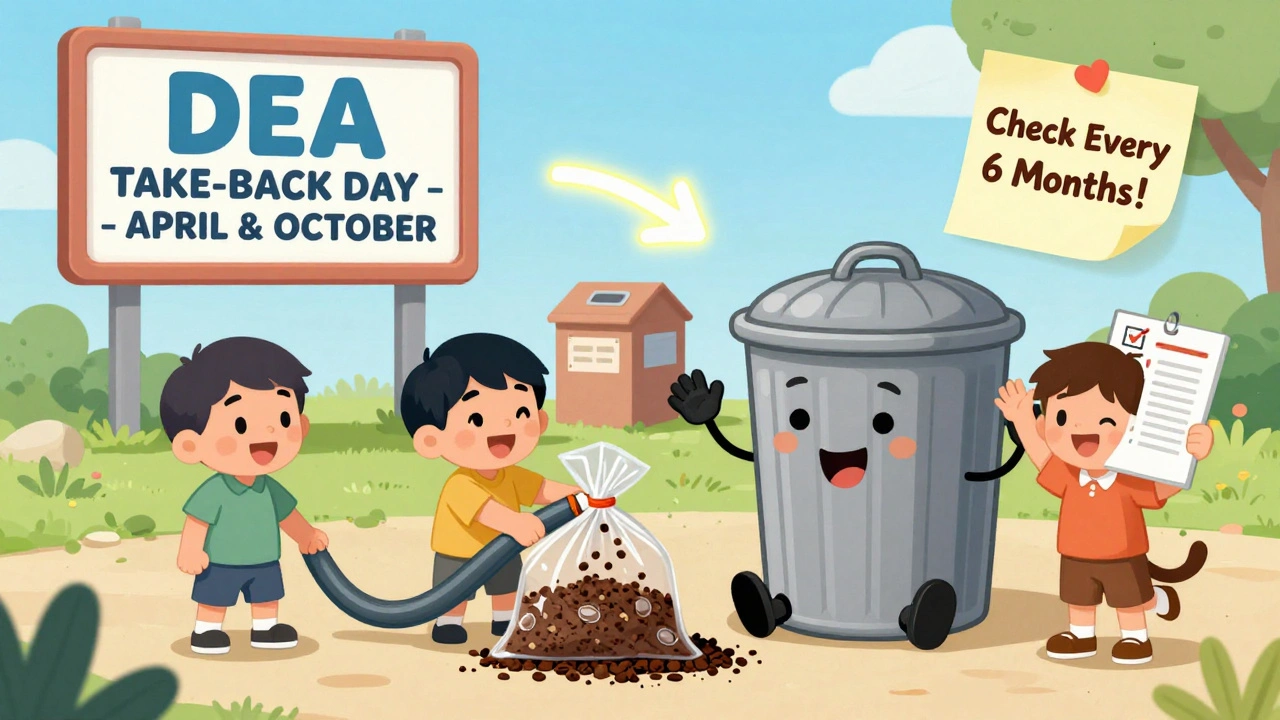
Use a drug take-back program. The DEA holds National Prescription Drug Take Back Days twice a year-in April and October. In 2022, they collected over a million pounds of meds. Find your local drop-off site at DEA.gov/takebackday.
No take-back nearby? Mix pills with coffee grounds or cat litter (1:3 ratio). Put them in a sealed bag. Toss in the trash. This reduces accidental ingestion by 76%, according to the FDA. Don’t crush pills unless the label says it’s safe. Some are time-released. Crushing them can be dangerous.
Make It a Routine
A checklist only works if you use it. Set reminders:
- Every six months: Do a full inventory. Toss expired meds. Reorganize.
- Every month: Check for physical changes in pills or liquids.
- Every day: Verify fridge temp if you store meds there.
- Every time you refill a prescription: Update your list.
Keep your checklist printed and taped to the inside of your medicine cabinet door. Or save it on your phone. Use the notes app. Write: “Check expiration dates. Lock box. Separate names. No bathroom.”
Households that use a formal checklist have 89% fewer medication errors, according to a 2023 Consumer Reports survey. That’s not a small number. That’s life or death.
Special Cases: Inhalers, Topicals, and Supplements
Inhalers? Store them in a plastic bag or box. Accidental activation is common. One study found 22% of users had device failures from improper storage. Keep them away from heat. Don’t leave them in the car.
Topical creams, ointments, and repellents? They’re still medications. Kaitlyn’s Law includes them. Store them with your other meds. Don’t keep them in the shower. Don’t leave them on the sink. A 2021 FDA warning cited 127 cases where people used topical creams as oral meds. One person took a diaper rash cream thinking it was cough syrup. That’s not a joke. That’s a hospital visit.
Supplements? Same rules. Vitamin D, fish oil, melatonin-they all degrade. Store them like real medicine. Keep them sealed. Keep them cool. Keep them locked.
Your Medication Storage Checklist (Print This)
Use this as your daily guide. Check each item monthly. Update as needed.
- ✅ All meds stored in original containers with labels
- ✅ Each family member’s meds stored separately
- ✅ High-alert meds (insulin, opioids, warfarin) in locked, labeled box
- ✅ No meds in bathroom, kitchen counter, or car
- ✅ Storage area: 68-77°F, 40-50% humidity
- ✅ Light-sensitive meds in dark containers or opaque boxes
- ✅ Refrigerated meds checked daily with thermometer
- ✅ All opened multi-dose items labeled with date opened
- ✅ All meds stored at least 4 feet off the ground
- ✅ Medication cabinet/box locked with combination lock
- ✅ Expired meds removed every 6 months
- ✅ Disposal plan in place: take-back program or mix with coffee grounds
- ✅ Monthly visual check for color, texture, odor changes
What If You Forget?
It’s easy to get lazy. You’re tired. The meds are “fine.” You’ll do it tomorrow.
Here’s the hard truth: you won’t. And when something goes wrong-when your grandkid finds the painkillers, or your spouse grabs the wrong insulin-you won’t get a second chance.
Set a recurring calendar alert: “Medication Storage Check - June 1, December 1.” Put a sticky note on the fridge. Tell a family member to remind you. Make it part of your routine, like brushing your teeth.
Medication safety isn’t about perfection. It’s about progress. One less pill in the bathroom. One lockbox bought. One expiration date checked. That’s how you protect your family.
Can I store all my family’s medications in one cabinet?
No. Storing all family members’ medications together increases the risk of accidental mix-ups by up to 63%. Always separate them by person using different shelves, bins, or labeled containers. Even over-the-counter meds like ibuprofen or allergy pills should be kept apart.
Is it safe to keep medications in the bathroom?
No. Bathrooms have high humidity (up to 90%) and temperature swings during showers, which can degrade pills, liquids, and inhalers by 30-50%. The American Academy of Pediatrics and the EPA both recommend avoiding bathrooms entirely. Choose a cool, dry closet or locked drawer instead.
How do I dispose of expired medications safely?
Use a drug take-back program-like the DEA’s National Prescription Drug Take Back Day-whenever possible. If none are available, mix pills with coffee grounds or cat litter (1:3 ratio), seal them in a bag, and throw them in the trash. Never flush pills. Flushing contaminates waterways with pharmaceuticals, which has been detected in 80% of U.S. waterways.
Do I need to refrigerate all my medications?
Only if the label says so. Insulin, certain antibiotics, and some biologics require refrigeration. Most pills and liquids are fine at room temperature. Always check the packaging. Refrigerating meds that don’t need it can cause condensation and damage. Store refrigerated meds away from food and label them clearly.
What should I do if I find a medication I don’t recognize?
Don’t guess. Don’t take it. Take a photo of the pill, including any markings or colors, and use a pill identifier tool like the one on WebMD or Drugs.com. If you still can’t tell, call your pharmacist or poison control at 1-800-222-1222. It’s better to be safe than sorry.
Are childproof caps enough to keep kids safe?
No. Childproof caps are designed to slow down kids, not stop them. Studies show 87% of children under five can open them within minutes. The only reliable protection is a locked cabinet, safe, or medicine lockbox. Combination locks are more effective than key locks because they can’t be lost or stolen.
How often should I check my medication storage?
Check your storage every six months-ideally during daylight saving time changes. Do a quick monthly visual check for changes in color, texture, or smell. If you store refrigerated meds, check the temperature daily. A simple log on the fridge can help you stay consistent.
Comments (10)
-
Olivia Portier December 9, 2025OMG YES this is so needed!! I just found my nephew’s toy car full of my mom’s blood pressure pills last week 😱 I thought she was just being forgetful but nooo-she had them in the bathroom since 2019. Now I’ve got a locked box in the closet and a sticky note on the fridge that says ‘NO BATHROOM, NO EXCEPTIONS.’ Thank you for this!

-
Tiffany Sowby December 11, 2025This is just more fearmongering from the medical-industrial complex. Pills are fine in the bathroom. My grandma took her meds there for 40 years and lived to 98. You people are overreacting.

-
Asset Finance Komrade December 11, 2025The notion that pharmaceutical stability is contingent upon ambient humidity levels is, in fact, a reductionist fallacy. One must consider the thermodynamic entropy of molecular degradation in relation to relative moisture saturation indices-not merely anecdotal ‘studies’ from Consumer Reports. Also, why is there no mention of epigenetic influences on drug metabolism? 🤔

-
Jennifer Blandford December 13, 2025I literally cried reading this. My dad almost died last year because he grabbed the wrong insulin bottle. We didn’t even know they looked that similar. Now we have color-coded bins, a lockbox, and I check his meds every Sunday with him. It’s not just safety-it’s love. 💙

-
Morgan Tait December 13, 2025You know who really controls medication storage? The pharmaceutical companies. They want you to throw out pills early so you keep buying. The FDA’s ‘expiration dates’ are just marketing. My uncle took 10-year-old antibiotics during a trip to Thailand and saved his life. You’re being manipulated.

-
Darcie Streeter-Oxland December 13, 2025The assertion that humidity levels exceeding 60% result in a 30–50% degradation rate of pharmaceutical compounds is not substantiated by peer-reviewed clinical trials of sufficient statistical power. Furthermore, the recommendation to employ combination locks implies an assumption of universal domestic threat vectors, which may not be empirically valid across all socioeconomic strata.

-
Taya Rtichsheva December 14, 2025so i put all my meds in the drawer next to my vibrator and now i’m basically a pharmacist 🤷♀️

-
Christian Landry December 15, 2025I did the fridge thing for my insulin but forgot to label it and my roommate put it in the yogurt section 😅 now I use a little plastic bin with a sharpie on it. Also, I mix expired pills with coffee grounds now-smells like a crime scene but at least my kid won’t eat them. 🙏

-
Katie Harrison December 17, 2025I appreciate the thoroughness of this checklist. However, I must emphasize the importance of respecting autonomy: locking medications may be necessary in households with minors or vulnerable individuals, but in adult-only homes, it may constitute an unnecessary infringement on personal liberty. Safety and dignity must coexist.

-
Guylaine Lapointe December 17, 2025You missed one critical point: never store medications near cleaning supplies. Last month, my sister accidentally took bleach thinking it was her thyroid med. She’s fine now, but the ER bill was $12,000. Always keep meds away from anything that could be mistaken for them-even if it’s in a different drawer. And yes, I’m still mad.
